
You are currently browsing the tag archive for the ‘Pride’ tag.
Key Points(TL;DR)
- The pride movement of the 1970s and 1980s focused on securing legal and social acceptance for lesbian, gay, and bisexual (LGB) individuals, achieving significant milestones like same-sex marriage legalization.
- With gay marriage widely accepted in the West, the original goals of the pride movement were largely fulfilled, suggesting a natural conclusion to its initial mission.
- The rise of queer theory and postmodern ideologies in the 1990s shifted the movement’s focus toward challenging all societal norms, diverging from its original aim of integration.
- Some critics argue that this shift, influenced by concepts like David Halperin’s “queer as an identity without essence,” has led to public behaviors that challenge traditional norms of decency.
- While personal freedom is valued, there is debate over whether certain expressions should be limited in public and professional spaces, reflecting tensions between individual rights and societal expectations.
Introduction to the Original Pride Movement
The pride movement, which gained momentum in the 1970s and 1980s, was a transformative force in advocating for the rights and acceptance of lesbian, gay, and bisexual (LGB) individuals in Western societies. Sparked by the 1969 Stonewall Riots, the movement crystallized with the first gay pride parade in 1970, known as the Christopher Street Liberation Day. This period saw significant achievements, such as the election of openly gay officials like Kathy Kozachenko and Harvey Milk, and the 1973 decision by the American Psychiatric Association to declassify homosexuality as a mental illness. The movement’s central aim was to secure legal recognition and social acceptance, with a particular focus on achieving same-sex marriage rights, a goal realized in many Western nations by the 2000s, notably with the U.S. Supreme Court’s 2015 ruling in Obergefell v. Hodges (History of Gay Rights).
Achievement of Core Goals
The legalization of same-sex marriage marked a pivotal victory for the LGB community, fulfilling a core objective of the original pride movement. By 2015, when the U.S. Supreme Court affirmed same-sex marriage as a constitutional right, many legal and social barriers that once marginalized LGB individuals had been dismantled. This milestone suggested that the movement had largely achieved its aim of integrating LGB individuals into societal frameworks, allowing them to live openly without systemic discrimination. However, rather than marking a point of closure, this success coincided with a significant ideological shift within the movement, redirecting its focus from acceptance to broader, more radical objectives.
Ideological Shift and Queer Theory
In the 1990s, the emergence of queer theory and postmodern ideologies reshaped the pride movement’s trajectory. Unlike the earlier focus on securing specific rights for LGB individuals, queer theory, as articulated by scholars like David M. Halperin, emphasizes the fluidity of identities and challenges all forms of normativity, including societal structures beyond sexuality. This perspective views “queer” not as a fixed identity but as a positionality that opposes dominant norms, fundamentally altering the movement’s goals from integration to deconstruction of societal frameworks (Queer Theory). Critics argue this shift has led to a movement that prioritizes subversion over acceptance, creating tension with the original pride ethos.
Queer as an Identity Without Essence
David Halperin’s concept of “queer” as an “identity without an essence” encapsulates this new direction, defining “queer” as “whatever is at odds with the normal, the legitimate, the dominant” (Saint Foucault). This framework has broadened the pride movement to include expressions that challenge traditional norms, such as public nudity or other behaviors some view as extreme. Critics contend that these displays, often seen at modern pride events, diverge from the movement’s original focus on dignity and acceptance, instead promoting a radical opposition to societal standards that can feel coercive to those who value traditional norms of public conduct (The Tyranny of Queer Theory).
Balancing Freedom and Public Norms
While personal freedom is a cornerstone of democratic societies, the evolution of the pride movement raises questions about the appropriateness of certain expressions in public and professional spaces. The original pride movement sought to ensure individuals could live authentically without fear of persecution, a goal many believe has been achieved in much of the West. However, the current movement’s emphasis on challenging all norms has led to debates about whether behaviors like public nudity or unconventional gender expressions should be normalized in shared spaces. Critics argue that while private expression is a right, imposing such behaviors in public settings can undermine the movement’s original intent, alienating those who supported its initial goals and prompting questions about whether the essence of “pride” has been lost.
Evolution of the Pride Movement: From Acceptance to Ideological Shift
Origins and Achievements of the Pride Movement
The pride movement, which took shape in the 1970s and 1980s, was a response to decades of systemic discrimination against lesbian, gay, and bisexual (LGB) individuals. The 1969 Stonewall Riots in New York City served as a catalyst, galvanizing activists to demand equal rights and societal acceptance. The first gay pride parade, held in 1970 as the Christopher Street Liberation Day, marked a significant step toward visibility and empowerment (History of Gay Rights). During the 1970s, the movement achieved notable milestones, including the election of Kathy Kozachenko to the Ann Arbor City Council in 1974, making her the first openly gay elected official in the United States, and Harvey Milk’s election in 1977 as a San Francisco supervisor. Another landmark was the American Psychiatric Association’s 1973 decision to remove homosexuality from its list of mental disorders, a critical step toward destigmatization (Milestones in Gay Rights). The 1980s, however, were overshadowed by the HIV/AIDS crisis, which shifted some focus to health advocacy while reinforcing the movement’s commitment to visibility and rights. The ultimate goal of legalizing same-sex marriage was realized in many Western countries, with a defining moment in the United States when the Supreme Court’s 2015 Obergefell v. Hodges decision affirmed marriage equality as a constitutional right, signaling the fulfillment of a core objective of the original pride movement.
Fulfillment of Original Goals
The legalization of same-sex marriage represented a triumph for the LGB community, effectively achieving the pride movement’s primary aim of securing legal and social acceptance. By 2015, same-sex marriage was recognized across much of the Western world, dismantling significant legal barriers that had marginalized LGB individuals. This milestone allowed many to live openly, marry, and access rights previously denied, such as inheritance and healthcare benefits. Social attitudes also shifted, with increasing acceptance of LGB identities in mainstream culture. This success suggested that the pride movement, as originally conceived, had accomplished its mission of integrating LGB individuals into societal frameworks. However, rather than marking a point of closure, this achievement coincided with a transformation in the movement’s focus, driven by new ideological currents that diverged from its foundational goals.
Rise of Queer Theory and Postmodernism
In the 1990s, the pride movement underwent a significant ideological shift with the emergence of queer theory and postmodern leftism. Queer theory, rooted in post-structuralist critical theory, challenges the notion of fixed identities and normativity, particularly heteronormativity. Scholars like Michel Foucault, Gloria Anzaldúa, and Judith Butler contributed to this framework, which views gender and sexuality as social constructs rather than essential truths (Queer Theory). Unlike the earlier pride movement’s focus on securing specific rights for LGB individuals, queer theory advocates for a broader deconstruction of societal norms, emphasizing fluidity and diversity in identities. This shift redirected the movement from seeking inclusion within existing structures to challenging those structures entirely, a departure that some critics argue has diluted the original focus on acceptance and equality (The Tyranny of Queer Theory).
David Halperin’s Queer Identity Without Essence
Central to this ideological shift is David M. Halperin’s concept of “queer” as an “identity without an essence,” articulated in his 1995 book Saint Foucault. Halperin defines “queer” as “whatever is at odds with the normal, the legitimate, the dominant,” suggesting it is not tied to any specific group or characteristic but rather exists in opposition to societal norms (Saint Foucault). This perspective has profoundly influenced the modern pride movement, broadening its scope to include a wide range of identities and expressions that challenge traditional norms. As a result, pride events have increasingly featured behaviors such as public nudity, BDSM displays, and other unconventional expressions, which some view as radical departures from the movement’s original focus on dignity and acceptance. Critics argue that this approach, rooted in Halperin’s framework, promotes a form of anti-normativity that can feel coercive, particularly when it demands public acceptance of behaviors many find inappropriate for shared spaces.
Contemporary Critiques and Public Space Concerns
The evolution of the pride movement has sparked significant debate about its current direction and impact. Critics contend that the incorporation of queer theory’s anti-normative stance has led to a movement that prioritizes subversion over integration, often at the expense of the broader social acceptance sought by earlier activists. Modern pride events, which sometimes include explicit displays or unconventional gender expressions, are seen by some as attempts to normalize behaviors that challenge traditional norms of public decency. This shift has been criticized as alienating those who supported the original goals of the pride movement, such as legal equality and social acceptance (The Tyranny of Queer Theory). Furthermore, the movement’s alignment with corporate interests, evident in the commercialization of Pride Month, has raised concerns about its loss of radical edge, transforming it into a mainstream spectacle that may dilute its political significance (Queer’ing Corporate Pride). The debate also touches on the balance between personal freedom and public responsibility, with some arguing that while individuals should have the right to express themselves privately, imposing such expressions in public or professional settings can undermine social cohesion and the movement’s original intent.
Balancing Freedom and Societal Norms
The tension between personal freedom and societal expectations lies at the heart of contemporary critiques of the pride movement. The original movement fought for the right of LGB individuals to live authentically without persecution, a goal largely achieved in many Western societies. However, the current movement’s emphasis on challenging all norms, as influenced by queer theory, has led to public expressions that some find excessive or inappropriate, such as public nudity or behaviors associated with niche subcultures. While personal freedom is a cornerstone of democratic societies, there is a growing sentiment that such expressions should be confined to private settings to respect shared public spaces. This perspective argues that the movement’s shift toward enforcing new norms, such as mandatory pronoun usage or the promotion of gender identities some view as anti-scientific, risks alienating supporters of the original pride movement and undermining its legacy of fostering inclusion and dignity.
Conclusion
The pride movement has undergone a profound transformation since its inception in the 1970s and 1980s. Initially focused on securing legal and social acceptance for LGB individuals, it achieved significant victories, most notably the legalization of same-sex marriage. However, the rise of queer theory and postmodern ideologies has redirected the movement toward a broader, more radical agenda that challenges all societal norms. David Halperin’s concept of “queer” as an identity without essence has contributed to this shift, leading to public expressions that some view as divergent from the movement’s original goals. While personal freedom remains a fundamental value, the debate over the appropriateness of certain behaviors in public spaces highlights a perceived loss of the pride movement’s original essence. As the movement continues to evolve, it faces the challenge of balancing individual expression with societal expectations, prompting reflection on whether the “pride” in pride remains true to its founding principles.
| Aspect | Original Pride Movement (1970s-1980s) | Modern Pride Movement (Post-1990s) |
|---|---|---|
| Primary Goal | Legal and social acceptance for LGB individuals, particularly same-sex marriage | Deconstruction of societal norms, including gender and sexuality norms |
| Key Achievements | Removal of homosexuality as a mental disorder (1973), election of openly gay officials, same-sex marriage legalization (2015 in the U.S.) | Increased visibility of diverse identities, mainstream corporate support for Pride Month |
| Ideological Basis | Civil rights and equality within existing societal frameworks | Queer theory and postmodernism, emphasizing anti-normativity |
| Public Expressions | Marches and parades focused on visibility and dignity | Inclusion of public nudity, BDSM, and other unconventional displays |
| Critiques | Faced opposition from conservative groups and societal stigma | Criticized for overreach, commercialization, and alienation of original supporters |
Key Citations
But the TQ+ brought the children into this crap, while force teaming and using the #LGB as shields.
And we have every right to be pissed off.
#LGBWithoutTheTQ”

The first cropped photo is what activists would like you to see.
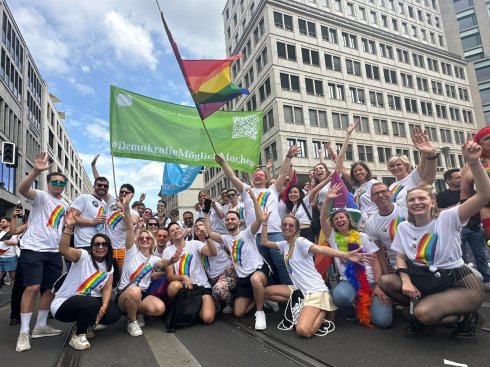
The unedited version of the same photo is what pride is at the moment and what they do not want you to see.
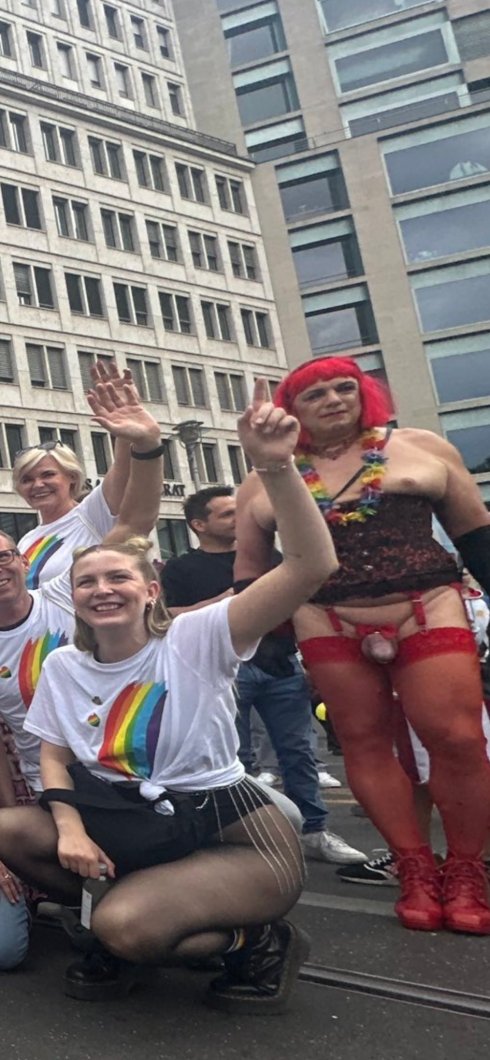
There is no pride in ‘liberating’ activities that do not belong in the public sphere.
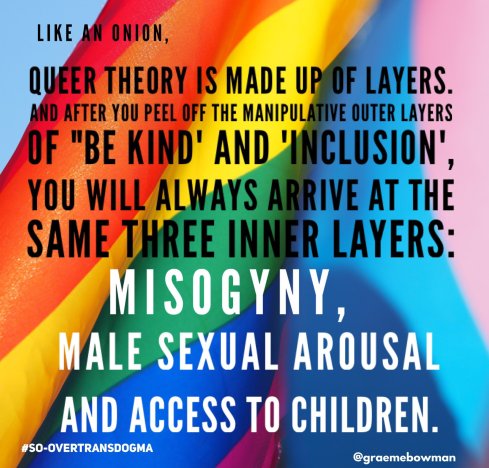
Be discerning and realize that the current incarnation of Pride shares very little with its roots of gay equality, rights, and marriage. This new pride is very much based on the picture below.
When school boards and school officials refuse to listen, concerned parents take action. Canada is a pluralistic multi-cultural society. It is the duty of our institutions to reflect the diversity that exists in our country. It is not our institutions responsibility to decide which types of ‘diversity’ is acceptable and which are not.
“Last June in a shocking but unreported event at Vimy Ridge, an Ottawa Public School under the OCDSB, more than 70% of K-8 children were mysteriously absent on Pride Celebration Day. There was no media coverage of the event but I’ve since spoken with parents and teachers from the school who shared details. Parents of Muslim children are over the Rainbow.
The School announced that it was holding a Pride celebration day though an e-mail to parents. When Muslim parents pushed back, saying that this was contrary to their religious beliefs they were met with lectures about their own doctrines of tolerance and acceptance from school administrators. Needless to say, this didn’t go well.
One parent I spoke with, who gathered more than 7,500 signatures in just a few days before Change.org throttled petition, said that school officials were informed that tolerance and acceptance did not mean celebrating and affirming and the parents of kids at the school showed their disagreement by sending a message – we will keep our kids home.
An event like this was reported earlier this year in a southern Ontario school where 30% of kids were absent on a rainbow day. This week, the same London, Ontario school, staged a repeat performance. According to my source, this is an issue of concern at the national level for Muslim organizations.
In another case of religious tradition under attack, Josh Alexander of “Save Canada” stood outside a Calgary High-school this week handing out Bibles and was physically accosted by rainbow protestors. Alexander had called for an international student walkout day on the 17th of May, #IDAHOBIT day, through his growing social media network and counter protestors turned up, assaulted him and attempted to burn bibles. Click the image to go to the bird platform to see the unsettling repeated assaults against Josh in the Rebel News Video.
This is an example of what happens when you allow the radical leftists to move themselves from the margins to the centre of a organization aka organizational/institutional capture. Lesbians are not welcome and other same sex attracted individuals are not welcome.
At Pride…
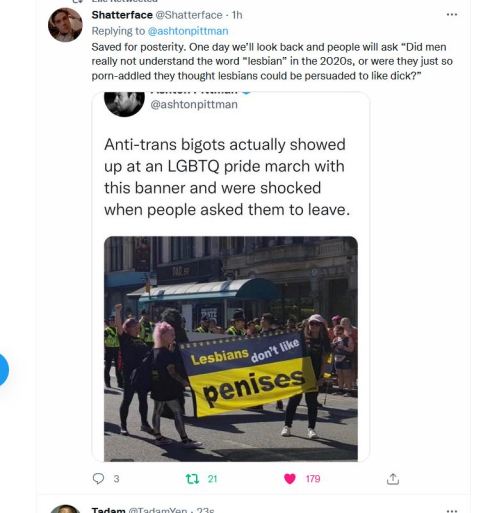
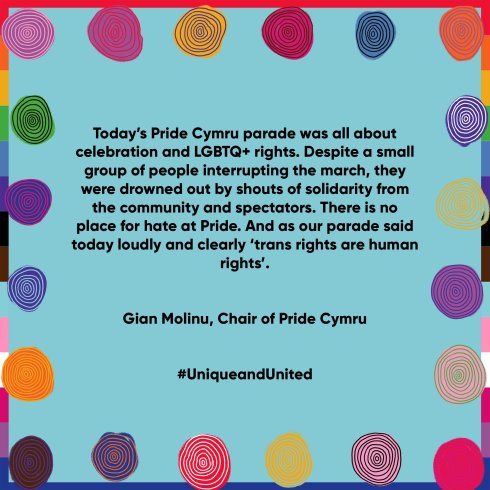
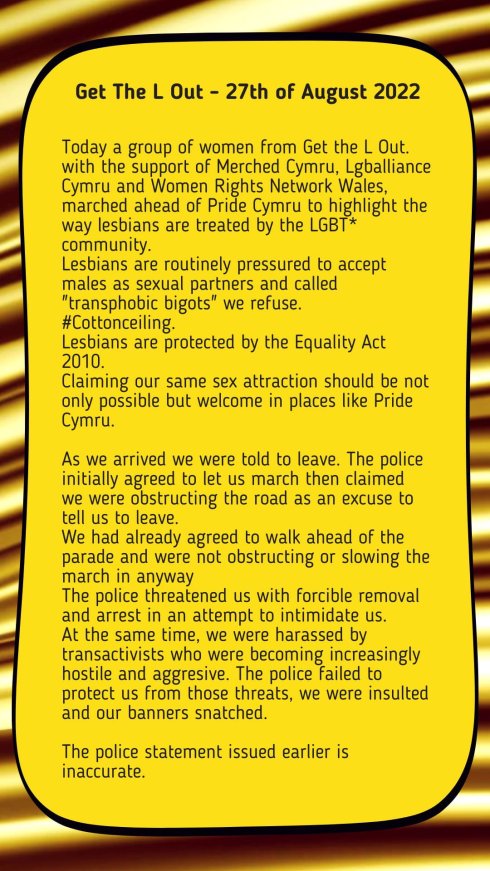
So really, once you centre white heterosexual men at Pride – can you even call it ‘Pride’ anymore with any sort of nod to respecting reality?











 bleatmop
 Mystro
 The Arbourist


 Dead Wild Roses
Your opinions…