
You are currently browsing the tag archive for the ‘Queer Theory’ tag.
At the core of much of the tension surrounding transgender issues lies a profound and inescapable cognitive dissonance.
P
Biological reality is clear and immutable.
P
Human sex is binary—male or female—and determined at conception. No medical intervention, no amount of social affirmation, and no subjective feeling can change this fundamental fact. You will always and forever remain the sex you were born.
P
Transgender ideology asserts the opposite. It claims that whatever sex you feel you are, you become in reality. Your internal sense of self overrides chromosomes, reproductive anatomy, and every observable marker of biological sex. This ideology is inherently anti-reality.
P
Those who fully internalize it place themselves in a state of permanent conflict—not just with their own bodies, but with the entire external world. Reality itself becomes the enemy, repeatedly negating their subjective self-perception.
P
Queer Theory provides the escape hatch. Rather than confronting the mismatch between feelings and facts, adherents are guided to externalize the source of their distress. Through an oppressor/oppressed lens, the cause of their pain is never their own faulty perception of self—absolutely not. Instead, it is “normative” society that is actively oppressing them, enforcing rigid gender norms and inflicting all their suffering. This framework transforms personal dissonance into righteous grievance. The distress is no longer internal; it is the fault of everyone else.
P
Medical interventions amplify the problem. So-called “gender-affirming care”—puberty blockers followed by cross-sex hormones—adds fuel to the fire. These treatments carry serious, well-documented deleterious effects on both mental and physical health. Far from resolving underlying issues, they often deepen psychological instability while creating permanent physical changes.
P
The result is a perfect storm: individuals who were already vulnerable, now further destabilized, carrying a massive chip on their shoulders. They view the rest of society—the “normative” majority—as the active source of their pain. To defend their constructed identity and quiet the cognitive dissonance, they feel compelled to strike back against this perceived evil force: you and me.In this worldview, disagreement equals enmity.
P
If you refuse to affirm their ideology, you are not offering a different opinion—you are the oppressor who must be confronted, silenced, or defeated.
P
Dissent is violence.
P
Reality itself is violence.
P
This dynamic helps explain patterns of hostility, aggression, and, in extreme cases, violence that emerge from certain segments of transgender activism. It does not stem primarily from societal rejection, but from a foundational rejection of biological reality and the refusal to address internal distress with honesty.
True compassion does not mean enabling delusion.
P
It means grounding support in reality—the only place where genuine mental health and social peace can be found.

As a parent, you want your child’s education to focus on facts, skills, and values that prepare them for life. But in some classrooms, teachers are introducing queer theory—a radical ideology that challenges traditional norms about gender, sexuality, and society. This guide will help you understand what’s happening, why it’s a problem, and how you can take action to protect your child.
What Is the “Motte and Bailey” Tactic?
Imagine a castle with a strong, defensible tower (the “motte”) and a large, less defensible courtyard (the “bailey”). The motte and bailey tactic is a trick where someone makes a bold, controversial claim (the bailey) but, when challenged, retreats to a safer, less controversial claim (the motte). In education, this looks like:
- The Bailey (bold claim): Teachers say they’re “queering the curriculum” to challenge norms and promote radical ideas about gender and sexuality.
- The Motte (safe claim): When parents object, teachers retreat to saying they’re just being “inclusive” or “teaching diversity.”
This tactic makes it hard to argue against without seeming like you’re against inclusion. But inclusion and queerness are not the same thing, and it’s important to know the difference.
Key Terms You Need to Know
- Inclusivity: Making sure all students feel welcome and respected, regardless of their background (e.g., race, religion, disability). True inclusivity is about kindness and fairness, not ideology.
- Queer: Originally a slur, this term has been reclaimed by some to describe non-traditional sexual orientations or gender identities. In education, it often means challenging or rejecting societal norms.
- Queering the Curriculum: This means adding queer theory to lessons. Queer theory isn’t just about acceptance—it’s about questioning and destabilizing what’s considered “normal” (e.g., traditional family structures, biological sex). In elementary schools, this can confuse young children who need clear, factual learning.
Coercive and Deceptive Tactics Used in Schools
Some teachers push queer theory while dismissing parents’ concerns. Here are the main tactics they use:
- Hiding Behind “Inclusivity”: Teachers claim they’re just being inclusive, but they’re actually promoting queer ideology. For example, they might say they’re “teaching inclusively” to make it sound harmless, even though they’re introducing complex ideas about gender and sexuality.
- Using Critical Theory: Teachers use methods like critical literacy, which encourages students to question power and norms. This might sound educational, but it’s often a way to push activism instead of facts—too advanced and ideological for young kids.
- Ignoring Parents: When parents object, teachers might offer small compromises (like letting a child skip a lesson) but won’t change the overall curriculum. They dismiss concerns as unimportant or unreasonable.
- Leveraging Policy: Teachers use school rules or laws to defend their actions, even if parents disagree. This makes parents feel like they have no say.
These tactics are coercive because they force queer ideology into classrooms while sidelining parents. They’re deceptive because they hide behind feel-good words like “inclusivity” to avoid real discussion.
Why This Is a Problem
- It’s Not Age-Appropriate: Elementary students need to focus on basics like reading and math, not complex ideas about gender and sexuality.
- It Undermines Parental Authority: Parents should have a say in what their kids learn. Ignoring you breaks that trust.
- It Confuses Children: Challenging basic truths (like boys and girls) can unsettle young kids who need stability.
- It’s Activism, Not Education: Schools should teach facts, not push political ideas.
What Parents Can Do to Stop It
You have the power to protect your child’s education. Here’s how:
- Educate Yourself:
- Learn what queer theory is and how it’s used in schools. Look up articles or videos online.
- Ask for your school’s curriculum details—lesson plans, books, anything they’re teaching.
- Talk to Teachers:
- Ask clear questions: “What are you teaching about gender or sexuality? Why is this in the curriculum?”
- Stay calm but firm: “I’m all for kindness, but I’m worried about ideology in the classroom.”
- Engage with School Boards:
- Go to meetings and speak up. Bring examples of what’s being taught.
- Suggest focusing on core skills instead of controversial topics.
- Form Parent Groups:
- Team up with other parents who feel the same way.
- Share info and plan together—maybe write a group letter to the school.
- Monitor What Your Child Learns:
- Talk to your kid about their day. Check their homework or classwork.
- If something seems off, write it down and raise it with the teacher.
- Use Legal Resources:
- If the school won’t listen, talk to a lawyer who knows education law.
- Look up your state’s rules on parental rights.
- Advocate for Policy Changes:
- Push for rules that let parents approve or get notified about sensitive topics.
- Back school board members who care about parents’ voices.
- Consider Alternatives:
- If the school won’t budge, look into private schools or homeschooling.
- Find options that match your values and focus on real learning.
Final Thoughts
You’re your child’s best defender. Don’t let schools brush you off or confuse you with buzzwords. Demand clear answers and a focus on age-appropriate, fact-based education. By staying informed and active, you can keep your child’s classroom a place for learning—not ideology.

Key Points(TL;DR)
- The pride movement of the 1970s and 1980s focused on securing legal and social acceptance for lesbian, gay, and bisexual (LGB) individuals, achieving significant milestones like same-sex marriage legalization.
- With gay marriage widely accepted in the West, the original goals of the pride movement were largely fulfilled, suggesting a natural conclusion to its initial mission.
- The rise of queer theory and postmodern ideologies in the 1990s shifted the movement’s focus toward challenging all societal norms, diverging from its original aim of integration.
- Some critics argue that this shift, influenced by concepts like David Halperin’s “queer as an identity without essence,” has led to public behaviors that challenge traditional norms of decency.
- While personal freedom is valued, there is debate over whether certain expressions should be limited in public and professional spaces, reflecting tensions between individual rights and societal expectations.
Introduction to the Original Pride Movement
The pride movement, which gained momentum in the 1970s and 1980s, was a transformative force in advocating for the rights and acceptance of lesbian, gay, and bisexual (LGB) individuals in Western societies. Sparked by the 1969 Stonewall Riots, the movement crystallized with the first gay pride parade in 1970, known as the Christopher Street Liberation Day. This period saw significant achievements, such as the election of openly gay officials like Kathy Kozachenko and Harvey Milk, and the 1973 decision by the American Psychiatric Association to declassify homosexuality as a mental illness. The movement’s central aim was to secure legal recognition and social acceptance, with a particular focus on achieving same-sex marriage rights, a goal realized in many Western nations by the 2000s, notably with the U.S. Supreme Court’s 2015 ruling in Obergefell v. Hodges (History of Gay Rights).
Achievement of Core Goals
The legalization of same-sex marriage marked a pivotal victory for the LGB community, fulfilling a core objective of the original pride movement. By 2015, when the U.S. Supreme Court affirmed same-sex marriage as a constitutional right, many legal and social barriers that once marginalized LGB individuals had been dismantled. This milestone suggested that the movement had largely achieved its aim of integrating LGB individuals into societal frameworks, allowing them to live openly without systemic discrimination. However, rather than marking a point of closure, this success coincided with a significant ideological shift within the movement, redirecting its focus from acceptance to broader, more radical objectives.
Ideological Shift and Queer Theory
In the 1990s, the emergence of queer theory and postmodern ideologies reshaped the pride movement’s trajectory. Unlike the earlier focus on securing specific rights for LGB individuals, queer theory, as articulated by scholars like David M. Halperin, emphasizes the fluidity of identities and challenges all forms of normativity, including societal structures beyond sexuality. This perspective views “queer” not as a fixed identity but as a positionality that opposes dominant norms, fundamentally altering the movement’s goals from integration to deconstruction of societal frameworks (Queer Theory). Critics argue this shift has led to a movement that prioritizes subversion over acceptance, creating tension with the original pride ethos.
Queer as an Identity Without Essence
David Halperin’s concept of “queer” as an “identity without an essence” encapsulates this new direction, defining “queer” as “whatever is at odds with the normal, the legitimate, the dominant” (Saint Foucault). This framework has broadened the pride movement to include expressions that challenge traditional norms, such as public nudity or other behaviors some view as extreme. Critics contend that these displays, often seen at modern pride events, diverge from the movement’s original focus on dignity and acceptance, instead promoting a radical opposition to societal standards that can feel coercive to those who value traditional norms of public conduct (The Tyranny of Queer Theory).
Balancing Freedom and Public Norms
While personal freedom is a cornerstone of democratic societies, the evolution of the pride movement raises questions about the appropriateness of certain expressions in public and professional spaces. The original pride movement sought to ensure individuals could live authentically without fear of persecution, a goal many believe has been achieved in much of the West. However, the current movement’s emphasis on challenging all norms has led to debates about whether behaviors like public nudity or unconventional gender expressions should be normalized in shared spaces. Critics argue that while private expression is a right, imposing such behaviors in public settings can undermine the movement’s original intent, alienating those who supported its initial goals and prompting questions about whether the essence of “pride” has been lost.
Evolution of the Pride Movement: From Acceptance to Ideological Shift
Origins and Achievements of the Pride Movement
The pride movement, which took shape in the 1970s and 1980s, was a response to decades of systemic discrimination against lesbian, gay, and bisexual (LGB) individuals. The 1969 Stonewall Riots in New York City served as a catalyst, galvanizing activists to demand equal rights and societal acceptance. The first gay pride parade, held in 1970 as the Christopher Street Liberation Day, marked a significant step toward visibility and empowerment (History of Gay Rights). During the 1970s, the movement achieved notable milestones, including the election of Kathy Kozachenko to the Ann Arbor City Council in 1974, making her the first openly gay elected official in the United States, and Harvey Milk’s election in 1977 as a San Francisco supervisor. Another landmark was the American Psychiatric Association’s 1973 decision to remove homosexuality from its list of mental disorders, a critical step toward destigmatization (Milestones in Gay Rights). The 1980s, however, were overshadowed by the HIV/AIDS crisis, which shifted some focus to health advocacy while reinforcing the movement’s commitment to visibility and rights. The ultimate goal of legalizing same-sex marriage was realized in many Western countries, with a defining moment in the United States when the Supreme Court’s 2015 Obergefell v. Hodges decision affirmed marriage equality as a constitutional right, signaling the fulfillment of a core objective of the original pride movement.
Fulfillment of Original Goals
The legalization of same-sex marriage represented a triumph for the LGB community, effectively achieving the pride movement’s primary aim of securing legal and social acceptance. By 2015, same-sex marriage was recognized across much of the Western world, dismantling significant legal barriers that had marginalized LGB individuals. This milestone allowed many to live openly, marry, and access rights previously denied, such as inheritance and healthcare benefits. Social attitudes also shifted, with increasing acceptance of LGB identities in mainstream culture. This success suggested that the pride movement, as originally conceived, had accomplished its mission of integrating LGB individuals into societal frameworks. However, rather than marking a point of closure, this achievement coincided with a transformation in the movement’s focus, driven by new ideological currents that diverged from its foundational goals.
Rise of Queer Theory and Postmodernism
In the 1990s, the pride movement underwent a significant ideological shift with the emergence of queer theory and postmodern leftism. Queer theory, rooted in post-structuralist critical theory, challenges the notion of fixed identities and normativity, particularly heteronormativity. Scholars like Michel Foucault, Gloria Anzaldúa, and Judith Butler contributed to this framework, which views gender and sexuality as social constructs rather than essential truths (Queer Theory). Unlike the earlier pride movement’s focus on securing specific rights for LGB individuals, queer theory advocates for a broader deconstruction of societal norms, emphasizing fluidity and diversity in identities. This shift redirected the movement from seeking inclusion within existing structures to challenging those structures entirely, a departure that some critics argue has diluted the original focus on acceptance and equality (The Tyranny of Queer Theory).
David Halperin’s Queer Identity Without Essence
Central to this ideological shift is David M. Halperin’s concept of “queer” as an “identity without an essence,” articulated in his 1995 book Saint Foucault. Halperin defines “queer” as “whatever is at odds with the normal, the legitimate, the dominant,” suggesting it is not tied to any specific group or characteristic but rather exists in opposition to societal norms (Saint Foucault). This perspective has profoundly influenced the modern pride movement, broadening its scope to include a wide range of identities and expressions that challenge traditional norms. As a result, pride events have increasingly featured behaviors such as public nudity, BDSM displays, and other unconventional expressions, which some view as radical departures from the movement’s original focus on dignity and acceptance. Critics argue that this approach, rooted in Halperin’s framework, promotes a form of anti-normativity that can feel coercive, particularly when it demands public acceptance of behaviors many find inappropriate for shared spaces.
Contemporary Critiques and Public Space Concerns
The evolution of the pride movement has sparked significant debate about its current direction and impact. Critics contend that the incorporation of queer theory’s anti-normative stance has led to a movement that prioritizes subversion over integration, often at the expense of the broader social acceptance sought by earlier activists. Modern pride events, which sometimes include explicit displays or unconventional gender expressions, are seen by some as attempts to normalize behaviors that challenge traditional norms of public decency. This shift has been criticized as alienating those who supported the original goals of the pride movement, such as legal equality and social acceptance (The Tyranny of Queer Theory). Furthermore, the movement’s alignment with corporate interests, evident in the commercialization of Pride Month, has raised concerns about its loss of radical edge, transforming it into a mainstream spectacle that may dilute its political significance (Queer’ing Corporate Pride). The debate also touches on the balance between personal freedom and public responsibility, with some arguing that while individuals should have the right to express themselves privately, imposing such expressions in public or professional settings can undermine social cohesion and the movement’s original intent.
Balancing Freedom and Societal Norms
The tension between personal freedom and societal expectations lies at the heart of contemporary critiques of the pride movement. The original movement fought for the right of LGB individuals to live authentically without persecution, a goal largely achieved in many Western societies. However, the current movement’s emphasis on challenging all norms, as influenced by queer theory, has led to public expressions that some find excessive or inappropriate, such as public nudity or behaviors associated with niche subcultures. While personal freedom is a cornerstone of democratic societies, there is a growing sentiment that such expressions should be confined to private settings to respect shared public spaces. This perspective argues that the movement’s shift toward enforcing new norms, such as mandatory pronoun usage or the promotion of gender identities some view as anti-scientific, risks alienating supporters of the original pride movement and undermining its legacy of fostering inclusion and dignity.
Conclusion
The pride movement has undergone a profound transformation since its inception in the 1970s and 1980s. Initially focused on securing legal and social acceptance for LGB individuals, it achieved significant victories, most notably the legalization of same-sex marriage. However, the rise of queer theory and postmodern ideologies has redirected the movement toward a broader, more radical agenda that challenges all societal norms. David Halperin’s concept of “queer” as an identity without essence has contributed to this shift, leading to public expressions that some view as divergent from the movement’s original goals. While personal freedom remains a fundamental value, the debate over the appropriateness of certain behaviors in public spaces highlights a perceived loss of the pride movement’s original essence. As the movement continues to evolve, it faces the challenge of balancing individual expression with societal expectations, prompting reflection on whether the “pride” in pride remains true to its founding principles.
| Aspect | Original Pride Movement (1970s-1980s) | Modern Pride Movement (Post-1990s) |
|---|---|---|
| Primary Goal | Legal and social acceptance for LGB individuals, particularly same-sex marriage | Deconstruction of societal norms, including gender and sexuality norms |
| Key Achievements | Removal of homosexuality as a mental disorder (1973), election of openly gay officials, same-sex marriage legalization (2015 in the U.S.) | Increased visibility of diverse identities, mainstream corporate support for Pride Month |
| Ideological Basis | Civil rights and equality within existing societal frameworks | Queer theory and postmodernism, emphasizing anti-normativity |
| Public Expressions | Marches and parades focused on visibility and dignity | Inclusion of public nudity, BDSM, and other unconventional displays |
| Critiques | Faced opposition from conservative groups and societal stigma | Criticized for overreach, commercialization, and alienation of original supporters |
Key Citations
The Alberta government’s recent initiative to establish provincewide standards for school library materials, announced on May 26, 2025, underscores the critical role of parental input in ensuring that educational resources align with community values and developmental needs. The online survey, open until June 6, 2025, seeks feedback from Albertans to create consistent guidelines for selecting age-appropriate materials, particularly addressing concerns about sexually explicit content in K-12 school libraries. Parental involvement is essential because parents, as primary caregivers, have a vested interest in their children’s moral and intellectual development. They possess unique insights into their children’s emotional and psychological readiness, which standardized systems may overlook. By involving parents, the government ensures that library materials reflect the values and expectations of the families they serve, fostering trust and transparency in the education system. As Education Minister Demetrios Nicolaides emphasized, the goal is to create “guardrails” to protect students from accessing inappropriate content, such as graphic novels containing explicit depictions of sexual acts, molestation, or self-harm, which were found in some Edmonton and Calgary school libraries.
Ensuring age-appropriate materials in school libraries is paramount to safeguarding children’s well-being and supporting their developmental stages. Young students, particularly in elementary and junior high schools, are at formative stages where exposure to graphic content—such as nudity, explicit sexual acts, or themes of molestation—can be confusing or harmful. The Alberta government’s survey highlights specific concerns about four graphic novels, including Gender Queer by Maia Kobabe and Fun Home by Alison Bechdel, which contain explicit content deemed inappropriate for K-9 students. Age-appropriate materials should align with cognitive and emotional maturity, providing resources that educate without overwhelming or exposing children to mature themes prematurely. School libraries must balance fostering a love for reading with ensuring content is suitable for the intended age group, as outlined in the government’s call for developmentally appropriate resources to meet diverse student needs. This approach not only protects students but also supports teachers and librarians in curating collections that enhance learning while respecting parental expectations.
Critics often argue that restricting access to certain materials constitutes censorship or a “book ban,” potentially limiting students’ exposure to diverse perspectives, especially on topics like 2SLGBTQ+ identities. This perspective, voiced by the Alberta Teachers’ Association (ATA) and others, suggests that such standards could disproportionately target marginalized communities and stifle students’ ability to see themselves represented in literature. While diversity in literature is important, this argument overlooks the distinction between censorship and age-appropriate curation. The Alberta government explicitly states that the initiative is not about banning books but about establishing consistent standards to ensure materials are suitable for specific age groups. For instance, Nicolaides clarified that content related to 2SLGBTQ+ themes is not the target; the focus is on graphic sexual content, regardless of subject matter. A book on astrophysics with explicit imagery would face the same scrutiny, demonstrating that the policy aims to protect, not exclude. Moreover, existing school board processes, like those in Edmonton and Calgary, already include mechanisms for reviewing content, suggesting that standardized guidelines would enhance, not replace, professional judgment.
Another common counterargument is that restricting access to certain materials could hinder students’ ability to access information about sensitive topics, such as sexual abuse, which may be critical for their safety. Some, including voices on social media, argue that libraries provide a safe space for students to explore topics that parents might not address at home, citing cases where books helped children identify and report abuse. While this concern is valid, it does not negate the need for age-appropriate standards. Libraries can still provide educational resources on sensitive topics, such as body safety or abuse prevention, without including graphic depictions unsuitable for young readers. The government’s survey asks who should determine appropriateness—options include teachers, librarians, parents, or students—indicating a collaborative approach that values professional expertise alongside parental input. By setting clear standards, schools can ensure that resources on critical topics are accessible in a manner that respects developmental readiness, thus maintaining a balance between safety and education.
In conclusion, the Alberta government’s survey on school library materials reflects a commitment to balancing parental input with the need for age-appropriate resources, ensuring that school libraries remain safe and supportive environments for students. By involving parents, the government acknowledges their role in shaping educational content that aligns with community values and protects children from inappropriate material. While critics raise concerns about censorship or restricted access to vital information, these arguments fail to account for the nuanced approach of setting consistent, transparent standards rather than outright bans. The initiative, set to inform policies for the 2025-26 school year, aims to create a framework where professional judgment, parental concerns, and student needs converge. Albertans’ participation in the survey will be crucial in shaping a system that prioritizes both educational freedom and the well-being of young learners.

Today’s installment of crazy from the Activist Left.
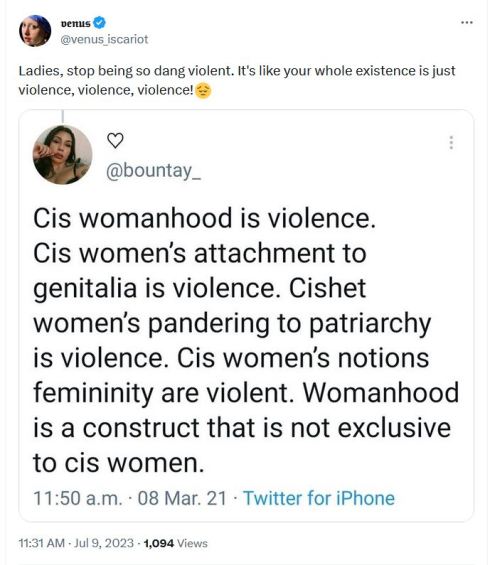
I was going to explain each of this person’s statements, but then reconsidered. Instead I’ll leave you with this thought. How this point of view works is about constructing an baseless imaginary threat pointing out how oppressive that constructed threat is and then slip in the actual reality of the situation. In this case women (adult human females) need to work and educate themselves and readjust their attitudes to allow men who call themselves women to use their spaces and services and to be recognized as women (because oppression).
Like most queer theory the example above is firmly in the bullshit baffles brains/emotional blackmail zone.
React appropriately. Name it for what it is and reject the queer premise. In this case – men regardless of how they feel about their subjective gender identity can not change their sex and become women. Nothing else needs to be said.
Be suspicious of everthing past the LGB in the LGBTQIA+ acronym, because the “+” sign does some very heavy, very questionable, lifting.
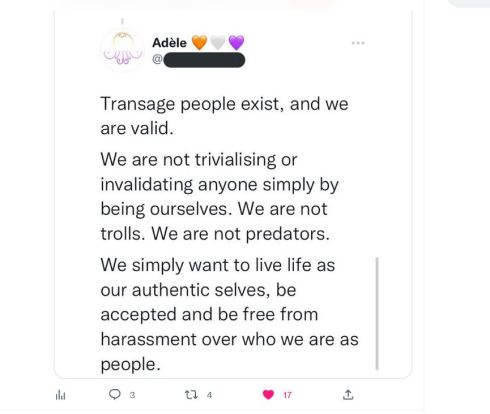
So remember folks:
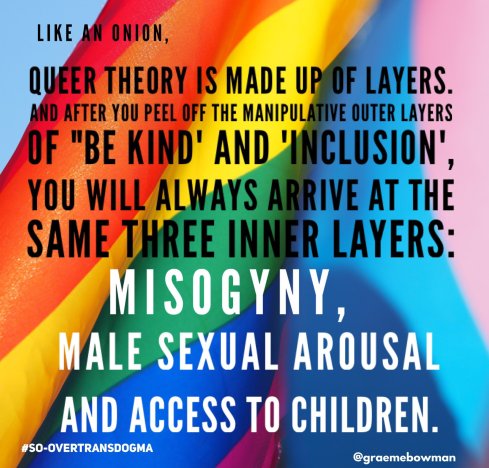
Grab the link to the paper and follow along. Learn about where all this queer bullshite comes from and what the theory is really about in their words.
People have very rapidly realized, whether in Groomer Schools, marketing, or so many other corners of society that we’ve been suckered into supporting Queer Theory under the banner of a gay and lesbian civil rights movement. We’ve also figured out very quickly that Queer Theory is a branch of Identity Marxism: Queer Marxism, which takes “normalcy” as its special form of bourgeois property to abolish through (Queer) class struggle. Where, though, did Queer Theory come from? It is relatively widely accepted that the first real Queer Theory paper is Gayle Rubin’s 1984 essay “Thinking Sex,” which calls for a new radical politics of sexuality. To help people understand what Queer Theory is and always has been about, James Lindsay proudly hosts a three-part New Discourses Podcast series reading through “Thinking Sex” in full and offering his commentary on it. In this first part, we learn that Queer Theory from its very beginnings is profoundly interested in both child pornography and pedophilia. It’s almost shocking to hear. Join James to understand Queer Theory from its very origins.
Gayle Rubin’s shocking 1984 essay “Thinking Sex.” In this episode, he continues with a second part of Rubin’s essay in which it becomes clear that Queer Theory is all about breaking down all boundaries and categories between acceptable and unacceptable sexual behavior using explicitly Marxist-style analysis (Queer Theory is Queer Marxism).
The Queer Subversion of Feminism: Gayle Rubin’s “Thinking Sex” Part 3
In the previous two episodes of the New Discourses Podcast, host James Lindsay reads through the first two thirds of Gayle Rubin’s shocking 1984 essay, “Thinking Sex,” widely regarded as the first essay in Queer Theory. In it, as Rubin’s subtitle indicates, “Notes for a Radical Theory of the Politics of Sexuality,” she takes feminism (especially sex-negative radical feminism) to task for being insufficiently radical as a politics of sexuality. In fact, she accuses it (not entirely wrongly) of being resoundingly conservative with regard to sex and sexuality. In this episode of the New Discourses Podcast, James walks you through this most tedious portion of the essay where the seeds of subverting feminism itself are planted. Within just a couple of decades from this point, the Queer Marxist movement will have used Rubin’s call for a “radical theory of the politics of sexuality” to completely undermine the women’s movement and basically kill it and the category of “woman” itself. Join him to understand how it started.











 bleatmop
 Mystro


 Dead Wild Roses
Your opinions…