
You are currently browsing the tag archive for the ‘Race Essentialism’ tag.
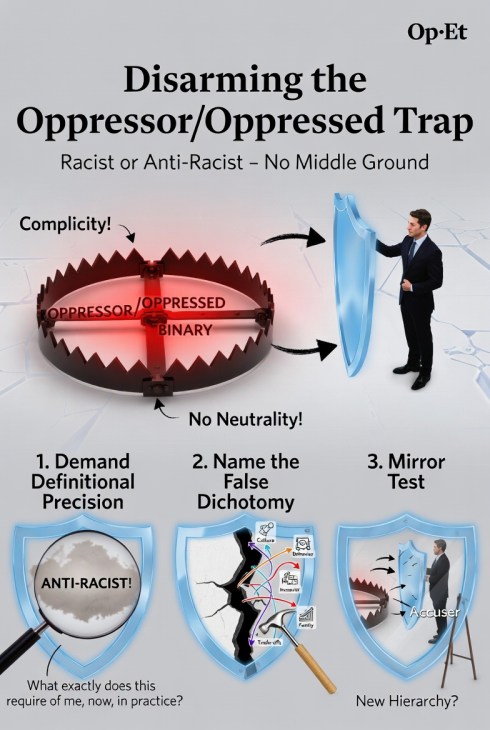
One of the most manipulative habits in contemporary politics is the oppressor/oppressed binary. It takes a complicated society, flattens it into a morality play, and assigns everyone a role before the argument even begins. You are not allowed to be a citizen, a skeptic, or simply a person trying to judge a claim on its merits. You must be either a resister of oppression or an accomplice to it. There is no middle ground. There is no neutrality. There is only confession or guilt.
This is the logic behind slogans like Ibram X. Kendi’s claim that the opposite of racist is not “not racist,” but “anti-racist.” It sounds brave and morally serious. In practice, it is a trap. It abolishes the possibility that a person can reject racism while also rejecting activist dogma, racial essentialism, or race-based policy. Once the slogan is accepted, disagreement itself becomes incriminating. Silence is violence. Skepticism is fragility. Restraint is complicity. The argument is rigged before it starts.
That is what makes the framework so effective. It does not persuade. It corners. It takes a difficult moral and empirical question and turns it into a loyalty test. Once that move is made, debate stops being a search for truth and becomes a public sorting ritual. On affirmative action, immigration, policing, school curricula, crime, history, or speech, the details matter less than whether you submit to the script. You are not judged by the quality of your reasoning. You are judged by whether you have signalled the right side.
The first way to break the trap is to demand definitional precision. Ask the simplest possible question: what, exactly, does “anti-racist” require of me here, now, in practice? What specific belief, action, or policy would prove that I am not complicit? Force the slogan to cash itself out. This matters because many activist terms draw their power from strategic vagueness. They sound morally elevated precisely because they are never pinned down. Once pinned down, they often expand into endless duties of confession, endorsement, and ideological retraining. When the standard can never be met, the point is no longer moral clarity. The point is obedience.
The second move is to name the false dichotomy. Calmly, but without apology. The binary assumes that every disparity is evidence of oppression and that every refusal to endorse the preferred remedy is therefore collaboration with injustice. But reality does not work that way. Human beings are not made of one motive. Institutions do not produce one kind of outcome. Policies have trade-offs. Causes are mixed. Incentives matter. Culture matters. History matters. Family structure matters. Behaviour matters. Human variation matters. A worldview that permits only one explanation is not morally deep. It is intellectually cheap.
“The point is no longer moral clarity. The point is obedience.”
Complexity starts to look like cowardice. Nuance starts to look like betrayal. Evidence that cuts against the preferred story is dismissed as harm. The framework protects itself the way bad frameworks always do: by treating every challenge as proof that the challenge was necessary.
The third move is the mirror test. If disagreement with your theory makes someone morally tainted, what exactly are you doing to dissenters? If refusal to use your language, endorse your policies, or accept your metaphysics makes a person an oppressor, then you have not abolished domination. You have redistributed it. You have built a new moral hierarchy with yourself at the top and everyone insufficiently converted beneath you. The names have changed. The structure has not.
This is why the binary feels so powerful. It flatters the speaker while shaming the listener. It offers moral clarity without the inconvenience of evidence. It turns political disagreement into a purity test and ordinary citizens into suspects. That is intoxicating, especially for people who enjoy the feeling of righteousness more than the discipline of thought.
Racism is real. Injustice is real. But so is the danger of any framework that treats disagreement as guilt and complexity as sin. Liberalism was built on the harder truth that citizens will differ, causes will be mixed, and power must be restrained even when exercised in the name of virtue. The oppressor/oppressed binary rejects that discipline. It wants a world of permanent accusation, permanent sorting, and permanent moral theatre.
Do not argue inside that trap. Do not accept the role of defendant in someone else’s catechism. Ask for definitions. Expose the binary. Turn the logic back on itself. The moment a moral framework abolishes the right to dissent, it has stopped being a tool of justice and become a costume for power.











 bleatmop
 Mystro
 The Arbourist


 Dead Wild Roses
Your opinions…