
You are currently browsing the tag archive for the ‘Radical Feminism’ tag.
This letter published in the Scottish newspaper The National.
It is a letter that would likely not see the light of day here in Canada where we seem to be beholden to a small subset of society that demands we disbelieve our eyes and perceptions to order to ‘be kind’ and validate their delusions of gender. I’m tired. Very ducking tired of expending energy dealing with entitled queer males who masquerade as women all the while pleading they are the most oppressed people(?) in society. It’s horseshit from stem to stern. And dangerous horseshit at that, as the lunacy extends to putting predatory males in female prisons and defunding rape crisis centres because they have the audacity to maintain a female only service. Women (adult human females) in Canada have to fight for their rights to spaces, boundaries, and services *again* against this latest queered delusional assault by men. It would be hilarious if it wasn’t so detrimental to female rights in society.
This letter highlight illustrates the disconnect from reality that is central to queer theory and identity politics. The corrosive politics of the personal (identity) can only survive in a society that has reality based rights, protections, and safeguards for its citizens. Women in Afghanistan can not identify out what is happening to them. Like all of fucking history if you are born female you are automatically second class in society and no amount of queer pandering to the identity gods will ever change that.
But enough of me, let us get to the letter, which is brilliant.
“In recent years it has become fashionable in predominantly English-speaking “progressive” circles and establishments to feign bewilderment at basic evolutionary facts related to our species. Often, this bewilderment is specifically reserved for only one half of the population. Despite millions of years of mammalian ancestry preceding us, it is only now that the female homo sapiens is apparently a convoluted, nonsensical entity.
A cherished argument to prop up this convoluted, nonsensical entity is that female people everywhere at any point in time do not share exactly the same experiences, therefore a “woman” can encompass any male who lays claim to the label.
It is true that women come from all kinds of socioeconomic and cultural backgrounds, and as a result they will have been shaped as individuals by various experiences over the course of their lives. Women differ in our beliefs, political values, personalities and ethics.
Yet, looking at events unfolding in Afghanistan in recent days, many women around the world feel a shared sense of dread and heartache for the women trapped in such intolerable circumstances. The sickening, sinking feeling is an instinctive one that bypasses all pseudo-intellectualism. Strip away the relatively superficial differences between women and that sickening, sinking feeling is an instinctive one precisely because there are some experiences that only female humans can be subjected to. For better or worse, there is a common reality that no convoluted, nonsensical definition can erase.
Looking an Afghan woman in the eyes, what connects her suffering with our struggles here in Scotland? The embodied reality of womanhood that transcends time, distance and cultures. She is me and I am her. It is a visceral bond that no male can ever identify into and no female can ever identify out of.
It is only by an accident of fate that I live in the UK. I am one of the rare winners in the grotesque lottery of life. Life for women in the UK has been shaped by its own cultural and religious heritage. Its historical trajectory enabled British women to organise and win incredible gains for their daughters in a way that women from many other countries can only dream of doing.
The plight of Afghan women is a stark reminder of the iron fist of oppression that men can wield against women on the basis of our sex. It is an uncomfortable truth that without the majority of men on our side, women truly are at the mercy of the vicious whims and savage violence of men. My heart breaks for the women of Afghanistan – so many of them had a taste of freedom, opportunity and being a person in their own right, and now it has evaporated almost overnight. I know what is happening to them could happen to me too, if circumstances enabled it. The incel attack in Plymouth reveals the deep hatred and desires of subjugation that some men harbour for women.
Far too many women in the UK take their precious freedoms for granted. Yes, there’s much that can be better, but it’s important to realise just how rare it is to live in a time and place where women have so many rights and protections within a stable, wealthy society and where most men view us as worthy of full personhood.
Some women are so intoxicated by these freedoms – freedoms they themselves did not win – that they think it’s great fun to indulge in all kinds of outlandish luxury beliefs, such as biological sex being a social construct, women are not oppressed on the basis of sex, and that being a woman is nothing but a feeling and set of sexist stereotypes. They have feasted at the table of liberty for so long that they think they can ignore reality by chanting mantras and “queering” words.
Bloated by their gluttony, they cheer the erosion of the same rights and protections that enabled their arrogance and ignorance. Their fingers and mouths greasy with the remnants of the fruits of labour of the women that came before them, they sneer at those who understand the precarious nature of our rights and personhood and seek to protect it. They might belch out insults and smears in between mouthfuls, but deep in their hearts they know they would never willingly trade places with Afghan women, because all the queer theory in the world won’t save them from the slaughterhouse.
Mel T
Only men would have this much success pushing an ideology that is corrosive toward woman’s rights, boundaries, and safety all the while under the guise of being inclusive and progressive. Patriarchy 2.0 sucks.
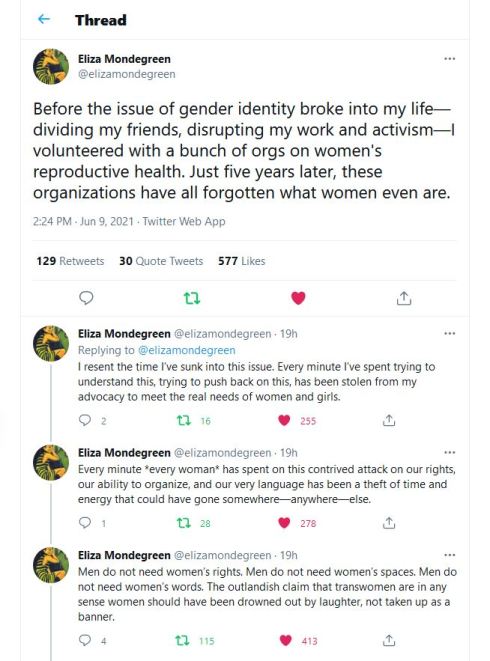
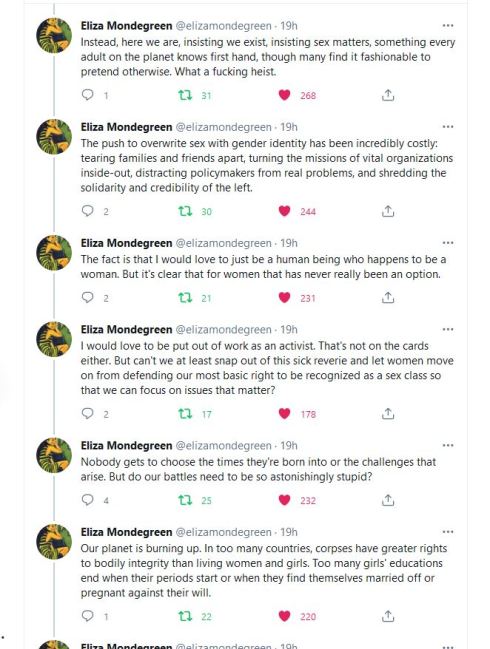

Give us a break indeed. :/
This ruling changes the environment. This UK ruling states that gender critical beliefs are also protected beliefs under law in the the UK. In other words, you can’t be fired from your job for stating the blindly obvious *FACT* that human beings cannot change their sex. This is a huge victory for women, free speech, and of course Ms. Forstater.
Thank you Ms. Forstater for having enough resilience and courage to stand up for women and their rights.
“Ms Forstater, from St Albans in Hertfordshire, did not have her contract renewed at the think tank Center for Global Development (CGD) in March 2019, after posting a series of tweets questioning government plans – which were later scrapped – to let people declare their own gender.
She claimed she was discriminated against because of her beliefs, which include “that sex is immutable and not to be conflated with gender identity”.
In the initial tribunal employment judge James Tayler said that her approach was “not worthy of respect in a democratic society”.
He concluded that Ms Forstater was “absolutist” in her view and said she was not entitled to ignore the rights of a transgender person and the “enormous pain that can be caused by misgendering”.
But the Honourable Mr Justice Choudhury said her “gender-critical beliefs” did fall under the Equalities Act as they “did not seek to destroy the rights of trans persons”.
Ms Forstater said she was “delighted to have been vindicated” but CGD said the decision was a “step backwards for inclusivity and equality for all”.
In a video statement, Ms Forstater said: “I’m proud of the role I’ve played in clarifying the law and encouraging more people to speak up”.
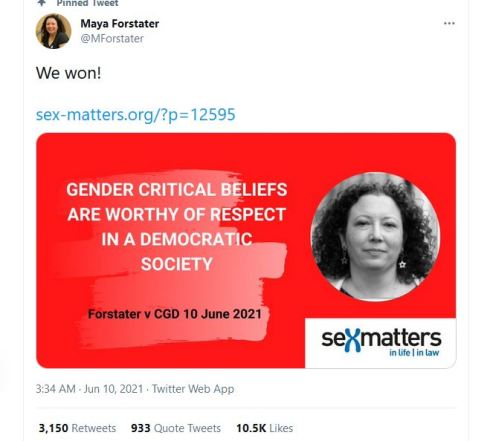
Visit and support women’s rights at sex-matters.org
The table of contents and a link to the full .pdf download. :)

Found on JCJ’s site: Speech at Women’s Equality Party Assembly, 23 September 2020
To lay out my thoughts about women’s political representation, I want to first outline my socialist and radical feminist analysis of women’s politics. What I most want to underline is that from my perspective, feminism is a form of materialist class politics, not a form of identity politics. That is, my analysis of the position of women is rooted in understanding that female people have a particular type of body and reproductive capacity and are subject to a system of power on the basis of being female. This power structure exists because of the historical development of a hierarchical system of extraction of the reproductive and socially reproductive labour of female people, otherwise known as patriarchy. Consequently, women have a range of shared material political interests. Most obviously these pertain to issues around reproductive and sexual autonomy, and the violences women are subjected to by male power’s effort to control their bodies as a sexual and reproductive resource. This then extends to how women’s labour is devalued, invisibilised, and appropriated by the intertwined structures of patriarchy and capitalism. This includes women’s disproportionate poverty, the wage gap, maternity cover and child-care, the undervaluing and feminisation of all forms of care labour, the concentration of women in low-paid and low status occupations, and the ways all these issues disproportionately impact working class and racialised women. Lastly, this leads to the demand for a fundamental structural transformation in order to challenge extractive relations, undertake a just accounting of women’s labour, and do away with the symbolic representations and psychological conditioning that undermines women’s humanity by positioning them as a sexual, reproductive, domestic and emotional resource for males. The fundamental structure of patriarchal gender is then a matter of socialising women into the role of a service-class orientated to male needs, and socialising males into a mode of dominance and entitlement. Feminist politics which reinforces female socialisation and de-centers the needs and interests of female people is thus antithetical to challenging gender in its deepest sense.
On the question of why women’s political representation matters, let’s focus on two key areas. The first involves the symbolic importance of women’s representation, the way it serves as a role model and opens possibilities for other women, and the fact that ‘representational justice or equality’ is an important value in and of itself. With respect to the inclusion of trans women in women’s representation, this immediately forces a confrontation with the bitterly contested ontological question of ‘what is a woman.’ As should be apparent from what I’ve just said, my answer to this question is informed by materialist class analysis. That is, women are a sex-class. This matters not only because it frames women’s class interests, but because the alternative interpretation, from our perspective, relies on essentialising gender, which we consider to be the mechanism of the oppression of women as a sex-class. At the heart of this conflict is the fundamental question of the definition of women being changed from a sex class to a gender class. Given that we think that gender is how women are oppressed on the basis of sex, we consider it regressive for women to be recognised in public life as instantiations of gender, and to be redefined on the basis of an identification with gender that not only bears little relation to our experience as female human beings, but diminishes the way patriarchal gender profoundly harms our humanity.
I think it’s worth briefly thinking this under the rubric of ‘Diversity and Inclusion.’ The aim of inclusion is actually structurally contradictory to the aim of diversity. If everyone is included inside one category, then many salient differences between groups get lost, and we undermine diversity. Much present identity politics is focused on a possibly over-stated emphasis on difference, while conversely, the relation of women and trans women is being thought under the sole political directive of inclusion, which is undermining the recognition of important political and social differences. What we should be aiming towards is a model that honours both similarity and difference. We need to recognise that female people and people who identify as women are not identical, and stop trying to erase this difference in a way which many women feel is overwriting their political existence and interests,. This will allow us stand in solidarity with each other, in areas where our political interests are aligned.
This leads to the second area where representation matters, the expression of women’s political interests. This is not simple, because under patriarchy women have the most fractured class consciousness of any oppressed group, and it is far from evident that women in positions of political authority are in the business of representing women’s interests. I would hope, however, that this is less true of the political consciousness of women inside a party set up by and for women. The question then is to what extent women and trans women share political interests. My claim here would be that trans women who respect the difference between trans women and women, and understand why women resist being redefined on the basis of gender, can stand in real and meaningful solidarity with women, although our interests still do not completely coincide. However, at present, given the effort to erase differences, redefine women by gender, and demand access to all sex-based spaces with no gatekeeping, the interests of women and those aligned with the present trans rights project, are, in fact, diametrically opposed. This was evident in Munroe Bergdoff’s much criticised injunction that women shouldn’t centre reproductive issues at the Woman’s March because it was ‘exclusionary’. It is also starkly illustrated by how often advocates of present trans rights discourse diminish the impact of male violence on women’s lives – as indeed Judith Butler did yesterday – and the extent to which being raised in a society that sexualises women from their early teens, demands that female people have sex-based spaces to preserve their dignity and humanity, as well as their safety. This is source of great regret, as opposition to male violence is one of the places where women and trans women’s interests should most closely align. On the basis of all these factors I would argue that – especially under current circumstances – it is not appropriate for trans women to represent women politically, and I hope in time we can move towards a place where we can stand in close solidarity with each other.
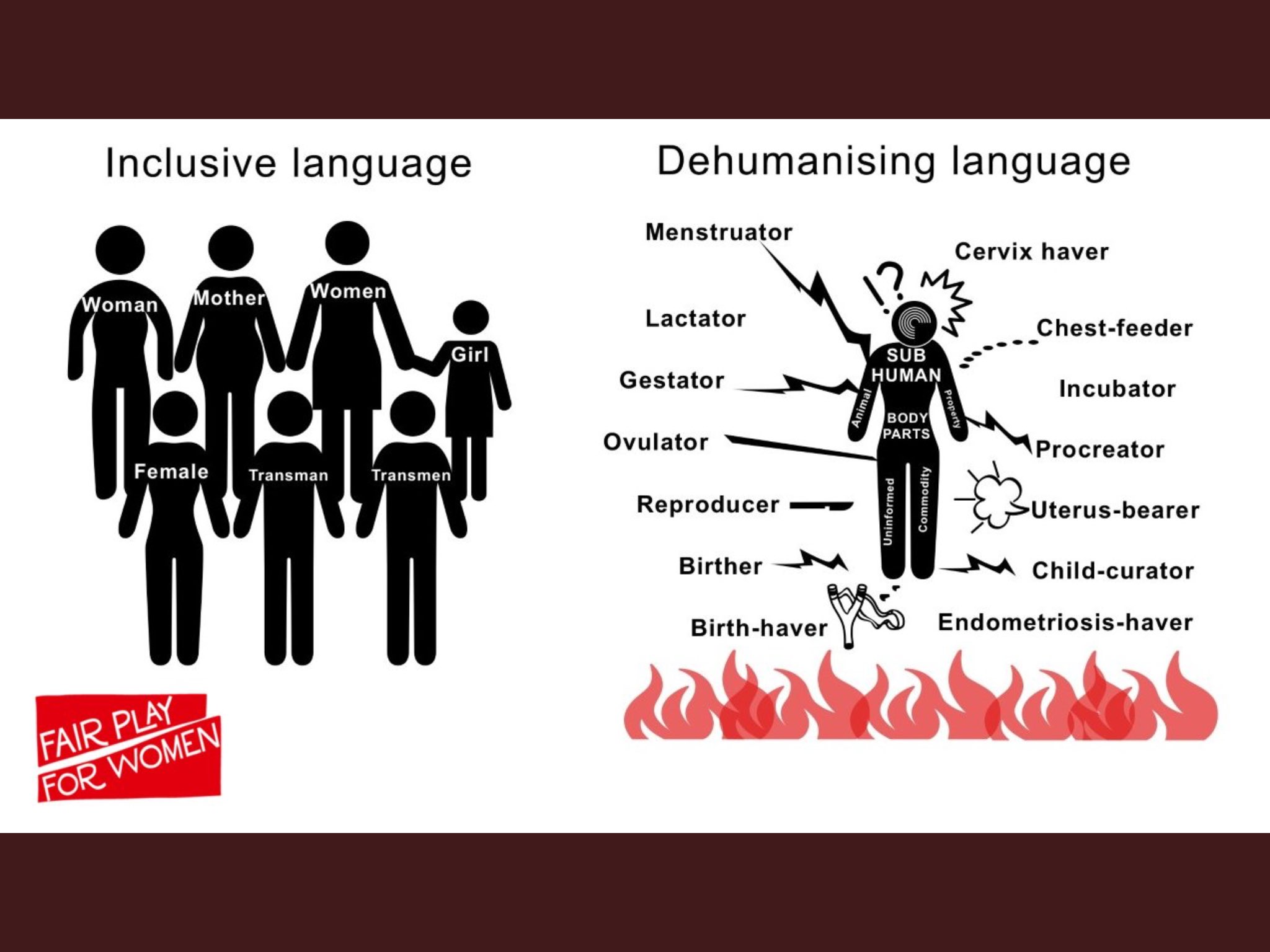
Our language needs to reflect concepts that correspond to physical material reality. Individuals that seek to remove females from the public sphere would have us believe that the terms on the right are somehow the correct terms – they are not – they are dehumanizing terms.
On the left represents what an accurate depiction of what inclusion looks like.











 bleatmop
 Mystro
 The Arbourist


 Dead Wild Roses
Your opinions…