
You are currently browsing the tag archive for the ‘School’ tag.
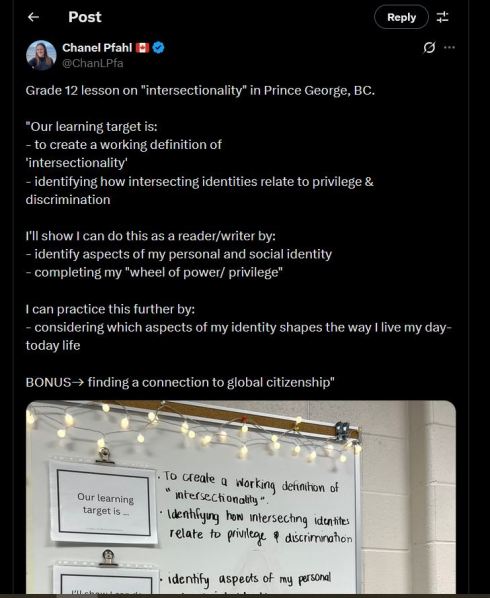
In Prince George, British Columbia, Grade 12 students were recently asked to “map their identities” on a wheel of power and privilege and define how overlapping traits like race, gender, and class shape their lives. The exercise was meant to foster empathy. Instead, it taught students to see themselves—and one another—through a hierarchy of guilt and grievance.
This is intersectionality in action. Coined by legal scholar Kimberlé Crenshaw in 1989, the theory originally sought to highlight how overlapping identities could compound discrimination. But in today’s classrooms, HR seminars, and activist spaces, intersectionality has evolved into something more aggressive: a political sorting tool that assigns moral value based on group identity rather than personal conduct. When used this way, it becomes weaponized intersectionality.
1. Define It Precisely
When arguing against it, start by defining intersectionality clearly. Don’t caricature it. Acknowledge its original intent—understanding overlapping forms of discrimination—but distinguish that from its modern mutation, which treats identity as destiny. This makes your critique credible and inoculates against claims of ignorance or bad faith.
2. Expose the Hidden Premise
Weaponized intersectionality rests on a simple but flawed assumption: that all disparities are the result of oppression and that moral authority flows from victimhood. Challenge that premise. Inequality does not always mean injustice. Lived experience matters, but it does not override evidence or reason.
3. Defend Universalism
Reassert the Enlightenment principle that all individuals possess equal moral worth regardless of group identity. Intersectionality divides by assigning virtue or guilt to immutable traits; universalism unites by judging actions, not ancestry. This is not denial of injustice—it’s the precondition for solving it.
4. Point Out Its Social Effects
Weaponized intersectionality erodes solidarity. It breeds resentment, teaching students and citizens alike to view each other as oppressors or oppressed. Even some leftist thinkers, like Nancy Fraser, have warned that intersectionality replaces economic analysis with “cultural essentialism,” fracturing potential alliances for real reform.
5. Offer a Better Vision
Don’t just oppose—propose. Replace identity grids with human rights frameworks. Discuss shared values such as dignity, equality before the law, and freedom of conscience. These ideas have lifted more people from oppression than any taxonomy of privilege ever could.
The Prince George lesson shows what happens when ideology replaces education: empathy becomes accusation, and learning becomes confession. Weaponized intersectionality promises justice but delivers division. The antidote is not denial of difference but defense of common humanity—an argument every student deserves to hear.
This was the result of a male student ‘self-id’ing into a female sport locker room. The female child that complained about having a male perv on them and her Father were both subject to censure and school disciplinary procedures, including attempting to compel their speech and actions. Thankfully that bullshit was stopped dead in its tracks.
I am the mother of the trans student in question and my [son] daughter did not make any comments at all. The entire team can back this up, other than the girl that made up the story for attention.
This is slander, defamation of character, and we have secured a lawyer….
Travis responded:
I am the father of the girl you claim “made up a story for attention.” The truth is your son watched my daughter and multiple other girls change in the locker room. While he got a free show they got violated.
You think this is fine and dandy. I wonder how you would feel if I watched you undress?
For that transgression school officials demanded that Travis apologize, and ended a contract it had with him as coach of the school’s girls’ soccer team.
Claimed the ADF in its lawsuit:
The First Amendment does not countenance this kind of government censorship, where a public school mandates that students and coaches refrain from expressing any view that offends its prescribed views, particularly on an issue as important as whether the school should permit males identifying as girls to undress, shower and change in the girls’ locker room.
Travis and Blake Allen were entitled to express their views on that issue and, in expressing those views, to support them with what is a biological fact — that a biological teenage male is, indeed, a male.
This case presents a textbook example of unconstitutional viewpoint discrimination, and Plaintiffs are entitled to all appropriate relief.
ADF summed up their argument:
By requiring Blake Allen to take part in a “restorative circle” to help her “understand the rights of students to access public accommodations … in a manner consistent with their gender identity” and “submit a reflective essay” that meets Defendants’ own standards in order to avoid additional out-of-school suspension, Defendants are seeking to compel her to speak in violation of the First and Fourteenth Amendments.
By requiring Travis Allen to issue a public apology for his September 29 Facebook post as a condition to be reinstated as a coach, Defendants are seeking to compel him to speak in violation of the First and Fourteenth Amendments.
The state of Vermont has created this problem by its willingness to buy into the current fad of “transgenderism.” It states that
- All students have a gender identity which is self-determined;
- All persons, including students attending school, have privacy rights.
Vermont defines “transgender” as “an individual whose gender identity or gender expression is different from the individual’s assigned sex at birth.”
Conflict is therefore inevitable, yet it never existed when the Genesis account was considered the basis of all law. Genesis 1:27, if Vermont state officials would follow it, eliminates the conflict: “God created man in His own image, in the image of God He created him, male and female He created them.”
After reviewing the lawsuit, school officials backed down. Said ADF: “Shortly after filing the lawsuit, counsel for the school officials notified ADF attorneys that the superintendent was rescinding the disciplinary actions.”
Score one for the good guys.
We start our lives as the whole of the universe. Reality is completely comprised of our perceptions and any “outside” object that is blocked from our senses puffs out of existence. Eventually, we learn object permanence, and we recognized that things outside us actually do exist on their own, but we are still the centre of the universe. Then our universe grows a little bit and we can relate to those closest to us and we start to look out for our tiny group. And here, unfortunately, is were too many of us stop.
Empathy is hard. Damn hard. We may well have an innate ability for it, but it is only through a great deal of instruction, practice, and nurturing that empathy can develop and extend beyond our immediate circles. The ability to understand your fellow humans, to see how we’re connected, to look beyond one’s own limited perspective – these are skills that require much honing. They need to be taught.
Here is a short documentary on an empathy class in Japan. It is amazing. These 4th graders display moments of clarity, responsibility, and understanding that outshine many adults in the world. This is an immensely important project, one that needs to be adopted by schools around the world. Grab some tissues, this one is full of all kinds of strong emotions.











 bleatmop
 Mystro
 The Arbourist


 Dead Wild Roses
Your opinions…