
You are currently browsing the tag archive for the ‘United States’ tag.
Iran, American Hegemony, and Western Resolve.
For years, Iran has functioned not as a normal state with normal ambitions, but as a regime that exports pressure through proxies, intimidation, missile programs, and calibrated disorder. Ottawa itself has repeatedly described Iran as “the principal source of instability and terror in the Middle East,” while stressing that Tehran must never be allowed to obtain or develop nuclear weapons. That matters because it cuts through the usual fog. This was not a strike against a harmless status quo. It was a strike against a regime that has spent years making the region more combustible, more violent, and more difficult to govern. (Canada PM)
That does not make war clean. It does not make every target choice wise. It does not make every legal question disappear. But it does clarify the strategic question. If a regime repeatedly funds, arms, and directs forces that destabilize the region, then eventually someone must decide whether deterrence is a word or a policy. The American and Israeli action in Iran is best understood in those terms. Not as a fantasy of moral purity, but as a decision to reimpose costs on a state that had grown used to exporting them. Ottawa’s own language makes that case harder to evade than many critics would like. (Canada PM)
This is the part many Western governments still struggle to say plainly. Order is not maintained by sentiment alone. It is not maintained by declarations, concern, and another exhausted appeal to “the international community.” Canada’s March 3 statement admitted the core reality: years of negotiations, sanctions, international monitoring, and multilateral pressure did not neutralize the Iranian threat. That is a brutal admission, and an important one. It means the soft-language consensus failed on its own stated terms. At some point, if the threat remains, either somebody acts or the speeches become a form of theatre performed over a steadily deteriorating map. (Canada PM)
“American hegemony, however much the word offends refined opinion, has often been the hard outer shell of a wider Western order.”
So yes, there is a case for saying the strikes were good in strategic terms. Iran was not a stabilizing power that got misunderstood by the usual Western moralists. It was a revolutionary regime that helped build and sustain a network of armed clients and auxiliaries across the region. Striking at that centre of gravity carries risks, but so did allowing it to operate under the assumption that the West had become too managerial, too conflict-averse, and too morally confused to act decisively. The risk of action is real. The risk of permanent indulgence was real too, and too often treated as invisible. (Canada PM)
That is why this moment matters beyond Iran. Not because one campaign settles the world. Not because every adversary will instantly become cautious. But because power still communicates. It communicates especially to regimes that have spent years studying the West and concluding that we prefer procedure to force, messaging to punishment, and managed humiliation to escalation. The lesson of Iran may not be that America will always act. It is simpler and more important than that: America still can act, and under some conditions still will. Even the White House’s preferred language of “peace through strength” matters less here as slogan than as signal. Adversaries do not have to admire the wording to understand the demonstration. (Canada PM)
That broader message is where China enters the discussion, but only carefully. It would be too strong, and probably false, to say Beijing has “backed down” because of Iran. Reuters reporting on Chinese military activity around Taiwan points to a narrower and more ambiguous picture: visible Chinese air activity around Taiwan has fallen sharply, but Taiwanese officials and analysts offered multiple possible explanations, including a possible Trump-Xi meeting atmosphere and internal turbulence inside China’s military. They explicitly warned against reading too much into a short lull. So the honest claim is not that China has folded. It is that Beijing is being reminded, in public, that the United States still possesses both the means and, at times, the appetite to use hard power. That is an inference. It is not yet a proved geopolitical shift. (Reuters)
The January Venezuela raid helps make that point, though only in a limited sense. Reuters reported that U.S. officials explicitly framed the operation as a warning to Beijing to keep its distance from the Americas. That does not prove deterrence has been restored, and it does not establish a new global pattern on its own. It does show that the message was sent. In Venezuela and now Iran, Washington has demonstrated that recent American power has not been purely rhetorical. Rivals may draw their own conclusions, but they are being given fresh evidence that the United States still possesses both the means and, at times, the appetite to use hard force. (Reuters)
And that matters because American hegemony, however much the word offends refined opinion, has served for decades as the hard outer shell of a wider Western order. It has not produced a perfect world. It has produced something rarer: a world in which hostile powers, rogue regimes, and ambitious revisionists often had to think twice. That “think twice” space is not everything, but it is a great deal. Lose it, and you do not get peace. You get more tests, more probes, more daring clients, more rulers gambling that the old sheriff now prefers seminars to force. The language may rankle. The reality remains. (Reuters)
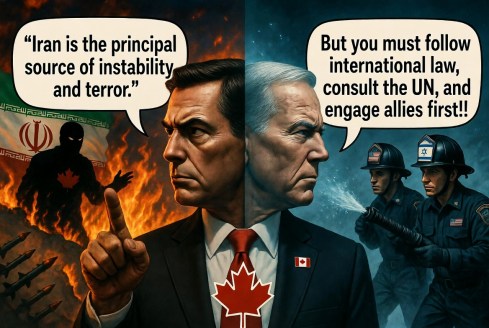
“Ottawa could identify the arsonist, but still felt compelled to lecture the firefighters on process before the building stopped burning.”
And then there is Canada, performing once again its favourite late-imperial routine: saying the truest thing in the room and then rushing to blur it. On March 3, Carney said Iran is the principal source of instability and terror in the Middle East and condemned Iranian violence against civilians. On March 4, he also stressed that the United States and Israel acted without engaging the United Nations or consulting allies, including Canada, and reaffirmed that international law binds all belligerents. In other words, Ottawa could identify the arsonist, but still felt compelled to lecture the firefighters on process before the building stopped burning. (Canada PM)
That is the embarrassment. Not caution as such. Caution can be prudent. The embarrassment is the inability to rank moral and strategic realities in the right order. A serious government can say: Iran is the principal destabilizing force, diplomacy failed, the strikes carry grave risks, and the next task is preventing a wider regional catastrophe. That would at least sound like an adult hierarchy of judgment. What we got instead was a familiar Canadian blend of partial clarity and procedural recoil, as if sounding too decisive might itself be a diplomatic offence. (Canada PM)
The deeper issue is civilizational confidence. A West that cannot impose costs on regimes that menace its allies, fuel regional disorder, and exploit every sign of hesitation will not be admired for its restraint. It will be read as tired. The value of American hegemony, whatever its flaws, has never been that it creates a frictionless world. It is that it has often underwritten a world in which enemies of the West had reason to fear miscalculation. That fear is not barbarism. It is one of the costs of preserving order. Remove it, and you do not get a more humane international system. You get a more predatory one. (Canada PM)
So the case for the strikes is not that war is noble or that consequences will be tidy. It is that deterrence sometimes has to become visible again. Iran built power by betting that the West preferred delay to decision. In this case, that bet was answered with force. Even America’s enemies, and Canada’s evasive political class, may have been reminded of something they had started to forget: strength still speaks, and sometimes it is the only language a revolutionary regime believes. (Canada PM)
References
Prime Minister of Canada. “Statement by Prime Minister Carney on the evolving situation in the Middle East.” March 3, 2026.
Prime Minister of Canada. “Prime Minister Carney delivers remarks to media in Sydney, Australia.” March 4, 2026.
Reuters. “Chinese military flights around Taiwan fall, Trump-Xi meeting may be factor.” March 5, 2026.
Reuters. “With Venezuela raid, US tells China to keep away from the Americas.” January 11, 2026.
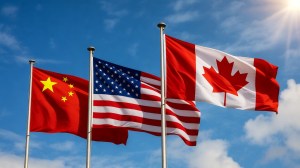
Canada is in the middle of a familiar temptation: the Americans are difficult, therefore the Chinese offer must be sane.
The immediate backdrop is concrete. On January 16, 2026, Canada announced a reset in economic ties with China that includes lowering barriers for a set number of Chinese EVs, while China reduces tariffs on key Canadian exports like canola. (Reuters) Washington responded with open irritation, warning Canada it may regret the move and stressing Chinese EVs will face U.S. barriers. (Reuters)
If you want a simple, pasteable bromide for people losing their minds online, it’s this: the U.S. and China both do bad things, but they do bad things in different ways, at different scales, with different “escape hatches.” One is a democracy with adversarial institutions that sometimes work. The other is a one-party state that treats accountability as a threat.
To make that visible, here are five egregious “hits” from each—then the contrast that actually matters.
Five things the United States does that Canadians have reason to resent
1) Protectionist trade punishment against allies
Steel/aluminum tariffs and recurring lumber duties are the classic pattern: national-interest rhetoric, domestic political payoff, allied collateral damage. Canada has repeatedly challenged U.S. measures on steel/aluminum and softwood lumber. (Global Affairs Canada)
Takeaway: the U.S. will squeeze Canada when it’s convenient—sometimes loudly, sometimes as a bureaucratic grind.
2) Energy and infrastructure whiplash
Keystone XL is the poster child of U.S. policy reversals that impose real costs north of the border and then move on. The project’s termination is documented by the company and Canadian/Alberta sources. (TC Energy)
Takeaway: the U.S. can treat Canadian capital as disposable when U.S. domestic politics flips.
3) Extraterritorial reach into Canadians’ private financial lives
FATCA and related information-sharing arrangements are widely experienced as a sovereignty irritant (and have been litigated in Canada). The Supreme Court of Canada ultimately declined to hear a constitutional challenge in 2023. (STEP)
Takeaway: the U.S. often assumes its laws get to follow people across borders.
4) A surveillance state that had to be restrained after the fact
Bulk telephone metadata collection under Patriot Act authorities became politically toxic and was later reformed/ended under the USA Freedom Act’s structure. (Default)
Takeaway: democracies can drift into overreach; the difference is that overreach can become a scandal, a law change, and a court fight.
5) The post-9/11 stain: indefinite detention and coercive interrogation
Guantánamo’s long-running controversy and the Senate Intelligence Committee’s reporting on the CIA program remain enduring examples of U.S. moral failure. (Senate Select Committee on Intelligence)
Takeaway: the U.S. is capable of serious rights abuses—then also capable of documenting them publicly, litigating them, and partially reversing course.
Five things the People’s Republic of China does that are categorically different
1) Mass rights violations against Uyghurs and other Muslim minorities in Xinjiang
The UN human rights office assessed serious human rights concerns in Xinjiang and noted that the scale of certain detention practices may constitute international crimes, including crimes against humanity. Canada has publicly echoed those concerns in multilateral statements. (OHCHR)
Takeaway: this is not “policy disagreement.” It’s a regime-scale human rights problem.
2) Hong Kong: the model of “one country, one party”
The ongoing use of the national security framework to prosecute prominent pro-democracy figures is a live, observable indicator of how Beijing treats dissent when it has full jurisdiction. (Reuters)
Takeaway: when Beijing says “stability,” it means obedience.
3) Foreign interference and transnational pressure tactics
Canadian public safety materials and parliamentary reporting describe investigations into transnational repression activity and concerns around “overseas police stations” and foreign influence. (Public Safety Canada)
Takeaway: the Chinese state’s threat model can extend into diaspora communities abroad.
4) Systematic acquisition—licit and illicit—of sensitive technology and IP
The U.S. intelligence community’s public threat assessment explicitly describes China’s efforts to accelerate S&T progress through licit and illicit means, including IP acquisition/theft and cyber operations. (Director of National Intelligence)
Takeaway: your “market partner” may also be running an extraction strategy against your innovation base.
5) Environmental and maritime predation at scale
China remains a dominant player in coal buildout even while expanding renewables, a dual-track strategy with global climate implications. (Financial Times)
On the oceans, multiple research and advocacy reports emphasize the size and global footprint of China’s distant-water fishing and associated IUU concerns. (Brookings)
Takeaway: when the state backs extraction, the externalities get exported.
Compare and contrast: the difference is accountability
If you read those lists and conclude “both sides are bad,” you’ve missed the key variable.
The U.S. does bad things in a system with adversarial leak paths:
investigative journalism, courts, opposition parties, congressional reports, and leadership turnover. That doesn’t prevent abuses. It does make abuses contestable—and sometimes reversible. (Senate Select Committee on Intelligence)
China does bad things in a system designed to prevent contestation:
one-party rule, censorship, legal instruments aimed at “subversion,” and a governance style that treats independent scrutiny as hostile action. The problem isn’t “China is foreign.” The problem is that the regime’s incentives run against transparency by design. (Reuters)
So when someone says, “Maybe we should pivot away from the Americans,” the adult response is:
- Yes, diversify.
- No, don’t pretend dependency on an authoritarian state is merely a swap of suppliers.
A quick media-literacy rule for your feed
If a post uses a checklist like “America did X, therefore China is fine,” it’s usually laundering a conclusion.
A better frame is risk profile:
- In a democracy, policy risk is high but visible—and the country can change its mind in public.
- In a one-party state, policy risk is lower until it isn’t—and then you discover the rules were never meant to protect you.
Canada can do business with anyone. But it should not confuse trade with trust, or frustration with Washington with safety in Beijing.
If Canada wants autonomy, the answer isn’t romanticizing China. It’s building a broader portfolio across countries where the rule of law is not a slogan in a press release.
References
- Canada–China trade reset (EV tariffs/canola): Reuters; Guardian. (Reuters)
- U.S. criticism of Canada opening to Chinese EVs: Reuters. (Reuters)
- U.S. tariffs/lumber disputes: Global Affairs Canada; Reuters. (Global Affairs Canada)
- Keystone XL termination: TC Energy; Government of Alberta. (TC Energy)
- FATCA Canadian challenge result: STEP (re Supreme Court dismissal). (STEP)
- USA Freedom Act / end of bulk metadata: Lawfare; Just Security. (Default)
- CIA detention/interrogation report: U.S. Senate Intelligence Committee report PDF. (Senate Select Committee on Intelligence)
- Guantánamo context: Reuters; Amnesty. (Reuters)
- Xinjiang assessment: OHCHR report + Canada multilateral statement. (OHCHR)
- Hong Kong NSL crackdown example: Reuters (Jimmy Lai). (Reuters)
- Transnational repression / overseas police station concerns: Public Safety Canada; House of Commons report PDF. (Public Safety Canada)
- China tech acquisition / IP theft framing: ODNI Annual Threat Assessment PDF. (Director of National Intelligence)
- Coal buildout: Financial Times; Reuters analysis. (Financial Times)
- Distant-water fishing footprint / IUU concerns: Brookings; EJF; Oceana. (Brookings)
US commentators still seem to be mulling the prospects of how close, or how far they came to living in an authoritarian fascist state under Donald Trump. It is interesting how little air time the States dances with fascism get in the media today.
The liberal economist and New York Times columnist Paul Krugman put things well on the morning of January 7, 2021, in a column titled “Appeasement Got Us Where We Are”:
‘So, is it finally OK to use the F-word? One shouldn’t use the term “fascist” lightly…Donald Trump, however, is indeed a fascist — an authoritarian willing to use violence to achieve his racial nationalist goals. So are many of his supporters. If you had any doubts about that, Wednesday’s attack on Congress should have ended them.’
Observing the events one day before, when Donald Trump instigated an attempted putsch meant to overthrow previously normative bourgeois electoral democracy and constitutional rule of law, the esteemed veteran historian Robert Paxton, author of the classic volume The Anatomy of Fascism, finally relented. He had to admit that he’d been wrong on Trump and that the 45th US president was in fact what Krugman said – and what many of us on the margins had been saying from the start.
Paxton was one of a bevy of “fascism experts” who had been proclaiming that Trump didn’t qualify for “the F-word.” This august list of Trump fascism-deniers included an impressive roster of 20th Century European historians who were hopelessly out of their depth when it came to analyzing 21st century US society and politics: Paxton, Stanley Payne (emeritus at the University of Wisconsin), Roger Griffin (Oxford), Richard Evans (Cambridge), and Samuel Moyn (Yale) (also meriting mention here is Japanese historian Gary Leupp [Tuft’]s). But field specialization and professional immersion in the previous century was no excuse for other deniers: NYU law professor Bruce Neuborne and the political scientists and government professors Sheri Berman, Cory Robin, Eric de Bruin, and Jason Brownlee. The heights of denialist comedy were scaled by Neuborne, who couldn’t put “the F-word” in his text or index in a book that discovered no less than twenty common themes, tactics, and policies that Trump as president was “copying from the early Hitler government” while “following Hitler’s playbook” and “letting Hitler’s genies out of the bottle”: holding power without winning majority support; finding and using direct lines of communication with their base; blaming others and dividing along racial lines; relentlessly demonizing opponents; constantly attacking objective truth; relentlessly attacking mainstream media; assaulting science; cultivating a fawning alternative media to spread lies; regular orchestrated mass hate-rallies; extreme nationalism; closing borders; embracing mass detention and deportation; using borders to protect selected industries; embedding authoritarian rule by rewarding capitalist elites; rejecting international norms; attacking domestic democratic processes; attacking courts and the rule of law; glorifying the military and demanding loyalty oaths; proclaiming unchecked power; relegating women to subordinate roles[1].
When asked about parallels with Trump and the Trump presidency, the “fascism experts” engaged in straw-dog reasoning by ticking off numerous and obvious ways in which the 45th United States president and the United States during the Trump years fell short of the committed doctrinal fascism of Mussolini and Hitler and the fully consolidated fascist regimes of interwar and WWII Europe. Nothing less than Classic Coke passed muster for these sweet-rooted connoisseurs of pure historical fascism, who chattered about the absence of “real fascism” in Trump and Trumpism as they missed and/or unduly downplayed remarkable political, rhetorical, ideological, and movement continuities between fascism old and new while failing to grasp contemporary US and global fascism as a movement and politics – a movement and politics with a very real (if clumsy and more “instinctive” than doctrinal) fascist cult leader in the most powerful job of the most powerful nation in world history from January 20, 2017 through January 20, 2021.
The next presidential election in the US should be very telling as the populace will once again have to choose between the ribald Republican strongman and some hapless Democrat empty suit.
Time to Revisit Mr.Wise on the problem of race in the United States.
The crimes humans commit against each other have numerous justifications and rationalizations, to most of us in North America, we hear more about the atrocities of our enemies, that we do of the ones we commit in our name. John Dower examines the Cold War period in history and concludes that our hands were just as bloody, if not more so, than our hated enemy.
“When the torture manuals refer to “neutralizing” targets, this was commonly recognized as a euphemism for killing. There is no evidence that cover US forces participated directly in the the grotesque torture, death squads, massacres, and “disappearances” characteristic of the dirty wars that ravaged Latin America, only that they promoted and supported them. At the same time, there i”s little or no evidence that, in taking sides in these wars and training and materially aiding “anticommunist” participants in them, the United States gave serious attention to human rights or the rule of law. In most countries south of the border, Washington supported right-wing regimes in their state terror. In Nicaragua, it abetted the Contras in pursing a murderous campaign of “guerrilla” terror against the government. Proxy war, surrogate terror, disdain for human rights and even for plain decency all came together.
As always, it is not possible to quantify the costs of this violence with any exactitude. For South and Central American societies, the political, cultural, and psychological costs were – and to some degree still are – enormous. Writing in Cambridge History of the Cold War, John Coatsworth observed that the Contra insurrection in Nicaragua devastated the economy, forced the government to abandon most of its social programs, and “cost th lives of 30,000 Nicaraguans, mostly civilian supporters of the Sandinista revolution.” He put the death toll in El Salvador between 1979 and 1984 at nearly forty thousand, most who were unarmed combatants murdered by the armed forces.
Coatsworth also noted in passing that President Reagan visited Guatemala City in December 1982 and praised the ruling military junta for its commitment to defend the country against the threat of communism. In 1982- 1983 alone, the government forced eight hundred thousand peasants into “civil patrols” ordered to uncover and kill insurgents or see their communities destroyed. It followed up on its threat by destroying an estimated 686 villages and hamlets and killing between fifty thousand and seventy-five thousand people.
All told, Coatsworth estimates that the Cold War in Central America saw nearly three hundred thousand deaths in a population of thirty million, plus a million refugees who fled the area, mostly for the United States. Based on examination of published CIA and State Department materials plus other reports unsympathetic to communist regimes, he reached this conclusion: “Between 1960, by which time the Soviets had dismantled Stalin’s gulags, and the Soviet collapse in 1990, the numbers of political prisoners, torture victims, and executions of nonviolent political dissenters in Latin America vastly exceeded those in the Soviet Union and its East European satellites. In other words, from 1960 to 1990, the Soviet Union bloc as a whole was less repressive, measured in terms of human victims, than many individual Latin American countries.”
This does not diminish the multiple horrors of Soviet violence and oppression, but helps place them in perspective.”
-John W. Dower. The Violent American Century. pp. 68 – 69.
It seems like so few people understand the context of empire and how it affects American foreign policy. Let’s take a quick peek at Greece and how we treat fellow democracies when it comes to maintaining ‘interests of state’.
“In the case of Spain there is some plausibility to the argument that the United States had to deal with the leader that it found there, even if he happened to be a fascist. But the story was different in Greece. We helped bring the militarists to power there, and the legacy of our complicity still poisons Greek attitudes toward the United States. There is probably no democratic public anywhere on earth with more deeply entrenched anti-American views than the Greeks. The roots of these attitudes go back to the birth of the Cold War itself, to the Greek civil war of 1946 – 49 and the U.S. decision embodied by the Truman Doctrine to intervene on the neofascist side because the wartime Greek partisan forces had been Communist-dominated. In 1949, the neofascists won and created a brutal right-wing government protected by the Greek secret police, composed of officers trained in the United States by the wartime Office of Strategic Services and its successor, the CIA.
[…]
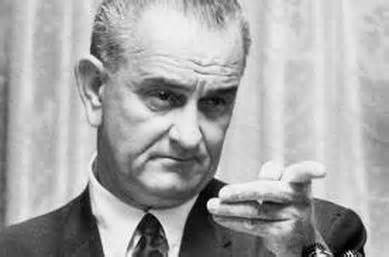
All you need to know from U.S. President Lyndon Baines Johnston about promoting peace and democracy abroad. – “Fuck your parliament and your constitution. We pay a lot of good American dollars to the Greeks. If your prime minister gives me talk about democracy, parliament, and constitution, he, his parliament, and his constitution may not last very long.”
In February of 1964, George Papandreou was elected prime minister by a huge majority. He tried to remain on friendly terms with the the Americans, but President Lyndon Johnson’s White House was pressuring him to sacrifice Greek interests on the disputed island of Cyprus in favour of Turkey, where the United States was also building military bases. Both Greece and Turkey had been members of NATO since 1952, but by the mid – 1960’s the United States seemed more interested in cultivating Turkey. When the Greek ambassador told President Johnson that his proposed solution to the Cyprus dispute was unacceptable to the Greek parliament, Johnson reportedly responded, “Fuck your parliament and your constitution. We pay a lot of good American dollars to the Greeks. If your prime minister gives me talk about democracy, parliament, and constitution, he, his parliament, and his constitution may not last very long.” And they did not.
The CIA, under its Athens station chief, John Muary, immediately began plotting with Greek military officers they had trained and cultivated for over twenty years. In order to create a sense of crisis, the Greek intelligence service, the KYP, carried out an extensive program of terrorist attacks and bombings that it blamed on the left. Constantin Costa-Gavras’s 1969 film, Z, accurately depicts those days. On April 21, 1967, just before the beginning of an election campaign that would have returned Papandreou as prime minister, the military acted. Claiming they were protecting the country from a communist coup, a five-man junta, four of whom had close connections with either the CIA or the U.S. military in Greece, established one of the most repressive regimes sponsored by either side during the Cold War.
The “Greek colonels”, as they came to be known, opened up the country to American missile launch sites and espionage bases, and they donated some $549,000 to the Nixon-Agnew election campaign.
[…]
The leader of the junta, Colonel George Papadopoulos, was an avowed fascist and admirer of Adolf Hitler. He had been trained in the United States during World War II and had been on the CIA payroll for fifteen years preceding the coup. His regime was noted for it’s brutality. During the colonel’s first month in power some 8,000 professionals, students, and others disliked by the junta were seized and tortured. Many were executed. In 1969, the eighteen member countries of the European Commission of Human Rights threatened to expel Greece – it walked out before the commission could act -but even this had no effect on American policies. “
-The Sorrows of Empire – Chalmers Johnson. pp. 204 – 206
Just in case you were unsure of how realpolitik worked and in need of your levels of depression and ennui topped up.
Women will bring peace to the world (if men don’t destroy it first) and they shall do it through understanding and listening to each other. Listen to the power of their words.
“Ten black mothers sat on the stage in an auditorium and looked into a diverse crowd of women in the audience. They were about to share something personal and hurtful with this room full of mostly strangers.
They were going to talk about something they didn’t normally share with their white friends or colleagues.
It was about to get real in that room.
In the aftermath of the killing of Michael Brown, an unarmed black teenager fatally shot by a white Ferguson, Missouri police officer, conversations about race in the St. Louis area have been loaded.
Christi Griffin, the president of The Ethics Project, wanted this to be different. She wanted to invite mothers of other races to hear directly from black mothers the reality of raising a black son in America. She wanted them to hear the words they each had said to their own sons, in different variations over the years, but all with the same message: Stay alive. Come home alive.
She wanted mothers who had never felt the fear, every single time their son walked outside or drove a car, that he could possibly be killed to hear what that felt like.
Griffin’s son, now grown, had never gotten in trouble nor given her any trouble growing up. But when her son was 14 years old, the family moved into an all-white neighborhood. She took him to the police department to introduce him to the staff. She wanted the officers to know that he belonged there, that he lived there.
When he turned 16, it was time for another talk. Every single time he got into his car to drive, she made him take his license out of his wallet and his insurance card out of the glove compartment.
“I did not want him reaching for anything in the car.”
He graduated from college with a degree in physics.
Marlowe Thomas-Tulloch said that when she noticed her grandson was getting bigger and taller, she laid bare a truth to him: Son, if the police stop you, I need for you to be humble. But I need more than that. I need for you to be prepared to be humiliated.
If they tell you take your hands out of your pockets, take your hands out. Be ready to turn your pockets out. If they tell you to sit down, be prepared to lie down.
You only walk in the street with one boy at a time, she told him.
“What?” her grandson said. In his 17-year-old mind, he hadn’t done anything wrong and nothing was going to happen to him.
“If it’s three or more, you’re a mob,” she said. “That’s how they will see you.”
She started to cry.
“Listen to me,” she begged. “Hear me.”
Finally, she felt him feel her fear.
If they ask you who you are, name your family.
Yes, sir and no, sir. If they are in your face, even if they are wrong, humble yourself and submit yourself to the moment.
“I’m serious,” she said. “Because I love you.”
She told him she would rather pick him up from the police station than identify his body at a morgue.
When her grandson left to go home, she called her daughter to tell her about the conversation. Her daughter asked her what she had said, because her son came home upset, with tears in his eyes.
“I hope I said enough to save his life,” Thomas-Tulloch said. “I’d rather go down giving him everything I got.”
The mothers talked about the times their sons had been stopped in their own neighborhoods because “they fit the description.” They shared the times their sons had come home full of rage and hurt for being stopped and questioned for no reason. And they told the other mothers how often they told their sons to simply swallow the injustice of the moment. Because they wanted them alive, above all.
Amy Hunter, director of racial justice at the YWCA in metro St. Louis, said it’s taken her 10 years to be able to share this story about her son without crying. She didn’t want her white friends to see her cry when she told it. She didn’t want to look weak.
Her four children are now older, but when one of her sons was 12, he decided to walk home from the Delmar Loop in University City where he had met some friends.
He saw a police officer circling him, and he knew. He was wearing Sperrys, a tucked-in polo shirt, a belt. He was 12, and he knew, but he was scared.
He lived five houses away, and he hadn’t done anything wrong.
“I knew you were home,” he said to his mom when he finally made it home after being frisked. “I knew I was about to get stopped, and I thought about running home to you.”
His mother froze.
“I forgot to tell him,” she said. “I forgot to tell him: Don’t run. Don’t run or they’ll shoot you.”
Her 12-year-old cried when he told her what had happened and asked if he was stopped because he was black.
“Probably, yeah,” she said.
“I just want to know, how long will this last?” he asked her.
That’s when she started to cry.
“For the rest of your life,” she said.
It doesn’t matter about your college degree, the car you drive, the street you live on, she told the moms in the audience. It’s not going to shield your child like a Superman cape. She admitted that it was difficult to share these painful moments.
Just one of the mothers on the stage asked a single question of the audience. Assata Henderson, who has raised three children, all college graduates, said she called her sons to ask them what they remembered about “the talk” she had given them about how to survive as a black man.
“Mama, you talked all the time,” they said to her.
It made her wonder, she said. She said she wasn’t pointing any fingers, but it made her wonder about the conversations the other mothers were having with their sons, who grow up to be police officers, judges and CEOs.
“You’re the mothers,” she said to the crowd. “What are the conversations you are having with the police officers who harass our children?”[
[Source]











 bleatmop
 Mystro
 The Arbourist


 Dead Wild Roses
Your opinions…