
You are currently browsing the tag archive for the ‘Universities’ tag.
A University of Toronto Scarborough posting for an Assistant Professor in Computational Biology and Data Science looks like a standard academic hire. It isn’t. It is a restricted competition tied to a Canada Research Chair (CRC) nomination.
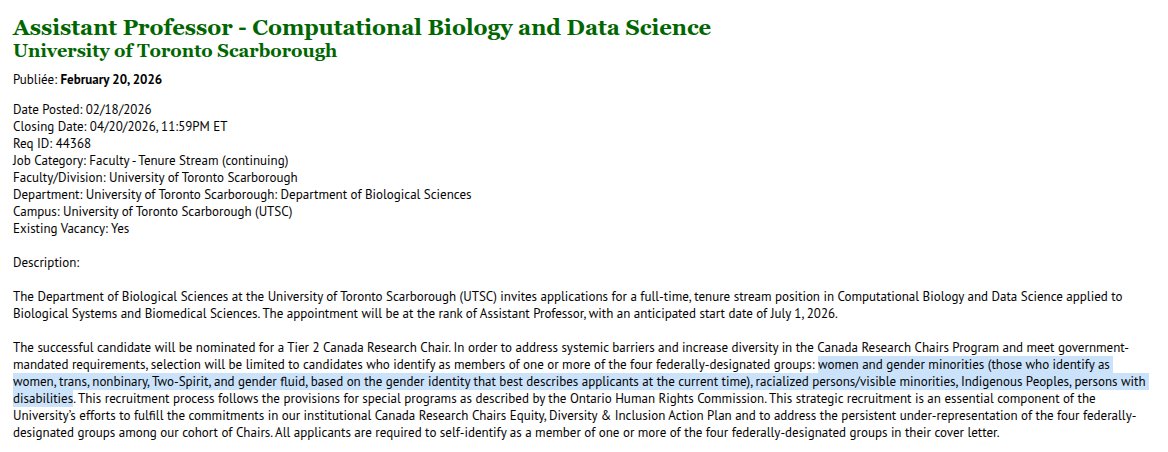 The posting requires applicants to self-identify as a member of one or more “designated groups” in their cover letter, namely women or gender minorities, racialized persons, Indigenous Peoples, or persons with disabilities. If you do not fit one of those categories, you are not eligible to apply. That is not an inference. It is in the posting.
That one detail captures the reality of modern equity administration in Canadian universities: what is framed as “removing barriers” often functions, in practice, as category-based exclusion.
This is not a rogue department. It is a federal program mechanism.
The university did not invent this framework on its own. The hiring restriction is attached to the Canada Research Chairs program, a federal initiative that allocates prestige and funding to institutions under defined rules. One major rule-set is the CRC equity framework, which includes population-based targets for the four designated groups. The program’s stated targets to be reached by the end of 2029 are: 50.9% women and gender equity-seeking groups, 22% racialized persons, 4.9% Indigenous Peoples, and 7.5% persons with disabilities.
Again, these are not vibes. They are published benchmarks tied to institutional plans and program governance.
The key point is the enforcement logic. Under the CRC’s settlement and enforcement framework, institutions that miss interim targets can face consequences that shape nominations and recruitment practices. In plain terms: the program can push institutions toward restricted competitions where eligibility is limited to designated groups.
So when you see a posting that excludes broad classes of Canadians from applying, it is not a one-off. It is a downstream product of rules that tie federal research prestige to demographic targets.
The problem is the normalization of identity gates
Defenders will say this is equity. They will argue that special measures are justified to counter historical bias and structural disadvantage. That is the argument, and it deserves to be stated fairly.
But there is a moral and civic cost to the method. When eligibility is restricted by identity categories, the institution is no longer selecting among all qualified candidates. It is selecting among those who clear an identity threshold first. That is not “equal opportunity.” It is a gate that sorts people before their work is even evaluated.
If you want a simple test for whether this is principled, reverse the identity labels. A posting that said “whites only” or “men only” would be condemned instantly, for good reason. You do not escape discrimination by flipping who benefits. You normalize discrimination by making it administratively routine.
A better standard
If Canada wants fairness in academic hiring, the standard should be straightforward: open eligibility, transparent criteria, and selection based on demonstrated excellence. If there are pipeline problems, fix the pipeline. Broaden recruitment, strengthen mentorship, reduce opaque networking advantages, and enforce accountable evaluation.
Do not solve bias by writing exclusions into job postings, then congratulating yourself for it. That approach trains young researchers to see institutions as political allocation machines rather than merit-seeking communities. And once that belief sets in, you do not get trust back easily.

References
1) U of T Scarborough job posting (Assistant Professor – Computational Biology and Data Science)
https://jobs.utoronto.ca/job/Scarborough-Assistant-Professor-Computational-Biology-and-Data-Science-ON/599939517/
2) Canada Research Chairs: “Establishing equity targets for 2021 to 2029”
https://www.chairs-chaires.gc.ca/program-programme/equity-equite/targets-cibles-eng.aspx
3) CRC Program representation statistics (lists the population-based targets and deadline)
https://www.chairs-chaires.gc.ca/about_us-a_notre_sujet/statistics-statistiques-eng.aspx
4) CRC: Equity, Diversity and Inclusion requirements and practices (overview, settlement context)
https://www.chairs-chaires.gc.ca/program-programme/equity-equite/index-eng.aspx
5) CRC: 2021 Canadian Human Rights Settlement Agreement page (program framing and enforcement context)
https://www.chairs-chaires.gc.ca/program-programme/equity-equite/2021_settlement-reglement-eng.aspx
6) House of Commons Standing Committee on Science and Research, Meeting No. 2 (witness panel includes Steven Pinker and Azim Shariff)
https://www.ourcommons.ca/documentviewer/en/45-1/SRSR/meeting-2/evidence
Looking at everything through the oppressor/oppressed lens is dangerous.
“On these facts, it can be difficult to tell whether universities have been acting with willful indifference or just willfully. Time—and discovery—will tell. But every now and then we get a bracing glimpse of what the administrators who are responsible for implementing campus antidiscrimination policies really think about Jews. At Columbia, text messages exchanged by a group of deans during a panel discussion about the crisis of campus antisemitism offered some honest insight. While a Jewish panelist was speaking, one of the deans remarked that it was “hard to hear the woe is me” because it was coming “from such a place of privilege.” A second accused a Jewish speaker of “tak[ing] full advantage” of the crisis on campus for its “[h]uge fundraising potential.” A third was more concise, if less articulate. She reacted to the panel with a vomiting emoji.
The texts are bad, but the reality they reflect is even worse. They illustrate the moral and intellectual rot that has been gnawing away at our institutions of higher learning for decades. Our universities have long nurtured—and have by now been largely captured by—an ideology that divides the world into victim classes and oppressor classes, and views our legal and judicial institutions as systems of subordination masquerading as neutral arbiters of justice. Under this worldview, Jews occupy a position of unique “privilege” as the apex oppressors on a social pyramid of power and subordination. They cannot—by definition—be victims because they are oppressors. As such, they are unworthy of the same protections afforded to groups at the bottom of the pyramid of social oppression.
If you buy into this worldview, hatred against Jews is justifiable and violence against them is defensible as a legitimate act of resistance—or, at the very least, not worthy of sympathy. That is why it was “hard” for a Columbia dean to hear what she derided as “the woe is me” from a Jewish speaker. It’s why another was quick to accuse a Jewish speaker of using his power to exploit the moment for its “fundraising potential.”
The current crisis of campus antisemitism has laid bare for all Americans just how dangerous a cultural moment we are living in. The same ideological forces that have unleashed virulent antisemitism on our campuses have also unleashed some of the worst atrocities in modern history. They are antithetical to our nation’s core values. Individual liberty and individual responsibility have no home in a system obsessed with allocating collective guilt. And when the rule of law is seen as a racialized system of subordination, equality under the law is a delusion. We’ve seen this revolution before. It doesn’t end well.”











 bleatmop
 Mystro


 Dead Wild Roses
Your opinions…