
You are currently browsing the monthly archive for January 2023.
This is a lens shattering essay by Olúfẹ́mi Táíwò who asks us to put aside our current demarcations of African history – Precolonial, Colonial, and Post-Colonial because they obfuscate the rich tapestry that is the history of Africa.
“When ‘precolonial’ is used for describing African ideas, processes, institutions and practices, through time, it misrepresents them. When deployed to explain African experience and institutions, and characterise the logic of their evolution through history, it is worthless and theoretically vacuous. The concept of ‘precolonial’ anything hides, it never discloses; it obscures, it never illuminates; it does not aid understanding in any manner, shape or form.”
[…]
“Perhaps the most pernicious effect of deploying the various iterations of ‘precolonial’ is the way it marginalises ideas, especially philosophy, in Africa. Because ‘precolonial’ takes colonialism as the dividing line for organising ideas within its temporality and forces us to conceive of spaces relative to how they stand in the arrival and dispersal of colonialism in the continent, we, unwittingly for the most part, end up talking as if ideas, practices, processes and institutions can be understood within frameworks delineated by the precolonial, colonial and postcolonial schema. So, when we are looking at philosophy or modes of governance – to take two arbitrary examples – given our justifiable hostility to things colonial, we construe ‘precolonial’ as necessarily having nothing to do with the colonial, the latter understood as having ‘European’, ‘Western’ or ‘modern’ provenance while, simultaneously, interpreting it as ‘traditional’, ‘indigenous’ and the like.
The misdescription we identified above induces misinterpretation as well as a misrecognition of the genealogy and exchange of ideas, the evolution of institutions, and the identity of thinkers in the area. The problem is profound. Because of the primacy accorded to identity in the business of finding ideas and institutions that could be separated from anything European, Western or modern, African scholars for a long time contorted themselves into finding ‘African philosophy’ that was authentically ‘African’, were even willing to give up on the very term ‘philosophy’ and called their ideational production ‘African Traditional Thought’. The driving question was a matter of whether or not such ideas had been ‘contaminated’ by colonialism and its appurtenant practices, ideas, processes and institutions. When a scholar announces an interest in studying ‘Traditional African Political Thought’, in light of our analysis so far, the first question to ask is whether ‘traditional’ in this formulation has any room for evolution such that we can periodise ‘traditional thought’. Of course, I am assuming what should be obvious: is the thought involved the same throughout history, or were there changes induced by both exogenous and endogenous causes to it, and how are those changes to be understood? The other problem takes us to the next section of this discussion: the problem of facilely deploying an entire continent as a unit of analysis.
Let us recall the temporal framework adopted by Solanke above. Anyone reading his account is immediately enabled to situate his ideas about what transpired in medieval West Africa in relation to what was happening at other places in Africa, nay, the world, within the same temporal boundaries. This enables us to see how similar ideas found in different parts of our world do not have to be explained in terms of influences or common origins. That way, we would have no difficulty identifying African contributions to the global circuit of ideas in ancient times, in medieval times and right to the present. And such contributions would not be limited to so-called ‘authentic’, ‘indigenous’ or ‘traditional’ African fare. The tendency to treat Africa as a unit of analysis motivated by a wrong-headed approach, which took challenging Europe’s ignorant elucidations of African phenomena as the primary object, has issued in genealogies and narratives of intellectual history that bear no resemblance to how things really happened in history, or how African thinkers actually conducted themselves in the global circuit of ideas. This is why Africa hardly ever features in the annals of philosophy, and chronologies in philosophy anthologies do not carry African entries in frameworks demarcated by the Gregorian calendar.”
[…]
“All this would be invisible to the trinity of precolonial, colonial and postcolonial division of African history for organising states and ideas, practices and institutions, processes and thinkers and intellectual movements through time. Tossing the retrograde ‘precolonial’ epithet in the dustbin can bring only gains in expanding our knowledge, enriching our conceptual repertoires, and telling stories that are closer to the truth than the alternative.
It is time to say bye-bye to the idea of a ‘precolonial’ anything in our intellectual discourses respecting Africa.”
I recommend following the link and reading the entire essay, it’s a great read.
This is what brought me to arms. We are fighting against an ideology that not only wants to tear down this society, but to forever live in a state of revolution. It’s unstable bullshit at its finest and must never be allowed to realize its goals.

Transactivism and transgender ideology in general have little respect for truth, morality, and established scientific/medical procedures and processes. It is imperative to realize that this ideology at its very core is activist inspired and activist driven. Their goal is to violently change how society works and there is never a bridge too far. There is no institution or individual that is not worth the sacrifice if the overarching goal (destabilizing society enough for social revolution, so the margins can be moved to the centre) can be met.
So, yes its okay to push the demonstrably false narrative of affirm-or-suicide on parents. If the familial bond can be severed, any damage inflicted is worth it because creating another destabilized transgender activist helps the cause along. The gender-mill always requires more useful idiots to do its bidding.
“Sapir believes that the fear-mongering with inflated statistics about trans suicide rates has been essential to activists in achieving their goals in the political arena. “The affirm-or-suicide mantra has become the central strategy of contemporary transgender activism, and at times it would seem that activists have little else in their rhetorical arsenal,” said Sapir.
Sapir cites recent examples of the hyperbolic language used by purveyors of the affirm-or-suicide myth. Khiara Bridges told Senator Josh Hawley during a recent senate hearing that his “transphobic” line of questioning is why “one in five” transgender people attempt suicide.
Secretary of Transportation Pete Buttigieg agreed with his husband Chasten, who said that the Florida Parental Rights in Education Act would “kill kids.” Maia Kobabe, author of the pornographic children’s book Gender Queer, said her book’s presence in libraries was “life-saving.” The term “life-saving” was also used by Assistant Secretary for Health and Human Services Rachel Levine regarding “gender affirming” interventions (i.e. sex changes) for kids. Levine is a trans-identified biological male.
“Despite the unwaveringly confident manner in which these claims are often asserted, there is no good evidence that failing to ‘affirm’ minors in their ‘gender identity’ will increase the likelihood of them committing suicide,” said Sapir. “Gender activists commonly argue that roughly four in ten transgender-identified youth (TIY) attempt suicide when not socially and medically ‘affirmed.’ Does the research bear this out? The simple answer is: no,” he adds.
Sapir found that surveys of suicidality in “trans” youth rely on self-report and do little to vet whether suicide was actually attempted. Studies that claim “trans” youth are at elevated risk of suicide are commonly compared with average mentally healthy teenagers, which is deeply misleading. When researchers compared “trans” youth with teens suffering from similar mental health problems, there was virtually no difference in suicide rates between the groups. “Trans” youth are not any more suicidal than teens with garden variety mental illness, which means that failing to “affirm” a child’s transgender identity does not drive suicidal behavior.
Teens with rapid onset gender dysphoria are “known to have very high rates of anxiety, depression, history of sexual trauma, anorexia, and eating disorders, all of which typically precede their gender-related distress,” said Sapir, who believes that gender distress may be a symptom of a troubled teenage girl, but it is incorrectly being treated as an underlying cause.
Sapir dives into the studies purporting to find that puberty blockers given to minors lead to reduced suicidality. The author of the studies, Jack Turban, a trans activist and psychiatry fellow at UCSF, has a long history of designing poor experiments and using bad methodology and biased samples to draw erroneous conclusions from data. “Turban sold his work to an eager media environment as having found strong evidence that puberty blockers are life-saving and medically necessary. And they gobbled it up uncritically,” said Sapir.
A Randomized Controlled Trial (RCT) is the gold standard for finding a causal relationship in science. No RCT has ever studied the effects of puberty blockers to treat gender dysphoria, which is why the FDA has never approved the use of Lupron and other puberty blockers for that purpose.
The claims activists make about puberty blockers being completely safe, effective, and a “pause button on puberty” rely entirely on referencing their approved on-label use which is to treat precocious puberty, not how they are increasingly being used off-label to treat gender dysphoria.
Sapir breaks down a thoroughly debunked 2018 article by Jason Rafferty published in Pediatrics that claimed to find conclusive evidence that alternatives to gender-affirming care are “futile and harmful.”
“The article contains a shocking number of errors, omissions, and blatant mischaracterizations of the available research on pediatric gender transition, some of them so fundamental and egregious as to suggest bad faith in the authors,” said Sapir. He added that the article’s central conclusion is negated by its citations and flawed logic.
“The hyperbole surrounding the suicide threat is designed to get us to overlook the fundamentally experimental nature of pediatric gender medicine,” said Sapir. The point of suicide alarmism, he adds, is to get us to not weigh the pros and cons, benefits and risks.”
Clearly, transgender ideology has always been on the wrong side of science. Hopefully soon it will be on the wrong side of history.
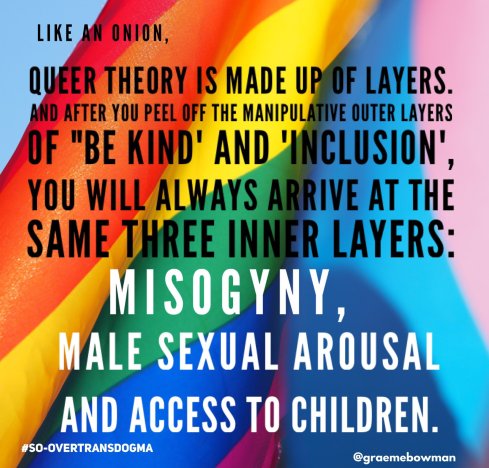
Be suspicious of everthing past the LGB in the LGBTQIA+ acronym, because the “+” sign does some very heavy, very questionable, lifting.
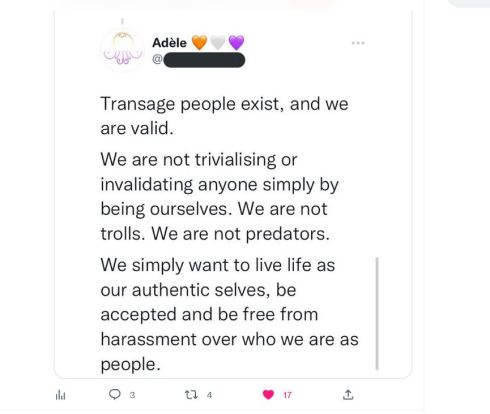
So remember folks:











 bleatmop
 Mystro
 The Arbourist


 Dead Wild Roses
Your opinions…