
You are currently browsing the monthly archive for November 2025.
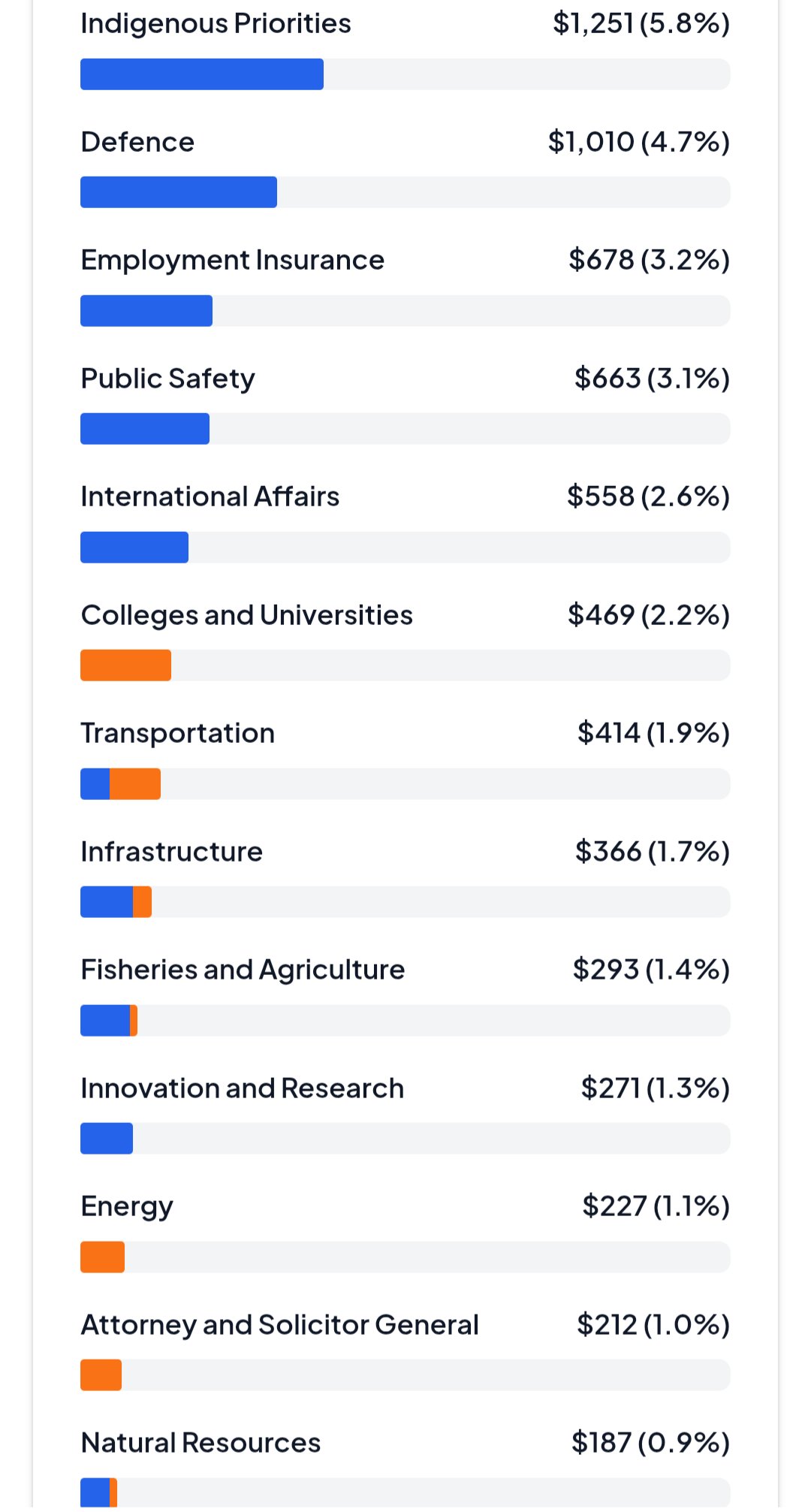
Canada’s federal budget tells a story that few seem willing to read critically. According to CanadaSpends.com, Ottawa allocates $1.251 billion—5.8 percent of the budget—to “Indigenous Priorities,” eclipsing even Defence ($1.010 billion, 4.7 percent). The arithmetic alone invites scrutiny. At what point does reconciliation become a fiscal reflex, untethered from measurable outcomes?
The Arithmetic of Imbalance
Consider a simple exercise in opportunity cost. Halving “Indigenous Priorities” to $625.5 million would free an equal amount—$625.5 million—for redeployment elsewhere. Redirecting that sum to Public Safety, currently $663 million (3.1 percent), would nearly double its capacity to $1.288 billion. The outcome: stronger policing resources, reinforced border security, and potentially measurable reductions in crime—objectives grounded in deterrence rather than symbolism.
This is not an argument against Indigenous advancement. It is an argument for proportionality and accountability. “Indigenous Priorities” now consume more than Employment Insurance ($678 million), International Affairs ($558 million), and Colleges and Universities ($469 million) combined. Defence, tasked with national sovereignty, trails by $241 million. When cultural or consultative programs eclipse citizen security and education, something in our fiscal compass is misaligned.
The Accountability Deficit
Proponents will cite historical redress, and that moral claim has force. But truth in budgeting requires evidence, not sentiment. Where are the audited outcomes showing that each billion spent yields measurable gains in Indigenous health, education, or economic independence?
The problem is not merely bureaucratic inertia—it is structural opacity, worsened by political choice. In December 2015, the newly elected Liberal government suspended enforcement of the First Nations Financial Transparency Act, which had required Indigenous governments to publish audited financial statements and leadership salaries. The minister at the time, Carolyn Bennett, directed her department to “cease all discretionary compliance measures” and reinstated funding to communities that refused disclosure.
In effect, Ottawa dismantled the only system ensuring public visibility into how billions of tax dollars are spent. Nearly a decade later, the Auditor General’s 2025 report found “unsatisfactory progress” on more than half of all Indigenous-services audit recommendations, despite an 84 percent increase in program spending since 2019. The data are undeniable: accountability has eroded even as expenditures have soared.
Fiscal Compassion, Not Fiscal Indulgence
Canada does not need less compassion; it needs measurable compassion—spending that demonstrably improves lives rather than perpetuates dependency. Halving the current Indigenous Priorities budget would not abolish support or reverse reconciliation. It would introduce accountability, allowing funds to be reallocated to public safety, infrastructure, or innovation—areas with immediate and empirically verifiable benefits.
Until Indigenous programs are evaluated with the same rigour applied to defence, education, or social insurance, billion-dollar gestures will remain ends in themselves—virtue without verification.
References
- CanadaSpends.com – Federal Tax Visualizer
- Government of Canada Statement on the First Nations Financial Transparency Act (2015)
- Office of the Auditor General of Canada, 2025 Report – Programs for First Nations
- Canadian Affairs News – Poll: Canadians Want Transparency in First Nations Finances (2025)
- Standing Committee Appearance: Supplementary Estimates (2024)
- Crown-Indigenous Relations and Northern Affairs Canada 2023–24 Results Report
Alberta’s education system is at a breaking point. As more than 51,000 teachers strike across the province over oversized classrooms, the battle over class-size caps, staffing levels, and funding formulas has erupted into a full-blown crisis. With reports of classes swelling into the 30s and even 40s—and with the province no longer publishing detailed class-size data—the dispute between the Alberta Teachers’ Association (ATA) and the Government of Alberta has become a referendum on whether quality learning can survive without clearer metrics, stricter rules, and targeted investments. This analysis examines the facts, details each side’s proposals, and steelmans both perspectives so readers can decide where the truth lies.
A Classroom Crisis or Budgetary Reality?
On October 6, 2025, teachers across Alberta walked out, declaring that the province’s classrooms have become “untenable.” The ATA’s strike action followed a decisive 89.5% rejection of the government’s offer—a signal of deep discontent.
(Source: Shootin’ the Breeze)
The core issues are class size, student complexity, and resource allocation. Teachers report classes of 30–40 students, rising numbers of high-needs children, and too few educational assistants or supports.
(Source: Learning Success Blog)
The government, meanwhile, stresses budget restraint, local flexibility, and warns that province-wide class caps would impose unsustainable costs.
What Do the Facts Reveal?
Data Transparency:
Until 2019, the province published annual class-size data for schools. In 2019, the current government ended that practice—making it difficult to establish accurate, province-wide numbers.
(Source: Braceworks)
Reported Trends:
An ATA survey found that 72% of Albertans believe class sizes are “too big,” while only 20% think they are “about right.”
(Source: ATA News)
Nearly 40% of teachers say their largest class has between 30 and 40 students; some exceed 40.
Funding and Growth:
In 2020, Alberta shifted to a three-year weighted moving average (WMA) for per-student funding. This was meant to stabilize budgets, but schools in fast-growing regions argue it made it harder to keep pace with enrollment increases.
(Source: Braceworks)
Together, these factors—rising enrollment, slower hiring, and more complex student needs—created the “classroom crisis” the ATA describes.
The ATA’s Position (Steelmanned)
- Binding Class-Size Caps:
The ATA calls for enforceable limits—especially smaller classes in early grades and high-needs classrooms. Oversized classes, they argue, reduce individualized feedback and classroom management capacity. - Staffing and Support for Complexity:
The ATA emphasizes that class composition matters as much as headcount. Classrooms with several students requiring individualized plans or behavioural supports demand additional staffing. - Funding to Hire 5,000+ Teachers:
To meet the province’s 2003 class-size recommendations, Alberta would need over 5,000 more teachers.
(Source: Swift News) - Quality of Learning:
The ATA contends this is not about wages—it’s about ensuring conditions where teachers can teach and students can learn.
In summary:
The ATA’s strongest case is that Alberta’s classrooms are objectively too large and complex for effective instruction, and only binding standards—backed by resources—can restore educational quality.
The Government’s Position (Steelmanned)
- Fiscal Responsibility:
The government argues that rigid caps would cost billions and force trade-offs with other priorities such as facilities and technology. - Local Flexibility:
Because school boards face different realities—urban crowding versus rural under-enrollment—the government says decisions should remain local, not imposed from Edmonton. - Targeted Investments, Not Blanket Caps:
The province has proposed hiring 3,000 teachers and 1,500 educational assistants over three years to focus on high-need areas, calling this a “strategic” alternative to universal caps.
(Source: CityNews Edmonton) - Continuity of Schooling:
The government invoked back-to-work legislation, arguing that prolonged strikes risk irreparable harm to students.
In summary:
The government’s steelmanned position is that it’s acting responsibly—preserving local flexibility, fiscal discipline, and stability while still targeting the worst pressure points.
What the Evidence Suggests
The educational research is nuanced:
- Smaller classes, especially in early grades, improve academic outcomes and behavioural management. (See: Project STAR, Krueger 2002)
- Benefits decline as grades rise or when teacher quality is not addressed simultaneously.
- Blanket reductions are expensive; targeted reductions often deliver higher returns per dollar.
Applied to Alberta:
The province may achieve the best results by targeting early-years and complex-needs classrooms, rather than imposing uniform caps across all grades. The evidence supports smaller classes where they matter most, not necessarily everywhere.
Where the Facts Should Lead Public Judgment
- Demand Transparency:
Reinstate province-wide class-size reporting so both government and ATA claims can be verified. - Target Early Grades and Complex Classes:
Evidence shows these investments yield the highest payoff. - Acknowledge Trade-offs:
Caps and hiring increases require billions in funding—citizens deserve clear accounting of costs and benefits. - Negotiate in Good Faith:
Both sides have legitimate claims: teachers on workload, government on fiscal prudence. A transparent mediation process focused on data—not ideology—would best serve students.
Final Thoughts
This strike is not just about teacher pay. It’s about the structure of public education itself—what class sizes are acceptable, how complexity is managed, and how Alberta balances fiscal discipline with classroom realities.
If your priority is student-centered learning and teacher retention, the ATA’s demand for enforceable caps has merit. If your focus is fiscal sustainability and flexibility, the government’s caution makes sense.
Either way, the solution must begin with facts: transparent class-size data, verifiable outcomes, and evidence-based reforms that put students first.

References
- Alberta Teachers’ Association – Class size issues top of mind for Albertans
- Learning Success Blog – Alberta’s 51,000 Teachers Strike Over Classroom Crisis as Class Sizes Hit 40 Students
- Braceworks – Alberta stopped tracking class sizes. Then it changed its funding formula. Now, it’s a teachers’ strike issue.
- Shootin’ the Breeze – Alberta teachers vote 95% for strike over wages and class sizes
- CityNews Calgary – Overcrowding in spotlight ahead of possible Alberta teachers strike
- Swift News – ATA Wants More Than 5,000 New Teachers To Meet Class-Size Recommendations

I’ve summarized the article here.
In challenging the prevailing narrative of unmitigated harm in Canada’s residential schools, Michelle Stirling scrutinizes Phyllis Webstad’s story, the inspiration behind Orange Shirt Day. Webstad boarded at St. Joseph’s in 1973, a facility under federal oversight where she attended public school alongside local children, not a cloistered religious institution. Stirling points out the absence of Catholic nuns in daily operations by that time, with Indigenous staff predominant, and questions the portrayal of familial abandonment on the Dog Creek Reserve amid documented violence, suggesting her placement served as a safeguard rather than an act of cultural erasure.
Vivian Ketchum’s recollection of being removed at age five to the Presbyterian-run Cecilia Jeffrey school is similarly contextualized as a welfare intervention, particularly against the backdrop of tuberculosis ravaging her community, which left her with lung scars. Stirling dismantles media distortions, such as those in “The Secret Path,” which erroneously inject Catholic elements into a Presbyterian setting, while citing Robert MacBain’s compilation of affirmative student letters that refute widespread abuse claims and highlight the school’s role as a refuge from dire home conditions.
Stirling ultimately cautions against the pitfalls of relying on childhood memories in legal compensation processes, where leading questions can shape recollections, and contrasts dominant tales with positive accounts like Lena Paul’s depiction of the school as a haven from familial turmoil. By exposing fabrications in works like the “Sugarcane” documentary, the article advocates for a balanced historical lens that prioritizes verifiable facts over emotive victimhood, fostering genuine reconciliation free from manipulated animosity.











 bleatmop
 Mystro


 Dead Wild Roses
Your opinions…