
A free society is not composed of isolated individuals on one side and government on the other. If those are the only two poles we recognize, every social problem eventually collapses into either a private burden or a state responsibility.
Civil society is the layer of life in between.
It is the network of families, friendships, churches, charities, clubs, unions, schools, neighbourhood groups, sports leagues, choirs, professional associations, volunteer organizations, and local institutions where people learn to live together without being commanded by the state. It is made of membership, duty, custom, trust, persuasion, service, affection, and shared purpose.
Alexis de Tocqueville noticed this in 19th-century America. What impressed him was not only the formal machinery of democracy, but the habit of association: citizens forming groups, solving problems, organizing locally, and learning self-government by practicing it together. Civil society is where that kind of habit is formed.
Civil society is not the same thing as government. Government works through law, taxation, regulation, courts, policing, public administration, and public authority. These are necessary. A society without courts, contracts, law enforcement, or public order will not remain free for long. But government is a blunt instrument compared with the dense human relationships that make ordinary life livable.
The state can punish theft, enforce contracts, provide services, and regulate conduct. It cannot easily make people neighbourly. It cannot manufacture trust by decree. It cannot replace every family, friendship, congregation, team, club, charity, and local association without becoming too large, too intrusive, and too impersonal.
Civil society is also not the same thing as the market. Markets matter because they allow people to cooperate through work, trade, investment, risk, and voluntary exchange. But not every human relationship is commercial. Friends are not customers. Children are not products. Neighbours are not merely service providers. Communities need loyalties and obligations that cannot be reduced to money.
That is where civil society does its work.
A person who joins a choir, coaches a team, volunteers at a food bank, serves on a board, visits a shut-in, helps with a fundraiser, mentors a young worker, or checks on an elderly neighbour is doing something socially important even if it does not look political. These acts create habits that no statute can simply summon into existence: patience, reciprocity, responsibility, compromise, forgiveness, and care for people beyond the self.
This is why civil society matters to a classically liberal society. Rights protect the individual from coercion, but rights alone do not teach people how to live well with one another. Law sets boundaries, but it cannot provide every form of belonging. Markets create prosperity, but they cannot provide every form of meaning. A free society needs people who can do more than assert rights, obey rules, and make transactions. It needs citizens who can join, serve, trust, repair, and keep showing up.
None of this means civil society is perfect. Families can fail. Churches can fail. Schools can fail. Charities can fail. Local communities can become narrow, unfair, stagnant, or cruel. Voluntary institutions are made of human beings, and human beings bring their faults with them.
Sometimes government intervention is necessary. Sometimes civil society is too weak, too captured, too exclusionary, or too absent to meet a real need. A serious defence of civil society does not require pretending otherwise.
But the alternative to imperfect civil society is not perfection. It is usually a colder society with fewer places to belong and more pressure on the state to fill the gaps. When families weaken, churches empty, local associations fade, and neighbours stop knowing one another, people do not float freely into greater autonomy. They often become more isolated, and isolated people tend to look upward for help, meaning, protection, and recognition.
That is how the state grows downward into more areas of ordinary life. Some of that growth may answer real suffering, but something is lost when every human need becomes a public program and every social failure becomes an administrative problem.
Civil society is slower than bureaucracy and less efficient than a spreadsheet, but it is far more human. It is where trust becomes real because people have to practice it: meeting, disagreeing, disappointing one another, forgiving one another, organizing, compromising, and trying again.
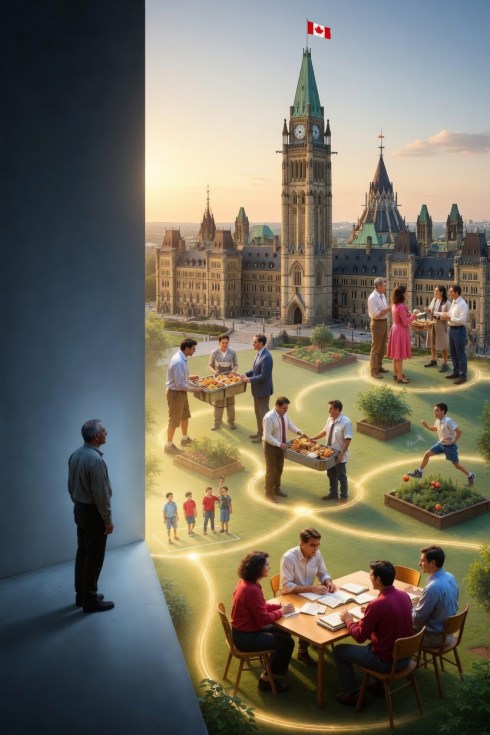
“Civil society: the human layer between the individual and the state. Where trust is practiced, communities form, and freedom becomes livable.”
In summary, civil society is the layer of voluntary life between the individual and the state. It is made of the relationships, institutions, duties, and habits that allow people to cooperate without constant government command.
It does not replace law. It does not replace markets. It does not replace individual rights.
It makes them livable.
A free society cannot survive as only individuals and government. It needs the institutions in between.











 bleatmop
 Mystro


 Dead Wild Roses
Leave a comment
Comments feed for this article