
“You typed it. Someone lived it.”
That is the ominous opening of an Edmonton Police Service campaign encouraging residents to report “online hate.” Perhaps this means threats, criminal harassment, incitement to violence or the wilful promotion of hatred—all matters in which the police may have a legitimate role.
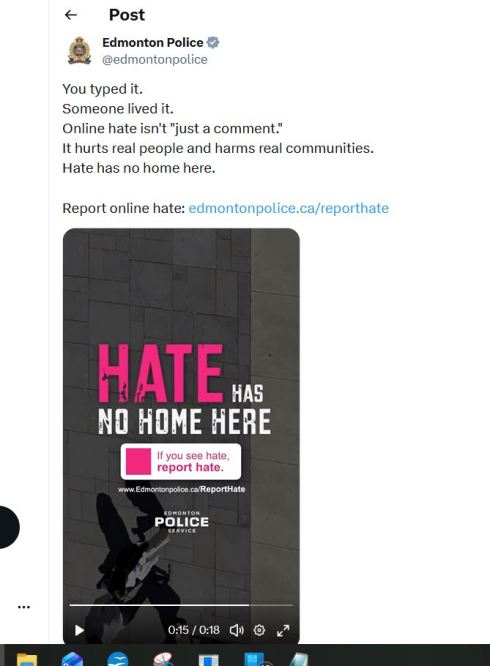
Follow the link, however, and the mandate becomes considerably broader.
EPS defines a “hate-motivated incident” as a non-criminal action motivated by bias, prejudice or hate. Its examples include insults, offensive jokes, slurs and racial comments. Reports receive a police file number, are reviewed by Hate Crime investigators and may result in contact from an investigator.
In other words, Edmonton police are inviting citizens to report one another for speech that the police themselves acknowledge may be entirely lawful.
There is a reasonable argument for recording certain non-criminal incidents. A slur painted on someone’s fence may precede vandalism or violence. A pattern of escalating behaviour may help police assess a later threat. Victims may also need information about services even when no charge is possible.
But those limited purposes do not justify a public campaign that deliberately blurs the boundary between crime and offence.
Canadian law sets a demanding threshold for criminal hate speech. Public incitement must be likely to cause a breach of the peace, while wilful promotion requires more than an ugly opinion or an offensive joke. The Supreme Court has described the legal definition of hatred as an “onerous and objective standard.” That high threshold exists because freedom of expression means very little if it protects only speech that authorities consider kind, constructive or socially beneficial.
“Hate has no home here” may be a civic aspiration, but it is not a legal standard. Hurt is real, yet hurt alone does not confer police jurisdiction.
When police encourage reports of lawful expression, they place the weight of the state behind ordinary social and political disputes. The resulting file may never produce a charge, but the knowledge that a joke, argument or unpopular opinion can reach a Hate Crime investigator is itself capable of chilling speech.
EPS should vigorously investigate threats, harassment, vandalism and criminal hate propaganda. It should also tell citizens clearly when reported conduct is not a police matter.
A free society must leave room for speech that is stupid, cruel and offensive. Such speech can be answered, condemned or ignored. It should not automatically become an entry in a police database.
The police exist to enforce the law—not to supervise Edmonton’s emotional climate.
References
- Edmonton Police Service, “Report a Hate Motivated Incident Online”:
https://www.edmontonpolice.ca/ContactEPS/ReportAHateMotivatedIncidentOnline - Edmonton Police Service, “Hate and Bias Crime”:
https://www.edmontonpolice.ca/CommunityPolicing/OrganizedCrime/HateBiasCrime - Criminal Code, section 319:
https://laws-lois.justice.gc.ca/eng/acts/c-46/section-319.html - Supreme Court of Canada, Hansman v. Neufeld, 2023 SCC 14:
https://decisions.scc-csc.ca/scc-csc/scc-csc/en/item/19911/index.do











 bleatmop
 Mystro


 Dead Wild Roses
Leave a comment
Comments feed for this article