
You are currently browsing The Arbourist’s articles.
Critical theory, as articulated by James Lindsay and rooted in the Frankfurt School’s intellectual project, forms the corrosive core of contemporary “woke” ideology. At its heart, it is not a constructive framework for social improvement but a methodological commitment to negation. Its aim is not to diagnose specific problems and propose reforms, but to discredit existing social arrangements by measuring them against an imagined standard of perfection that its own architects say cannot be positively described.
This orientation traces back to Max Horkheimer’s 1937 essay Traditional and Critical Theory. Traditional theory, he argued—drawing from the natural sciences and classical philosophies—engages with observable reality and grapples with the inevitable trade-offs embedded in human life. Critical theory rejects this approach. It evaluates the real world not against empirical evidence or feasible alternatives, but against a speculative ideal that can never be fully articulated, let alone realized. In 1969, Horkheimer reaffirmed this openly: because the ideal society cannot be conceptualized in existing terms, the only available activity is relentless critique of whatever exists. In effect, the real world is condemned for being real.
This negative idealism weaponizes the gap between the actual and the imaginary. Real societies, by necessity, require trade-offs: freedom of speech permits offensive speech; environmental protection imposes economic and temporal costs; social order requires rules, hierarchies of competence, and constraints on behavior. Critical theory interprets these trade-offs not as inherent features of human life but as intolerable flaws. It provides no functional replacement for what it seeks to dismantle. Instead, it declares that racism, class division, penal systems, borders, gender norms, or any designated “problematic” ought not to exist in the ideal world. Everything short of that unreachable ideal becomes proof of systemic oppression.
By measuring the real against an impossible standard, critical theory does not reform institutions—it erodes their legitimacy. It fosters perpetual grievance while strategically withholding any concrete alternative that could be scrutinized, tested, or judged by the same standards it applies to the world.
James Lindsay identifies three major historical ideologies that employ this same pattern of negative utopianism: communism, fascism, and political Islam. The claim is not that these movements are identical, but that they exhibit the same critical-theoretical structure:
- Communism imagines a stateless, classless society populated by “socialist man,” a type of human being who does not yet exist. Until such a person emerges, every tradition, institution, and authority is condemned as perpetuating exploitation.¹
- Fascism posits a perfectly ordered national or racial hierarchy unified around the mythic volk. Anything cosmopolitan, liberal, or “degenerate” is denounced as a betrayal of that utopian unity.²
- Political Islam (in its revolutionary form) imagines global submission to divine law. The present age is delegitimized as jahiliyyah—ignorance—and therefore unworthy of loyalty until the ideal community is imposed.³
In each case, the ideal is defined primarily by what it negates: capitalism, decadence, unbelief. And in each case, the historical results were catastrophic: gulags, war, genocide, theocratic oppression. The ideal was literally u-topian—“no place.”
Critical theory operates on precisely the same logic. Its power lies in inflaming resentment, undermining trust in existing institutions, and inducing a permanent revolutionary consciousness. It teaches adherents to view every tradition, norm, and hierarchy as illegitimate simply because it exists. It replaces trade-offs with absolutist moral demands, and flaws with indictments. It offers no blueprint for construction—only a sophisticated toolkit for deconstruction.
This is why contemporary “woke” politics behaves as it does. The endless denunciations of “systems,” “structures,” and “hegemonies”; the refusal to offer workable solutions; the moral absolutism; the perpetual expansion of grievance categories; the inability to articulate what a healthy society would look like—all reflect the same methodological negation that Horkheimer enshrined. It is criticism without end, and without responsibility.
Critical theory, in this sense, is not a path to reform but a program of societal disintegration. By demanding the impossible and attacking the real for failing to produce perfection, it generates only dissatisfaction, conflict, and institutional decay. The historical record is unambiguous: no system built on a negative utopia has ever produced anything but rubble.
To embrace critical theory is to wage war on reality under the banner of a perfection that cannot exist. That is why it must be understood clearly—and rejected root and branch.
Citations
Primary Critical Theory Sources
- Max Horkheimer, Traditional and Critical Theory (1937).
- Max Horkheimer, Critical Theory: Selected Essays (1969).
- Herbert Marcuse, One-Dimensional Man (1964).
- Jürgen Habermas, Knowledge and Human Interests (1968).
- Theodor W. Adorno, Negative Dialectics (1966).
Historical Ideology Sources
6. Karl Marx & Friedrich Engels, The German Ideology (1846); Critique of the Gotha Program (1875).
7. Benito Mussolini & Giovanni Gentile, The Doctrine of Fascism (1932).
8. Sayyid Qutb, Milestones (1964) — foundational for modern political Islam.
9. Ruhollah Khomeini, Islamic Government (1970).
Secondary Sources / Contemporary Analysis
10. James Lindsay, Cynical Theories (with Helen Pluckrose, 2020).
11. James Lindsay, The Marxification of Education (2023).
12. Roger Scruton, Fools, Frauds and Firebrands (2015).
13. Paul Gottfried, The Strange Death of Marxism (2005).
14. Mark Lilla, The Reckless Mind (2016).
15. John Gray, Black Mass: Apocalyptic Religion and the Death of Utopia (2007).

Glossary of Key Terms
Critical Theory – An ideological project originating with the Frankfurt School that critiques society against an impossible ideal rather than proposing practicable reforms.
Negative Idealism – Measuring reality against a utopia that cannot be articulated or realized.
Utopia – Literally “no place”; an imagined perfect society used as a moral weapon against the real world.
Hegemony – Antonio Gramsci’s concept of cultural dominance; used by CT to claim that norms and values are tools of oppression.
Structural Oppression – The assertion that unjust outcomes are produced by hidden systems rather than individual actions.
Standpoint Epistemology – The belief that knowledge is tied to identity; “lived experience” is epistemically privileged.
Praxis – Activism embedded into theory; in CT, the idea that theory must produce political action.
Reification – A Marxist term meaning the naturalization of social constructs; used to claim that institutions disguise power.
Signs You Are Encountering Critical Theory in Real Life
Here are the typical markers:
1. The language of systems and structures
Phrases like:
- “systemic oppression”
- “institutional racism”
- “hegemonic norms”
- “structures of privilege”
These shift blame from individuals to invisible systems.
2. Demands for perfect equity, not equality
If disparities alone are treated as dispositive evidence of injustice, CT is operating.
3. Appeals to lived experience as decisive evidence
Personal narrative is elevated above data or argument.
4. Moral asymmetry between groups
Some identities are framed as inherently oppressive; others as inherently oppressed.
5. Critique without end, without alternatives
If someone deconstructs everything but proposes nothing testable or concrete, it’s CT.
6. Rebranding ordinary conflict as oppression
If disagreement is treated as harm, and harm as violence, CT is at work.
7. The “if it exists, it’s oppressive” rule
Traditions, norms, meritocracy, law, biology—all treated as power structures.
How to Deal With Critical Theory in an Argument
Critical Theory arguments do not operate on normal rules of evidence or rational debate. Here’s how to engage effectively, calmly, and persuasively.
1. Reintroduce Trade-Offs
CT denies trade-offs. Bring them back.
“Every policy choice has costs—what trade-offs are you proposing in exchange for your solution?”
This forces concreteness.
2. Ask for Positive Alternatives
CT collapses when it must define what it wants.
“If the current system is oppressive, what specific system would you replace it with? How would it work in practice?”
Make them articulate the utopia in concrete terms. They rarely can.
3. Reject Claims Based Solely on Disparity
Demand causal reasoning.
“A disparity doesn’t automatically indicate discrimination. What evidence shows a causal link?”
This moves the debate from ideology to empiricism.
4. Expose Moral Asymmetry
Ask:
“Why are only some groups moralized? Do individuals still have agency?”
This undermines the oppressor/oppressed binary.
5. Clarify Definitions
CT thrives on shifting definitions.
Ask:
- “What do you mean by racism?”
- “How are you defining harm?”
- “What counts as violence?”
Pinning down definitions prevents concept-hopping.
6. Refuse Standpoint Epistemology
Challenge the epistemic claim:
“Lived experience matters, but it’s not a substitute for evidence. How can we verify your claim?”
This resets the terms of rational inquiry.
7. Separate Compassion From Ideology
Many people adopt CT-infused ideas because they want to be good.
Tell them:
“Your moral concern is admirable. CT is not the only—or even the best—way to address injustice.”
This opens space for alternatives and lowers defensiveness.
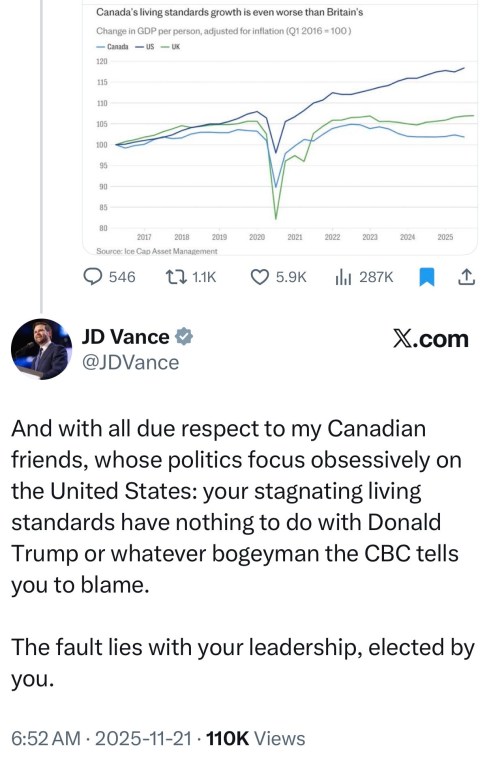
Canada finds itself at a crossroads. In recent years, per capita GDP growth has stalled, productivity remains sluggish, and housing, healthcare, and infrastructure face mounting pressure. These trends have prompted urgent debate about the causes of stagnation, ranging from global economic shifts and demographic aging to domestic policy decisions. Among commentators, JD Vance recently sparked attention with pointed critiques of Canada’s immigration policies and multicultural model, framing them as principal contributors to declining living standards. Beyond the immediate provocation, his intervention highlights a deeper question: how should Canadians assess responsibility for the state of their economy?
Immigration, Policy Choices, and Economic Outcomes
Canada’s foreign-born population now stands at approximately 23 percent, the highest in the G7, reflecting a sharp rise over the past decade. This increase was accelerated by post-pandemic labor shortages and policy decisions prioritizing high-volume admissions. While immigration is a crucial driver of population growth and labor supply, recent evidence indicates that integration has lagged, particularly for newcomers with credentials or skills mismatched to domestic demand. Unemployment rates among recent immigrants are approximately twice those of Canadian-born workers, and overall productivity growth has remained below historical trends.
These outcomes underscore a key point: while external factors including global commodity cycles, trade dynamics, and U.S. policy affect Canada’s economy, domestic decisions regarding immigration volume, infrastructure investment, and skills integration exert primary influence over living standards. The choice to expand immigration without simultaneously scaling capacity for integration, housing, and healthcare has consequences that voters ultimately authorize at the ballot box.
Stoic Lessons for Civic Responsibility
Confronted with these structural and policy realities, Canadians might feel tempted to externalize blame to markets, foreign governments, or pundits. Here, the Stoic philosophers offer timeless guidance. Marcus Aurelius wrote in his Meditations: “You have power over your mind—not outside events. Realize this, and you will find strength.” Epictetus similarly asserted: “It’s not what happens to you, but how you react to it that matters.” These principles demand that citizens distinguish between factors within their control and those beyond it, focusing energy on the former.
Stoicism is not a creed of passivity. It insists on rigorous self-examination and deliberate action. In Canada’s context, this means acknowledging the consequences of policy choices and recognizing that solutions—whether adjusting immigration strategy, improving integration programs, or investing in productivity-enhancing infrastructure—lie within domestic capacity.
Pathways to Renewal
Practical measures aligned with these principles include:
- Aligning immigration targets with absorptive capacity: Recent adjustments to temporary resident admissions, reducing projected numbers by approximately 43 percent, illustrate the potential for recalibration.
- Prioritizing skill-aligned integration: Investing in credential recognition, language training, and targeted labor placement can ensure that new arrivals contribute effectively to productivity.
- Strengthening domestic infrastructure and services: Housing, healthcare, and transportation require proportional investment to match demographic growth.
- Informed civic engagement: Voting with awareness of policy consequences is fundamental to maintaining democratic accountability and ensuring long-term economic stability.
By taking responsibility, Canadians act in accordance with Stoic precepts: focusing on what they can control rather than scapegoating external forces. The challenge is not merely economic—it is moral and civic. Prosperity depends as much on deliberate collective action as on external circumstance.
Conclusion
Canada’s stagnating living standards are the product of complex factors, yet domestic choices remain decisive. While commentary from external observers like JD Vance may provoke discomfort, the underlying lesson is clear: sovereignty entails responsibility, and agency begins at home. To confront stagnation, Canadians must embrace candid assessment of policy outcomes, deliberate reform, and disciplined civic engagement. In the words of Seneca: “We suffer more often in imagination than in reality.” Facing the realities we have constructed—and acting to improve them—is the first step toward renewal.
References
- Statistics Canada. Labour Force Survey, 2025. https://www150.statcan.gc.ca/n1/en/type/data
- Government of Canada. Immigration, Refugees and Citizenship Canada: Annual Report to Parliament on Immigration, 2024. https://www.canada.ca/en/immigration-refugees-citizenship/corporate/publications-manuals/annual-report-parliament-immigration.html
- Marcus Aurelius. Meditations. Trans. Gregory Hays, 2002.
- Epictetus. Enchiridion. Trans. Elizabeth Carter, 1758.
- Seneca. Letters from a Stoic. Trans. Robin Campbell, 2004.
Glossary
- Per Capita GDP: The average economic output per person, often used as a measure of living standards.
- Productivity: Output per unit of input; a key driver of sustainable economic growth.
- Integration Programs: Policies and services designed to help immigrants participate effectively in the labor market and society.
- Absorptive Capacity: The ability of a system (economy, infrastructure, institutions) to accommodate growth without adverse effects.
- Stoicism: Philosophical framework emphasizing rational control over one’s mind and actions rather than external circumstances.
See Jonathan Kay’s X thread on the queering of outdoor education.
The British Columbia Teachers’ Federation (BCTF) has introduced a framework termed “Queering Outdoor Education,” which integrates queer theory, drag pedagogy, and decolonial approaches into environmental learning. This curriculum comprises lessons that encourage students to interpret natural phenomena through the lens of fluid identities, anti-normative critique, and social justice. While the framework is promoted as fostering inclusivity and challenging colonial and heteronormative assumptions, it raises substantive concerns regarding developmental appropriateness, educational clarity, and the potential for early ideological enculturation.
Metaphor and Conceptual Instability
The initial lessons employ metaphor as a primary pedagogical tool. Students are encouraged to draw analogies between natural elements—such as clouds, logs, or plants—and human identities, emphasizing fluidity and anti-essentialist perspectives. While metaphor can be valuable in education, these lessons risk overextending conceptual abstraction, replacing concrete environmental observation with ideological instruction. For children, particularly in early or middle childhood, excessive abstraction can hinder cognitive development by conflating empirical phenomena with normative social and political constructs.
Additionally, the curriculum critiques conventional linguistic frames, including metaphors like “birds and the bees,” positioning them as instruments of colonial and heteronormative power. Such framing may introduce complex sociopolitical interpretations into contexts traditionally reserved for foundational biological and ecological learning, potentially overwhelming young learners.
Moralizing Nature and Identity
Subsequent lessons extend these metaphorical frameworks into moral and social instruction. Students are asked to emulate the perceived allyship of natural objects and to conceptualize human identities in terms of ecological hierarchies, categorizing queer identities as “native” and others as “invasive.” While intended to promote reflection on inclusion and belonging, these exercises risk essentializing human worth according to ideologically charged criteria, substituting experiential learning with prescriptive social norms. By conflating ecological systems with social hierarchies, the curriculum may foster confusion rather than ethical understanding, undermining both environmental literacy and social cohesion.
Sexualization and Performative Instruction
The later lessons introduce overtly sexualized and performative elements, including the celebration of non-reproductive animal behaviors and the incorporation of drag-based exercises into outdoor activities. While drag pedagogy emphasizes self-invention and challenges normative binaries, its application to children’s environmental education raises questions of age-appropriateness. Embedding explicit discussions of sexuality and performative gender in contexts intended to cultivate observation, curiosity, and engagement with nature may distract from core learning objectives and impose adult conceptual frameworks onto immature cognitive and moral development.
Implications for Pedagogy
The queering of outdoor education exemplifies a broader pedagogical tension between radical inclusivity and the developmental needs of children. Integrating complex adult theoretical frameworks into early environmental education risks destabilizing students’ conceptual understanding, substituting guided inquiry with ideological instruction. While well-intentioned, such approaches may inadvertently limit children’s capacity for independent exploration, critical reasoning, and unmediated interaction with the natural world. Educational practice promote the idea of equality, not equity, along with the preservation of developmental appropriateness and cognitive accessibility.

Glossary
- Queer Pedagogy: An educational approach that incorporates queer theory to challenge traditional assumptions about gender, sexuality, and identity.
- Drag Pedagogy: A subset of queer pedagogy emphasizing performance, self-invention, and the destabilization of normative social roles.
- Decolonial Education: Curriculum frameworks aimed at addressing and countering the legacies of colonialism, often by centering Indigenous perspectives.
- Anti-Normative Critique: A critical approach that questions conventional social, cultural, or gender norms.
- Cognitive Development: The mental growth and acquisition of knowledge, reasoning, and understanding in children.
- Ideological Enculturation: The process of instilling a particular worldview or set of political beliefs, often through education.
References
- British Columbia Teachers’ Federation. Queering Outdoor Education Newsletter. 2025.
- Lacandona, Gaia. Drag Pedagogy: Performance and Learning. 2018.
- Polukoshko, Jody. Queer and Decolonial Approaches to Outdoor Learning. BCTF publication, 2024.
- Sumara, Dennis. Alternative Pedagogies and Cognitive Development: A Critical Review. 2017.
Suggested Readings Critiquing Queer Pedagogy
- Lindsay, James & McEwen, Bob. Critical Pedagogy and the Limits of Ideological Education. 2021.
- Wood, Peter. The Manipulation of Youth: How Ideology Enters the Classroom. 2019.
- Scholes, Robert. Childhood, Ideology, and the Limits of Social Theory. 2018.
- Davies, Belinda. Rethinking Radical Curricula: Balancing Innovation with Developmental Appropriateness. 2020.
That time is coming again, folks. Winter is Coming, and with it the familiar mix of beauty, inconvenience, and the kind of treachery only an Alberta chinook can undo.
Pretty soon the sidewalk in front of your house — that narrow strip we all share — will turn into a skating rink unless we do something about it. The goal is simple: get it down to dry pavement so the mail carrier, the kids heading to school, the dog-walkers, and that older couple two doors down don’t end up on their backsides with a broken wrist.
I used to think the shopping-cart test revealed everything you needed to know about a person. Turns out shoveling your walk is the grown-up version, with higher stakes. Returning a cart is easy. Clearing a sidewalk when it’s minus twenty and your snow blower is coughing its last breath? That’s real work. And some of us simply can’t do it — age, injury, travel, money, life. Totally understood.
But for those of us who can, even a half hour with a shovel keeps the whole block safer and friendlier. It means the paramedics don’t have to haul someone away from in front of your house. It means Mrs. Henderson doesn’t have to tiptoe in the street because the sidewalk’s an ice sheet. It means we all get to live in a neighbourhood that quietly says: we look out for each other here.
So when the snow flies, let’s grab the shovel, clear our stretch, and—if you’ve got it in you—give the neighbour’s corner a quick pass if they’re away or hurting. Those small, extra gestures are what make winter survivable and community real.
Winter is Coming. Let’s not let it win—and let’s make our block somewhere worth walking.


*exhales slowly*… Riiiiiiiiight
The most devastating critique of expanded government economic power—whether advanced by the woke left or the postliberal right—rests not on the familiar warning that today’s weapon will be turned against us tomorrow, but on a deeper and more fundamental truth: government is constitutionally incapable of generating sustained abundance because it is always and everywhere a third-person economic actor. James Lindsay, building on Milton Friedman and Bob McEwen, distinguishes three categories of economic decision-making. First-person transactions occur when individuals spend their own money on their own needs; second-person transactions arise when either the money or the consumption belongs to someone else; third-person transactions, the exclusive domain of government, occur when an agent spends other people’s money on still other people’s needs. This final category produces a catastrophic double detachment from both cost and quality, rendering genuine wealth creation impossible no matter how noble the intention.
In first-person economics, the actor faces unrelenting pressure to balance cost against quality, efficiency against adequacy, and innovation against economy. Because the problem is his own and the resources are his own, he has every incentive to discover superior solutions and—under private property and profit—to scale those solutions for strangers whose problems he may not personally care about. The profit motive performs the miraculous feat of aligning naked self-interest with the systematic solving of dispersed human problems. Markets thus become discovery machines that generate exactly the surpluses society demands—no more, no less—while constantly punishing waste and rewarding improvement. Abundance emerges not from altruism but from an incentive structure that makes indifference compatible with service.
Government, by contrast, enters every economic arena as a pure third-person participant. Taxpayer funds are not its own, the services or goods it procures are not for its own consumption, and the bureaucrats or politicians who allocate resources face no personal bankruptcy for failure nor personal enrichment for success. Policy directives may demand “efficiency” or “innovation,” but these remain precatory slogans without the lash of loss or the lure of gain. The result is systemic waste, misallocation, and eventual stagnation. Historical episodes of apparent state-led productivity—Soviet industrialisation, Nazi rearmament, contemporary Chinese growth—prove the rule: they rely on forced mobilisation, suppressed consumption, and often plunder, and they collapse once the coercive surplus is exhausted and the misallocations compound.¹
The Chinese case, far from refuting the argument, illustrates its prescience. Beijing’s hybrid system permits profit only after political quotas are met and party loyalty is demonstrated. The resulting economy can indeed produce impressive physical output, yet it does so at the cost of collapsing total-factor productivity, ghost cities, and a property sector larger than the 1929 American bubble. Private entrepreneurs now husband cash and flee rather than invest, precisely because the third-person political actor can expropriate gains at will. What appears as hyperproductivity is in reality a sugar rush of debt and coercion, already giving way to the predictable hangover of a middle-income trap.²
The American founders understood that liberty and prosperity require strict limits on state economic power not merely to prevent tyranny but to preserve the only known incentive structure capable of producing general abundance. Proposals from Zohran Mkwana’s “no problem too small for government” socialism to JD Vance’s calls for state-directed “right-wing ends” share the same fatal flaw: they seek to achieve through third-person coercion what only first-person discovery coordinated by profit and price can deliver.³ Until the right grasps that government cannot be made to possess the correct incentives—any more than a square can be made circular—the allure of “using the state for our side” will continue to seduce and ultimately impoverish. True prosperity demands not a more muscular manager of the economy but the humbling recognition that no such manager can ever exist.
Endnotes
- Historical state-led cases: China, the USSR, and Nazi Germany achieved output spikes through coercion and consumption suppression, not sustainable productivity; each encountered severe misallocation and stagnation once coercive inputs were exhausted.
- China’s slowdown: China’s growth was driven by market liberalization (1978–2010) and reversed when political control tightened; falling TFP, capital flight, and overbuilding confirm the limits of state-led productivity.
- Incentive failure is structural: No ideological orientation can turn a bureaucracy into a profit-and-loss–disciplined discovery process; industrial policy without market discipline becomes third-person misallocation.

Glossary
First-person transaction: A situation where individuals spend their own money on their own needs.
Second-person transaction: A transaction where either the money or the consumption belongs to someone else.
Third-person transaction: When an agent (e.g., government) spends other people’s money on other people’s needs, lacking direct incentives for efficiency or quality.
Total-factor productivity (TFP): A measure of how efficiently an economy turns labor and capital into output.
Middle-income trap: When a developing country’s growth stalls after reaching middle-income status due to declining productivity and misallocation.
References
Foundational Economics & Productivity
- Solow, Robert. “Technical Change and the Aggregate Production Function.” Review of Economics and Statistics (1957).
https://doi.org/10.2307/1926047 - Baumol, William. The Cost Disease: Why Computers Get Cheaper and Health Care Doesn’t. Yale University Press (2012).
https://yalebooks.yale.edu/book/9780300179286/the-cost-disease/ - Gordon, Robert. The Rise and Fall of American Growth. Princeton University Press (2016).
https://press.princeton.edu/books/hardcover/9780691147727/the-rise-and-fall-of-american-growth
State Capacity, Bureaucracy, and Incentives
- Tullock, Gordon. The Politics of Bureaucracy. Public Affairs Press (1965).
https://oll.libertyfund.org/title/tullock-bureaucracy - Niskanen, William. Bureaucracy and Representative Government. Aldine-Atherton (1971).
https://www.cato.org/books/bureaucracy-representative-government - Hayek, F.A. “The Use of Knowledge in Society.” American Economic Review (1945).
https://www.econlib.org/library/Essays/hykKnw.html
Industrial Policy & Development Economics
- Rodrik, Dani. “Industrial Policy for the Twenty-First Century.” Harvard University (2004).
https://drodrik.scholar.harvard.edu/files/dani-rodrik/files/industrial-policy-twenty-first-century.pdf - Amsden, Alice. Asia’s Next Giant: South Korea and Late Industrialization. Oxford University Press (1989).
https://global.oup.com/academic/product/asias-next-giant-9780195076035 - Wade, Robert. Governing the Market: Economic Theory and the Role of Government in East Asian Industrialization. Princeton University Press (2003).
https://press.princeton.edu/books/paperback/9780691117294/governing-the-market
China’s Growth and Slowdown
- Brandt, Loren; Van Biesebroeck, Johannes; Zhang, Yifan. “Creative Accounting or Creative Destruction? Firm-Level Productivity Growth in Chinese Manufacturing.” Journal of Development Economics (2012).
https://doi.org/10.1016/j.jdeveco.2012.02.001 - Pritchett, Lant & Summers, Lawrence. “Asiaphoria Meets Regression to the Mean.” NBER Working Paper No. 20573 (2014).
https://www.nber.org/papers/w20573
Nordic Economies & Welfare States
- Bergh, Andreas & Henrekson, Magnus. Government Size and Implications for Economic Growth. AEI Press (2011).
https://www.aei.org/research-products/book/government-size-and-implications-for-economic-growth/ - OECD Data on Nordic Economies.
https://data.oecd.org/
Market Failure, Government Failure, Incentives
- Coase, Ronald. “The Problem of Social Cost.” Journal of Law and Economics (1960).
https://www.jstor.org/stable/724810 - Kirzner, Israel. Competition and Entrepreneurship. University of Chicago Press (1973).
https://press.uchicago.edu/ucp/books/book/chicago/C/bo5972460.html
Technology, Innovation & Productivity Slowdown
- Bloom, Nicholas et al. “Are Ideas Getting Harder to Find?” American Economic Review (2020).
https://www.aeaweb.org/articles?id=10.1257/aer.20180338











 bleatmop
 Mystro
 The Arbourist


 Dead Wild Roses
Your opinions…