
You are currently browsing The Arbourist’s articles.
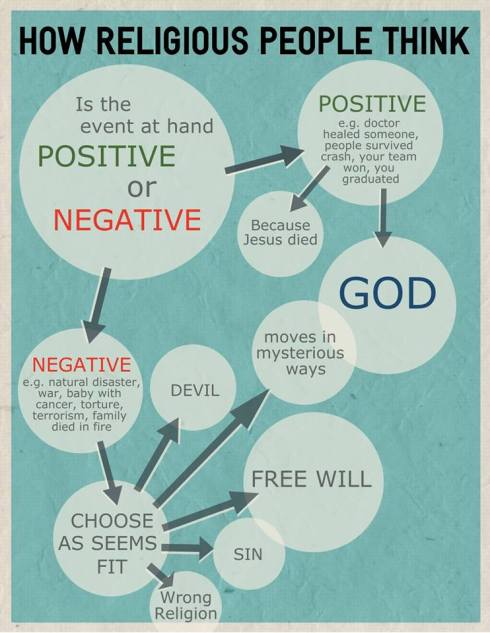
Your handy-dandy guide to religious reasoning…
We’ve had a few pieces on the disconnect between the public and the political process. This essay by Richard D. Wolff looks to answering the question why, despite there being two different political parties in the US, that the overall arc of the US body politic maintains the same general direction.
“In short, “democracy” has been applied to societies whose political/residential sphere was at least formally democratic but whose economic sphere was decidedly not.
The ideological rigidity of most brands of anti-statism across US history served nicely to keep the focus forever on state/public versus individual/private in thinking and acting about social change. Democracy was redefined in practical terms as the liberty of the individual/private from the intrusion of the state/public. The democratic quality of the individual/private enterprise – the central structure of the economy – was exempted from analysis or even from view in terms of its structural incompatibility with democracy. Legalistic equations of capitalist corporations with individual personhood also helped to distract attention away from the undemocratic structure of the corporation. Likewise, the US government’s commitment to a “democratic foreign policy” fostered the reproduction elsewhere of the same undemocratic economic structure that characterized the US.
The right wing of US politics has long understood and responded to social movements for equality and democracy as threats to capitalism. Its leaders built their coalitions by working to mobilize public opinion against those movements as threats to the “American way of life.” It built its ideology on the notion that democracy meant a state kept from intruding on the lives and activities of persons and enterprises rendered as equivalently “individuals.” Equality to them meant equality of opportunity, not outcomes: and then only if opportunity was strictly disconnected from the wealth, income and social position each individual was born into.
The left wing of US politics has always tried hard to sustain the notion that capitalism was not only compatible with egalitarianism and democracy. It would also be strengthened, not threatened, by moving capitalist society closer to equality and democracy. In practical terms it contested against the right wing by insisting that the mass of people – the workers in capitalist enterprises – would become disaffected from and disloyal to capitalism if it indulged its anti-egalitarian and anti-democratic tendencies. Capitalism, it argued and argues, will be strengthened not threatened by less inequality and more democracy.
Both left and right – and their expressions in the leaderships of the Republican and Democratic Parties – live in fear, conscious or otherwise, that the mass of people, the working class, will become disaffected from capitalism. “Populist” is the currently popular epithet that expresses this fear. Both parties contest for the support of the leaders of capitalism – major shareholders and the corporate boards of directors they select – by offering their alternative strategies for avoiding, controlling, or safely channeling mass disaffection with capitalism.”
Want to know moar, citizen? Check out Manufacturing Consent by Noam Chomsky.
Women’s Day has come around again. Let’s focus on the material conditions that inhibit the flourishing of women. A huge thank you to those women who have stepped up and are being seen in society thus providing the path for others to follow. Concomitantly, thanks to those who have chosen to take paths the patriarchy denies light to, but are vitally contributing to the well being of society and future generations.
I am a big fan of raunchel’s musings. Her writing is adroit, prescient, and incisive. A small sample highlights teh awesome:
“Because if there is one thing that a woman isn’t allowed to be in our society, it’s different. We aren’t allowed to be individuals, we only are part of a group. And we need this group, we have to be with others, to have a measure of safety. Alone, we’re vulnerable. Of course, in a group, with others, we’re still vulnerable, but less so. This means that it is vital to be part of a group. And to be part of a group, we have to be like the others.
Unfortunately, we live in a world where there are many pressures on women. All of society has expectations for us, and every deviation thereof means that we have to be punished. This punishment often is exclusion. We are expected to be silent, to be meek, to be a thousand things. But none of those things are being strong, being ambitious, or just being yourself.
This is why women often refuse to take the centre stage. Not only have we been taught since they were little girls that they should be silent, but they also know that if they do, they are excluded. They basically become un-persons, and even associating with them brings the same social punishment.
The reason why this is so strongly enforced is very simple. Nothing is as undermining to patriarchy as a woman who actually achieves something.”
–
Finite area but infinite perimeter? What magic is this?
In case you were unfamiliar. :)
Some historical context By Tom Englehardt showing the lead up to the bright and cheery future we now inhabit.
“In the end, those seeds, first planted in Afghan and Pakistani soil in 1979, led to the attacks of September 11, 2001. That day was the very definition of chaos brought to the imperial heartland, and spurred the emergence of a new, post-Constitutional governing structure, through the expansion of the national security state to monumental proportions and a staggering version of imperial overreach. On the basis of the supposed need to keep Americans safe from terrorism (and essentially nothing else), the national security state would balloon into a dominant — and dominantly funded — set of institutions at the heart of American political life (without which, rest assured, FBI Director James Comey’s public interventions in an American election would have been inconceivable). In these years, that state-within-a-state became the unofficial fourth branch of government, at a moment when two of the others — Congress and the courts, or at least the Supreme Court — were faltering.
The 9/11 attacks also unleashed the Bush administration’s stunningly ambitious, ultimately disastrous Global War on Terror, and over-the-top fantasies about establishing a military-enforced Pax Americana, first in the Middle East and then perhaps globally. They also unleashed its wars in Afghanistan and Iraq, the U.S. drone assassination program across significant parts of the planet, the building of an unprecedented global surveillance state, the spread of a kind of secrecy so all-encompassing that much of government activity became unknowable to “the People,” and a kind of imperial overreach that sent literally trillions of dollars (often via warrior corporations) tumbling into the abyss. All of these were chaos-creating factors.
At the same time, the basic needs of many Americans went increasingly unattended, of those at least who weren’t part of a Gilded Age 1% sucking up American wealth in an extraordinary fashion. The one-percenters then repurposed some of those trickle-up funds for the buying and selling of politicians, again in an atmosphere of remarkable secrecy. (It was often impossible to know who had given money to whom for what.) In turn, that stream of Supreme Court-approved funds changed the nature of, and perhaps the very idea of, what an election was.
Meanwhile, parts of the heartland were being hollowed out, while — even as the military continued to produce trillion-dollar boondoggle weapons systems — the country’s inadequately funded infrastructure began to crumble in a way that once would have been inconceivable. Similarly, the non-security-state part of the government — Congress in particular — began to falter and wither. Meanwhile, one of the country’s two great political parties launched a scorched-earth campaign against governing representatives of the other and against the very idea of governing in a reasonably democratic fashion or getting much of anything done at all. At the same time, that party shattered into disorderly, competing factions that grew ever more extreme and produced what is likely to become a unique celebrity presidency of chaos.
The United States with all its wealth and power is, of course, hardly an Afghanistan or a Libya or a Yemen or a Somalia. It still remains a genuinely great power, and one with remarkable resources to wield and fall back on. Nonetheless, the recent election offered striking evidence that the empire of chaos had indeed made the trip homeward. It’s now with us big time, all the time. Get used to it.”
Something something reaping…and sowing et cetera. :/











 bleatmop
 Mystro


 Dead Wild Roses
Your opinions…