
You are currently browsing The Arbourist’s articles.
Confused? So is the rest of the rational world. :)

 Too long it has been, since a gaming post graced DWR. The Battle Royal first person shooter game PlayerUnknown’s Battleground (PUBG), still in early access, has made its way on to my gaming list.
First and foremost, like all early access games, there is a dire need for optimization and stability as frame rate and connectivity to the game servers can sometimes be quite questionable. When things are going great though, watch out, this is one of the games in which you say to yourself, ‘Okay, just one more before bed…’ and then suddenly it is 4am.
The concept is quite simple. I’ll let Wikipedia do the talking:
“The game is based on battle royal-style game mods previously developed by Brendan “PlayerUnknown” Greene for other games, but expanded into one standalone game under Greene’s creative direction. In the game, up to one hundred players parachute onto an island and scavenge for weapons and equipment to kill others while avoiding getting killed themselves. The available safe area of the game’s world decreases in size over a match, directing surviving players into tighter areas and forcing encounters. The last player or team standing wins the round.”
And that’s it. Throw 100 avatars onto a 8km island and see who comes out the winner. It is the chaos that comes with each round that brings me, and others back again and again. What makes the game so darn replayable is a series of risk/reward decisions must be made in every phase of the gaming experience.
Firstly, where does one jump out of the plane? Choosing a city or hamlet will increase your chances of getting the guns and gear you need to survive but then twelve other people have that exact same idea and are heading to the same area. So then it becomes a frantic race to see who can arm themselves first and have the advantage over their unarmed opponents, or do you go more out of the way, with less chance of the good loot, but also less people.
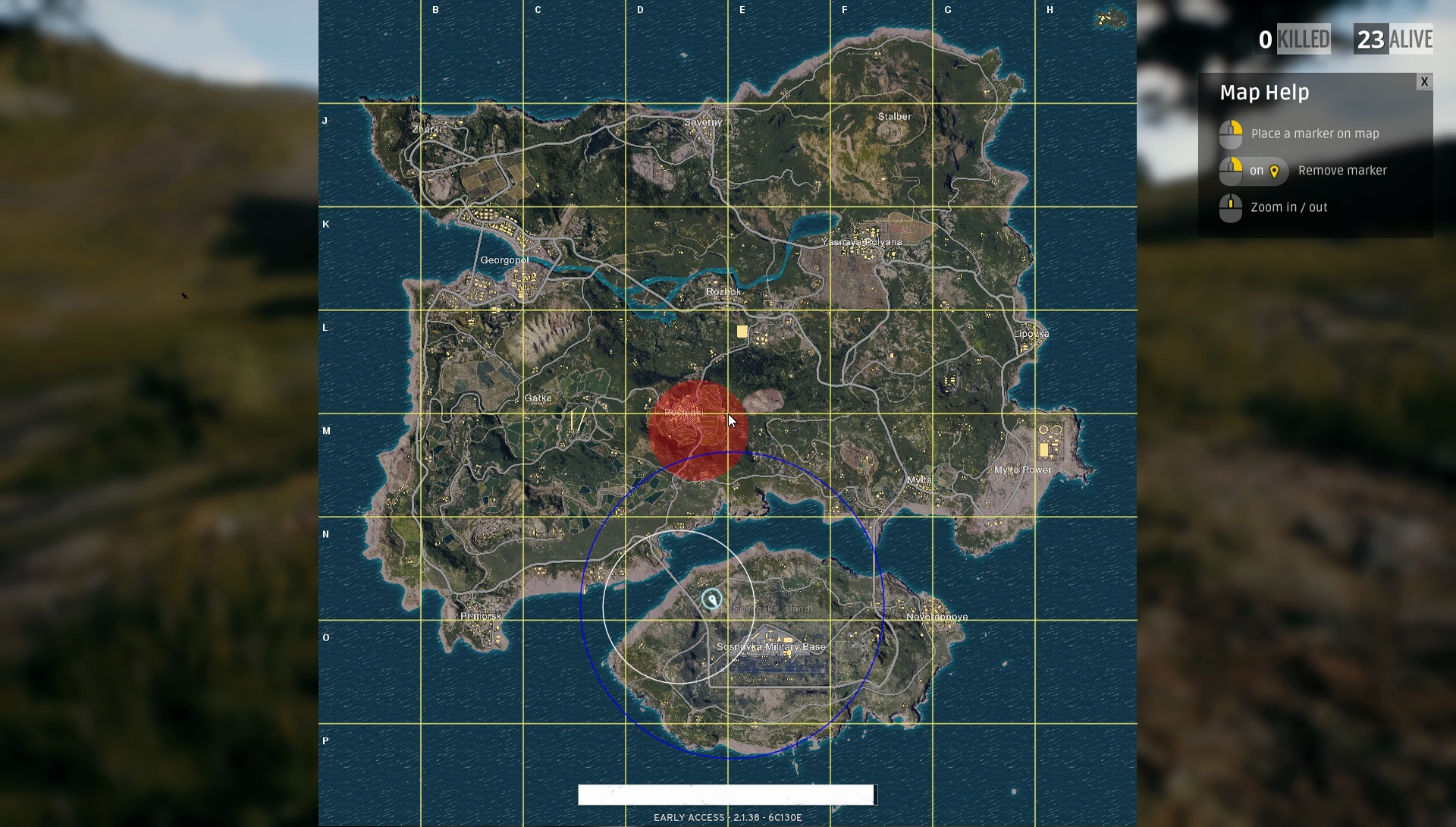 Secondly, layer on top of the loot vs people decisions, the geographical considerations involved in having a good run. The available playing area cordons off after five minutes, what happens is that a large circle appears randomly on the map and after some time an ominous blue forcefield slowly closes around that circle effectively shepherding the players into a new smaller playing area. Being far away from where the circle is drawn is never a good thing and forces you to make decisions that e often not tactically sound. Thus, dropping toward the middle of the island is generally a fairly good idea because you will never be too far away from the initial circle boundary.
Thirdly, add to the mix the randomness of the gear available; sometimes you just cannot find a scope, or enough ammunition, or armour and you have to make due with what is available.
Of course, on top of all these points is the fact that you are playing against people who will be as conniving and opportunistic as humanly possible as everyone is trying to win the match. You can bet your bottom dollar that people are lying in ambush waiting for the likes of unwary players who are not being careful. Every corner must be checked, wide open spaces avoided, tree lines inspected, ridges surveyed – because the bastards are out there and will unhelpfully remind you of their presence, and your misfortune, with gunfire.
PUBG allows the option of teaming up with either a squad of 2 or 4 people, the new caveat being that rather than dying outright when injured, members of your team can revive you if they get to you before you bleed out. Thus, more dynamics are added as then people tend to stick together and fight together leading to nasty 4 v 4 firefights and ambushes.
Playing this game has brought back some of the early pulse pounding experiences I’ve had with first person shooters when they first made their appearance on the market. Running that flag in Soldier of Fortune 2, or being the last team member alive in Counterstrike were all heart rate quickening good times. PUBG has brought those sorts of experiences back in a new setting that I’m finding most enjoyable.
Well, folks let me tell you, listening the the choral finale of Mahler 2 is inspiring, but singing it… Next level experience. We had the Calgary Youth Orchestra and 3 other choirs join my choir to tackle this monumental piece. Every chorister should have the opportunity to sing in this iconic musical experience.
Original German
Aufersteh’n, ja aufersteh’n
Wirst du, Mein Staub,
Nach kurzer Ruh’!
Unsterblich Leben! Unsterblich Leben
wird der dich rief dir geben!
Wieder aufzublüh’n wirst du gesät!
Der Herr der Ernte geht
und sammelt Garben
uns ein, die starben!
—Friedrich Klopstock
O glaube, mein Herz, o glaube:
Es geht dir nichts verloren!
Dein ist, ja dein, was du gesehnt!
Dein, was du geliebt,
Was du gestritten!
O glaube
Du wardst nicht umsonst geboren!
Hast nicht umsonst gelebt, gelitten!
Was entstanden ist
Das muss vergehen!
Was vergangen, auferstehen!
Hör’ auf zu beben!
Bereite dich zu leben!
O Schmerz! Du Alldurchdringer!
Dir bin ich entrungen!
O Tod! Du Allbezwinger!
Nun bist du bezwungen!
Mit Flügeln, die ich mir errungen,
In heißem Liebesstreben,
Werd’ ich entschweben
Zum Licht, zu dem kein Aug’ gedrungen!
Sterben werd’ ich, um zu leben!
Aufersteh’n, ja aufersteh’n
wirst du, mein Herz, in einem Nu!
Was du geschlagen
zu Gott wird es dich tragen!
—Gustav Mahler
In English
Rise again, yes, rise again,
Will you My dust,
After a brief rest!
Immortal life! Immortal life
Will He who called you, give you.
To bloom again were you sown!
The Lord of the harvest goes
And gathers in, like sheaves,
Us together, who died.
—Friedrich Klopstock
O believe, my heart, O believe:
Nothing to you is lost!
Yours is, yes yours, is what you desired
Yours, what you have loved
What you have fought for!
O believe,
You were not born for nothing!
Have not for nothing, lived, suffered!
What was created
Must perish,
What perished, rise again!
Cease from trembling!
Prepare yourself to live!
O Pain, You piercer of all things,
From you, I have been wrested!
O Death, You conqueror of all things,
Now, are you conquered!
With wings which I have won for myself,
In love’s fierce striving,
I shall soar upwards
To the light which no eye has penetrated!
Die shall I in order to live.
Rise again, yes, rise again,
Will you, my heart, in an instant!
That for which you suffered,
To God shall it carry you!
—Gustav Mahler
 :)
:)
The idea that spanking is somehow a valid parenting practice is disturbing enough. What is more troubling is that people who practice spanking are likely to justify it within their own moral framework and not change their views on the subject.
“To find answers, I looked at violence across cultures and history with my colleague Alan Fiske of the University of California, Los Angeles. We analyzed records of all kinds of violence, ranging from war to torture to genocide to homicide. While this was rather depressing work, it also led to some very interesting findings. We identified a pattern in that violence that was both predictive and explanatory.
The commonality was that the primary motivations were moral. This means that the perpetrators of violence felt like what they are doing was morally right. In fact, when they were committing the act, they perceived that not acting would be morally wrong. It wasn’t about a breakdown in moral sensibilities, but more that their sense of morality was different. They viewed violence as the fundamentally right thing to do even if no one else could see any possible justification for it.
With this lens, let’s go back to that spanking scenario. A child disobeys his mother, who spanks him because she believes it is her duty to protect him from himself and ensure that he becomes a responsible adult. She sees it as her obligation as a parent.
Similarly, drill sergeants and gang leaders often haze new recruits, as they believe it is their duty to create lifelong bonds and instill obedience, which are required in battle. We can even see this mentality with terrorists. ISIL members believe they are morally justified and obligated to commit acts of terror, while US soldiers accept some loss of civilian lives to achieve the deaths of those terrorists. In all of these scenarios, the violent act is perceived by the perpetrator as virtuous. As details emerge about the California shootings, we will begin to see more about the shooters; whether they felt their violence was something they had an obligation to do, and if so, why.
The general pattern we saw in the cases we studied was that violence was intended to regulate social relationships and sustain a moral order. The perpetrators are in control of their actions—they know they are hurting fellow human beings, and that is exactly what they intend to do.”
–Tage Rai Lecturer, MIT Sloan School of Management
Consider this conversation and then juxtaposition it with all the chatter one hears about ‘gender identity’ and ‘gender expression’. Add to your lens the notion of male privilege and how it often plays out when it comes to respecting the boundaries of females.
(not) Funny how that works.
http://auntiewanda.tumblr.com/post/160517895825/cecaeliawitch-this-was-a-pretty-grand-moment-and
Gail Dines is an amazing feminist. She lectures worldwide and has written many an article as well as few really good books. She sums up the slide toward liberal feminism in three meagre slides.
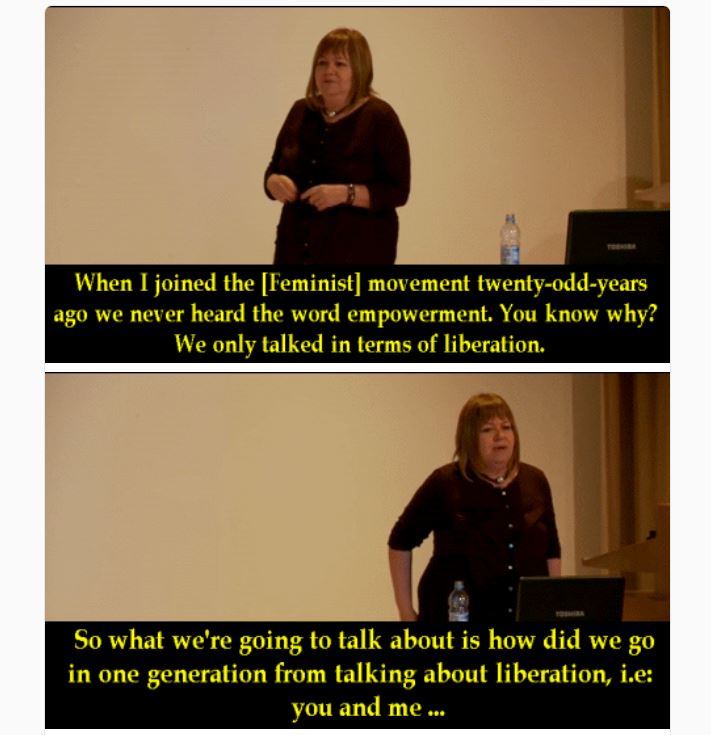
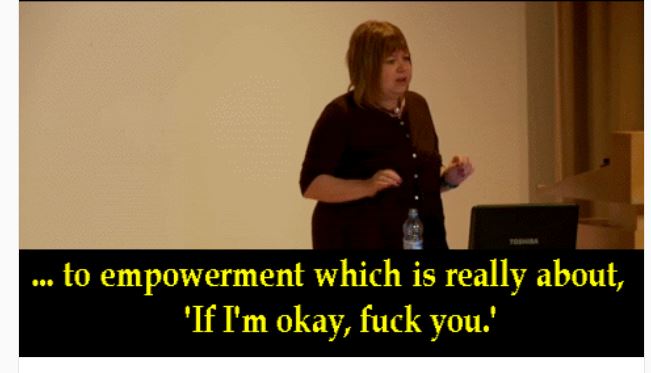
Let’s move away from the neo-liberal/libertarian ‘I’ve got mine, fuck you’ trend that has dominated much of recent popular feminist discourse.











 bleatmop
 Mystro


 Dead Wild Roses
Your opinions…