
You are currently browsing The Arbourist’s articles.
At the core of much of the tension surrounding transgender issues lies a profound and inescapable cognitive dissonance.
P
Biological reality is clear and immutable.
P
Human sex is binary—male or female—and determined at conception. No medical intervention, no amount of social affirmation, and no subjective feeling can change this fundamental fact. You will always and forever remain the sex you were born.
P
Transgender ideology asserts the opposite. It claims that whatever sex you feel you are, you become in reality. Your internal sense of self overrides chromosomes, reproductive anatomy, and every observable marker of biological sex. This ideology is inherently anti-reality.
P
Those who fully internalize it place themselves in a state of permanent conflict—not just with their own bodies, but with the entire external world. Reality itself becomes the enemy, repeatedly negating their subjective self-perception.
P
Queer Theory provides the escape hatch. Rather than confronting the mismatch between feelings and facts, adherents are guided to externalize the source of their distress. Through an oppressor/oppressed lens, the cause of their pain is never their own faulty perception of self—absolutely not. Instead, it is “normative” society that is actively oppressing them, enforcing rigid gender norms and inflicting all their suffering. This framework transforms personal dissonance into righteous grievance. The distress is no longer internal; it is the fault of everyone else.
P
Medical interventions amplify the problem. So-called “gender-affirming care”—puberty blockers followed by cross-sex hormones—adds fuel to the fire. These treatments carry serious, well-documented deleterious effects on both mental and physical health. Far from resolving underlying issues, they often deepen psychological instability while creating permanent physical changes.
P
The result is a perfect storm: individuals who were already vulnerable, now further destabilized, carrying a massive chip on their shoulders. They view the rest of society—the “normative” majority—as the active source of their pain. To defend their constructed identity and quiet the cognitive dissonance, they feel compelled to strike back against this perceived evil force: you and me.In this worldview, disagreement equals enmity.
P
If you refuse to affirm their ideology, you are not offering a different opinion—you are the oppressor who must be confronted, silenced, or defeated.
P
Dissent is violence.
P
Reality itself is violence.
P
This dynamic helps explain patterns of hostility, aggression, and, in extreme cases, violence that emerge from certain segments of transgender activism. It does not stem primarily from societal rejection, but from a foundational rejection of biological reality and the refusal to address internal distress with honesty.
True compassion does not mean enabling delusion.
P
It means grounding support in reality—the only place where genuine mental health and social peace can be found.

Modern North American politics is increasingly conducted as if the other side is not an opponent but a threat. Not “wrong,” but illegitimate. Not “mistaken,” but dangerous. Once that framing takes hold, everything downstream gets harder: legislating, compromising, trusting institutions, even sharing a country.
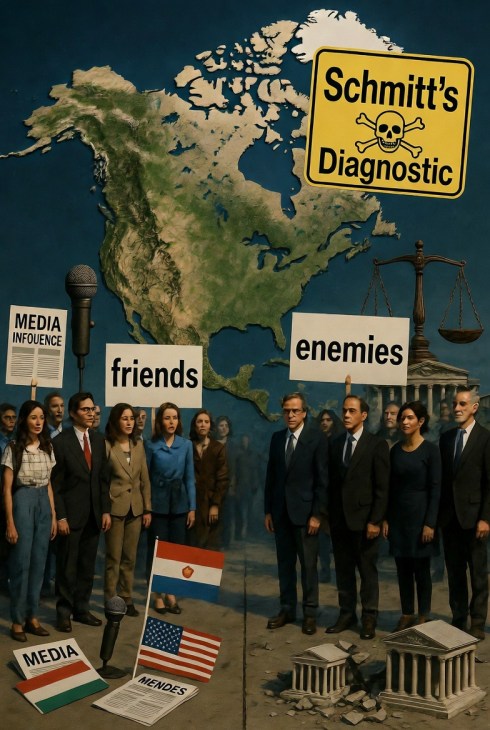
There’s a name for this move, and it’s older than social media: the friend–enemy distinction associated with the German jurist Carl Schmitt. Use it carefully. Attribute it correctly. Treat it as a warning label, not a blueprint.
The Schmitt paragraph (correct attribution without laundering)
In The Concept of the Political (first as an essay in 1927; expanded as a book in 1932), Carl Schmitt argued that what is distinctively political is not morality, economics, or aesthetics, but the capacity to sort human beings into friends and enemies—public groupings that can reach the highest intensity and, in the extreme case, make violence thinkable. (Stanford Encyclopedia of Philosophy) Schmitt is a morally compromised figure: he joined the Nazi Party in 1933 and wrote in support of the regime, which makes him “radioactive” as an authority. (Wikipedia) That’s precisely why the concept should be handled as a diagnostic for a recurring political pattern—not as an endorsement of Schmitt’s politics, and not as a permission slip to treat fellow citizens as foes.
That’s the frame. Now the point: you can reject Schmitt’s politics and still find his definition useful for recognizing when a society is sliding from politics-as-bargaining into politics-as-threat-management.
1) What the friend–enemy distinction is (and isn’t)
Schmitt’s core claim is often quoted badly. The clean version is this:
- It’s public, not personal. “Enemy” is not your private dislike. It’s a public adversary, a category applied at the level of groups. (Stanford Encyclopedia of Philosophy)
- It’s about intensity and stakes. The distinction becomes political when disagreement is framed as a contest over a community’s existence or way of life—when coercion becomes not just imaginable but morally narratable. (Stanford Encyclopedia of Philosophy)
- It’s not reducible to morality. In Schmitt’s framing, you can judge an enemy morally good and still treat them as an enemy; the political is not the same thing as ethics. (Stanford Encyclopedia of Philosophy)
So the friend–enemy distinction is less a philosophy lesson than a switch. When it flips on, political disagreement stops being about what we should do and becomes about who is allowed to be “us.”
2) The observable move: how to spot it in the wild
You’re watching friend–enemy politics when rhetoric shifts from:
- “Their plan won’t work” → “They cannot be permitted to govern.”
- “We’ll reverse this policy later” → “If they win, the country is finished.”
- “We can bargain on X” → “Any compromise is betrayal.”
- “Institutions are imperfect” → “Institutions are legitimate only when they deliver our outcomes.”
Here’s the part that matters: this is not just “heated language.” It’s a legitimacy test. The argument isn’t “our side has better ideas.” It’s “the other side is outside the moral community.”
What it sounds like now (no special villains required)
Over the last decade, ordinary campaign language has absorbed a new register: catastrophe certainty. You hear it when routine electoral competition is narrated as a point of no return not “we’ll reverse their policy,” but “if they win, the country is over.” You hear it when every institution that fails to deliver your preferred outcome becomes not merely flawed but captured—courts, schools, public health bodies, legacy media, election administration. Once those are recast as enemy infrastructure, the next step is predictable: treating compromise as collaboration.
That’s the Schmittian escalator: it turns normal democratic rivalry into a kind of internal cold war.
3) Why this maps onto polarization in the U.S. (with verifiable anchors)
American public opinion data increasingly fits the emotional profile you would expect in a friend–enemy environment: high frustration, high anger, low confidence, and pervasive negativity toward the opposing party.
Pew Research Center (survey fielded Sept. 22–28, 2025) reports that roughly half of U.S. adults say each party makes them feel angry (Democratic Party 50%, Republican Party 49%), and large majorities say each makes them feel frustrated (Democratic Party 75%, Republican Party 64%). (Pew Research Center) Pew also reports that majorities view both parties as too extreme (GOP 61%, Democrats 57%). (Pew Research Center)
That doesn’t “prove Schmitt.” It shows a climate where it’s easy for elites and activists to plausibly say: “The other side isn’t just wrong; they’re dangerous.”
Political science has a name for the emotional side of this: affective polarization which is the tendency for partisans to dislike and distrust the out-party as a social group. Iyengar, Sood, and Lelkes argue that affect increasingly operates through social identity dynamics rather than ideological distance alone. (Political Communication Lab)
Affective polarization supplies the fuel. Friend–enemy rhetoric supplies the spark.
4) Why Canada is not “the same,” but not immune
Canada has its own stresses: regional tensions, institutional distrust, culture-war imports, and an online ecosystem shared with the U.S. but it is still a mistake to claim Canada is simply America north.
A careful comparative point looks like this: research summarized by UBC Magazine reports Canadians show moderate affective polarization and lower levels of deeper hostility (political sectarianism) than Americans; divisions exist, but they are less intense, and fewer people treat the other side as morally beyond the pale. (UBC Alumni Magazine)
A note on insulation (not immunity) 🧯
Canada also has some built-in insulation: parliamentary governance can make politics feel less like a single, winner-take-all presidency; multi-party dynamics can prevent a total two-tribe monopoly; party discipline can concentrate bargaining inside caucuses rather than turning every vote into a public loyalty test. None of that makes Canada immune especially in a shared online ecosystem with American media incentives but it helps explain why Canadian polarization can be real without being identical.
5) Why identity politics dovetails so easily (even when it starts as justice) 🧩
“Identity politics” is a term that gets used as a slur, so define it cleanly. The Stanford Encyclopedia of Philosophy describes identity politics as political activity and theorizing rooted in shared experiences of injustice among members of particular social groups, often aiming to secure political freedom for a marginalized constituency. (Stanford Encyclopedia of Philosophy)
That definition is not inherently friend–enemy. You can organize around group experiences without treating dissenters as enemies.
So why the dovetail?
Because identity politics—left and right—naturally foregrounds group boundaries: who counts, who belongs, who’s harmed, who threatens, who is owed what. Schmitt’s point is that any distinction ethnic, cultural, religious, linguistic, and ideological can become politically decisive if it becomes a marker of collective identity with enough intensity. (Stanford Encyclopedia of Philosophy)
Now add moralization. Finkel and colleagues define political sectarianism as “the tendency to adopt a moralized identification with one political group and against another.” (Political Communication Lab) Once politics is moralized at the identity level, compromise starts to look like apostasy: you don’t bargain with evil; you resist it.
Here’s the dovetail in one line:
Identity makes the boundary salient; moralization makes it sacred; friend–enemy logic makes it coercive.
The accelerant: attention economics
The friend–enemy move also fits the modern information economy. Outrage travels; nuance doesn’t. Platforms and partisan media ecosystems reward content that converts complexity into moral clarity so we get villains, victims, emergencies, and betrayal. That incentive structure doesn’t invent the friend–enemy distinction, but it mass-produces it, because existential framing is the most reliable way to keep attention and discipline the in-group.
6) The cost: why friend–enemy politics jams the machinery of governance
When politics is friend–enemy:
- Compromise becomes betrayal.
Not merely “a bad deal,” but disloyalty to the tribe. - Institutions become contested terrain.
Courts, legislatures, bureaucracies, and media are judged not by process but by whether they serve “us.” Legitimacy becomes outcome-dependent. - Policy friction skyrockets.
Even mutually beneficial reforms become hard because the other side’s win is treated as loss of status or existential risk. - Moderation gets punished.
The moderate’s basic civic move—“I’ll grant you partial legitimacy and bargain” gets rebranded as weakness or collaboration.
The social cost (quiet, cumulative, real)
The damage isn’t confined to legislatures. Friend–enemy framing erodes social trust: people self-censor at work, avoid neighbours, and retreat into curated friend-only spaces. Institutions become identity badges your media, your university, your charities, your professional associations until public life resembles a network of gated communities with competing moral jurisdictions.
7) The steelman (and the answer)
Steelman: sometimes the other side really is dangerous. Sometimes a movement is openly anti-democratic, violent, or committed to permanent domination. In those cases, “enemy” language can feel like moral clarity.
Answer: danger exists. But friend–enemy framing is cheap to claim and expensive to live under. The burden of proof has to be high, because once you normalize existential threat talk, you train citizens to treat routine democratic alternation as intolerable. You also incentivize mirroring: nobody wants to be the only player insisting it’s “just politics” while being branded a threat.
Friend–enemy politics is a ratchet. It rarely turns only one way.
8) A short field guide: “know it when you see it”
You’re in friend–enemy territory when you hear:
- “They’re illegitimate.”
- “If they win, the country is over.”
- “Neutrality is complicity.”
- “Compromise is betrayal.”
- “The system is rigged—unless we win.”
- “Your neighbour’s vote is violence / treason / conquest.”
And you’re watching it spread when those claims expand outward to tag neutral institutions and ordinary citizens: not just the party but anyone who isn’t for us is with them.
9) The exit ramp: moderation without naïveté
This is not a call for civility theatre. It’s a call for civic hygiene.
A workable politics of moderation has one core rule:
Treat opponents as lawful rivals unless and until they clearly demonstrate otherwise and even then, be precise.
Practically, that means:
- Argue policy in terms of tradeoffs, constraints, second-order effects (the language of governing, not excommunication).
- Reserve “enemy” language for genuinely exceptional cases, and specify evidence and predictions that could, in principle, be falsified.
- Defend institutional legitimacy as a process, not a scoreboard.
If you can’t do that, you don’t just intensify conflict you corrode the shared premise that makes democratic disagreement possible: that losing an election is not losing the country.
Closing: the consequence if we don’t name it
Schmitt’s concept is dangerous partly because it’s accurate as a description of how politics can harden. Once a society trains itself to see politics as friend versus enemy, it will eventually demand enemy-handling tools: purges, blacklists, emergency powers, legitimacy tests, permanent distrust. The policy state becomes brittle; the civic culture becomes suspicious; moderation becomes a vice.
The friend–enemy distinction is not merely an idea. It’s a habit of mind. And habits, unlike ideologies, don’t require formal assent. They spread by imitation.
The minimum defensive act is to recognize the move when it’s being done to you, and when you’re tempted to do it back. 🧭
Glossary
Affective polarization — Dislike, distrust, and social hostility toward supporters of the opposing party, treated as a group identity rather than merely a set of policy positions. (Political Communication Lab)
Catastrophe register / no-return framing — A rhetorical mode that describes ordinary electoral competition as an existential point of no return (“if they win, the country is over”).
Friend–enemy distinction (Schmitt) — The claim that the political is defined by the capacity to distinguish friend from enemy in a public sense, with sufficient intensity that coercion or violence becomes thinkable in extreme cases. (Stanford Encyclopedia of Philosophy)
Identity politics — Political activity and theorizing grounded in shared experiences of injustice among members of particular social groups, typically aimed at securing political freedom for a marginalized constituency. (Stanford Encyclopedia of Philosophy)
Legitimacy denial — Treating the opposing side as outside the set of lawful rivals who may govern; shifting from “they’re wrong” to “they must not rule.”
Political sectarianism — “The tendency to adopt a moralized identification with one political group and against another,” borrowing the metaphor of religious sects rather than mere teams. (Political Communication Lab)
Process legitimacy — The idea that institutions are legitimate because procedures are lawful, stable, and fairly applied—not because they produce outcomes you like.
Citations (Sources)
- Carl Schmitt (Stanford Encyclopedia of Philosophy), overview of Schmitt and the friend–enemy distinction. (Stanford Encyclopedia of Philosophy)
- Background note on The Concept of the Political and Schmitt’s Nazi Party membership (reference context). (Wikipedia)
- Pew Research Center (Oct 30, 2025), party feelings: anger/frustration measures. (Pew Research Center)
- Pew Research Center (Oct 30, 2025), views of both parties: “too extreme” findings. (Pew Research Center)
- UBC Magazine (Dec 2, 2025), summary of Canadian polarization research and comparative claims. (UBC Alumni Magazine)
- Iyengar, Sood, & Lelkes (2012), “Affect, Not Ideology,” on affective polarization as social identity. (Political Communication Lab)
- Finkel et al. (Science, 2020), “Political sectarianism in America,” definition and framework. (Political Communication Lab)
- Identity Politics (Stanford Encyclopedia of Philosophy), definition and scope. (Stanford Encyclopedia of Philosophy)
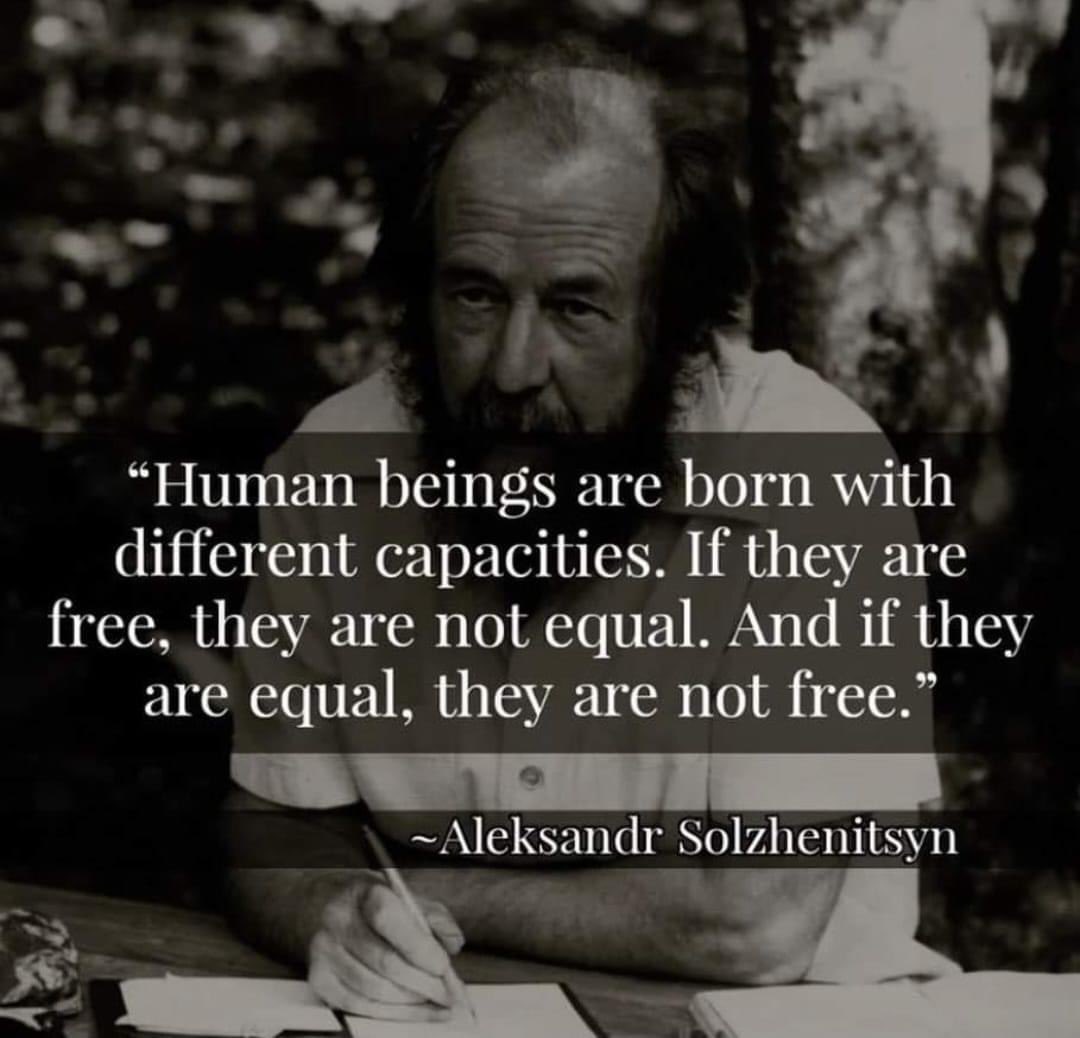
This meme only “works” if you stop letting equality smuggle itself in as a moral trump card.
Humans are born uneven. Not in worth—in capacity. Strength, IQ, impulse control, charm, health, family stability, appetite for risk, luck. You can pretend those differences don’t matter, but the moment people are allowed to act freely, they cash out into unequal outcomes. Some people build, some coast, some burn it all down. Freedom is a sorting machine.
So the first half is basically a description: if people are free, they will not end up equal. Not because someone rigged the game. Because the inputs aren’t equal and choices compound.
The second half is the warning: if you demand equality of outcomes, you don’t get it for free. You get it by force. There’s no other mechanism. Outcomes only converge when you stop people from doing the things that produce divergence: earning more, choosing differently, hiring freely, saying what they think, competing hard, associating with who they want, opting out. Equality-as-leveling needs an enforcer. And enforcers don’t show up with a gentle “please.” They show up with rules, penalties, and permission structures—what you’re allowed to do, to say, to keep.
That’s the core trade: freedom produces inequality; outcome equality requires coercion.
Now for the part people always dodge: there are different “equalities.” And conflating them is the whole scam.
- Equal dignity: every person counts as a person. That’s a moral claim. Compatible with freedom.
- Equality before the law: same rules, same due process, no caste exemptions. Also compatible with freedom—arguably required for it.
- Equality of outcomes: everyone ends up in roughly the same place. That’s the one that fights liberty, because it needs constant correction.
Most modern arguments cheat by pointing at the first two and then demanding the third. “If you deny outcome parity, you deny human worth.” No—what you’re denying is the claim that the state (or HR, or the university, or the tribunal) should get to manage adult lives until the spreadsheet looks morally satisfying.
You can have compassion without pretending outcomes should match. You can want upward mobility without confiscating difference. You can care about the bottom without pretending the top is illegitimate.
And yes: sometimes liberty creates ugly inequality. The honest response is to name the costs and argue about which constraints are justified—fraud laws, safety nets, antitrust, disability supports, basic education—without turning “equality” into a magic word that dissolves the question of coercion.
The meme’s point is simple and harsh: if you want equal outcomes, you’re volunteering everyone for supervision. And the people doing the supervising never start by supervising themselves.

A meme slid past my feed this week that’s basically a whole comment section compressed into one sentence:
“If you’re real quiet about Renée Good and Alex Pretti, but were really loud about Charlie Kirk—I see you. We all see you.”
You can feel what it’s trying to do. It’s not asking a question. It’s issuing a verdict — and inviting the crowd to clap. 👀
Before we get moral about it (or defensive about it), it helps to name what’s happening. This kind of meme is a conversational device. It’s a way of sorting people into “clean” and “suspect” without having to do the slow work of inquiry.
This post isn’t about denying hypocrisy exists. Selective empathy is real. It’s ugly. It’s also common — across every tribe that’s ever existed. The point here is narrower:
When we treat silence as proof of motive, we stop talking about what’s true and start talking about who’s safe.
And once the conversation becomes “who’s safe,” facts arrive late and leave early.
What the meme is actually doing
That one sentence performs four moves:
- An observable claim: “Some people were loud about X and quiet about Y.”
- A measurement dodge: “Loud” and “quiet” are undefined (posts? news coverage? your feed? my feed?).
- A motive leap: The difference is taken as evidence of moral defect.
- A social threat: “I see you. We all see you.” = reputational enforcement.
In other words: it skips the checkable part (#1) and jumps straight to the morally satisfying part (#3), backed by a crowd (#4).
If you want conversation instead of sorting, you reverse the order: connect → define → test → then (carefully) infer.
The best one-sentence reply is not a rebuttal
Before you ask any questions, you lower the temperature:
“All political violence and unjust killing is wrong. If selective empathy is happening, I agree it’s worth confronting.”
That sentence does two things: it refuses the tribal frame, and it makes your questions sound like inquiry rather than evasion.
Make the meme’s claim testable
Here are the three questions that turn heat into light:
- “When you say loud vs quiet, what counts as loud/quiet?”
- “Do you mean the same individuals, or the general vibe of your feed?”
- “On a 0–10, how sure are you it’s the same people — and what gets you to that number?”
If the conversation can’t answer those, it isn’t actually about truth. It’s about loyalty.
“Real conversations” in action (composites)
What follows are composites — not quotes — written to sound like the kinds of exchanges that reliably show up under posts like this. The point is not to win. The point is to keep two minds in the same room long enough to examine certainty.
Conversation A: The public comment (low bandwidth, high heat)
Them: “If you were loud about Kirk but quiet now, you’re telling on yourself.”
You: “I hear the frustration. Selective empathy is real, and it’s corrosive.”
Them: “Exactly. People only care about their team.”
You: “Can I ask one clarifying question — when you say ‘quiet’ and ‘loud,’ do you mean the same individuals, or the general vibe of your feed?”
Them: “Same individuals.”
You: “On a 0–10, how sure are you it’s the same individuals?”
Them: “Nine.”
You: “What gets you to 9?”
Them: “I saw them post about Kirk immediately.”
You: “Okay. What would move you to an 8? Would it matter if some of them simply never saw the other story, or didn’t know enough yet to comment?”
Them: “Maybe, but come on.”
You: “Fair. I’m not denying hypocrisy exists. I’m trying to separate ‘didn’t see / didn’t know’ from ‘doesn’t care.’ If we’re going to accuse motives, I want it to land on something we can actually verify.”
Notice the move: you don’t “defend the quiet.” You ask whether the accusation is evidence-based or feed-based.
Conversation B: The DM (relationship context)
Friend: “I’m sick of fake empathy.”
You: “I get that. Can I ask what you want to happen with a post like this — reflection, apology, pressure, unfriending?”
Friend: “I want people to admit they’re biased.”
You: “Okay. On a 0–10, how sure are you it’s bias rather than attention/algorithm/people being afraid to say the wrong thing?”
Friend: “Nine.”
You: “What’s the strongest thing that puts it at 9?”
Friend: “They posted about Kirk instantly.”
You: “That’s a real data point. Would you be willing to test one person you mean? If they genuinely didn’t see the other story, would you want to know that before concluding motive?”
Friend: “…Yeah.”
You: “That’s all I’m guarding: one small door for ‘maybe there’s another explanation’ before we turn silence into a moral indictment.”
This is the “impossible conversations” pivot: from verdict to conditions for revising certainty.
Conversation C: The trap (“You were loud about Kirk”)
Them: “Funny you’re talking now. You were loud about Kirk.”
You: “Fair question. What are you inferring from that?”
Them: “That your empathy is tribal.”
You: “I don’t want that to be true. My honest answer is: the Kirk story saturated my feed, so I reacted fast. I saw the other story later.”
Them: “Convenient.”
You: “Maybe. So let’s test it. If you saw me condemn violence consistently across cases, would that move your certainty down even one point?”
Them: “Possibly.”
You: “Then we’re not stuck. And I’ll take the lesson too: I should be slower to mind-read others, because I don’t want it done to me.”
You decline the moral cage match and offer a falsifiable check: consistency over time.
The hidden leap: silence equals motive
The meme’s real power comes from a hidden assumption: silence proves character.
Sometimes silence is cowardice. Sometimes it’s indifference. Sometimes it’s ignorance. Sometimes it’s grief in private. Sometimes it’s uncertainty. Sometimes it’s algorithmic — people genuinely did not see what you saw.
If you want to accuse motives, you can. But if you want to persuade people who don’t already agree with you, you need to do the hard part first: define what you’re measuring, and test whether your inference survives alternative explanations.
A few clarifications before the comments do what comments do
- “So you’re saying hypocrisy isn’t real?” No. I’m saying hypocrisy accusations land harder when they’re grounded rather than assumed.
- “So you’re saying violence isn’t political?” No. I’m saying political interpretation isn’t a substitute for checking claims.
- “So you’re tone-policing?” No. I’m trying to keep inquiry alive when the conversation is about to be sealed shut.
- “So this is manipulation?” Only if you use it to stall forever. The point is mutual standards and one testable claim. If we can’t do that, we exit.
Suggested reading
- How to Have Impossible Conversations — the toolkit behind the “connection → certainty → one claim” pattern
- The Righteous Mind — why moral intuitions lead and reasoning follows
- Mistakes Were Made (But Not by Me) — why doubling down feels like integrity
- Never Split the Difference — practical emotional-safety tactics
- How Minds Change — what actually shifts belief over time
I’ve watched conversations snap shut the moment a label lands. “Authoritarian.” “Racist.” “Groomer.” “Commie.” “Fascist.” Sometimes it’s shouted; sometimes it’s delivered with a calm that’s worse. Either way, the label does the same job: it turns dialogue into sorting.
If you care about persuasion—or even just about staying human with people you disagree with—this is the moment that matters. Because once someone is convinced you are morally radioactive, your facts don’t enter the room. And once you decide they’re unreachable, you stop trying to reach them. The relationship becomes a trench. 🕳️
I’m writing about a specific conversational pattern—fast moral labeling that turns disagreement into contamination, and makes inquiry feel like betrayal. This post is about how to keep a relationship intact long enough to examine the certainty behind that label.
It draws heavily on the “impossible conversations” approach: connection first, then a mutual audit of certainty, then one claim we can actually test. Not a conversion campaign. Not a dunk. Not more fuel.
My claim is simple:
If you want a real conversation with someone who reaches for moral labels quickly, start by making a real connection—then invite a shared audit of certainty, not a duel of conclusions.
Lens A: From inside the moral-alarm posture
From the inside, this posture often doesn’t feel like ideology. It feels like moral eyesight. You can see harms other people don’t see—or don’t want to see—and the world keeps asking you to speak softly about it, to “debate,” to “be civil,” to wait your turn while people get hurt.
In that frame, neutrality isn’t neutral. A demand for “open inquiry” can sound like a demand to treat someone’s dignity as a hypothesis. So when I hear a policy proposal, a joke, a statistic, even a question—my mind scans for the pattern: Who gets harmed? Who gets protected? Who gets erased?
That’s why labels arrive quickly. Often, “fascist” isn’t meant as a careful historical claim. It’s shorthand for: this is authoritarian; it threatens vulnerable people; it belongs in the moral quarantine. The label is a gate. It keeps the moral community safe.
And to be fair: sometimes the alarm is justified. There are real authoritarian impulses in politics and institutions. The question isn’t whether harm exists. The question is whether a particular claim about harm is being held in a way that stays connected to evidence—and stays connected to other people.
So what keeps me in the conversation?
- You don’t start by correcting my language. You start by understanding what harm I think I’m preventing.
- You don’t perform neutrality. You show you have values too—especially values I recognize: dignity, fairness, reducing cruelty.
- You lower the temperature by reducing threat: to my identity, my group, my moral standing.
What makes me leave immediately?
- “You’re brainwashed.”
- “You’re evil.”
- “You’re hysterical.”
- Any vibe of: I need you to be stupid for me to be confident.
If you need me to feel small so you can feel right, I’m gone.
Lens B: Where I am now, and what I’m trying to do
I’m wary of ideological capture. I care about fairness and free inquiry, and I’m suspicious of moral language used as a weapon to shut down reasoning. I also know this: you don’t talk someone out of certainty by attacking it head-on. You often strengthen it. Certainty is frequently doing work: protecting identity, status, belonging, safety.
So my aim isn’t “defeat your conclusion.” It’s two-fold:
- Make enough connection that you feel safe staying in the room.
- Shift the conversation from “What do you believe?” to “How sure are you, and why?”
Beliefs can be tribal. But certainty is often a crack where curiosity can enter. 🌱
The approach: connection → certainty → one claim we can actually test
1) Connection before correction
Connection isn’t flattery. It isn’t surrender. It’s reducing the sense that this conversation is a status fight or a moral trial.
Concrete moves:
- Name a shared value.
“I think we both want fewer people harmed.”
“I’m with you on dignity; I’m unsure about the mechanism.” - Name your intent.
“I’m not trying to score points. I want to understand how you’re seeing this.” - Steelman one piece before touching the claim.
“If those outcomes are real, I can see why you’re alarmed.”
None of this concedes the label. It makes it possible to talk about what the label is trying to protect.
2) The certainty questions
Once connection is real—not perfect, just real—you invite a mutual audit. This is where the conversation becomes “impossible” in the good way: you’re not arguing conclusions; you’re exploring how the conclusion is held.
The simplest sequence I know:
- “On a scale from 0–10, how certain are you that [assertion]?”
- “What gets you to that number?”
- “What would move you down one point?”
- “What evidence would you expect to see if you were wrong?”
That last question is the tell. If nothing could change it, you’re not in a disagreement—you’re in a boundary ritual.
Guardrail: this isn’t meant to be an endless epistemology loop. If you’re auditing certainty forever and never testing a claim, you may be stalling—or being stalled.
3) Only then: test one claim together
Most fights fail because we try to litigate an entire worldview. Don’t. Pick one claim. Keep it local. Make it about outcomes and standards, not about moral status.
Rules that help:
- One topic. One example.
- Ask what counts as good evidence for both sides.
- Keep it falsifiable-ish. If it can’t be wrong, don’t wrestle it.
A short dialogue when “fascist” shows up
Here’s the kind of exchange I mean. It’s deliberately plain.
Them: “That’s basically fascist.”
Me: “When you say ‘fascist’ here, do you mean historically fascist, or more like authoritarian and harmful?”
Them: “Authoritarian. It targets marginalized people.”
Me: “Okay. On a 0–10 scale, how certain are you it leads to that harm?”
Them: “A 9.”
Me: “What gets you to 9?”
Them: “The pattern. It always goes this way.”
Me: “If we found out the outcomes didn’t increase harm to that group—say they were neutral or improved—would your certainty drop at all?”
Them: “Maybe.”
Me: “What evidence would you need to see for that ‘maybe’ to feel real?”
Notice what happened. I didn’t accept the label. I didn’t attack it either. I moved from label → claim → certainty → conditions for revision. That’s the move.
And I try to hold myself to the same standard. If I ask what would change your mind, I should be able to answer what would change mine. Symmetry is disarming. ⚖️
The “three doors” rule
When things get hot, offer choices so the other person doesn’t feel trapped:
“Do you want to do one of these?”
- Clarify terms (what do we mean?)
- Check certainty (how sure, and why?)
- Test one claim (what evidence would move us?)
If they refuse all three, I stop—not in anger, but in conservation mode:
“It sounds like we’re not in a place for a real exchange right now. I’m here if you want to try again later.”
When not to use this approach
Connection is not a duty in every context. If the exchange is coercive, humiliating, or unsafe—or if someone demands you accept a moral confession just to keep talking—leave. If concrete harm is immediate, address the harm first. Certainty-audits are not a substitute for accountability.
What success looks like
Success is not conversion. It’s not winning. It’s smaller—and because it’s smaller, it’s more real:
- “I still disagree, but I understand why you think that.”
- “Here’s what might change my mind.”
- “I don’t need to call you evil to keep my beliefs intact.”
If we can’t talk about certainty—ours or theirs—we will keep outsourcing moral judgment to labels. Labels are efficient. They are also corrosive. They turn disagreement into contamination. ☣️
The culture war runs on that corrosion. It doesn’t need more fuel.
If you want to reach someone deep in moral certainty, connection is the price of admission. Once you’re in, don’t aim for the headline. Aim for the one honest question that makes certainty visible—then sit there together long enough for reality to have a chance.

A few clarifications before the comments do what comments do
- “So you’re saying fascism isn’t real?” No. I’m saying labels are often used as conversation-stoppers, and I’m interested in testing the underlying claim together rather than trading moral verdicts.
- “So you’re saying just be nice to bigots?” No. Boundaries still matter. This is about how to talk when you choose to talk, and how to exit cleanly when you shouldn’t.
- “So you’re tone-policing people who are alarmed?” No. I’m describing a pattern where moral alarm hardens into moral certainty—and how to make certainty discussable without contempt.
- “So this is manipulation?” Only if you use it to stall forever. The point is mutual standards and one testable claim—if we can’t do that, the conversation ends.
Suggested reading
- How to Have Impossible Conversations — The core toolkit: rapport, questions, and clean exits.
- The Righteous Mind — Moral intuition first, reasoning second; helps explain threat dynamics.
- **Mistakes Were Made (But Not by Me) — Cognitive dissonance and why doubling down feels like integrity.
- Never Split the Difference — Emotional-safety techniques that pair well with “connection first.”
- How Minds Change — A modern synthesis on belief change and identity.
In Iran, child marriage isn’t merely a whispered rural custom; it’s a practice that can breathe because the law gives it room. A Radio Free Europe/Radio Liberty report tells the story of “Leila,” married at ten to a fifteen-year-old boy—an arrangement delivered to her in the night, a ring placed on her finger like a stamp. She describes the aftermath not as romance or “tradition,” but as fear, pain, and a body treated as if it were already spoken for.
The scandal here is not that bad people exist; it’s that systems can normalize the bad. The report states that marriage is legal for girls at 13 with parental consent, and that younger girls can be married with a judge’s permission (and that the legal age cited for boys is 15). It also cites 37,000 underage marriages registered in the last Iranian year ending in March (as of 2016), while noting that unregistered unions mean the true number is likely higher.
A society’s moral temperature shows up in what it excuses, and what it calls “inevitable.” The piece reports that the UN Committee on the Rights of the Child urged Iran to raise the marriage age and expressed concern that the legal framework permits sexual intercourse with girls as young as nine lunar years, alongside gaps in criminalization of other sexual abuse against very young children. This isn’t “culture” in the harmless sense; it’s power arranged into a rite, with a child paying the cost.

Bibliography 📚
-
Radio Free Europe/Radio Liberty (Radio Farda), “Childhood’s End: Forced Into Marriage At Age 10 In Iran” (Nov. 17, 2016).
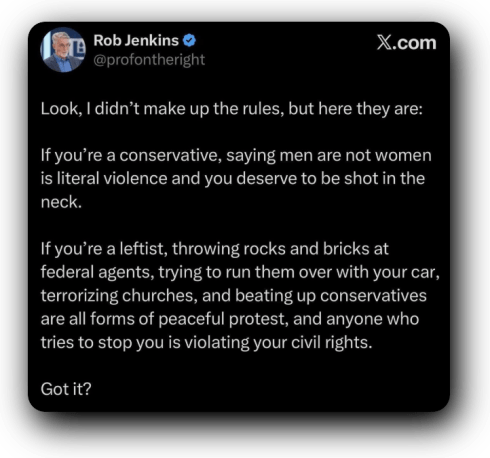
The X post is doing something familiar: it takes two ugly sentences, assigns one to “conservatives” and one to “leftists,” and then says, See? The rules are different. It’s a compressed morality play about “two-tier” reality—speech treated as violence on one side, actual violence laundered as “peaceful protest” on the other. The point isn’t subtle. The point is that subtlety is for suckers.
And yes: there is a real intellectual touchstone for the logic the meme is gesturing at—Herbert Marcuse and his essay Repressive Tolerance. Marcuse’s argument, in brief, is not “be nice to everyone equally.” It’s that “tolerance” inside an unjust system can function as a stabilizer for the powerful. If the social order is already rigged, then neutral tolerance becomes complicity. So “tolerance” may need to become selective: intolerance toward movements judged oppressive; preferential latitude toward movements judged emancipatory.
That is a mechanism you can recognize in our current atmosphere even if you reject Marcuse’s conclusions. Once you accept that framework—“neutral rules are a mask for power”—you quickly get to the idea that the formal categories we inherited (free speech, due process, viewpoint neutrality, equal enforcement) are not the point. The point is the moral direction of history. If you think the stakes are existential, then anything that slows “liberation” looks like violence, and anything that advances it starts to look excusable.
That’s the lure. It feels like moral seriousness.
It also tends to produce the exact thing the meme is ridiculing: asymmetric permission structures. On paper: “We oppose violence.” In practice: “We oppose violence when it serves the other tribe.” On paper: “Words have consequences.” In practice: “Words are violence when spoken by the wrong person, and merely ‘context’ when spoken by the right one.” If you want to defend selective enforcement as justice, Marcuse gives you a vocabulary. If you want to mock selective enforcement as hypocrisy, this meme gives you an image.
But the meme cheats in two ways.
First, it packages maximal caricatures as if they are the daily policy of real institutions: “people deserve to be shot,” “running over agents is peaceful,” “terrorizing churches is civil rights.” Those aren’t arguments; they’re adrenaline. They’re useful precisely because they let the reader skip the hard work: which specific cases, which authorities, which jurisdictions, which outcomes, which standards? A meme that can’t name a case doesn’t want to inform you. It wants to recruit you.
Second, it collapses three distinct questions into one hot blob:
- What is the law?
- How is it being enforced?
- Should the law be changed?
You can have a serious conversation about two-tier policing and still be allergic to meme logic. Two-tier policing isn’t a vibe; it’s an empirical claim: similar conduct, different outcomes, explained by ideology rather than facts. That’s testable, at least in principle. Pick comparable cases. Compare charging decisions, bail, sentencing, media framing, institutional statements, internal policies, and (crucially) what evidence was available at the time. If the pattern holds, you’ve found something corrosive.
Neutrality is never clean. Discretion and bias are baked into enforcement. That’s why consistency and transparency aren’t niceties; they’re the only way discretion doesn’t become patronage.
And if the pattern doesn’t hold? Then the meme is just a mood board for resentment.
Here’s the deeper issue: equal application of the law is not a decorative liberal slogan. It’s the only thing that keeps politics from becoming a permanent emergency. The moment your faction decides that formal neutrality is merely “repressive tolerance,” you have granted yourself a standing exemption. The moment the other faction learns that lesson, you get escalation, then retaliation, then institutional rot. The system stops being a referee and becomes a weapon. Everyone notices. Nobody trusts verdicts. Everything becomes a street fight conducted through courts, bureaucracies, and HR policies.
Which is, ironically, a recipe for more repression—just not evenly distributed. 🙂
If you want to critique selective enforcement without becoming a partisan mirror image, try this simple discipline:
- Name the standard (what rule should apply?).
- Name the comparator (what similar case was treated differently?).
- Name the decision point (who chose not to enforce, or enforced aggressively?).
- Say what you’d accept if the tribes were swapped.
Sometimes the double standard is real. The remedy is not revenge; it’s comparison—same conduct, same rule, same consequence, even when it’s your side.
That last one is the lie detector. Most people fail it quickly. That’s not because they’re stupid; it’s because the incentive structure is poisonous. If you’re convinced the other side is not merely wrong but illegitimate, “neutral rules” start to feel like self-harm.
Marcuse understood that temptation and tried to turn it into theory. The meme understands the temptation and turns it into a dunk.
My view is more boring and therefore more useful: a society can survive deep disagreement; it cannot survive the public belief that enforcement is a tribal privilege. If you think we have two-tier policing or two-tier moral accounting, don’t answer with a meme that trains your readers to crave revenge. Answer with receipts, standards, comparators, and the willingness to be constrained by the rule you want applied to your enemies.
Otherwise, you’re not defending fairness. You’re just changing who gets to do the repressing.











 bleatmop
 Mystro
 The Arbourist


 Dead Wild Roses
Your opinions…