
You are currently browsing the category archive for the ‘Canada’ category.
The Edmonton Public School Board’s (EPSB) sweeping book ban has erupted into a quintessential Alberta debacle: a government directive mangled by overzealous implementation, corroding trust in educational oversight.
In July, the UCP government under Premier Danielle Smith ordered schools to remove “inappropriate” materials from libraries, targeting explicit sexual content to protect children. Instead of applying a common-sense filter, EPSB produced a blacklist of more than 200 titles—including The Handmaid’s Tale, The Color Purple, and The Godfather. Even Jaws and works by George R.R. Martin didn’t escape the purge. Critics dubbed it “vicious compliance”: technically following the order, but in a way designed to spark outrage.
Smith quickly condemned the overreach, pausing the ban and pledging clarifications so that classics remain available. The government’s vagueness deserves criticism, but EPSB’s reaction exposed something deeper: Alberta’s educational establishment either failed to grasp the policy’s intent—or chose to deliberately misapply it, then leak the story to embarrass the UCP. In either case, it is professional negligence.
The fallout has been swift. Margaret Atwood ridiculed the move, bookstores report surging sales of “banned” books, and the episode has reinforced suspicions that education officials are more interested in scoring political points than serving students.
Irony abounds: in trying to shield children from explicit content, the government gave its critics ammunition; in trying to follow the directive to the letter, EPSB managed to turn itself into the villain. What should have been a straightforward matter of removing genuinely pornographic material has spiraled into a culture-war sideshow, eroding public confidence in both policymakers and educational leaders.
The lesson is plain: sloppy governance is bad—but bad-faith compliance from those entrusted with education is worse.

In Canada’s high-trust society, the rule of law cannot endure selective enforcement. When certain groups are shielded from consequences while others face harsh penalties for identical actions, the principle of equality before the law collapses. What emerges instead is favoritism by creed or identity—a betrayal that fragments unity and breeds resentment.
Uneven Standards in Practice
Toronto street prayers (August 2024). Hundreds of worshippers staged outdoor prayers at a busy downtown intersection, apparently without permits, halting traffic. Police did not intervene and later described the disruption as lawful. Few doubt how a Christian congregation attempting the same would have been treated: injunctions would be swift, fines inevitable. The point is not hostility toward prayer, but the evident double standard.[1]
Reckless firearm discharge in Muskoka (August 2025). Videos surfaced of men firing rifles and pistols from a snowmobile bridge near MacTier. Ontario Provincial Police confirmed an investigation, warning that careless use of firearms can bring Criminal Code charges. Yet similar celebratory gunfire at cultural festivals, whether at South Asian weddings or Indigenous gatherings, often receives muted responses or “contextual” exemptions. Danger is danger, regardless of tradition.[2]
Pro-Palestinian marches in Toronto (2024–2025). Demonstrations repeatedly blocked major roads, including rallies where smoke bombs were deployed from overpasses. Despite millions spent on policing, arrests remained rare—only 24 across hundreds of events by March 2024. Contrast this restraint with the 2022 Freedom Convoy in Ottawa, where the Emergencies Act was invoked, bank accounts were frozen, and police forcibly dismantled encampments. The contrast is glaring: enforcement appears to hinge less on infractions than on identity and political alignment.[3][4]
Mill’s Warning on Law and Liberty
John Stuart Mill, in On Liberty (1859), emphasized that genuine freedom depends on impartiality of the law. If rules are applied based on popularity or group identity, he argued, society replaces principle with prejudice, inviting arbitrary power. Selective enforcement, Mill warned, is a subtle but corrosive path to tyranny—not only by the state but by favored factions within society.[5]
Restoring Trust
A society built on trust cannot thrive under inconsistent law enforcement. The law must apply equally, regardless of race, religion, or political leaning. To preserve legitimacy, policing standards should be codified and subject to independent oversight. Discretion is unavoidable, but unreviewed discretion becomes favoritism. Equality before the law is not optional—it is the bedrock of Canadian unity. Without it, trust will wither, and division will prevail.

References
- “Toronto residents upset after Hamas supporters blockade busy intersection.” Juno News, Mar 21, 2025. Link
- “Gun video sparks OPP investigation.” MuskokaRadio.com, Aug 28, 2025. Link
“UPDATE: Bracebridge OPP investigating social media videos depicting unlawful firearm use.” MyMuskokaNow, Aug 28, 2025. Link
“OPP seek public help in identifying men firing guns off bridge in Mactier.” Barrie360.com, Aug 30, 2025. Link - “Police arrest two at pro-Palestinian rally that delayed Trudeau event in Toronto.” CityNews, Mar 15, 2024. Link
“Palestine solidarity protesters attacked by police in Toronto.” People’s Dispatch, Apr 3, 2024. Link
“Violent Crackdown at Land Day March.” The Grind Magazine, Mar 31, 2024. Link - “Canada convoy protest.” Wikipedia, accessed Sept 2025. Link
“TD Bank freezes accounts that received money for Canada protests.” Reuters, Feb 12, 2022. Link - Mill, J.S. On Liberty. London: John W. Parker and Son, 1859.
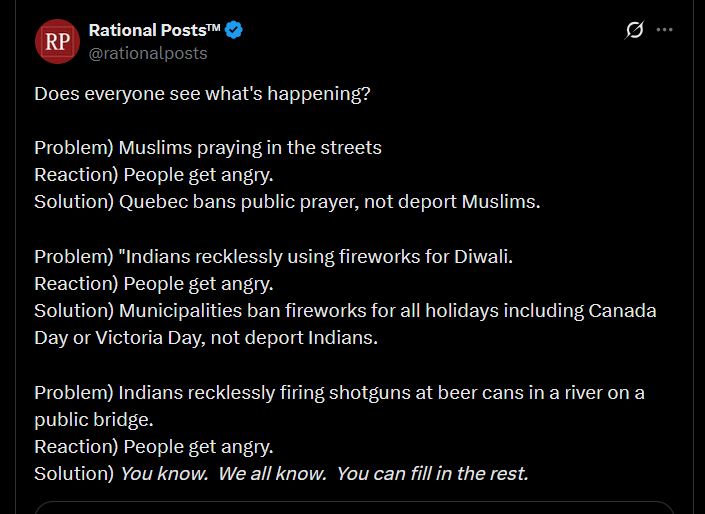
The solution to thwart this insidious strategy of systematically stripping Canadians of their rights lies in enforcing the law with unyielding equality, blind to race or religion, a principle that stands as the bedrock of a just society. The Rational Posts narrative reveals a troubling trend: public outrage over Muslims praying in streets or Indians celebrating Diwali with fireworks, and now shotguns on a bridge, triggers blanket bans, from Quebec’s prohibition on public prayer to municipal fireworks restrictions, effectively punishing entire communities rather than addressing specific transgressions. This corrosive approach, echoing the divisive echoes of Jim Crow or apartheid, corrodes multicultural unity and foments resentment, as social cohesion studies irrefutably demonstrate. Instead, precise legislation targeting reckless acts, such as discharging firearms irresponsibly, must replace these broad edicts, ensuring accountability without stifling cultural expression. Fair laws unite: bans divide. Let us, with urgent resolve, choose the former and reclaim a Canada where justice, not prejudice, prevails.
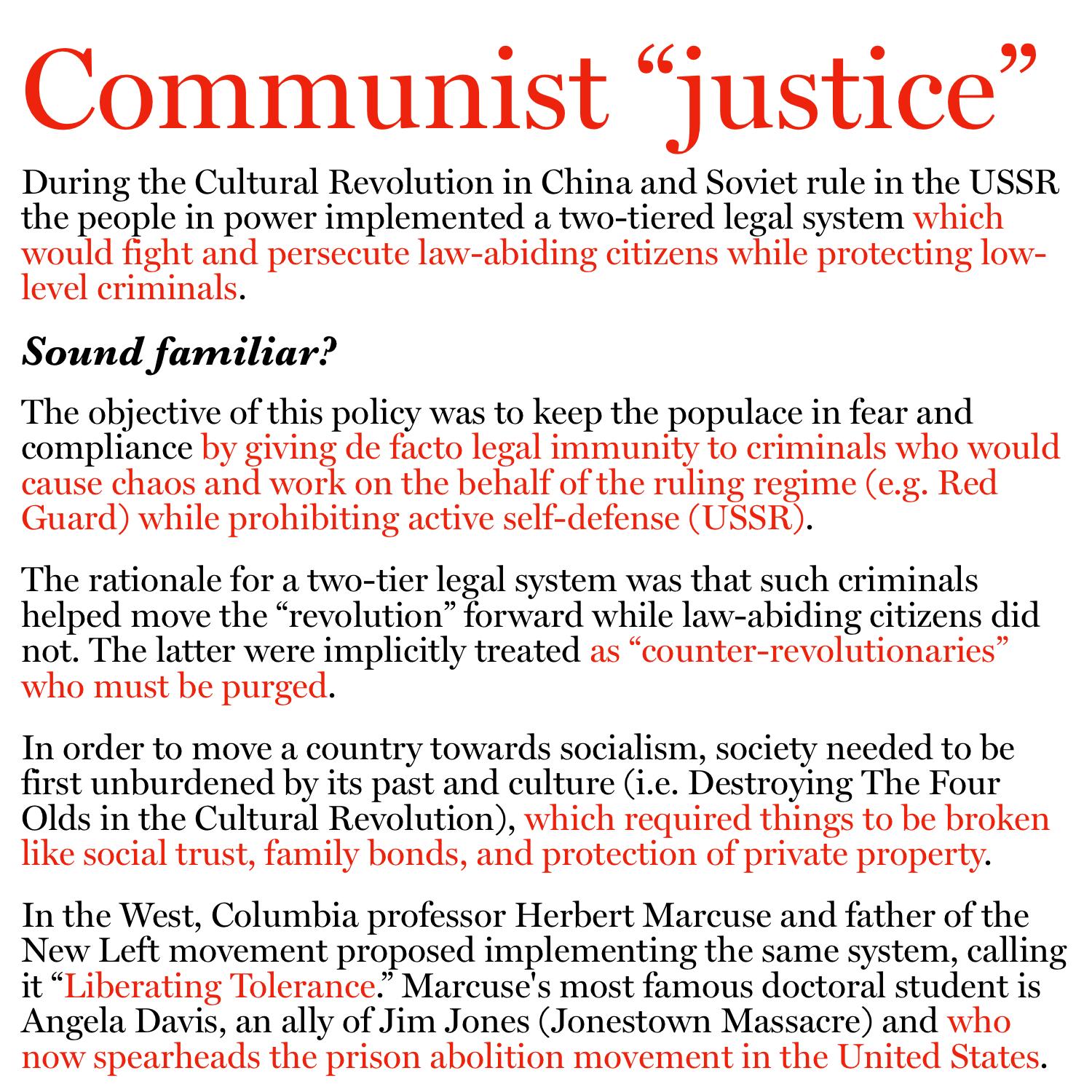
Overlay recent events in Canada with what has happened in history. This is ride we do NOT want to be on.
In the machinery of modern media, false narratives do not emerge spontaneously. They are the product of deliberate groundwork: the careful shaping of public perception before an event occurs. Borrowing from military doctrine this tactic is called operational preparation of the environment (OPE) which are defined as activities that enhance situational awareness and set conditions for future operations.1 When adapted to the information domain, OPE becomes narrative control: seeding frames, priming audiences, and conditioning reflexive responses that can be triggered later for maximum effect.
Adversaries whether geopolitical rivals, activist networks, or opportunistic elites exploit this tactic by sowing division. The result is a public primed for outrage, where engineered crises and isolated incidents ignite prearranged narratives. Spotting these patterns is the first step toward resisting them.
Repetition and Priming
Narrative preparation often begins with repetition. Specific terms are echoed across platforms until they seem self-evident. Phrases like “stochastic terrorism” or “rising anti-LGBTQ hate” do not spread organically; they are priming devices. For instance, drag events framed as battlegrounds for “bigotry” and “inclusion” gain prominence not because of isolated incidents alone, but because media amplification primes audiences to see a pattern of systemic oppression.2
Consider also the long arc of the “racist policing” narrative. From Ferguson in 2014, through the cases of Michael Brown and Breonna Taylor, to the killing of George Floyd in 2020, framing evolved but the groundwork ensured predictable outrage.3 Media studies confirm that such coverage often prioritizes framing over fact, shaping reflexive responses rather than reasoned analysis.4
Selective Amplification
Once the ground is prepared, selective amplification takes over. An isolated incident for instance, graffiti on a council office, a slur at a rally—balloons into emblematic proof of a “hate wave.” Counter-evidence, such as a shooter’s non-binary identity, often disappears from coverage because it disrupts the narrative arc.5
This is not journalism as truth-seeking; it is journalism as engineering. Narrative amplification corrodes credibility, manufacturing crises that serve political and cultural goals. International rivals such as Russia and China employ similar techniques, weaponizing narrative dominance in conflicts and domestic politics alike.6
Case Study: Edmonton Public Schools
A recent example illustrates how this process operates in Canada. In 2025, the Edmonton Public School Board (EPSB) was accused of “book banning” after it questioned the suitability of certain titles with explicit sexual themes. Activist networks and sympathetic media framed the issue as a matter of “queer affirmation” and censorship. Yet, as I argued in a prior essay, this was not about censorship at all but about narrative warfare; casting parental concerns as bigotry while advancing a predetermined ideological script.7 The case demonstrates how operational preparation of the environment works at the local level: emotional language, repetition of “book ban” rhetoric, and selective omission of context primed audiences for outrage.
Building Inoculation
What does media literacy look like in this landscape? It means detecting the telltale signs of OPE:
- Uniform Surges: Are identical phrases appearing simultaneously across news outlets and social media?
- Emotive Frames: Does coverage push outrage before evidence is fully presented?
- Suppressed Counterpoints: Are inconvenient facts downplayed or omitted?
- Pre-seeded Narratives: Does the framing seem rehearsed, echoing earlier campaigns?
The solution is not paranoia but discipline. Verify facts independently, resist outrage cycles, and name the tactic when you see it—“this is OPE unfolding.” Exposing the method robs it of its power. In the contested terrain of fifth-generation warfare, awareness is both shield and sword.

End Notes
- U.S. Department of Defense, Dictionary of Military and Associated Terms, s.v. “Operational Preparation of the Environment.”
- Britannica, “Stochastic Terrorism,” and GLAAD, “Accelerated Rhetoric and Anti-LGBTQ Incidents” (2023).
- The Conversation, “Media Narratives and the George Floyd Protests” (2020).
- Reny, T. & Newman, B. (2021). “The Opinion-Mobilizing Effect of Frames: Media Narratives in the Black Lives Matter Movement.” American Political Science Review.
- NBC News, “Nonbinary Identity of Colorado Springs Shooting Suspect Raises Questions” (2022).
- Canadian International Governance Innovation (CIGI), “Narrative Dominance in the Information Age” (2021); Army University Press, “Information Operations and the Modern Battlespace” (2020).
- The Arbourist, “Book Bans and Narrative Warfare: How the Edmonton Public School Board Plays the Queer Pedagogy Script,” Dead Wild Roses (August 30, 2025).
The latest claim of “unmarked graves” at St. Joseph’s Mission Residential School in British Columbia exposes a familiar pattern: sweeping headlines, scant evidence. On August 14, 2025, the Williams Lake First Nation announced ground-penetrating radar (GPR) detected 16 “anomalies.” Global News and others framed them as “potential burial sites.” Yet no remains have been confirmed, substituting implication for proof.
Canadians know this script. In 2021, Kamloops’ claim of 215 “graves” became Canada’s “news story of the year,” sparking global outrage and $12 million in federal funding. Four years on, no bodies surfaced—GPR anomalies aligned with tree roots or septic tiles. Still, the unverified narrative lingers as proof of mass graves.
Geophysicists note GPR cannot distinguish human remains from soil disruptions—a fact buried in coverage. Yet sensational claims yield dividends: $8 million in reconciliation grants since 2021, media clout, and moral authority, all absent hard evidence. The Williams Lake announcement follows suit, with no excavation planned, only “consultation.”
None of this negates the residential school era’s tragedies—deaths from disease or neglect were documented. But inflating anomalies into “graves” distorts history, manipulates grief, and diverts resources from urgent Indigenous needs. Worse, a proposed federal bill to criminalize “denialism” would shield such claims from scrutiny, turning skepticism into heresy.
Truth demands excavation, not headlines. Until anomalies are verified, Canadians are asked to mistake speculation for fact. That is not reconciliation—it is a grave error, fracturing trust in a nation desperate for unity.

Sources Referenced
- Global News, “Williams Lake First Nation Finds 16 Potential Burial Sites,” August 14, 2025
- Fraser Institute, “No Evidence of ‘Mass Graves’ in Residential Schools,” February 12, 2024
- National Post, “Kamloops Graves Remain Unproven,” April 6, 2025
- Struggles-Activist.com, “Three Years Later, Canadian ‘Mass Graves’ Claims Remain Unproven,” January 7, 2025
- Aggregated X posts, August 2025
Canada’s tariff wars reveal a glaring double standard: confrontation with Communist China draws muted shrugs, while disputes with the United States ignite fiery “elbow up” rhetoric and national outrage. When China slapped a 75.8% tariff on Canadian canola in August 2025—retaliation for Ottawa’s 100% tariff on Chinese electric vehicles and 25% on steel and aluminum announced earlier that spring—Manitoba farmers were left reeling. Nearly half of their canola exports go to China, and industry estimates project multi-billion-dollar losses. Yet Canada’s political class and major media outlets framed Beijing’s move as a mere “tit-for-tat” trade dispute, urging patience and diplomacy. Outside the mainstream, social media filled with posts lamenting the devastation in farm country.
Contrast this with the uproar over U.S. tariffs. In March 2025, President Donald Trump imposed 25% duties on Canadian goods (excluding energy), escalating them to 35% by August. Ottawa erupted. Prime Minister Mark Carney thundered about the need for a unified “North American market,” while pundits and media outlets blasted “unjustified” American aggression. Canadians were rallied with slogans of defiance and “elbow up” resolve. Yet under CUSMA, more than 85% of Canada–U.S. trade remains tariff-free, meaning the outrage over Washington’s measures dwarfed the reaction to China’s far heavier blow to canola.
The contrast betrays selective indignation. China, an authoritarian regime, cripples a vital Canadian industry yet escapes national fury. The United States, a democratic ally, delivers a lesser economic hit and is vilified. Such narrative hypocrisy undermines both unity and credibility, sacrificing farmers’ livelihoods for geopolitical posturing. If Canada roars at Washington but bows to Beijing, it sends a dangerous message: principle is negotiable, and farmers are expendable.

Sources:
-
Statistics Canada, 2023 Trade Data
-
CBC News, “China’s Tariffs on Canadian Canola,” Aug. 13, 2025
-
Fraser Institute, “Trump’s Trade War Update,” Aug. 12, 2025
-
Globe and Mail, “Over 85% of Canada–U.S. Trade Remains Tariff-Free under CUSMA,” Aug. 2025
-
Aggregated X posts, Aug. 2025











 bleatmop
 Mystro


 Dead Wild Roses
Your opinions…