
You are currently browsing the category archive for the ‘Ethics’ category.
This is what happens when you let activists into your organizations. Ideological capture is inevitable. Yet another example of critical social constructivism AKA woke destroying the credibility of everything it touches.

The sentencing of Lucy Connolly, a 41-year-old childminder from Northampton, to 31 months in prison for an offensive X post represents a disturbing shift toward authoritarian governance in the United Kingdom. On July 29, 2024, Connolly posted a message urging “mass deportation now” and to “set fire” to hotels housing asylum seekers, in the context of the Southport attacks. As reported by the BBC, “The post was viewed 310,000 times before she deleted it within four hours.” Despite her guilty plea and expressions of remorse, the severe sentence, upheld on appeal in May 2025, prioritizes punishment over proportionality, signaling a state overreach that stifles free speech. This case exemplifies how legal mechanisms can be weaponized to suppress dissent, a hallmark of authoritarian regimes.
The legal basis for Connolly’s conviction, Section 19 of the Public Order Act 1986, allows broad discretion in criminalizing speech deemed to incite racial hatred. The Crown Prosecution Service noted, “Connolly admitted publishing material which was threatening, abusive or insulting and intended to stir up racial hatred.” However, the post’s rapid deletion and Connolly’s lack of prior convictions suggest a lighter penalty, such as a fine, could have sufficed. Instead, the court imposed a near-maximum sentence, with the appeal judges stating, “There is no arguable basis for saying the sentence was disproportionate,” as per The Independent. This rigid application of vague laws to punish speech mirrors authoritarian tactics, where the state uses legal ambiguity to silence controversial voices and deter open discourse.
The societal impact of Connolly’s sentence creates a chilling effect on free expression, a cornerstone of democracy. The Free Speech Union criticized the sentence as “plainly disproportionate,” warning of its broader implications for free speech. Public reaction, including a fundraiser exceeding £50,000, reflects widespread concern that the punishment outweighs the crime. When a single post, however offensive, leads to over two years in prison for a first-time offender, it signals that the state values ideological control over individual liberty. This echoes authoritarian governance, where dissent is swiftly penalized to enforce conformity, pushing citizens toward self-censorship out of fear of legal consequences.
Comparisons to other cases highlight the disproportionate nature of Connolly’s punishment, reinforcing perceptions of authoritarian overreach. For instance, Philip Prescott received 28 months for violent disorder, while Haris Ghaffar got 20 months, despite their actions involving physical harm rather than words. The Independent reported, “Tyler Kay was jailed for 38 months for sharing Ms. Connolly’s post,” showing how the state extends punishment to amplifying speech, widening the net of censorship. This prioritization of controlling narrative over addressing tangible harm is a tactic seen in authoritarian regimes, where speech is deemed a greater threat than physical acts, undermining democratic principles.
In conclusion, Lucy Connolly’s 31-month sentence for an offensive X post marks a dangerous slide toward authoritarian governance in the UK. By leveraging vague legal provisions to impose harsh penalties on rapidly retracted speech, the state demonstrates a preference for control over individual rights. The chilling effect on free expression, disproportionate sentencing compared to violent crimes, and public backlash all point to a system prioritizing ideological conformity. As the Free Speech Union’s critique suggests, such precedents risk normalizing state overreach, eroding democratic freedoms and paving the way for further authoritarian measures under the guise of public order.
References:
1. BBC News. “Lucy Connolly jailed for race hate post on X loses appeal.” https://www.bbc.com/news/articles/c3v5926yeqro
2. The Independent. “Why was Lucy Connolly jailed for a tweet and why was her appeal dismissed?” https://www.the-independent.com/news/uk/crime/lucy-connolly-court-jail-appeal-b2754556.html
3. Crown Prosecution Service. “Updated sentence: Childminder admits inciting racial hatred over social media post.” https://www.cps.gov.uk/cps/news/updated-sentence-childminder-admits-inciting-racial-hatred-over-social-media-post

Freedom of speech is a cornerstone of Canadian democracy, enshrined in Section 2(b) of the Canadian Charter of Rights and Freedoms, which protects the right to express one’s opinions and beliefs without fear of censorship or reprisal. This fundamental right fosters open dialogue, encourages diverse perspectives, and underpins a free and democratic society. However, in recent years, the rise of Diversity, Equity, and Inclusion (DEI) initiatives, often rooted in ideological frameworks that prioritize certain narratives over others, has posed challenges to free expression. The case of Margaret Munn, a teacher candidate at the University of Western Ontario (UWO), exemplifies how such initiatives can suppress dissenting voices. Munn faced significant repercussions for expressing views critical of DEI and decolonization policies during her teacher training, highlighting a troubling trend where ideological conformity overshadows open discourse (FSU Canada, 2024).
Margaret Munn’s experience at UWO illustrates the chilling effect of DEI initiatives on academic freedom and free speech. As a mature student in the Bachelor of Education program, Munn was required to demonstrate “professionalism” by aligning with DEI and decolonization principles, which she found overly prescriptive. When she expressed concerns about these frameworks and their impact on educational practices, she faced accusations of unprofessionalism and was ultimately expelled from her practicum placement. This led to her inability to complete her degree, effectively derailing her career aspirations (FSU Canada, 2024). The Faculty of Education’s response, as detailed in court documents, emphasized adherence to institutional values over open debate, suggesting that questioning DEI principles was incompatible with professional standards (Court File No. CV-24-00002418-0000, 2024). This case underscores how DEI initiatives, when rigidly enforced, can create an environment where only approved viewpoints are tolerated, stifling the very diversity of thought they claim to promote.
The broader implications of Munn’s case reflect a growing tension between free speech and ideological mandates in Canadian institutions. DEI frameworks often emphasize collective equity over individual rights, which can lead to policies that prioritize certain groups’ sensitivities over open dialogue. At UWO, Munn was penalized not for harmful actions but for her intellectual dissent, which was deemed a violation of the faculty’s commitment to inclusivity (Quillette, 2024). This approach mirrors a wider trend where “woke” ideologies—encompassing DEI, decolonization, and related social justice frameworks—impose speech codes that limit what can be said or questioned. Such restrictions risk creating echo chambers, where only ideologically aligned perspectives are permitted, undermining the principles of academic inquiry and free expression that universities are meant to uphold. The suppression of Munn’s voice demonstrates how these initiatives can weaponize concepts like professionalism to silence dissent, eroding the pluralistic foundation of Canadian society.
Defending freedom of speech requires acknowledging that true diversity includes diversity of thought, even when those thoughts challenge prevailing ideologies. The Munn case highlights the need for institutions to prioritize open debate over ideological conformity. Universities, as bastions of intellectual freedom, should foster environments where students and faculty can question policies like DEI without fear of retribution. The Faculty Solidarity Unit (FSU) argues that Munn’s expulsion reflects a systemic issue where academic institutions prioritize ideological goals over Charter-protected rights (FSU Canada, 2024). Protecting free speech does not mean endorsing every viewpoint but ensuring that all perspectives can be expressed and debated without penalty. By contrast, the rigid application of DEI frameworks, as seen at UWO, risks creating a hierarchy of acceptable speech, where only certain ideas are deemed safe or professional, undermining the democratic principles that allow Canada to thrive.
In conclusion, the case of Margaret Munn vs. University of Western Ontario serves as a cautionary tale about the erosion of freedom of speech in Canada under the guise of DEI and related ideological initiatives. While these frameworks aim to promote inclusivity, their implementation can suppress dissenting voices, as seen in Munn’s expulsion for questioning institutional policies. Freedom of speech is not just a legal right but a cultural necessity that enables robust debate and the pursuit of truth. To safeguard this right, Canadian institutions must resist the temptation to enforce ideological conformity and instead embrace open dialogue, even when it challenges prevailing norms. By doing so, they can uphold the values of a free and democratic society where all voices, including those like Munn’s, are heard and respected (Quillette, 2024).
References
- FSU Canada. (2024). Margaret Munn v. University of Western Ontario. Retrieved from https://fsucanada.ca/margaret-munn-v-university-of-western-ontario/
- Court File No. CV-24-00002418-0000. (2024). Munn v. University of Western Ontario. Retrieved from https://acrobat.adobe.com/id/urn:aaid:sc:US:325ae543-0142-4ab4-9bb6-c79bae4e4571?viewer%21megaVerb=group-discover
- Quillette. (2024). Lessons from a Teachers’ College Battle over Free Speech and Decolonization. Retrieved from https://quillette.com/2024/11/29/lessons-from-a-teachers-college-battle-over-free-speech-and-decolonization/

The Tesla backlash of March 2025 and the Bud Light controversy of 2023 both ignited swift, ideologically charged consumer reactions amplified by social media. Bud Light’s woes began with a Dylan Mulvaney ad, sparking a conservative boycott that cratered sales by up to 26%, while Tesla’s stem from Elon Musk’s Trump ties, alienating liberals and moderates as its stock plummeted over 40%. Both cases show how fast brand loyalty can erode when politics collide with commerce.
Yet, the responses differ sharply in tone and tactics. Bud Light faced a peaceful, effective boycott—think Kid Rock’s viral gunplay—focused on wallets, not violence, with sales dipping hard but stabilizing later. Tesla’s backlash has veered into chaos, with arson and vandalism targeting cars and dealerships, reflecting a rawer fury possibly fueled by Musk’s outsized persona and Tesla’s physical presence as a punching bag. The right shunned Bud Light; the left now torches Tesla.
Bud Light retreated, tweaking its image to appease critics, while Musk doubles down, flaunting Teslas at the White House amid Trump’s support. The beer brand took a hit but survived as a commodity; Tesla’s premium status and Musk’s defiance make its crisis more existential, blending economic rejection with a destructive edge. These sagas reveal how political tribalism can punish brands—one with a cold shoulder, the other with Molotovs.

“I Investigated the UK’s Most CENSORIOUS Campus (4K)” delves into the atmosphere of one of the UK’s universities known for its restrictive policies on free speech. The video, by journalist Andrew Gold, investigates how this institution has become a focal point for debates on censorship, examining incidents where speakers have been banned or events canceled due to their potentially controversial content.
It discusses the tension between ensuring a safe space for all students and the traditional university ethos of open debate and inquiry, highlighting specific cases where academic freedom has been challenged by student activism or university policies.
The narrative captures both the perspectives of those advocating for more censorship to protect vulnerable groups and those who see it as an erosion of free expression.

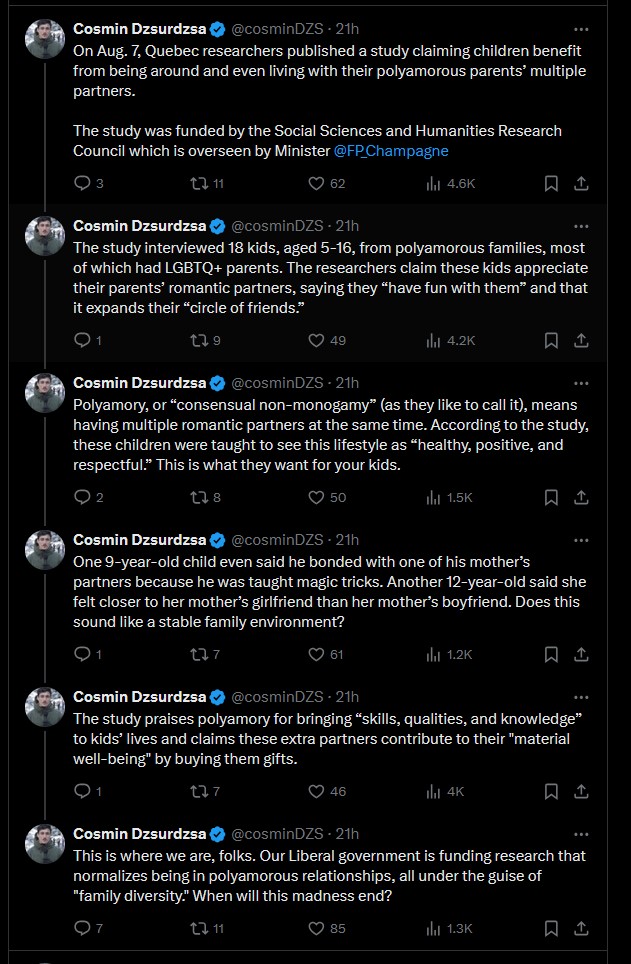
The Liberal government supports the corrosion of the basis of our society – a stable family structure is under siege as usual under the guise of “progressive” values.
On Aug. 7, Quebec researchers published an article on “Children’s views on the romantic partners of their polyamorous parents” in the Journal of Social and Personal Relationships.
The research was funded by the Social Sciences and Humanities Research Council of Canada, a federal grant-giving body that distributes taxpayer funds to academic projects.
SSHRC communications advisor Nicole Swiaterk confirmed to True North taxpayers paid $70,662 between 2019 and 2021 for the study. Funds were awarded via the Insight Development Grants competition.
Researchers interviewed 18 children between the ages of 5 and 16 years old. Three of the children in the cohort lived in households with their parents’ multiple sexual partners. Nine of the ten households interviewed included adults who identified as LGBTQ+.
“We found that the participating children generally appreciate their parents’ romantic partners,” researchers concluded.”
–Hat tip to the The True North













 bleatmop
 Mystro
 The Arbourist


 Dead Wild Roses
Your opinions…