
You are currently browsing the category archive for the ‘Media’ category.
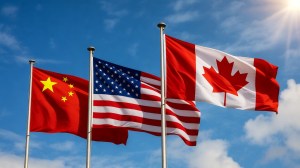
Canada is in the middle of a familiar temptation: the Americans are difficult, therefore the Chinese offer must be sane.
The immediate backdrop is concrete. On January 16, 2026, Canada announced a reset in economic ties with China that includes lowering barriers for a set number of Chinese EVs, while China reduces tariffs on key Canadian exports like canola. (Reuters) Washington responded with open irritation, warning Canada it may regret the move and stressing Chinese EVs will face U.S. barriers. (Reuters)
If you want a simple, pasteable bromide for people losing their minds online, it’s this: the U.S. and China both do bad things, but they do bad things in different ways, at different scales, with different “escape hatches.” One is a democracy with adversarial institutions that sometimes work. The other is a one-party state that treats accountability as a threat.
To make that visible, here are five egregious “hits” from each—then the contrast that actually matters.
Five things the United States does that Canadians have reason to resent
1) Protectionist trade punishment against allies
Steel/aluminum tariffs and recurring lumber duties are the classic pattern: national-interest rhetoric, domestic political payoff, allied collateral damage. Canada has repeatedly challenged U.S. measures on steel/aluminum and softwood lumber. (Global Affairs Canada)
Takeaway: the U.S. will squeeze Canada when it’s convenient—sometimes loudly, sometimes as a bureaucratic grind.
2) Energy and infrastructure whiplash
Keystone XL is the poster child of U.S. policy reversals that impose real costs north of the border and then move on. The project’s termination is documented by the company and Canadian/Alberta sources. (TC Energy)
Takeaway: the U.S. can treat Canadian capital as disposable when U.S. domestic politics flips.
3) Extraterritorial reach into Canadians’ private financial lives
FATCA and related information-sharing arrangements are widely experienced as a sovereignty irritant (and have been litigated in Canada). The Supreme Court of Canada ultimately declined to hear a constitutional challenge in 2023. (STEP)
Takeaway: the U.S. often assumes its laws get to follow people across borders.
4) A surveillance state that had to be restrained after the fact
Bulk telephone metadata collection under Patriot Act authorities became politically toxic and was later reformed/ended under the USA Freedom Act’s structure. (Default)
Takeaway: democracies can drift into overreach; the difference is that overreach can become a scandal, a law change, and a court fight.
5) The post-9/11 stain: indefinite detention and coercive interrogation
Guantánamo’s long-running controversy and the Senate Intelligence Committee’s reporting on the CIA program remain enduring examples of U.S. moral failure. (Senate Select Committee on Intelligence)
Takeaway: the U.S. is capable of serious rights abuses—then also capable of documenting them publicly, litigating them, and partially reversing course.
Five things the People’s Republic of China does that are categorically different
1) Mass rights violations against Uyghurs and other Muslim minorities in Xinjiang
The UN human rights office assessed serious human rights concerns in Xinjiang and noted that the scale of certain detention practices may constitute international crimes, including crimes against humanity. Canada has publicly echoed those concerns in multilateral statements. (OHCHR)
Takeaway: this is not “policy disagreement.” It’s a regime-scale human rights problem.
2) Hong Kong: the model of “one country, one party”
The ongoing use of the national security framework to prosecute prominent pro-democracy figures is a live, observable indicator of how Beijing treats dissent when it has full jurisdiction. (Reuters)
Takeaway: when Beijing says “stability,” it means obedience.
3) Foreign interference and transnational pressure tactics
Canadian public safety materials and parliamentary reporting describe investigations into transnational repression activity and concerns around “overseas police stations” and foreign influence. (Public Safety Canada)
Takeaway: the Chinese state’s threat model can extend into diaspora communities abroad.
4) Systematic acquisition—licit and illicit—of sensitive technology and IP
The U.S. intelligence community’s public threat assessment explicitly describes China’s efforts to accelerate S&T progress through licit and illicit means, including IP acquisition/theft and cyber operations. (Director of National Intelligence)
Takeaway: your “market partner” may also be running an extraction strategy against your innovation base.
5) Environmental and maritime predation at scale
China remains a dominant player in coal buildout even while expanding renewables, a dual-track strategy with global climate implications. (Financial Times)
On the oceans, multiple research and advocacy reports emphasize the size and global footprint of China’s distant-water fishing and associated IUU concerns. (Brookings)
Takeaway: when the state backs extraction, the externalities get exported.
Compare and contrast: the difference is accountability
If you read those lists and conclude “both sides are bad,” you’ve missed the key variable.
The U.S. does bad things in a system with adversarial leak paths:
investigative journalism, courts, opposition parties, congressional reports, and leadership turnover. That doesn’t prevent abuses. It does make abuses contestable—and sometimes reversible. (Senate Select Committee on Intelligence)
China does bad things in a system designed to prevent contestation:
one-party rule, censorship, legal instruments aimed at “subversion,” and a governance style that treats independent scrutiny as hostile action. The problem isn’t “China is foreign.” The problem is that the regime’s incentives run against transparency by design. (Reuters)
So when someone says, “Maybe we should pivot away from the Americans,” the adult response is:
- Yes, diversify.
- No, don’t pretend dependency on an authoritarian state is merely a swap of suppliers.
A quick media-literacy rule for your feed
If a post uses a checklist like “America did X, therefore China is fine,” it’s usually laundering a conclusion.
A better frame is risk profile:
- In a democracy, policy risk is high but visible—and the country can change its mind in public.
- In a one-party state, policy risk is lower until it isn’t—and then you discover the rules were never meant to protect you.
Canada can do business with anyone. But it should not confuse trade with trust, or frustration with Washington with safety in Beijing.
If Canada wants autonomy, the answer isn’t romanticizing China. It’s building a broader portfolio across countries where the rule of law is not a slogan in a press release.
References
- Canada–China trade reset (EV tariffs/canola): Reuters; Guardian. (Reuters)
- U.S. criticism of Canada opening to Chinese EVs: Reuters. (Reuters)
- U.S. tariffs/lumber disputes: Global Affairs Canada; Reuters. (Global Affairs Canada)
- Keystone XL termination: TC Energy; Government of Alberta. (TC Energy)
- FATCA Canadian challenge result: STEP (re Supreme Court dismissal). (STEP)
- USA Freedom Act / end of bulk metadata: Lawfare; Just Security. (Default)
- CIA detention/interrogation report: U.S. Senate Intelligence Committee report PDF. (Senate Select Committee on Intelligence)
- Guantánamo context: Reuters; Amnesty. (Reuters)
- Xinjiang assessment: OHCHR report + Canada multilateral statement. (OHCHR)
- Hong Kong NSL crackdown example: Reuters (Jimmy Lai). (Reuters)
- Transnational repression / overseas police station concerns: Public Safety Canada; House of Commons report PDF. (Public Safety Canada)
- China tech acquisition / IP theft framing: ODNI Annual Threat Assessment PDF. (Director of National Intelligence)
- Coal buildout: Financial Times; Reuters analysis. (Financial Times)
- Distant-water fishing footprint / IUU concerns: Brookings; EJF; Oceana. (Brookings)
Beautiful Trouble is a public toolbox for creative activism: first a collaboratively assembled book, later an online repository, and now also a training ecosystem. Its pitch is not subtle. Movements don’t only need convictions; they need methods.
The core value of Beautiful Trouble is not that it “proves” anything about the morality of activism. The value is that it exposes a modern fact of politics: attention is terrain. If you want to understand contemporary protest, you have to understand how actions are designed to travel, how institutions are pushed into visible choices, and how audiences form conclusions with partial information.
The project’s structure supports that aim. It’s modular: tactics, principles, theories, and short case stories that can be mixed and reused. It describes itself as a kind of “pattern language,” and its licensing encourages adaptation. That makes it unusually legible as an object of civic study: it doesn’t hide the playbook.
What it optimizes for
Most people still think politics is mainly argument. It isn’t. Not anymore. It’s increasingly interpretation under time pressure.
A large share of the public will never read the policy memo, the injunction, or the investigative timeline. They will see a clip. They will inherit a caption. They will absorb a moral frame already installed. Beautiful Trouble is built for that environment. It treats activism as attention design: actions shaped to be seen, remembered, and shared.
One of its principles says the quiet part out loud: the decisive moment is often the target’s response. That is not inherently nefarious. It is a standard logic in asymmetric conflict. When you can’t move power directly, you provoke power into showing itself.
For media literacy, this yields a simple rule: some public actions are designed less to “state a grievance” than to produce a reaction that will be more persuasive than the grievance.
Three clusters worth understanding
The toolbox contains many tools, but three clusters matter for public comprehension because they recur across movements and because they interact strongly with journalism and social media.
1) Impersonation formats and “identity correction”
The toolbox includes tactics associated with hoaxes, spoof announcements, and “identity correction.” These actions usually aim to create a dilemma: if the target rejects the message, the target may look callous; if it accepts any part of it, the target concedes ground. Their success depends on speed. A claim that travels faster than verification can leave residue even after correction.
The neutral point is not “this is always unethical” or “this is always justified.” The point is functional: these tactics exploit a predictable weakness in information flow. Novelty beats confirmation. Moral satisfaction beats caution.
The reader’s defense is boring and effective: treat “too perfect” claims and “official-sounding” announcements as unverified until corroborated.
2) Media-jacking and reaction capture
Another cluster focuses on borrowing attention: hijacking an event, inserting into an opponent’s stage, or redirecting a news cycle. The target is forced into a choice: ignore the action and risk looking weak or indifferent; respond forcefully and risk producing the exact optics the activists want.
This is why the response becomes the payload. The goal is often to make the institution appear brittle, panicked, or oppressive, whether through its own errors or through selective presentation.
The media-literacy question here is straightforward: is the target reacting to a genuine threat, or to an engineered dilemma designed to force a visible response? Sometimes it’s both. Don’t let a viral clip collapse the distinction.
3) Framing and reframing as the main contest
The most consequential “tactic” is not a stunt. It is framing: assigning roles, values, and categories before evidence arrives. What counts as “violence”? What counts as “self-defense”? What counts as “harm”? What is “legitimate”?
Framing is unavoidable. Humans need categories. But because it is unavoidable, it can be weaponized. When framing succeeds, neutral description becomes socially costly. Even vocabulary starts to signal affiliation.
The most reliable defense is category discipline. Separate:
-
what happened (event),
-
what the rule was (policy),
-
what the law allows (legal),
-
what you think is right (moral),
-
what will work (strategic).
Framing tries to weld those together into one reflex. Citizens stay free by refusing that weld.
What this means for civic competence
Beautiful Trouble is a public, teachable catalog of activist methods. That is precisely why it matters. It’s a window into how modern movements think about leverage in an attention economy.
The neutral takeaway is not “activism is manipulation.” It is that contemporary politics runs on reaction, narrative compression, and low-context consumption. A public that wants to be hard to steer needs one habit: slow the tape when an event arrives already framed as a moral emergency.
That is media literacy now. Not cynicism. Pattern recognition. 🧠

References
-
Beautiful Trouble homepage / toolbox landing pages.
Beautiful Trouble principle page (“the real action is your target’s reaction”).
Beautiful Trouble tactic pages: Identity correction; Media-jacking.
-
OR Books listing for Beautiful Trouble: Pocket Edition.
-
ICNC resource entry describing Beautiful Trouble as book/toolbox/training resource.
-
Google Books bibliographic page for Beautiful Trouble: A Toolbox for Revolution.
In his January 16, 2026 X post, James Lindsay treats the “ICE is Trump’s Gestapo” line as more than overheated language. He reads it as a political technique: a framing move that aims to provoke escalation, polarize interpretation, and sap legitimacy from federal immigration enforcement by making every subsequent clash look like retroactive confirmation.
Even if you don’t accept the strongest version of his claim (that it is centrally orchestrated), the underlying mechanism is worth taking seriously—because it doesn’t require orchestration to work. It requires an audience that consumes politics in fragments, and a media ecosystem that pays for heat.
The point of media literacy here is not to pick a side. It is to recognize when you are being handed a frame that’s designed to steer your moral conclusion before you are allowed to know what happened.
The loop, reduced to mechanics
The escalation loop has four moves.
1) Load the moral frame early.
“Gestapo” is not an argument. It is a verdict. It tells the audience what they are seeing before they see it. It collapses a contested enforcement dispute into a single image: secret police.
2) Convert observation into resistance.
Once people believe they’re facing secret police, ordinary scrutiny becomes morally charged. Disruption can be reframed as defense. Escalatory behavior becomes easier to justify, especially in crowds, especially on camera.
3) Force a response that looks like the frame.
As tension rises, agents harden posture: more crowd-control readiness, more force protection, more aggressive containment. Some of that may be lawful, and some may be excessive; the loop does not depend on the fine print. It depends on optics.
4) Circulate optics as proof.
Clips win. Captions win. The most provocative 15 seconds becomes “what happened,” for millions who will never read a court filing. The frame spreads because the frame is legible in low context.
Frame → friction → hardened posture → optics → reinforced frame. Repeat.
Notice what’s missing: slow adjudication of facts. The loop thrives on speed. It preys on low-context attention.
Why Minnesota is an instructive case
Minnesota matters here because the escalation loop is visible across multiple lanes at once: street-level conflict, political rhetoric, and rapid legal constraint.
Recent reporting describes the Department of Homeland Security deploying nearly 3,000 immigration agents into the Minneapolis–St. Paul area amid intense protests and public backlash. In that environment, a fatal shooting—Renée Good, shot by an ICE agent on January 7, 2026—became a catalytic event for further demonstrations and scrutiny.
Then the conflict moved into procedural warfare. On January 17, a federal judge issued an injunction restricting immigration agents from detaining or using force (including tear gas or pepper spray) against peaceful protesters and observers absent reasonable suspicion of criminal activity. That order is narrow, but it is not trivial: it codifies a boundary in exactly the arena where optics are most easily weaponized.
The rhetorical layer matters too. DHS has publicly condemned Minnesota Governor Tim Walz for using “modern-day Gestapo” language about ICE (and the White House has amplified that criticism). Whatever you think of the underlying enforcement operation, this is the accelerant: the label that turns complexity into a single moral picture.
If you want a single media-literacy takeaway from Minnesota, it’s this: the escalation loop often ends up constraining policy through courts and procedure, not merely through street confrontation. Once the story becomes “secret police,” legal process itself becomes part of the narrative battlefield—injunctions and motions become content, and content becomes legitimacy.
“Low information public” is the wrong diagnosis
“Low information” is typically used as a sneer. The sharper term is low context.
Most people aren’t stupid; they’re busy. They consume politics the way they consume weather: by glance. They get fragments, and fragments invite frames.
The “Gestapo” label works on low-context audiences because it is:
- Instantly moralized: villain and victim are assigned immediately.
- Highly visual: it primes the brain to interpret normal enforcement cues (gear, urgency, crowd control) as secret-police signals.
- Clip-native: it fits perfectly into captions and short video, where emotional clarity beats evidentiary completeness.
- Correction-resistant: anyone who says “slow down” can be painted as defending tyranny.
This is the real vulnerability narrative warfare exploits: not ignorance, but context starvation.
The key analytical distinction: intent vs incentives
Here’s where writers often lose credibility: they jump from “this pattern exists” to “this was orchestrated.”
Sometimes there is coordination. Often there isn’t. And you typically don’t need it to explain outcomes.
Shared incentives can produce coordinated-looking behavior without a central planner:
- Outrage frames mobilize attention.
- Attention produces fundraising, followers, and headlines.
- Headlines pressure officials and constrain institutions.
- Institutions respond in ways that produce more outrage footage.
That is enough.
The media action depends on showing a self-reinforcing system: rhetoric that increases confrontation risk, confrontation that increases hardened posture, posture that increases “secret police” plausibility to spectators.
That is media literacy: the ability to separate “this felt true on my feed” from “this is true in the world.”
How to defuse the loop
Defusing the escalation loop means starving it of inputs. That requires two fronts: institutional discipline and citizen discipline.
What institutions can do
1) Treat optics as a real constraint (not PR garnish).
In a clip-driven environment, unnecessary spectacle is narrative fuel. If tactics can be lawful and less visually coercive, the second option is often the strategically sane one.
2) Over-communicate rules, thresholds, and remedies.
Explain what triggers stops, detentions, and uses of force; explain complaint pathways; publish policy boundaries. If courts are drawing bright lines around peaceful protest and observation, those lines should become part of the public-facing doctrine, not buried in litigation.
3) Correct fast and publicly when mistakes occur.
Silence functions as permission for the loudest interpretation to win. Delay is a gift to the escalation loop.
4) Avoid “timing that reads like punishment.”
Even lawful actions can look retaliatory if they cluster around protests. In narrative warfare, timing becomes motive in the audience’s mind.
What readers can do
1) Treat moral super-labels as a stop sign.
When you see “Gestapo,” “fascist,” “terrorist,” “insurrection,” assume you’re being pushed into a conclusion. Slow down.
2) Refuse clip capture.
Ask: what happened thirty seconds before this clip starts? If you can’t answer, you’re watching a weaponized excerpt.
3) Use a two-source minimum.
One source gives you mood. A second source often provides the missing constraint—timeline, legal posture, or what is actually being alleged. The injunction’s specific limits, for example, are precisely the kind of detail clips rarely include.
4) Separate event, legality, and morality.
“This happened” is not “this was lawful,” and neither is “this was tyranny.” Narrative warfare succeeds by collapsing those categories into one reflex.
5) Ask what behavior the story is trying to elicit.
Is it trying to make you understand, or to make you react—share, donate, show up, escalate? That question alone breaks many spells.
Where this ends if we don’t learn
If the escalation loop runs unchecked, politics becomes performance for low-context consumption. Enforcement becomes optics. Protest becomes optics. Courts become props. Everyone plays to the camera because legitimacy is increasingly adjudicated there.
The antidote isn’t bland neutrality. It’s refusing to let a frame do your thinking for you—especially one engineered to convert fragments into certainty.
That’s what media literacy looks like now: not knowing everything, but knowing when you’re being steered.
“When a word arrives preloaded with a verdict, your job is to slow the tape.”

References
- James Lindsay, X post (January 16, 2026), “ICE is Trump’s Gestapo” narrative thread. (X (formerly Twitter))
- Reuters (January 17, 2026), report on federal judge’s injunction limiting immigration agents’ tactics toward peaceful protesters/observers in Minneapolis–St. Paul; includes mention of DHS deploying nearly 3,000 agents and context following Renée Good’s death. (Reuters)
- Associated Press (January 17, 2026), coverage of the same injunction and the lawsuit context, including limits on detentions and crowd-control measures against peaceful protesters/observers. (AP News)
- ABC News (January 14, 2026), background reporting confirming Renée Good was fatally shot by an ICE agent on January 7, 2026 and noting an FBI probe. (ABC News)
- U.S. Department of Homeland Security (May 19, 2025), DHS statement criticizing Gov. Tim Walz’s “modern-day Gestapo” language about ICE (useful for documenting the rhetoric’s public circulation). (Department of Homeland Security)
- White House (January 2026), article compiling public statements about ICE and “modern-day Gestapo” language (useful as an example of administration amplification rather than a neutral factual source). (whitehouse.gov)
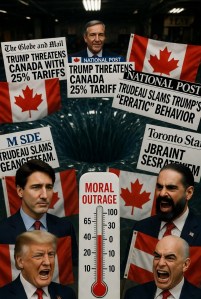
“Trump Derangement Syndrome” (TDS) isn’t a medical condition. It’s a rhetorical label for a recognizable pattern: Donald Trump becomes the organizing centre of political perception, so that every event is interpreted through him, and every interpretation is pulled toward maximal moral heat. Even people who agree on the facts can’t agree on the temperature, because the temperature is the point. Psychology writers describe it as a derogatory term for toxic, disproportionate reactions to Trump’s statements and actions.
And when politicians try to literalize it as a clinical diagnosis, it collapses into farce. It is fundamentally a political phenomenon, not a psychiatric one.
The useful question isn’t “Is Trump uniquely bad?” Reasonable people can say yes on qualities character, norms, rhetoric, policy, whatever. The useful question is: when does valid criticism become TDS? The answer is: when Trump stops being an object of analysis and becomes a gravity well.
What TDS looks like (beyond normal criticism)
Normal criticism is specific: this policy, this consequence, this evidence, this alternative. TDS is different in kind.
-
Totalization: Trump isn’t a president with a platform; he’s a single-cause explanation for everything.
-
Asymmetry: Similar behaviour in other leaders is background noise; in Trump it becomes existential threat (or, on the other side, heroic 4D chess).
-
Incentive blindness: The critic’s emotional reward (“I signaled correctly”) overrides the duty to be precise.
-
Predictable misreads: Even when Trump does something ordinary or mixed, it must be either apocalypse or genius.
This is why the term persists. It points generallyat a real cognitive trap: a personality-driven politics that makes judgment brittle. (It also gets used cynically to dismiss legitimate criticism; that’s part of the ecosystem, too.)
Why Canadian media amplifies it
Canada didn’t invent Trump fixation. But Canadian legacy media has strong reasons to keep Trump on the homepage. The reasons, in question, are not purely ideological.
1) Material proximity (it’s not “foreign news” in Canada).
When the U.S. president threatens tariffs, trade reprisals, or bilateral negotiations, Canadians feel it directly: jobs, prices, investment, and national policy all move. In Trump’s second term, Canadian economic and political life has repeatedly been forced to react to U.S. pressure: tariffs, trade disputes, and negotiations that shape Ottawa’s choices.
That creates a built-in news logic: Trump coverage is “domestic-adjacent,” not optional.
2) An attention model that rewards moral theatre.
Trump is an outrage engine. Outrage is a business model. Canadian mediais operating in a trust-and-revenue squeeze, and that squeeze selects for stories that reliably produce engagement. Commentators on Canada’s media crisis have argued that the Trump era intensified the trust spiral and the incentives toward heightened, adversarial framing.
3) Narrative convenience: Trump as a single, portable explanation.
Complex stories (housing, health systems, provincial-federal dysfunction) are hard. Trump is easy: one villain (or saviour), one emotional script, one endless drip of “breaking.” This is where amplification turns into distortion. A real cross-border policy dispute becomes a morality play; a complicated negotiation becomes a personality drama.
4) Coverage volume becomes self-justifying.
Once a newsroom commits, it has to keep feeding the lane it created. Tools that track Canadian legacy-media coverage of Trump-related economic conflict like tariffs for example, show how sustained and multi-outlet that attention can become.
The more space Trump occupies, the more “newsworthy” he becomes, because “everyone is talking about it” (including the newsroom).
None of this requires a conspiracy. It’s mostly incentive alignment: relevance + engagement + a simple narrative hook.
The cost: Canadians inherit America’s temperature
The predictable result is that Canadians import not just U.S. events, but U.S. emotional calibration.
-
Canadian politics gets interpreted as a shadow-play of American factions.
-
Domestic accountability weakens (“our problems are downstream of Trump / anti-Trump”).
-
Readers get trained to react first and think second, a reinforcing heuristic, because that’s what the coverage rewards.
And it corrodes trust: if audiences can feel when coverage is performing emotional certainty rather than reporting reality, they stop believing the institution is trying to be fair.
A reader’s heuristic: the TDS check
If this is going to be useful (not tribal), it needs a diagnostic you can run on yourself and on coverage:
-
Specificity test: Is the criticism about a policy and its consequences, or about Trump as a symbol?
-
Symmetry test: Would you report/feel the same way if a different president did it?
-
Proportionality test: Does the language match the evidence, or does it leap straight to existential claims?
-
Update test: When new facts arrive, does the story change—or does the narrative stay fixed?
-
Trade-off test: Are costs and alternatives discussed, or is “opposition” treated as sufficient analysis?
Pass those tests and you’re probably doing real criticism. Fail them repeatedly and you’re in the gravity well regardless of whether the content is rage or adoration.
The verdict
Trump is a legitimate target for strong criticism especially in a second term with direct consequences for Canada.
But the deeper media failure is not “being anti-Trump.” It’s outsourcing judgment to a narrative reflex: a system that selects for maximal heat, maximal frequency, and minimal precision. That’s how valid critique curdles into derangement—because it stops being about what happened, and becomes about what the story needs.
The fix is boring, which is why it’s rare: lower the temperature, raise the specificity, and let facts earn the conclusion.
Psychology Today — “The Paradox of ‘Trump Derangement Syndrome’” (Sep 5, 2024)
https://www.psychologytoday.com/ca/blog/the-meaningful-life/202409/the-paradox-of-trump-derangement-syndrome
The Loop (ECPR) — “Is ‘Trump Derangement Syndrome’ a genuine mental illness?” (Oct 13, 2025)
CBS News Minnesota — “Minnesota Senate Republicans’ bill to define ‘Trump derangement syndrome’ as mental illness…” (Mar 17, 2025)
https://www.cbsnews.com/minnesota/news/trump-derangement-syndrome-minnesota-senate-republicans/
Reuters Institute — Digital News Report 2025: Canada (Jun 17, 2025)
https://reutersinstitute.politics.ox.ac.uk/digital-news-report/2025/canada
The Trust Spiral (Tara Henley) — The state of media/trust dynamics (May 2024)
Reuters — “Trump puts 35% tariff on Canada…” (Jul 11, 2025)
https://www.reuters.com/world/us/trump-puts-35-tariff-canada-eyes-15-20-tariffs-others-2025-07-11/
Financial Times — “Canada scraps tech tax to advance trade talks with Donald Trump” (Jun 30, 2025)
https://www.ft.com/content/4cf98ada-7164-415d-95df-43609384a0e2
The Guardian — “White House says Canadian PM ‘caved’ to Trump demand to scrap tech tax” (Jun 30, 2025)
https://www.theguardian.com/world/2025/jun/30/canada-digital-services-tax-technology-giants-us-trade-talks
The Plakhov Group — Trade War: interactive visualizations of Canadian legacy-media coverage of Trump’s tariffs (Feb–Sep 2025 dataset)
https://www.theplakhovgroup.ca/detailed-briefs/trade-war-interactive-visualizations
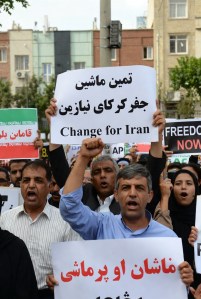
When Iran’s streets erupt, the regime’s first move is rarely ideological persuasion. It is logistical suffocation: arrests, fear, and the severing of communication. In early January 2026, reporting described widespread internet and phone disruptions as protests intensified. The point is not subtle. A state that can’t control bodies tries to control visibility.
Western audiences, meanwhile, do not experience Iran directly. They experience coverage: what makes the front page, what becomes “live,” what gets a correspondent, what earns context, what gets a single write-up and then disappears. That gatekeeping function doesn’t require fabrication to shape reality. It only requires allocation. In practice, editorial choices determine whether an uprising feels like history in motion or distant static.
The claim here is narrower than the familiar “the media lies” complaint. It is this: large news institutions can augment or diminish a story by controlling three dials — timing, framing, and follow-through — and those dials often track narrative comfort as much as factual urgency.
The timeline the public actually receives
Iran’s protest cycle began in late December 2025 and accelerated quickly. Wire reporting described large demonstrations after the rial hit record lows, police using tear gas, and protests spreading beyond Tehran. A few days later, reporting increasingly emphasized the state’s repression and the communications clampdown as the crisis deepened. By January 8–10, the blackout itself and the scale of unrest were central features in major coverage, alongside reports of deaths, detentions, and intensifying crackdowns.
None of this is to say “there was no coverage.” There was. The question is what kind of coverage it became, and when. A story can exist in print while being functionally minimized: treated as episodic, framed as local disorder, or kept at a low hum until a single undeniable hook forces it to the foreground. In this cycle, the communications cutoff became that hook — a reportable meta-event that is easy to verify and hard to ignore.
The BBC dispute is illustrative. Public criticism accused the BBC of thin or late attention; BBC News PR rebutted that claim. The argument itself is the point: audiences can feel the throttle even when they cannot quantify it precisely. When trust collapses, people start timing the coverage.
How stories are diminished without denying facts
1) Timing: when an event is treated as real.
In closed societies, early information is messy: shaky videos, activist claims, regime denials, and silence during blackouts. Caution can be defensible. But caution is also a convenient lever. If the bar for “confirmed” rises selectively, timidity becomes bias with clean hands. The public doesn’t see the internal deliberations; it sees the lag — and a lag signals “this isn’t important.”
2) Framing: what the story is about.
A protest can be framed as “economic unrest,” “public anger,” “unrest,” “crackdown,” or “a legitimacy crisis.” These are not synonyms. Each frame assigns agency and moral clarity differently.
“Economic unrest” implies weather: hardship produces crowds, crowds disperse, life continues. “Legitimacy crisis” implies politics: a governing order is being contested. Amnesty’s language, for example, emphasizes lethal state force; Reuters emphasizes regime warnings and suppression; AP emphasizes spread, detentions, and the hard edge of state response. Those differences matter because they tell the audience whether this is a temporary spasm or a turning point.
3) Follow-through: whether the story becomes a continuing reality.
One report is not coverage. Coverage is cadence: daily updates, on-the-ground reporting, explanatory context, and sustained attention when the situation is still unclear. Regimes understand this. A blackout isn’t only about disrupting domestic coordination; it also disrupts the foreign media rhythm that turns unrest into sustained international pressure.
The steelman case for restraint
There are good reasons major outlets hesitate:
-
verification is genuinely difficult during shutdowns,
-
misinformation can be weaponized by the regime and opportunists,
-
reckless amplification can endanger sources.
These are real constraints, not excuses. But they are only persuasive when applied consistently. The public’s frustration arises when “we can’t confirm” functions as a brake on some stories and not others — when caution looks less like discipline and more like selective incredulity.
A practical heuristic for readers
A useful concept must do more than flatter a tribe. It should help a reader detect when they are being shown an event versus being shown a story about the event. This can be done with a simple diagnostic — the Narrative Throttle Test:
-
Latency: How long did it take for a major outlet to treat it as major?
-
Vocabulary drift: Did coverage move from “unrest” to “crisis” only after the evidence became unavoidable?
-
Cadence: Was it sustained, or did it appear as isolated updates with no continuity?
-
Agency: Were protesters described as political actors with aims, or as reactive crowds with emotions?
-
Comparative salience: What else dominated the same window, and why?
These questions do not require assuming malice. They only require accepting that agenda-setting is power — and that power is exercised even by institutions that believe they are merely “reporting.”
The consequence
Iran’s future will be decided in Iran. But the West’s perception of Iran is decided in newsrooms. When coverage is delayed, flattened, or treated as a passing disturbance, the public receives a smaller event than the one unfolding. That matters because attention is a constraint on brutality. It is not the only constraint, and it is not always sufficient — but it is real.
The cleanest conclusion is also the least dramatic:
Facts do not reach the public raw. Institutions deliver them — loudly, softly, or not at all.
References
AP — Protests erupt in Iran over currency’s plunge to record low (Dec 29, 2025)
https://apnews.com/article/ddc955739fb412b642251dee10638f03
AP — Protests near the 2-week mark as authorities intensify crackdown (Jan 10, 2026)
https://apnews.com/article/c867cd53c99585cc5e0cd98eafe95d16
Reuters — Iran cut off from world as supreme leader warns protesters (Jan 9, 2026)
https://www.reuters.com/world/middle-east/iran-cut-off-world-supreme-leader-warns-protesters-2026-01-09/
The Guardian — Iran plunged into internet blackout as protests spread (Jan 8, 2026)
https://www.theguardian.com/world/2026/jan/08/iran-plunged-into-internet-blackout-as-protests-over-economy-spread-nationwide
Amnesty International Canada — Deaths and injuries rise amid renewed cycle of protest bloodshed (Jan 8, 2026)
https://amnesty.ca/human-rights-news/iran-deaths-injuries-renewed-cycle-protest-bloodshed/
BBC report mirrored via AOL — Huge anti-government protests in Tehran and other cities, videos show (Jan 8–9, 2026)
https://www.aol.com/articles/iran-regime-cuts-nationwide-internet-003409430.html
https://ca.news.yahoo.com/large-crowds-protesting-against-iranian-201839496.html
BBC report mirrored via ModernGhana — Iran crisis deepens: protests spread with chants of “death to the dictator” (Dec 31, 2025)
https://www.modernghana.com/videonews/bbc/5/597647/
Telegraph (commentary) — Critique of BBC’s Iran coverage (Jan 9, 2026)
https://www.telegraph.co.uk/news/2026/01/09/the-bbc-iran-coverage-poor/
BBC News PR tweet responding to coverage criticism (Jan 2026)
https://x.com/BBCNewsPR/status/2007048343793570289
CTP-ISW — Iran Update (Jan 5, 2026)
https://www.criticalthreats.org/analysis/iran-update-january-5-2026
CTP-ISW — Iran Update (Jan 9, 2026)
https://www.criticalthreats.org/analysis/iran-update-january-9-2026
In a revealing glimpse behind the curtain, commentator Andrew Doyle recently highlighted how certain narratives are tightly controlled within major media organizations. According to Doyle, the BBC has an “LGBT desk” that effectively acts as a gatekeeper, making sure all stories related to sexuality or gender must align with a particular viewpoint before they get the green light.
This revelation sheds light on how media outlets can become ideologically captured, turning into echo chambers rather than platforms for open dialogue. While there are undoubtedly excellent journalists at the BBC, Doyle’s insight reveals a systemic issue: when certain desks have the power of veto over stories, it raises questions about whose voices are being heard and whose are being filtered out.
In a time when free speech and diverse perspectives are more important than ever, understanding how these behind-the-scenes dynamics work is crucial. After all, a truly free press should aim to present a range of viewpoints rather than enforcing a single narrative.
To speak publicly about politics is to shape how people understand the world. That power is a privilege—and a civic responsibility. A public voice can clarify or distort, empower or demoralize, elevate or degrade. Too many voices in today’s public square choose the latter, trading integrity for attention or tribal loyalty. The only antidote is a higher standard: one demanded by audiences and upheld by those who choose to speak.Anyone who steps into the political arena owes their audience five core duties.
- Truth
The first duty is truth—plain, direct, and unvarnished. Truth requires more than avoiding lies; it demands clarity. Deliberate vagueness, selective omission, and euphemistic fog are forms of manipulation. They create suspicion without resolution and leave audiences less informed than before.
A responsible speaker illuminates. They do not hide the ball, blur the edges, or gesture toward implications they refuse to own. Truth is the foundation on which every other duty rests. - Principle Over Personal Feeling
Public speech must be anchored in principle, not personal loyalty or emotional comfort. Friendship with a public figure who behaves badly is not a shield against accountability. Silence in the name of loyalty is complicity.
This duty is difficult—because it asks us to prioritize values over relationships, and integrity over tribe. But politics is not a social club. It is the arena where ideas shape real lives. If we sacrifice principle for personal feeling, we betray the very people we claim to serve. - Responsibility for the Platform
A platform is not a megaphone; it is an editorial choice. Anyone who invites a guest, amplifies a voice, or endorses a narrative is responsible for that decision.
This means asking real, truth-seeking questions, being transparent about agreement or disagreement, acknowledging when a promoted voice proves flawed, and refusing to hide behind “I’m just giving them a platform.”
Public speakers are not neutral conduits. They are curators. And curation carries moral weight. - Evidence
Claims require evidence. Not vibes, not insinuation, not “just asking questions.” Evidence.
In a fragmented information landscape, audiences are already overwhelmed by speculation and outrage. A responsible speaker cuts through the noise by grounding arguments in verifiable facts. Evidence-based inquiry is not the enemy of passion—it is what gives passion legitimacy.
Without evidence, rhetoric becomes manipulation. With evidence, it becomes persuasion. - Solutions and Agency
The final duty is to offer solutions—real ones, grounded in reality. Telling people that everything is rigged or hopeless may generate clicks, but it destroys agency. A population convinced that nothing is within their control will stop trying to improve anything at all.
Responsible voices do the opposite. They show paths forward. They encourage personal responsibility. They foster hope rooted in action, not fantasy. They remind people that while the world is imperfect, it is not immovable.
Solutions are not about optimism; they are about empowerment.
The Standard We Should Demand
These duties are not optional. They are the price of admission for anyone who chooses to influence public understanding. Frauds and opportunists thrive by exploiting fear, tribalism, and cynicism. They will continue to do so until audiences refuse to reward them—and until speakers commit to something better.
When we insist on truth, principle, responsibility, evidence, and agency, we build a healthier public square. Not a perfect one, but a stronger one—one capable of sustaining a free society.












 bleatmop
 Mystro
 The Arbourist


 Dead Wild Roses
Your opinions…