
You are currently browsing the category archive for the ‘Politics’ category.
I’m with Rick on this one.
Voter turnout it at an all time low in Canada, let’s not increase that number anymore okay Steve?
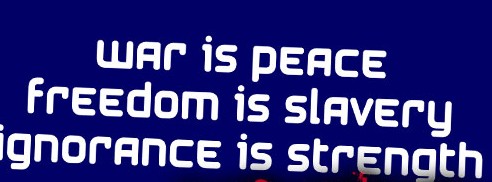 The government should not impose its values on the people of American, unless of course, its christian religious values. I wonder if anyone in the GOP has read George Orwell’s 1984, because they certainly seem to be running from the same playbook as the Party….
Jon Stewart and the Daily Show once again bring to light the blatant hypocrisy of the godbag infested GOP.
 Seeing history from a different perspective is often an enlightening experience. Noam Chomsky is a excellent guide to a historical narrative that makes sense and fits the facts of the situation, as opposed to what we are told by approved sources. It is a long read, somehow sadly classified as a radical perspective, but well worth your time. The media in the US often do not publish Chomsky’s work despite its accuracy and veracity, because publishing it might actually stir public opinion and motivate people to get involved with their government. It is left to alternative media organizations and Al Jazeera to find insight on how the world really works without the usual mainstream blinders.
“Significant anniversaries are solemnly commemorated – Japan’s attack on the US naval base at Pearl Harbor, for example. Others are ignored, and we can often learn valuable lessons from them about what is likely to lie ahead. Right now, in fact.
At the moment, we are failing to commemorate the 50th anniversary of President John F Kennedy’s decision to launch the most destructive and murderous act of aggression of the post-World War II period: the invasion of South Vietnam, later all of Indochina, leaving millions dead and four countries devastated, with casualties still mounting from the long-term effects of drenching South Vietnam with some of the most lethal carcinogens known, undertaken to destroy ground cover and food crops.
The prime target was South Vietnam. The aggression later spread to the North, then to the remote peasant society of northern Laos, and finally to rural Cambodia, which was bombed at the stunning level of all allied air operations in the Pacific region during World War II, including the two atom bombs dropped on Hiroshima and Nagasaki. In this, Henry Kissinger’s orders were being carried out – “anything that flies on anything that moves” – a call for genocide that is rare in the historical record. Little of this is remembered. Most was scarcely known beyond narrow circles of activists.
When the invasion was launched 50 years ago, concern was so slight that there were few efforts at justification, hardly more than the president’s impassioned plea that “we are opposed around the world by a monolithic and ruthless conspiracy that relies primarily on covert means for expanding its sphere of influence” and if the conspiracy achieves its ends in Laos and Vietnam, “the gates will be opened wide”.
Elsewhere, he warned further that “the complacent, the self-indulgent, the soft societies are about to be swept away with the debris of history [and] only the strong… can possibly survive”, in this case reflecting on the failure of US aggression and terror to crush Cuban independence.
By the time protest began to mount half a dozen years later, the respected Vietnam specialist and military historian Bernard Fall, no dove, forecast that “Vietnam as a cultural and historic entity… is threatened with extinction…[as]…the countryside literally dies under the blows of the largest military machine ever unleashed on an area of this size”. He was again referring to South Vietnam.
When the war ended eight horrendous years later, mainstream opinion was divided between those who described the war as a “noble cause” that could have been won with more dedication, and at the opposite extreme, the critics, to whom it was “a mistake” that proved too costly. By 1977, President Carter aroused little notice when he explained that we owe Vietnam “no debt” because “the destruction was mutual”.
 There are important lessons in all this for today, even apart from another reminder that only the weak and defeated are called to account for their crimes. One lesson is that to understand what is happening we should attend not only to critical events of the real world, often dismissed from history, but also to what leaders and elite opinion believe, however tinged with fantasy. Another lesson is that alongside the flights of fancy concocted to terrify and mobilise the public (and perhaps believed by some who are trapped in their own rhetoric), there is also geostrategic planning based on principles that are rational and stable over long periods because they are rooted in stable institutions and their concerns. That is true in the case of Vietnam as well. I will return to that, only stressing here that the persistent factors in state action are generally well concealed.
The Iraq war is an instructive case. It was marketed to a terrified public on the usual grounds of self-defense against an awesome threat to survival: the “single question”, George W Bush and Tony Blair declared, was whether Saddam Hussein would end his programs of developing weapons of mass destruction. When the single question received the wrong answer, government rhetoric shifted effortlessly to our “yearning for democracy”, and educated opinion duly followed course; all routine.
Later, as the scale of the US defeat in Iraq was becoming difficult to suppress, the government quietly conceded what had been clear all along. In 2007-2008, the administration officially announced that a final settlement must grant the US military bases and the right of combat operations, and must privilege US investors in the rich energy system – demands later reluctantly abandoned in the face of Iraqi resistance. And all well kept from the general population.
Gauging American decline
Sean makes some great points, let me reiterate them. Why are parents allowed to watch their child die because they believe in magic? Christian Science and faith healing are utter bullshite and yet they continue to torture children, often to death, because of their mysticism. The Christian Right then gets a seismic stiffy over universal healthcare and the fatuous notion of death panels, while they say NOTHING about those who choose to let their children die from treatable ailments. Where is the outcry from the religious pro-lifers? Oh well it doesn’t involve stripping away female bodily autonomy and it is murder in a religiously approved away so it must not count.
Frak Off.
The hypocrisy of the religious right is appalling. They should never be regarded as a source of moral guidance on any issue, ever.
This is a repost from askepticrtn.com it is important concisely written work that needs to be shared and amplified in the Canadian Blogosphere.
Another Resignation at Statistics Canada
February 12, 2012 in General Science by askeptic
On February 01, Philip Cross, Chief Economic Adviser at Statistics Canada announced his leaving the agency. He follows the head of the agency, Munir Sheikh, who resigned last year over Government plans to redesign the Census. Mr. Cross is leaving for much the same reason.
At issue is replacing a compulsory census questionnaire with a voluntary questionnaire. In essence, this means replacing a random sample with a discretionary sample. Discretionary samples have their applications, but making inferences about the population isn’t one of them. Unfortunately, making just these types of inferences is whole point of the Census. That’s why Mr. Sheikh wrote in an open letter to the Government:
“I want to take this opportunity to comment on a technical statistical issue which has become the subject of media discussion … the question of whether a voluntary survey can become a substitute for a mandatory census . . . It can not.” “Under the circumstances, I have tendered my resignation to the Prime Minister.”
Mr. Cross is quoted in the Globe and Mail as expressing concern “that the free exchange of ideas at the agency is diminishing, and that internal dissent is no longer being tolerated by senior managers – particularly when it comes to discussions about the 2011 census and new national household survey.” He goes further by saying: “a lot of good can be offset if you get one big thing wrong – and the big thing in this instance is census and NHS.”
At least we know the two people at Statistics Canada (well, formerly at StatsCan) with some sense of public service and responsibility. Now that they’ve left, StatsCan should be free from such annoyances.
Long form census data is worthless. The efforts to gather it, a waste of taxpayers money. Minister Tony Clement claims that he has his magic mojo working, enabling StatsCan to overcome the limitations of the mathematical and statistical sciences. I hope he shares it with the rest of us.
One question remains though, who will be rewriting all those science textbooks?

The New Corporate Logo for Alberta Power Companies - "Plunder"
And make no mistake it is a generous gift.
“In Alberta, the big standout price increase was for electricity, which cost 63.6 per cent more in January than it did a year ago,” he said.
Go figure. When the people who generate the power also control the supply do you think that they will manipulate the system of their benefit? Of course they will.
“In the wake of revelations that TransAlta Corp. manipulated the power market to increase profits, a report to the Alberta monitor warns there’s a risk that participants may be working together to the same end.
The study prepared by consultancy Charles River Associates for the Alberta Market Surveillance Administrator, the enforcement arm of a system set up when Alberta deregulated its power market in 1995, looks into whether the level of data released makes it possible for participants to work in concert — but not whether they actually have.
It concludes that the Alberta market “may be susceptible to co-ordinated behaviour” because it has high supplier concentration, barriers to entry, repeated and frequent interaction by players and relatively constant levels of demand.
So the situation is ripe for plunder of Alberta’s citizens and plunder is exactly what TransAlta did.
“In a negotiated settlement with the MSA, TransAlta agreed to pay $370,000 and admit it purposely blocked the import of cheaper hydroelectric power from British Columbia over 31 hours in November 2010, creating an artificial shortage of electricity and higher prices.
The settlement, which takes away excess profits of $245,000 and includes a $125,000 fine, will be the subject of an Alberta Utilities Commission public hearing in January.”
This is why we need regulation and strong government oversight because this is just one reported incident that happened to be egregious enough to be caught. Companies do not work for the pubic or the public good, they work to accrue the largest benefit of their shareholders and as noted above if swindling the people of alberta is good for the bottom line, so be it. Yet the lovely PC government goads us with whip and and the bludgeon to buy into this corrupt system.
“Alberta’s regulated rate option — the rate consumers pay if they haven’t signed contracts with electricity retailers — was designed by the provincial government to encourage retail consumers to purchase contracts, which would theoretically attract more competition.
In July 2010, the governing Conservatives ended long-term hedging of electricity prices and collapsed the protective umbrella that had previously shielded residential, farm and small commercial consumers from wild price spikes.”
This simple is collusion with the power companies by the PC party. This is not in the best interests of people of Alberta. Far from it. But let me assure you gentle readers, the brain-dead zombie sheeple of Alberta will continue to vote PC in the next election. Why? Your guess is as good as mine.
 It is good to see yet another right wing fanatic has a crunchy crazy wing-nut history. Savor the irony when suddenly(?) they attempt to get all serious and try interacting with empirical reality. Ezra Levant has little traction with reality and seems to have more interest in keeping his oil friends happy and trying to convince you to do the same.
Lets take a look at how well EL-Douche’s latest work stand up to criticism from a writer in the U.K. –
“Apart from being based on a premise that is largely irrelevant to the concerns of tar sands critics (that the tar sands are by far the most energy intensive source of fuel around, that they are endangering the lives and livelihoods of first nations peoples, that the toxic waste is poisoning the water and local wildlife, that they are an incredibly inefficient use of Canada’s natural gas supply), Levant’s book is incredibly poorly researched. His references are from newspaper articles, blogs, press releases – hardly an academic journal in sight.” (emphasis mine)
You fail EL-douche… as usual. But, then lets see what someone who deals with reality has to say on the oilsands issue…
“Ripping a page — or the cover — from fellow Conservative and former tobacco industry lobbyist Ezra Levant’s book, Prime Minister Stephen Harper and his new environment minister, Peter Kent, have taken to referring to the product of the Alberta tar sands as ethical oil.
The Prime Minister and Mr. Levant go back a long way. It was Mr. Levant who reluctantly stepped aside as the Alliance candidate in Calgary Southwest so that Mr. Harper could run in a by-election there in 2002. But the “ethical oil” argument they promote has holes as big as the ones in the ground around Fort McMurray.
To start, the logic is faulty. Just because a country or society is considered “ethical” does not mean everything it produces or exports is ethical. If we are going to delve into the ethics of the issue, we must look at the ethics of energy overall. That means considering the impacts of various energy systems on people and the environment.
Here, the science is troubling. It shows that the Alberta tar sands contribute to about five per cent of Canada’s greenhouse gas emissions and are the country’s fastest growing source of emissions. To date, they have disturbed 600 square kilometres of boreal forest with little or no chance of true reclamation, use enormous amounts of water, and pollute the surrounding air and water.
This past summer, an independent, peer-reviewed scientific study showed that toxic byproducts from the tar sands extraction industry are poisoning the Athabasca River, putting downstream First Nations communities and the fish they eat at risk. Health studies show these First Nations communities already have elevated rare cancers associated with exposure to such toxins.
If this is the most “ethical” source of oil we can find, we need to ask other questions about the moral purity of our intensively processed bitumen. For example, if we sell the oil to countries with poor human-rights records, like China, does that affect the product’s “ethical” nature? And how “ethical” are the companies operating in the tar sands; for example, Exxon Mobil, well-known sponsor of climate-change disinformation campaigns; BP, responsible for last year’s massive oily disaster in the Gulf of Mexico; or PetroChina? There’s also the effect of greenhouse gas emissions on our children and grandchildren, which to me is an intergenerational crime.
In this light, wouldn’t energy from technologies or sources that limit the greenhouse gas emissions that contribute to climate change and that have a minimal environmental and health impacts be far more ethical than fossil fuels? And, from an economic perspective, wouldn’t these more ethical technologies or fuel sources be doubly attractive to foreign buyers if they came from an “ethical” country like Canada?
As award-winning Alberta author Andrew Nikiforuk has argued, with proper development, the tar sands could help provide Canada with the oil and money we need to shift to a low-carbon economy. But major changes are needed. Environmental regulation and monitoring must be strengthened. Pollution and related health problems must be addressed. More of the revenue must go to Canadians rather than fossil fuel companies. And a national carbon tax would help us move from oil to less-polluting energy sources.
The problem is, no matter what Ezra Levant and his friends in government say, oil has never been about “ethics”. It has always been about money. Those who argue the case for “ethical oil” should work to ensure that our energy needs are met in a truly ethical way, now and into the future. In the end, the only truly ethical solution is to phase out oil. The black eye that tar sands oil is sporting can’t be remedied with meaningless phrases such as “ethical oil”.
To be seen as truly ethical when it comes to energy policy, Canada must slow down tar sands development, clean up the environmental problems, implement a national carbon tax, improve the regulatory and monitoring regime, and make sure that Canadians are reaping their fair share of the revenues. We must also start taking clean energy seriously. Rather than subsidizing the tar sands and all the fossil fuel industry through massive tax breaks, we should be investing in energy technologies that will benefit our health, economy, and climate.
It might also help if Canada’s environment minister spent more time protecting the environment rather than appeasing the oil industry and its apologists.”
Thanks Dr.Suzuki for providing a reasonable version of what is actually happening in the Tarsands and what must be done.











 bleatmop
 Mystro
 The Arbourist


 Dead Wild Roses
Your opinions…