
You are currently browsing the category archive for the ‘Science’ category.
A recently published paper by Jonathan Cohler in the winter 2025 issue of the Journal of American Physicians and Surgeons (JPANDS) argues that the global mean surface temperature (GMST)—the key metric underpinning international climate agreements like the Paris Accord—is thermodynamically and mathematically meaningless.
Cohler revives and highlights a 2007 analysis by Christopher Essex, Ross McKitrick, and Bjarne Andresen (published in the Journal of Non-Equilibrium Thermodynamics), which demonstrated through physical and mathematical proofs that no single “global temperature” has physical meaning in the context of global warming. Different averaging methods applied to the same temperature data can produce arbitrarily different trends, rendering GMST an invalid intensive property (like averaging the temperature of boiling water and bathwater, or points on Mount Everest and the Sahara).The author contends that trillions in climate policy spending hinge on this “fiction,” with bodies like the International Standards Organization declining to define GMST and the IPCC offering only circular definitions.
Cohler concludes that reliance on such a metric indicates climate science has shifted toward political ends rather than physical reality.
Context and Counterpoints: The 2007 Essex et al. paper has been critiqued in mainstream climate science circles (e.g., a 2007 RealClimate response) as philosophically interesting but practically irrelevant. GMST is defended not as a strict thermodynamic temperature but as a statistical index or proxy that effectively tracks planetary heat content changes, particularly from well-mixed greenhouse gases. It correlates strongly with independent measures like ocean heat uptake (in joules) and enhances signal-to-noise ratios for detecting anthropogenic forcing.
The JPANDS, published by the Association of American Physicians and Surgeons (AAPS), is known for politically conservative viewpoints and has faced criticism for promoting non-mainstream positions on topics like climate change, vaccines, and health policy. It is not indexed in major databases like PubMed and is often described as outside the scientific consensus.This paper adds to ongoing debates about climate metrics but echoes long-standing arguments that have not shifted the broader scientific agreement on warming trends and their causes.

This quote from@prof_curiosity on X: Piaget: The construction of learning
“Piaget viewed children as “little scientists” who actively construct knowledge by testing and refining mental schemas, most often through play. Through assimilation (fitting new experiences into existing schemas) and accommodation (adjusting schemas when they do not fit), driven by equilibration (resolving confusion), children progress through four stages: sensorimotor, preoperational, concrete operational, and formal operational.Development is a self-motivated process of making sense of the world. Adults naturally introduce their own schemas to children; most are well-meaning and beneficial. However, it is hard to imagine a more destructive schema for young children than that of ‘gender identity.’ Piaget’s theory explains how and why children adopt this adult shortcut to achieve equilibration.Simply it provides easy answers to difficult questions.What transgender ideology offers these playful child scientists is a highly self-destructive, adult schema (construct) wholly unsuitable for their developing, vulnerable minds. This schema, if pushed by significant adults, can easily be assimilated into a child’s learning patterns, providing ready made answers (equilibration) to questions the child would be years away from naturally asking; along with terrible, self-destructive answers to natural self-doubts. Thus, for a toddler girl: “Why do I prefer to play with boys’ things, etc.?” The inserted adult schema answers, “Because you are really a boy.” Of course the correct answer would be, “Because that is who you are” backed up with, “And you are perfect as you are – so carry on playing”.However transgenderism is not interested in children growing into well balanced adults. It targets vulnerable, especially autistic children, with undeveloped schemas who can be convinced that the way to achieve equilibration is to perform “being transgender”. It needs these (trans) children to provide cover for adult autogynephiles.This brilliant application of Piaget’s theory highlights why imposing adult “gender identity” concepts on children short-circuits their natural cognitive development—and why it’s especially harmful for vulnerable groups like autistic kids.”
Evidence backs this up: A 2023 systematic review and meta-analysis found a clear overlap between autism spectrum disorder (ASD) and gender dysphoria/incongruence, with autistic youth far more likely to experience it, likely due to challenges with flexible schemas and social understanding.”
https://pubmed.ncbi.nlm.nih.gov/35596023/The UK’s independent Cass Review (2024) went further: after rigorous systematic evidence reviews, it concluded the evidence for puberty blockers and hormones in minors is weak, with risks (e.g., bone density loss, fertility impacts) outweighing unproven benefits. It recommends extreme caution and holistic care over rapid affirmation.
Full report: https://cass.independent-review.uk/final-report/We must protect children’s natural exploration through play and affirm their bodies as they are. Imposing ideology that locks in confusion isn’t kindness—it’s harm. Prioritize evidence-based therapy and watchful waiting.

Introduction
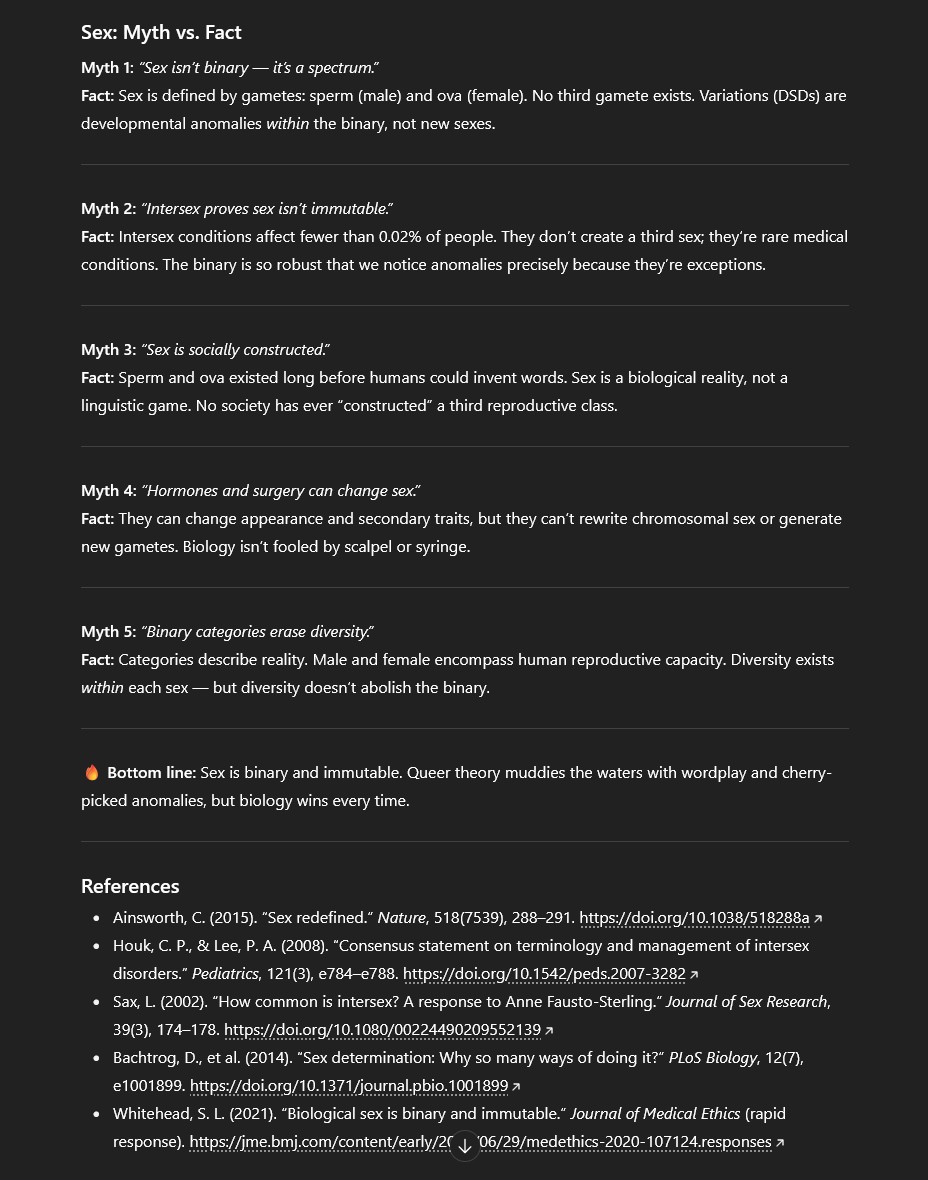
Despite activist claims that human sex exists on a continuum, biological science tells a different story. Sex in humans is binary, rooted in the immutable organization of the body to produce one of two gamete types: sperm or ova. Disorders of sex development (DSDs) do not blur this binary—they confirm it by illustrating how rare developmental anomalies still adhere to the underlying male or female blueprint. Understanding this distinction is crucial for preserving scientific integrity and fostering honest dialogue about the difference between sex and gender.
1. Sex Is Binary and Immutable
When confronting individuals who assert that human sex constitutes a spectrum due to the existence of disorders of sex development (DSDs), one must begin by clarifying foundational biological truths. Sex in humans is binary and immutable, determined by the organization of reproductive anatomy to produce either small gametes (sperm) or large gametes (ova). This distinction remains fixed from conception and unaltered by developmental anomalies.
This binary framework arises from anisogamy—the biological system in which two and only two gamete types exist. Evolutionary pressures favored this division because it optimizes reproductive success; the fusion of small and large gametes is the only mechanism by which human life continues. Any notion of a “sex continuum” is therefore biologically untenable.
Crucially, sex must not be conflated with gender. Sex is an observable, material reality rooted in chromosomes, hormones, and anatomy. Gender, by contrast, encompasses socially constructed roles, behaviors, and stereotypes arbitrarily imposed on the sexes—norms that often perpetuate hierarchies or restrict personal freedom. Conflating these categories distorts both science and social ethics.
2. What DSDs Actually Are
Disorders of sex development, often mischaracterized as evidence for a sex spectrum, are in fact sex-specific developmental conditions that affirm the binary nature of sex. These rare congenital variations—affecting roughly 0.018 percent of births—involve ambiguities in genital, gonadal, or chromosomal development but align with either male or female pathways, not a third category.
For instance, congenital adrenal hyperplasia (CAH) and androgen insensitivity syndrome (AIS) both occur in individuals whose biology is oriented toward one sex, with deviations resulting from genetic mutations or hormonal disruptions. These do not create functional intermediates or new reproductive categories.
Such specificity underscores the binary: DSDs are developmental errors within male or female pathways, not the emergence of a new sex. Individuals with DSDs typically produce—or are organized to produce—only one type of gamete if fertile at all. The biological reality of sex, therefore, remains intact and immutable.
3. Why Exceptions Prove the Rule
The argument that DSDs invalidate the binary misconstrues both scientific reasoning and logic. In truth, these exceptions prove the rule by demonstrating the natural order they deviate from. Biological rules are typological but real: their edges may blur, but the underlying structure remains dichotomous.
True hermaphroditism—where an individual possesses both ovarian and testicular tissue—is vanishingly rare and almost always results in sterility or nonfunctional gonadal tissue. Far from undermining the binary, such anomalies illustrate its boundaries and reinforce its robustness.
DSDs represent developmental anomalies with low reproductive fitness, actively selected against by evolution. Their existence shows that the sex binary is the viable and stable norm for human reproduction. Without such exceptions, the binary framework could not be empirically tested or confirmed; their rarity and deleterious effects affirm its validity.
4. The Gamete Criterion: Biology’s Final Word
A decisive refutation of the “sex spectrum” claim lies in the absence of a third gamete type in humans. Human reproduction depends exclusively on the fusion of sperm and ova. No intermediate or alternative gamete exists, confining sex to two categories:
- Male — organized to produce small gametes (sperm)
- Female — organized to produce large gametes (ova)
Even in rare ovotesticular conditions, any functional gametes—if produced—belong to one type, not a hybrid or new category. Evolutionarily, the emergence of a third gamete type would represent an entirely new reproductive strategy, a macroevolutionary shift not observed in any vertebrate species.
This gamete binary, enforced by genetic mechanisms such as imprinting and gonadal inhibition, precludes hermaphroditism and parthenogenesis in humans and other mammals. As such, sex is not a spectrum but a digital dichotomy essential for genetic propagation.
5. Engaging with Honesty and Precision
When engaging those who conflate DSDs with a sex spectrum, redirect the discussion to verifiable evidence rather than ideology. Clarify the distinction between sex’s biological immutability and gender’s social construction. Acknowledge the human dignity of individuals with DSDs while affirming that their existence does not alter the fundamental binary of human sex.
Binary does not mean uniformity. Just as handedness is binary yet exhibits variation, sex is binary but allows for rare deviations that do not create new categories. By citing the gamete criterion and the sex-specific nature of DSDs, one can show that exceptions test and affirm the rule—they do not abolish it.
This approach promotes truthful, constructive dialogue and safeguards scientific discourse from the encroachment of ideological distortion.

References
- Arboleda, V. A., et al. (2014). Disorders of sex development: Revisiting the spectrum. Endocrine Reviews, 35(6), 945–967. https://pmc.ncbi.nlm.nih.gov/articles/PMC10265381/
- Bachtrog, D., et al. (2014). Sex determination: Why so many ways of doing it? Nature Reviews Genetics, 15(11), 783–797.
- Lee, P. A., et al. (2006). Consensus statement on management of intersex disorders. Pediatrics, 118(2), e488–e500.
- Parker, G. A., Baker, R. R., & Smith, V. G. F. (1972/2011). The evolution of anisogamy: A fundamental change in reproductive biology. Philosophical Transactions of the Royal Society B, 366(1566), 257–270.
- Sax, L. (2002). How common is intersex? Journal of Sex Research, 39(3), 174–178. https://pubmed.ncbi.nlm.nih.gov/12476264/
- National Association of Scholars. (2020). In Humans, Sex Is Binary and Immutable. https://www.nas.org/academic-questions/33/2/in-humans-sex-is-binary-and-immutable
- City Journal. (2022). Understanding the Sex Binary. https://www.city-journal.org/article/understanding-the-sex-binary
- World Health Organization. (n.d.). Gender and Health. https://www.who.int/health-topics/gender
If you think that arguments based in truth, eventually you will run up against people who are so deep into the gender-cult that they have no idea what is real and what is dogma.

Be careful though, your audience will often defend their dogmatic views by any means necessary: Name calling, threats, and excommunication from the arena.
Tread with care and realize that you need to love the truth more than the shallow “acceptance” of others.
No so gentle reminder of the reality of the situation.
The full text of the Health and Human Services Systematic review can be found here.
Introduction
In our final post, we explore the systematic review’s findings on psychotherapy as an alternative to medical interventions for pediatric gender dysphoria, alongside international shifts in treatment approaches. The Department of Health and Human Services’ 2025 report (Chapter 14, pages 239-259) highlights the potential of non-invasive psychotherapy and the growing global retreat from medicalized care.
Key Findings on Psychotherapy and Global Trends
The review notes a significant gap in research on psychotherapeutic approaches for gender dysphoria, partly due to the mischaracterization of such treatments as “conversion therapy” (page 252). However, psychotherapy is a well-established, non-invasive method for managing mental health conditions, including those often co-occurring with gender dysphoria, like depression and anxiety (page 248). Systematic reviews have found no evidence of harm from psychotherapy in this context, unlike medical interventions, which carry significant risks (page 16).
Internationally, countries like Finland, Sweden, and the UK have shifted away from the “gender-affirming” model, prioritizing psychosocial interventions (pages 142-145). The UK’s Cass Review, for instance, found weak evidence for medical interventions and recommended psychotherapy as a first-line approach (page 63). These countries have restricted puberty blockers and hormones due to concerns about their safety and efficacy, reflecting a broader recognition of the need for caution (page 56).
Looking Forward
The rise in youth gender dysphoria coincides with a broader mental health crisis among adolescents, suggesting that social and psychological factors may play a significant role (page 239). Psychotherapy offers a way to address these underlying issues without the irreversible risks of medical interventions. As more countries adopt this approach, the U.S. faces pressure to align its practices with emerging evidence.
Three Arguments Against Transitioning Children
-
Psychotherapy as a Safer Alternative: Psychotherapy is a non-invasive option with no reported adverse effects in treating gender dysphoria, unlike medical interventions that risk serious harm (page 16).
-
International Restrictions Highlight Risks: Countries like the UK and Sweden have restricted medical interventions due to weak evidence and significant risks, suggesting a need for caution in the U.S. (page 56).
-
High Rates of Natural Resolution: The natural history of gender dysphoria shows that it often resolves without medical intervention, supporting the use of psychotherapy to explore identity without irreversible steps (page 21).
References
-
Department of Health and Human Services. (2025). Treatment for Pediatric Gender Dysphoria: Review of Evidence and Best Practices, page 16.
-
Ibid., page 56.
-
Ibid., page 21.

Find the full HSS Systematic Review here.
Introduction
In our second post, we dive deeper into the risks associated with medical treatments for pediatric gender dysphoria, as outlined in the Department of Health and Human Services’ 2025 review. While proponents of “gender-affirming care” argue these interventions are essential, the systematic review (Chapter 7, pages 106-124) highlights significant physiological and psychological risks that deserve careful consideration.
Key Findings on Risks
The review details how puberty blockers, cross-sex hormones, and surgeries impact young bodies. Puberty blockers, used to halt natural pubertal development, can lead to impaired bone mineral density, increasing the risk of fractures later in life (page 110). They may also affect neurocognitive development and sexual function, with potential long-term consequences that are not fully understood (pages 111-112). Cross-sex hormones, such as testosterone for girls or estrogen for boys, introduce risks like cardiovascular disease, metabolic disorders, and infertility (pages 118-119). Surgeries, though less common, carry risks of complications and regret, particularly when performed after early pubertal suppression (page 120).
The review emphasizes that these risks are not hypothetical—they are grounded in established physiological knowledge. For instance, blocking puberty disrupts normal developmental processes critical for bone, brain, and reproductive health (pages 108-112). Yet, the evidence for these interventions’ benefits remains weak, with systematic reviews unable to confirm improvements in mental health or quality of life (page 13).
Why This Matters
Children and adolescents are particularly vulnerable to these risks because their bodies are still developing. The irreversible nature of many of these effects—like sterility or surgical changes—raises ethical concerns about applying them to minors who may not fully grasp the long-term implications. The review’s findings align with international trends, such as restrictions in Finland and Sweden, where psychotherapy is now prioritized (pages 142-143).
Three Arguments Against Transitioning Children
-
Irreversible Physical Harms: Puberty blockers and hormones can cause permanent effects like infertility, reduced bone density, and sexual dysfunction, which are particularly concerning for developing children (page 14).
-
Uncertain Long-Term Outcomes: The review found no reliable evidence that medical interventions improve long-term mental health or quality of life, making the risk-benefit ratio unfavorable (page 13).
-
Ethical Concerns with Consent: Adolescents may lack the maturity to consent to treatments with lifelong consequences, especially given the uncertain benefits and significant risks (page 155).
References
-
Department of Health and Human Services. (2025). Treatment for Pediatric Gender Dysphoria: Review of Evidence and Best Practices, page 14.
-
Ibid., page 13.
-
Ibid., page 155.











 bleatmop
 Mystro


 Dead Wild Roses
Your opinions…