
Nothing like being bored with Feminism…
Nothing like being bored with Feminism…
Our choir will be singing this in May. My very first Mass. :) The counting in some of the movements are quite tricky, as young Mozart decided that switching between common and cut time was a cool thing to do.
The Mass in G major (K. 49/47d) is the first full mass composed by Wolfgang Amadeus Mozart. It is a missa brevis scored for SATB soloists, SATB choir, violin I and II, viola, and basso continuo.
Mozart wrote the Mass in G major at the age of 12. It was however neither his first setting of a part of the mass ordinary — two years earlier he had already composed a Kyrie (K. 33) —, nor was it his largest composition with a religious theme up to date: his sacred musical play Die Schuldigkeit des ersten Gebots had been premiered in the previous year.
Composed in Vienna in the autumn of 1768, this mass is Mozart’s only missa brevis to feature a viola part. It is not clear what occasion it was composed for, and it has been confused with the Waisenhausmesse, composed in the same year.
Religious music at the time was increasingly influenced by opera and Baroque embellishments in instrumentation; Mozart’s early masses, such as K. 49/47d, have been seen as a return to the more austere settings of the pre-Baroque era.
The six movements of the Mass follow the traditional Order of Mass:
- “Kyrie” Adagio, G major, common time
- “Kyrie eleison…” Andante, G major, 3/4
- “Gloria” Allegro, G major, common time
- “Credo” Allegro, G major, 3/4
- “Et incarnatus est…” Poco Adagio, C major, cut common time
- “Et resurrexit…” Allegro, G major, cut common time
- “Et in Spiritum Sanctum…” Andante, C major, 3/4; bass solo
- “Et in unam sanctam…” Allegro, G major, cut common time
- “Sanctus” Andante, G major, 3/4
- “Pleni sunt coeli et terra…” Allegro, G major, 3/4
- “Hosanna in excelsis…” Allegro, G major, 4/2
- “Benedictus” Andante, C major, 3/4; soloist quartet
- “Hosanna in excelsis…” Allegro, G major, 4/2
- “Agnus Dei” Adagio, G major, cut common time
- “Dona nobis pacem…” Allegro, G major, 3/8
Wow. Meghan Murphy simply and clearly posits what Feminism is about. Check out her blog here.
“There are various ways the divide between “feminisms” is articulated: liberal vs radical, third wave vs second wave, sex-positive vs sex-negative, but none of those have ever seemed wholly accurate to me. (In particular, challenging male-centred or coercive sex does not make one, “sex-negative,” so…) A feminist is someone who supports and/or is active in the fight to end patriarchy. The feminist movement is a political movement that fights towards women’s collective liberation and towards an end to male violence against women. That is to say, if you don’t support those goals, what you are doing is not feminism, no matter how many times you claim otherwise.
We cannot have both objectification and liberation, because being a sexualised object does not allow one to be a full human. We cannot both celebrate sexualised violence and have freedom from sexualised violence because sexualising violence, er… sexualises violence. We cannot normalise male entitlement by saying “men need access to sex and therefore we, as a society, must maintain a class of women who are available to satisfy men’s desires” and also expect to build a society wherein men don’t feel entitled to sexual access to women. We cannot say “women are more than pretty things to look at” but also tell young women that desirability will empower them. We cannot frame “choice” as political while simultaneously depoliticising and decontextualising the choices women make, in a capitalist patriarchy. We cannot confront rape culture while normalising the very ideas that found it: male entitlement, sexualised violence, and gender roles that are rooted in domination and subordination (i.e. masculinity and femininity).
While, the arguments I’m articulating here do, effectively, constitute “radical feminism,” in that it is a kind of feminism that “gets at the root,” I am defining something even more straightforward than that: Feminism – a real and definable thing that holds meaning!
[…]
“Join us or don’t – that really is your choice. But redefining a political movement that aims to protect real women’s lives and humanity in order to make the world more comfortable is not.”

Boom.

HAMILTON, OH—Despite being the beneficiary of numerous societal advantages and having faced little to no major adversity throughout his life, local man Travis Benton has spent the last four years squandering his white male privilege on a sales floor job at Best Buy, sources confirmed Tuesday. “You can get by with a regular HDMI cable, but if you’re looking at a length longer than 10 feet, I’d go with a gold-tipped one,” said the man dressed in a bright blue polo shirt and pin-on name tag as he continued to fritter away such innate life advantages as greater access to higher education, leniency from the justice system, and favorable treatment from other white males who lead and make hiring decisions at a disproportionately high number of American companies. “The AudioQuest gold-tip is actually the cable I use in my own home entertainment center and it provides excellent audio and video clarity, plus it comes with a full five-year warranty, unlike the 90-day warranty of a bargain brand. For your money, you’re not going to find a better cable.” At press time, the man born into the world’s most affluent and privileged socioeconomic group was spending his 15-minute break silently consuming a sleeve of Donettes purchased out of a vending machine.
I have to thank tumblr for occasionally putting such important concise definitions at my fingertips. So, let’s define what sex based oppression and where it comes from.
“As Friedrich Engels made clear, even before feminism’s First Wave, women were historically controlled because we are “a means of production”—without women, there are no heirs, and without heirs, no inherited property and wealth. Women’s reproductive capacity is why we were colonized as property, just as animals, countries, weapons and land was colonized. Otherwise, we wouldn’t have been important at all; any thing we could do (cooking, cleaning, sewing clothes) could have been done as well by men (and in the military, it was). The reason women were oppressed was to control our REPRODUCTIVE ABILITIES. This does not mean all women had these abilities, but women were assumed to have them until proven otherwise. (In many religious traditions, a woman’s “barren” status was the only acceptable reason for divorce.)
There can be no other logical, rational basis for women’s oppression; unless you think men were just being “mean” or something. No, it was for a very real, profit-centered reason. Men without families and heirs could not build empires (or even working farms) and without this centralized, religiously-sanctioned consolidation of the family, the state could not have evolved. The state then effectively empowered men to be women’s keepers until very very recently in human history.
THIS is the origin of women’s oppression.
So yes, women’s oppression is because of vaginas. Also: uteri, ovaries, ovum and menstrual cycles. That is just a fact. This is what got us consigned to the lower class, and our vulnerability during pregnancy and childbirth is historically what kept us weak and dependent on men. And this is how patriarchy evolved.
To write “vaginas” (or other female body-parts necessary for baby-making) out of the history of patriarchy and the evolution of the state, is flatly incorrect.
It is also anti-feminist, since this account effectively erases the one thing women were allowed to do, the one exception to our limitations: birthing and raising children. Anything women dared to do, had to be somehow connected to that. So, the first women artists and writers were women who painted their children’s portraits; sang their kids songs or made up stories and poems for them; knitted/crocheted/sewed their clothes, created pottery for the family to eat on, etc. Women’s creativity was harshly limited to domesticity like this, and yet, we found ways to express ourselves regardless. It is a story of SURVIVAL. To explain to our daughters (as Virginia Woolf did) why there is no female Shakespeare or Chaucer, is to go back to….. VAGINA. We were only allowed to have babies and failing that, teach or take care of some other woman’s babies.
Period.”
I apologize to my veteran blamers as this is 101 type stuff, but I like being able to link to posts that define a concept clearly. :)
[Source:“Gender is an Experience”]
This game has a long title, it is called Warhammer:Endtimes – Vermintide. Vermintide is a four player cooperative survival game, set in the Warhammer fantasy universe. People familiar with Valve’s Left4Dead series will be familiar with the play-style and challenges to be encountered in Vermintide.
The plot of the game resolves around the actions of the five playable heroes as they travel around the besieged city of Ubersreik. As this is a first person melee combat game all missions will revolve around you introducing the sharp end of your sword into the assorted Skaven rat beasts that serve as the enemies in Vermintide. Certainly, there is variation in theme, as there a missions where supplies are gathered or objectives are required to be destroyed, but make no mistake of where the focus lies in this game.

The focus of Vermintide is melee and the developer, FatShark, has done an excellent job of making rat smashing an exciting and challenging experience. Each character has a range of melee weapons that require different strategies adding a fair bit of depth to the game – for instance, choosing a two handed hammer versus a sword and shield combination will effect how the the player interacts with the levels.
The interaction with enemies is modelled very much on the Valve’s Left4Dead series with the Skaven hordes standing in for the zombie hordes that swarm the players. Being swarmed in game encourages the players to stick together and use the environment to their advantage to minimize the damage hordes can do. Facing down hordes would become stale quite quickly though, fortunately special classes of Skaven exist to only to wreck havoc and break apart tight knit groups of player characters.
- Skaven Gutter-Runners are agile, teleporting assassins that leap onto a player from medium distance. Assassins knock down their targets and require another player remove them.
- Skaven Globadiers or Gas-Rats throw area of effect poison clouds that break up the group.
- Skaven Ratling Gunners bring a mini-gun to the party and focus fire one of the members of the party.
- Skaven Packmasters bring are armed with a medieval man-catcher and will drag their victim away from the party.
- Skaven Rat Ogres – Huge, Durable, Uber-Rats that will punch or pound the players into submission.
The special Skaven force players to make quick tactical decisions as these specials are all high priority targets and always seem to show up with the party knee deep in regular Skaven.
 Knee deep in regular Skaven and constant besieged by specials – this formula keeps the pressure high through most maps. The difficulty level in Vermintide is quite challenging. This is one of those games where skipping the ‘easy’ and ‘normal’ levels is not a good idea. Without a firm grasp of Vermintide’s blocking and dodging mechanics novice players quickly succumb to the ravages of the Skaven horde.
Vermintide can be a grind, as better weapons are awarded only at the end of a completed map. Wiping halfway through a map grants only a small pittance of raw materials, and this barrier to progression can be frustrating at times.
Optimization issues still plague Vermintide as this game will put a heavy load on your CPU and GPU. Scaling down the graphics helps, but much work still remains for Fatshark when it comes to streamlining their code.
I’ve had a great deal of fun with Vermintide and if you have a beefy CPU and some friends who like cooperative action I would heartily recommend this game.
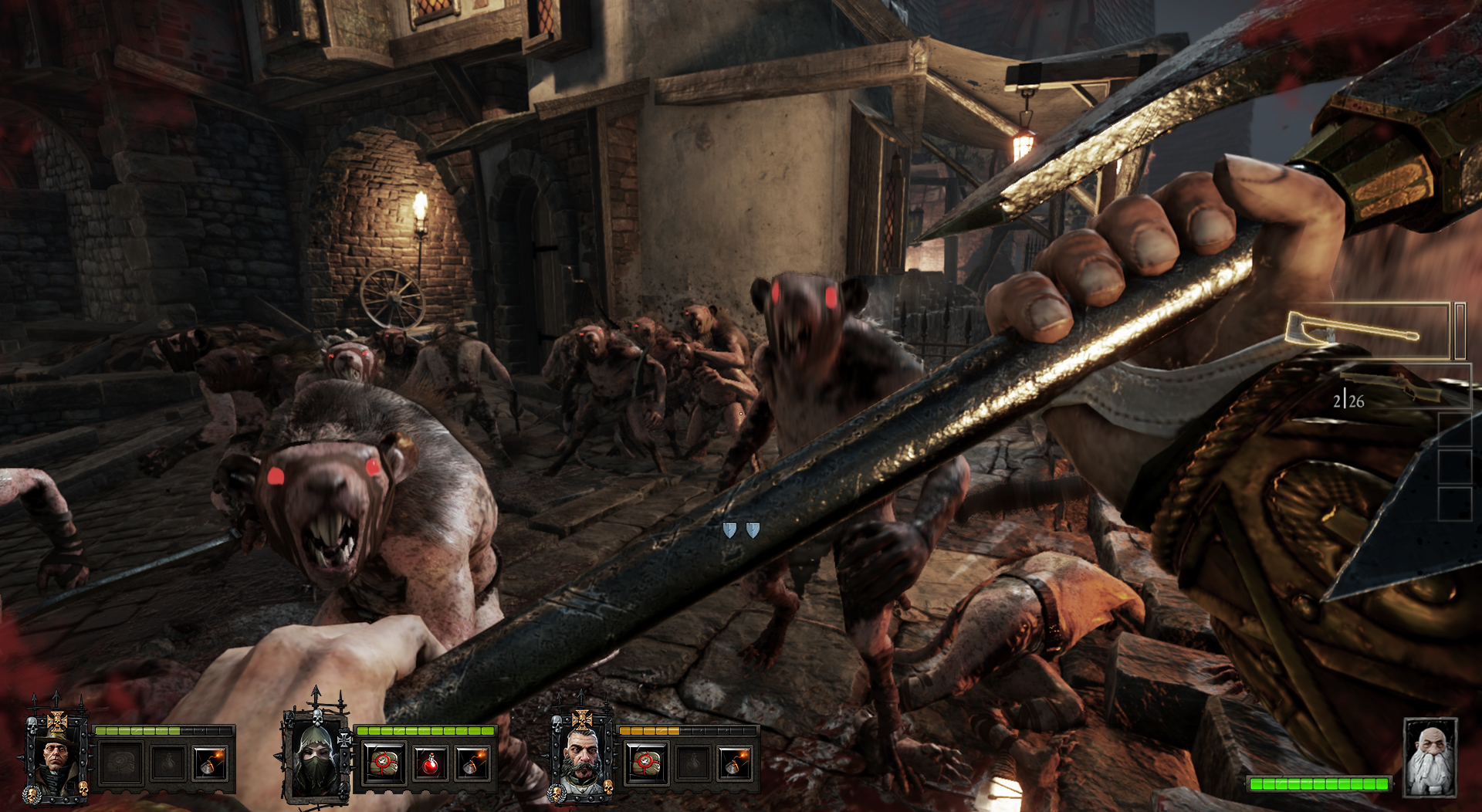
So many rats…
How untruth becomes truth; a good bit of insight into how religion becomes codified into society.











 bleatmop
 Mystro


 Dead Wild Roses
Your opinions…