
You are currently browsing the tag archive for the ‘Book Review’ tag.
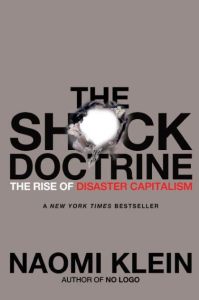 Naomi Klein’s The Shock Doctrine: The Rise of Disaster Capitalism (2007) is a searing indictment of neoliberalism, wielding a scalpel to dissect what Klein terms “disaster capitalism.” With relentless clarity, she argues that crises—natural, military, or economic—are exploited to ram through free-market policies that enrich elites while impoverishing the masses. The book’s 500-plus pages pulse with urgency, weaving history, economics, and geopolitics into a narrative as gripping as it is grim. Yet, its polemical zeal and occasional overreach—stretching causal links to near-conspiracy—risk undermining its rigor. This review outlines Klein’s thesis, summarizes the book’s contents, and critically assesses its claims with precise quotations and citations.
Thesis: Crisis as Capitalist Opportunity
Klein’s central thesis is that neoliberal policies, championed by Milton Friedman and the Chicago School, thrive on chaos. She argues that “the shock doctrine” exploits moments of collective trauma—wars, coups, natural disasters—to impose deregulation, privatization, and austerity, policies that “no one votes for” in free elections (Klein, 2007, p. 140). These shocks create a “blank slate” for corporate interests, as populations, disoriented by crisis, cannot mount effective resistance. “An economic system that requires constant growth… generates a steady stream of disasters all on its own,” she writes, citing financial crashes and wars as both byproduct and enabler of this system (p. 425). Klein challenges the myth of neoliberalism’s democratic triumph, asserting it relies on “violence and shock perpetrated on people, on countries, on economies” (p. 9). While compelling, her thesis occasionally flirts with hyperbole, implying intent where chaos and opportunism may suffice.
Summary of Contents
The Shock Doctrine spans seven parts, tracing neoliberalism’s rise through global case studies. Part 1 draws a provocative parallel between economic “shock therapy” and psychiatric experiments by Ewen Cameron, whose CIA-funded electroshock treatments aimed to “wipe” patients’ minds for reprogramming—a metaphor for neoliberalism’s erasure of existing economic orders (p. 29). Part 2 examines South America in the 1970s, focusing on Chile’s 1973 coup against Salvador Allende. Klein details how “Chicago Boys,” Friedman-trained economists, used Pinochet’s dictatorship to impose “shock treatment” policies like privatization, noting that “torture… was a tool used to build and maintain this free-market laboratory” (p. 105).
Parts 3 and 4 analyze the doctrine’s spread to Poland, Russia, South Africa, and Asia during the 1997 financial crisis, where “the destruction of entire societies” enabled rapid market reforms (p. 237). Part 5 introduces the “disaster capitalism complex,” a network of corporations profiting from privatized disaster response, as seen in post-tsunami Sri Lanka, where “developers… cleared fishing communities off the coasts” for luxury hotels (p. 381). Part 6 dissects Iraq post-2003, described as “the ultimate expression” of the doctrine, with “an orgy of privatization” amid war’s chaos (p. 381). The Conclusion highlights resistance, citing South America’s rollback of neoliberal policies and grassroots activism in Lebanon and South Africa as signs of hope (p. 455). Klein’s narrative is vivid, but her reliance on dramatic examples sometimes overshadows systemic analysis.
Critical Assessment
Klein’s strength lies in her meticulous research—four years of on-the-ground reporting—and her ability to connect disparate events into a coherent narrative. Reviewers like John Gray praise it as “one of the very few books that really help us understand the present,” noting its exposure of neoliberalism’s reliance on crisis (The Guardian, 2007). Stephen Amidon affirms its relevance to Iraq, where “Rumsfeld’s decision to allow the looting of the nation’s cultural identity” aligns with Klein’s thesis (New York Observer, 2007). Yet, critics like Joseph Stiglitz argue that her parallel between Cameron’s experiments and economic policy is “overdramatic and unconvincing,” stretching causality (The New York Times, 2007). The Economist is harsher, calling the book “a true economics disaster” for claims like the Falklands War spurring neoliberalism in Britain, which lack robust evidence (The Economist, 2007).
Klein’s portrayal of neoliberalism as a monolithic force can oversimplify. Her claim that “the Argentinian invasion of the Falklands was done in order to spur neoliberal reforms in Britain” (p. 131) is speculative, as geopolitical motives were more complex. Similarly, her assertion that Tiananmen Square “spurred China’s turn to the market” ignores China’s pre-1989 economic reforms (p. 171). As Shashi Tharoor notes, Klein is “too ready to see conspiracies where others might discern… chaos and confusion” (The Washington Post, 2007). Her focus on corporatism—where “public wealth [is turned] to private companies” (Bookbrowse, 2007)—is incisive, but risks conflating opportunistic profiteering with deliberate orchestration. Still, her evidence of profiteering, like Halliburton’s profits in Iraq’s “ghoulish dystopia” (p. 429), is damning and well-documented.
Conclusion
The Shock Doctrine is a tour de force, exposing the predatory underbelly of neoliberalism with a ferocity that demands attention. Its narrative, as Arundhati Roy declares, is “nothing less than the secret history of what we call the ‘free market’” (Amazon, 2007). Yet, its occasional lapses into exaggeration—casting every crisis as a calculated capitalist plot—dilute its precision. Klein’s call to resist, grounded in examples of grassroots pushback, offers hope, but her vision of systemic change feels underdeveloped. Read it for its revelatory scope, but temper its claims with skepticism: the truth of disaster capitalism is chilling enough without embellishment.
References
- Klein, N. (2007). The Shock Doctrine: The Rise of Disaster Capitalism. Picador.
- Gray, J. (2007). “The Shock Doctrine by Naomi Klein.” The Guardian. Retrieved from https://www.theguardian.com/books/2007/sep/15/politics.
- Amidon, S. (2007). “The Shock Doctrine.” New York Observer. Retrieved from https://observer.com/2007/09/the-shock-doctrine/.
- Stiglitz, J. E. (2007). “The Shock Doctrine by Naomi Klein.” The New York Times. Retrieved from https://www.nytimes.com/2007/09/29/books/review/Stiglitz-t.html.
- The Economist. (2007). “Naomi Klein Smackdown Roundup.” Retrieved from https://www.economist.com/blogs/freeexchange/2007/10/naomi_klein_smackdown_roundup.
- Tharoor, S. (2007). “The Shock Doctrine by Naomi Klein.” The Washington Post. Retrieved from https://www.washingtonpost.com/wp-dyn/content/article/2007/09/28/AR2007092801350.html.
- Bookbrowse. (2007). “The Shock Doctrine by Naomi Klein.” Retrieved from https://www.bookbrowse.com/reviews/index.cfm/book_number/2025/the-shock-doctrine.
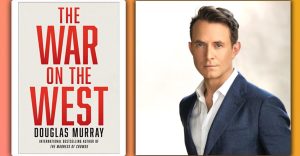 Douglas Murray’s The War on the West: How to Prevail in the Age of Unreason (2022) is a polemic that surges with conviction, decrying what Murray perceives as a concerted attack on Western civilization. With razor-sharp prose, he skewers ideologies he believes erode the West’s cultural and intellectual foundations. Yet, while his fervor galvanizes, the book’s reliance on selective evidence and occasional factual missteps muddies its truth-seeking ambition. This review outlines Murray’s thesis, summarizes the book’s contents, and critically assesses its claims with precise quotations and citations to ensure rigor.
Thesis: A Civilization Besieged
Murray argues that Western civilization faces an existential threat from within—a cultural war waged by ideologues who vilify its history and values while ignoring its triumphs. He contends that “the West is now the only major power bloc in the world that is talked about as though its very existence is a question, a problem, or a sin” (Murray, 2022, p. 7). This assault, he claims, stems from revisionist narratives—particularly around race, history, and culture—that weaponize guilt to dismantle reason and unity. Terms like “anti-racism” have been “twisted into a desire for vengeance” (p. 53), he asserts, urging a defense of Western principles as universal goods. While compelling, this thesis oversimplifies: Murray’s portrayal of the West as uniquely scapegoated sidesteps global critiques of other powers, such as China’s Uyghur policies, and risks painting dissent as a monolithic conspiracy.
Summary of Contents
The book dissects perceived attacks across multiple domains. In the chapter on race, Murray critiques policies like the English Touring Opera’s 2021 decision to prioritize “diversity” in casting, which he claims led to “the firing of white singers purely because of their race” (p. 64). He also targets America’s early COVID-19 vaccine prioritization for minority groups, arguing it reflects “anti-white racism dressed up as justice” (p. 71). His critique of the 1619 Project is scathing, calling it “an attempt to rewrite American history as a story of unremitting racial oppression” (p. 89), though he engages little with its scholarly debates.
Murray then surveys history, art, and education, lamenting the “erasure” of Western achievements. He cites the 2020 defacement of Winston Churchill’s statue in London as evidence of a “new puritanism” (p. 112) and questions why figures like Kant are condemned for historical racial views while Karl Marx’s anti-Semitic writings escape scrutiny (p. 136). Critical Race Theory (CRT) is a recurring target, branded as “a doctrine that turns anti-racism into a new form of racism” (p. 165). He also critiques intellectuals like Edward Said, accusing them of fostering “anti-Western resentment” (p. 181). While Murray’s defense of Western art and science as universal treasures resonates, his examples—like a Twitter claim that “2+2=4 is Western imperialism” (p. 203)—often amplify marginal voices to inflate the threat.
Critical Assessment
Murray’s passion is undeniable, but his argument falters under scrutiny. A key factual error undermines his credibility: he cites a California ethnic studies curriculum as advocating “counter-genocide” against Christians, a claim traced to activist Christopher Rufo. This is false; the curriculum draft, revised in 2021, contains no such language (California Department of Education, 2021, “Ethnic Studies Model Curriculum”). Similarly, Murray misrepresents a Sandia National Laboratories exercise as forcing white employees to apologize for privilege, when it was a voluntary diversity training with no such mandate (Snopes, 2020, “Did Sandia Labs Force White Employees to Apologize?”). As reviewer Samuel Catlin notes, “Murray’s reliance on such sources makes you seriously wonder about how accurately described the rest of the book is” (Jewish Currents, 2022).
His treatment of the 1619 Project also lacks nuance. Murray dismisses it as “arrogant overreach” (p. 89), yet ignores historians like Gordon Wood, who, while critical, engage its arguments as part of legitimate historiographical debate (Wood, 2020, The New York Review of Books). This selective outrage—condemning Western critics while excusing Marx’s slurs—betrays a double standard. His defense of slavery’s historical context, arguing “every society from Africa to the Middle East had slaves” (p. 98), veers into whataboutism, dodging the West’s unique role in the transatlantic trade’s scale and legacy.
Murray’s broader narrative—framing critics as a unified anti-Western cabal—overreaches. For instance, his claim that mathematics itself is under attack relies on a single, obscure blog post rather than mainstream discourse (p. 203). As The Times review observes, “Murray sometimes picks fights with paper tigers, inflating trivial incidents into existential threats” (The Times, 2022). This hyperbole risks trivializing his case, turning a call for reasoned defense into a culture-war shouting match.
Conclusion
The War on the West is a fervent plea to cherish Western civilization, but its flaws—factual inaccuracies, selective reasoning, and exaggerated threats—corrode its persuasiveness. Murray’s prose shines, and his defense of universal values like reason and liberty is laudable. Yet, as Catlin aptly puts it, “the war he describes is less a clash of civilizations than a clash of rhetorics” (Jewish Currents, 2022). The West’s strength lies in its capacity for self-critique, a trait Murray champions but undercuts with his combative tone. Read it for its vigor, but cross-check its claims: the battlelines are real, but far less tidy than Murray insists.
References
- Murray, D. (2022). The War on the West: How to Prevail in the Age of Unreason. HarperCollins.
- California Department of Education. (2021). Ethnic Studies Model Curriculum. Retrieved from https://www.cde.ca.gov/ci/cr/cf/esmc.asp.
- Snopes. (2020). “Did Sandia Labs Force White Employees to Apologize?” Retrieved from https://www.snopes.com/fact-check/sandia-labs-white-privilege/.
- Catlin, S. (2022). “The War on the West: A Review.” Jewish Currents. Retrieved from https://jewishcurrents.org/the-war-on-the-west.
- Wood, G. (2020). “The 1619 Project: A Debate.” The New York Review of Books. Retrieved from https://www.nybooks.com/articles/2020/11/19/1619-project-debate/.
- The Times. (2022). “The War on the West by Douglas Murray: Review.” Retrieved from https://www.thetimes.co.uk/article/the-war-on-the-west-by-douglas-murray-review.
This book is on my Xmas list.
The great leaders, according Kissinger have a mix of steady statecraft and a ideal vision of what they want their societies to become. The last paragraphs from the review of “Middle-Class Statecraft”.
Kissinger laments the failings of today’s faltering meritocracy:
‘The civic patriotism that once lent prestige to public service appears to have been outflanked by an identity-based factionalism and a competing cosmopolitanism. In America, a growing number of college graduates aspire to become globe-trotting corporate executives or professional activists; significantly fewer envision a role as regional- or national-level leaders in politics or the civil service. Something is amiss when the relationship between the leadership class and much of the public is defined by mutual hostility and suspicion.’
Kissinger here recognizes that interest cannot bind a people together. Ideology might bind peoples in common derangement, he suggests. But the “civic patriotism” he references is rooted in a people’s common moral life, shared culture, and even their religious faith. This is not to say that at age ninety-nine, Kissinger has become a public moralist. But this account recognizes that America—and much of the West—has lost something as they have encouraged their best and brightest to adopt the more cosmopolitan mores exemplified by the academy and elite business class. This is not the only cause of our crisis of leadership, however.
Our obvious lack of great leadership flows from the decline of deep literacy and thoughtfulness. Here, Kissinger argues that the rise of visual and digital culture is responsible. Television and social media produce less thoughtful and attentive minds, and television in particular, Kissinger thinks, undermined older norms of self-command and restraint in favor of public emotionalism and impatience. That this shift has happened amidst a world experiencing dramatic technological change is a disaster, he argues.
But despite a kind of gloomy realism about the challenges confronting our world, Kissinger’s overarching argument nonetheless demands an attitude of hope. Just as previous great leaders were to some degree sui generis, the next great statesmen could emerge from the most unlikely of places.
Richard Dawkin’s latest book the Greatest Show on Earth (GSOE) is a great primer on Evolution and the important contributions Charles Darwin made to the field of biology.
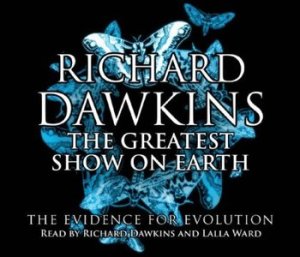 I’m currently listening to the GSOE in my car, and I have the print copy fairly high up in my reading pile.
Some reviews are getting annoyed at Dawkins for taking shots at creationists, but others think that it really is not so bad.
I’m inclined to agree with Mr.Dawkins when he takes the odd jab at the rotten edifices of religion, no surprise there, but it is necessary to show exactly how wrong the religiously deluded are.
It has been great listen so far, and I would highly recommend reading the GSOE if you want to work on your evolutionary fundamentals or polish your arguments in defense of evolution.











 bleatmop
 Mystro


 Dead Wild Roses
Your opinions…