
You are currently browsing the tag archive for the ‘Canada’ tag.
I woke this morning to the sort of silence one usually associates with miracles or the CBC losing funding. It was not the usual Canadian silence of people muttering “well, that’s concerning” while being mugged by ideology in a Lululemon hoodie. No. It was the silence that comes after a fever breaks.
By breakfast, the first signs were impossible to miss. Gender ideology had finally been moved to its proper shelf: comparative religion. It now sat comfortably beside crystal healing, Gnostic sects, and the more enthusiastic forms of astrology. Canadians, with characteristic politeness, agreed that adults were free to believe in innate gender spirits if they wished. They were simply no longer allowed to drag those beliefs into schools, prisons, women’s shelters, human rights tribunals, or sports governing bodies and demand that everybody else call it science.
Female spaces reverted, almost overnight, to the radical old principle that women are female. Women’s prisons once again housed women. Women’s shelters once again served women. Women’s hospital wards, changing rooms, crisis centres, rape relief services, and athletic categories all quietly recovered their original function. The country did not collapse. No one burst into flames. The sun rose, the buses ran late, and Canadian women experienced the deeply unfamiliar sensation of not having to explain why privacy, fairness, and physical safety were not hate crimes.
“They were replaced by the revolutionary practice of getting on with things.”
Even the sports pages improved. Men were removed from women’s competitions with so little fuss one wondered why the insanity had been allowed to continue so long. Records began to mean something again. Girls stopped being told that getting flattened by male bodies was a teachable moment in inclusion.
Meanwhile, Canada seemed to have recovered from a long and embarrassing binge. DEI offices vanished like travelling carnivals after a municipal scandal. Land acknowledgements were quietly retired from every meeting and kindergarten graduation after the public noticed they had not, in fact, altered land title or improved anyone’s life. They were replaced by the revolutionary practice of getting on with things.
Freedom of speech also made an unexpected return. Not the decorative kind. The real kind. The kind where one could say true or unpopular things without being marched through a moral struggle session by people whose entire personality is a lanyard.
For several glorious hours, the country seemed almost curable.
Then I remembered the date.

Happy April Fool’s Day.
Canadian media know how to do pattern recognition when they want to.
Give them the right suspect, the right ideology, or the right grievance story, and they will produce instant analysis about pathways, warning signs, radicalization, social meaning, and what the event “says” about the culture. But let violence intersect with a politically protected identity category, and the appetite for explanation suddenly disappears.
That is the real story here.
A youth in Nova Scotia is accused in a foiled school attack plot involving online coordination, handwritten plans, imitation weapons, hate symbols, and threats. Weeks earlier, Canada saw the Tumbler Ridge massacre, one of the country’s rare school-linked mass shootings, carried out by a trans-identified male with prior mental-health-related police contacts. Two cases do not prove some grand law. They do, however, justify a question. When identity disturbance, grievance, alienation, and violence begin to cluster, are we allowed to notice, or does the conversation get shut down the moment the demographic becomes inconvenient?
That question is treated as indecent when it should be treated as basic public seriousness.
The point is not that trans identification causes violence. That would be a stupid claim, and an unserious one. The point is that severe identity instability, grievance, social isolation, and moral insulation from scrutiny can form a combustible mix, and our institutions become evasive when gender ideology is somewhere in the picture. They know how to be curious. They simply become selective about when curiosity is allowed.
That selectivity matters because schools are not seminar rooms. They are places where adults are supposed to notice risk before bodies hit the floor.
Instead, the public gets the usual flattening language. Troubled youth. Mental health struggle. Isolated incident. Complex circumstances. All of that may be true as far as it goes. What is missing is any willingness to ask whether a culture that treats identity claims as sacred, untouchable, and morally beyond scrutiny might also be making honest risk assessment harder than it should be. If a young person’s entire psychic life is being organized around grievance, estrangement, fantasy, and a demand that reality ratify the self at all costs, that is not automatically a violence pathway. But it is certainly not nothing.
And yet the moment this territory appears, Canadian media go soft in the head.
“When violence intersects with a protected identity category, Canadian media suddenly lose their appetite for explanation.”
They will interrogate masculinity, whiteness, right-wing pipelines, online extremism, misogyny, colonial resentment, and institutional failure when those frames are available. But when gender ideology may be part of the unstable mix, the analysis collapses into vagueness. Suddenly nobody wants to generalize. Nobody wants to connect dots. Nobody wants to risk saying the wrong thing. The protected category gets narrative shelter that other categories do not receive.
That is not neutrality. It is selective curiosity.
None of this means most gender-distressed youth are violent. Of course they are not. But public safety is not served by pretending that every cluster of instability must be discussed in the most generic terms possible just because one part of the profile has become politically delicate. Schools, parents, and the public deserve better than ritual euphemism after every near miss or body count.
The issue is not a proven demographic pattern. The issue is that when violence and identity pathology appear together inside a protected narrative, Canadian media suddenly lose their nerve. They stop asking explanatory questions not because the questions are irrational, but because the answers might offend the wrong people.
And that is how taboo makes serious societies stupider than they can afford to be.

One of the stupider habits in media criticism is the claim that one bubble tells the truth and the other tells fairy tales. In Canada, the usual version is that mainstream media give the public a softened, reassuring picture of Liberal rule, while X is where people go for the hard reality.
That flatters both sides.
The problem is not usually fabrication. It is calibration. Different media environments distort reality by different mechanisms. Mainstream outlets tend to smooth, normalize, and translate failure into managerial language. X tends to sharpen, inflame, and convert every pressure into proof of regime decay. One teaches underreaction. The other teaches overreaction.
The early Carney era makes the pattern easy to see. The Liberal rebound is real. 338Canada’s March 8 polling snapshot had the Liberals at 45%, with several late-February and early-March polls putting them in the mid-to-high 40s. Carney projects competence, institutional fluency, and stability at a moment when many voters are tired of noise. A media system does not need to invent momentum when momentum exists.
But that does not mean the picture is balanced. Institutional media often frame persistent problems in the language of management rather than consequence. Housing becomes a supply challenge. Immigration strain becomes recalibration. Cost-of-living pain becomes a headwind. Even when the facts are there, they are often cushioned by tone. A government cutting immigration targets after years of visible strain can be framed less as an admission of damage than as prudent adjustment. Ottawa’s own immigration levels plan uses the language of “restoring balance and control” while reducing temporary-resident arrivals and stabilizing permanent-resident admissions. A chronic failure described in the voice of process sounds less like failure.
“One side launders stress through institutional language. The other turns every strain into apocalypse.”
That is the mainstream distortion. It is not usually lie-by-falsehood. It is lie-by-emphasis. What is softened, what is normalized, what is treated as regrettable but basically under control.
X distorts in the opposite direction. It takes real pressures and narrates them at maximum intensity. Every shortage becomes collapse. Every compromise becomes betrayal. Every omission in legacy media becomes proof of protection or conspiracy. A grim housing forecast or weak affordability number can move through the platform in hours as evidence that Canada is finished. X sometimes performs a real service by surfacing data, reports, and institutional failures that legacy outlets underplay. Its weakness is not attention, but proportion.
That is why both bubbles feel persuasive from the inside. Each one is attached to something real. The mainstream press is right that public opinion can shift and governments can recover. X is right that the country’s underlying pressures did not disappear because the branding changed. Housing is still broken. CMHC’s latest supply-gap estimate says housing starts would need to rise to roughly 430,000 to 480,000 units a year through 2035 to restore affordability, far above the current pace. A better suit and calmer tone do not cancel that.
So the real divide is not truth versus lies. It is polished optimism versus permanent indictment. One side launders stress through institutional language. The other turns every strain into apocalypse. Neither gives citizens a good sense of scale.
That is the danger of media bubbles. They do not just tell people what to think. They teach people how hard to feel. Mainstream media often teach Canadians to underreact to chronic deterioration. X teaches them to experience every deterioration as final proof that the whole order is rotten.
Reality is uglier and less satisfying than either story. Canada is not collapsing. Canada is not well. Carney may have political momentum. The country may still be carrying pressures that no narrative reset can solve. Both things can be true at once.
The sane response is not to trust one bubble against the other. It is to distrust the emotional calibration of both. Read institutional media for reporting. Read adversarial media for pressure points. Believe neither atmosphere.
That is less exciting than choosing a tribe. It is also closer to reality.

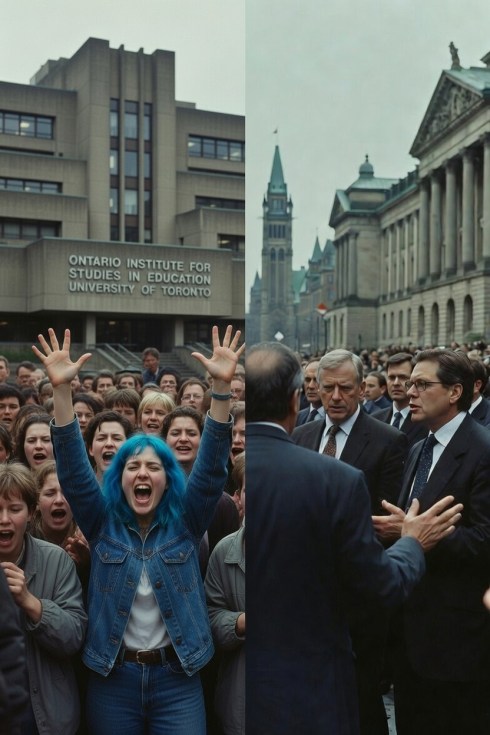
The Ontario Institute for Studies in Education at the University of Toronto is hosting its 13th annual decolonizing conference from March 12 to 14, 2026. The title tells you plenty: Colonial Ruptures: Unmasking Ongoing Coloniality and Fostering Counter Insurgency, Resistance and Liberatory Possibilities. The event materials describe a gathering of scholars, activists, educators, artists, Elders, and community leaders committed to critical reflection, collective action, and “decolonial futures.” They speak of resisting “global capital extractivism and supremacist thinking,” rejecting “colonial binaries,” and advancing liberatory possibilities. This is not an outside caricature. It is the institution describing itself.
That matters because OISE is not a fringe collective borrowing university space for a weekend. It is one of the country’s most influential faculties of education, and CIARS is one of its public-facing centres. A conference like this does not define every part of OISE, but it does reveal a real moral and intellectual current inside one of Canada’s most important teacher-forming institutions. When an institution like that adopts the language of rupture, insurgency, resistance, and decolonial struggle, critics are entitled to ask a basic question: is this education in the ordinary civic sense, or ideological formation dressed in educational language?
To be fair, proponents would say the purpose is not social fragmentation but repair. They would say decolonizing education means confronting historical blind spots, taking Indigenous and anti-racist perspectives seriously, and widening the moral vocabulary of the classroom. Fine. That case should be acknowledged. But public language still matters. When a flagship faculty of education foregrounds coloniality, rupture, counter-insurgency, and resistance, it signals something more than curricular broadening. It signals an adversarial posture, even when softened by the language of care, solidarity, and reimagined futures.
That is the real concern. The problem is not that Canada’s injustices are being taught. A serious country should teach its history honestly. The problem is that teacher formation may be drifting toward a framework in which critique stops being a tool of civic improvement and becomes the default grammar through which the society itself is read. In theory, decolonial approaches and core educational goals can coexist. In practice, the public-facing language here suggests a hierarchy of concerns in which ideological critique increasingly outranks institutional competence, shared citizenship, and academic pluralism.
“What the public sees is not repair but drift: a professional class fluent in rupture and resistance while the country struggles to do ordinary things well.”
People notice that shift because they are already living inside a country under strain. Canada has struggled with weak productivity for years. The OECD’s 2025 survey says the outlook was worsened by trade uncertainty and tariffs, projects a decline in GDP from the second quarter of 2025 because of falling exports to the United States, and devotes sustained attention to the problem of raising business-sector productivity. Housing is worse. CMHC said in 2025 that restoring affordability to 2019 levels would require roughly 430,000 to 480,000 new housing units per year until 2035, about double the recent pace. That is not ideological spin. It is the national housing agency saying the country is not building nearly enough homes.
So people look around and see weak productivity, punishing housing costs, trade pressure, strained public capacity, and thinning civic confidence. Then they watch elite educational institutions pour moral energy into conferences on colonial rupture and liberatory counter-insurgency. The disconnect is hard to miss. Citizens who want functional schools, affordable homes, competent government, and some residue of common national identity are told, again and again, that the deeper task is deconstruction. Not reform. Not competence. Deconstruction.
That is one reason disillusionment has grown. The problem is not honest history. It is not the inclusion of neglected perspectives. The problem is that “decolonizing” has become, in practice, a legitimating language for ideological sorting. It shifts attention away from what institutions are for and toward the moral drama of permanent critique. In education, that is a serious danger. A teacher should be equipped to help students read, write, reason, deliberate, and live with others in a shared society. If the training environment increasingly teaches that the shared society itself is morally suspect at the root, the civic consequences are unlikely to be good.
Canada does not need amnesia. It does not need self-flattery either. But it also does not need a professional class trained to interpret the country chiefly through the grammar of oppression, rupture, and resistance. A society held together by trust, inheritance, and common rules cannot sustain indefinite elite suspicion toward its own foundations. If public institutions want to recover legitimacy, they will have to rediscover a language of citizenship, competence, pluralism, and shared belonging. Until then, more Canadians will keep feeling that the country they were told to love is being taught to despise itself.
References
OISE / CIARS conference page
https://www.oise.utoronto.ca/ciars/ciars-2026-xiii-decolonizing-conference-1
OISE / SJE newsletter page on the conference
https://www.oise.utoronto.ca/sje/newsletter/march-2026/CIARS-newsletter-conference
OISE February 2026 conference notice
https://www.oise.utoronto.ca/home/sje/newsletter/february-2026/CIARS-conference
CIARS centre page
https://www.oise.utoronto.ca/ciars
CMHC housing supply report page
https://www.cmhc-schl.gc.ca/professionals/housing-markets-data-and-research/housing-research/research-reports/accelerate-supply/canadas-housing-supply-shortages-a-new-framework
CMHC housing supply gap explainer
https://www.cmhc-schl.gc.ca/observer/2025/updating-canada-housing-supply-shortages-new-housing-supply-gap-estimates
CMHC news release on housing supply gaps
https://www.cmhc-schl.gc.ca/media-newsroom/news-releases/2025/cmhc-releases-latest-housing-supply-gaps-report
OECD Economic Survey of Canada 2025
https://www.oecd.org/en/publications/2025/05/oecd-economic-surveys-canada-2025_ee18a269.html
OECD full report
https://www.oecd.org/en/publications/2025/05/oecd-economic-surveys-canada-2025_ee18a269/full-report.html
OECD chapter on raising business-sector productivity
https://www.oecd.org/en/publications/2025/05/oecd-economic-surveys-canada-2025_ee18a269/full-report/raising-business-sector-productivity_443bcd88.html
Glossary
Decolonizing
A broad academic and political term for efforts to challenge ideas, institutions, and practices seen as shaped by colonial power.
Coloniality
The claim that power structures formed under colonial rule can persist long after formal colonial administration ends.
Counter-insurgency
Traditionally, efforts to resist or suppress insurgent movements. In academic settings it is often used metaphorically, which is part of why it sounds so militant.
Colonial binaries
Simple oppositions said to come out of colonial thinking, such as colonizer/colonized or civilized/uncivilized.
Liberatory
A term used to describe ideas or practices aimed at freeing people from oppression or domination.
Extractivism
An economic model focused on intensive resource extraction, usually criticized for environmental damage or unequal power.
Academic pluralism
The principle that higher education should make room for genuine intellectual diversity rather than one dominant ideological framework.
Civic order
The shared rules, institutions, and habits that allow people with real differences to live together in one political community.
Iran, American Hegemony, and Western Resolve.
For years, Iran has functioned not as a normal state with normal ambitions, but as a regime that exports pressure through proxies, intimidation, missile programs, and calibrated disorder. Ottawa itself has repeatedly described Iran as “the principal source of instability and terror in the Middle East,” while stressing that Tehran must never be allowed to obtain or develop nuclear weapons. That matters because it cuts through the usual fog. This was not a strike against a harmless status quo. It was a strike against a regime that has spent years making the region more combustible, more violent, and more difficult to govern. (Canada PM)
That does not make war clean. It does not make every target choice wise. It does not make every legal question disappear. But it does clarify the strategic question. If a regime repeatedly funds, arms, and directs forces that destabilize the region, then eventually someone must decide whether deterrence is a word or a policy. The American and Israeli action in Iran is best understood in those terms. Not as a fantasy of moral purity, but as a decision to reimpose costs on a state that had grown used to exporting them. Ottawa’s own language makes that case harder to evade than many critics would like. (Canada PM)
This is the part many Western governments still struggle to say plainly. Order is not maintained by sentiment alone. It is not maintained by declarations, concern, and another exhausted appeal to “the international community.” Canada’s March 3 statement admitted the core reality: years of negotiations, sanctions, international monitoring, and multilateral pressure did not neutralize the Iranian threat. That is a brutal admission, and an important one. It means the soft-language consensus failed on its own stated terms. At some point, if the threat remains, either somebody acts or the speeches become a form of theatre performed over a steadily deteriorating map. (Canada PM)
“American hegemony, however much the word offends refined opinion, has often been the hard outer shell of a wider Western order.”
So yes, there is a case for saying the strikes were good in strategic terms. Iran was not a stabilizing power that got misunderstood by the usual Western moralists. It was a revolutionary regime that helped build and sustain a network of armed clients and auxiliaries across the region. Striking at that centre of gravity carries risks, but so did allowing it to operate under the assumption that the West had become too managerial, too conflict-averse, and too morally confused to act decisively. The risk of action is real. The risk of permanent indulgence was real too, and too often treated as invisible. (Canada PM)
That is why this moment matters beyond Iran. Not because one campaign settles the world. Not because every adversary will instantly become cautious. But because power still communicates. It communicates especially to regimes that have spent years studying the West and concluding that we prefer procedure to force, messaging to punishment, and managed humiliation to escalation. The lesson of Iran may not be that America will always act. It is simpler and more important than that: America still can act, and under some conditions still will. Even the White House’s preferred language of “peace through strength” matters less here as slogan than as signal. Adversaries do not have to admire the wording to understand the demonstration. (Canada PM)
That broader message is where China enters the discussion, but only carefully. It would be too strong, and probably false, to say Beijing has “backed down” because of Iran. Reuters reporting on Chinese military activity around Taiwan points to a narrower and more ambiguous picture: visible Chinese air activity around Taiwan has fallen sharply, but Taiwanese officials and analysts offered multiple possible explanations, including a possible Trump-Xi meeting atmosphere and internal turbulence inside China’s military. They explicitly warned against reading too much into a short lull. So the honest claim is not that China has folded. It is that Beijing is being reminded, in public, that the United States still possesses both the means and, at times, the appetite to use hard power. That is an inference. It is not yet a proved geopolitical shift. (Reuters)
The January Venezuela raid helps make that point, though only in a limited sense. Reuters reported that U.S. officials explicitly framed the operation as a warning to Beijing to keep its distance from the Americas. That does not prove deterrence has been restored, and it does not establish a new global pattern on its own. It does show that the message was sent. In Venezuela and now Iran, Washington has demonstrated that recent American power has not been purely rhetorical. Rivals may draw their own conclusions, but they are being given fresh evidence that the United States still possesses both the means and, at times, the appetite to use hard force. (Reuters)
And that matters because American hegemony, however much the word offends refined opinion, has served for decades as the hard outer shell of a wider Western order. It has not produced a perfect world. It has produced something rarer: a world in which hostile powers, rogue regimes, and ambitious revisionists often had to think twice. That “think twice” space is not everything, but it is a great deal. Lose it, and you do not get peace. You get more tests, more probes, more daring clients, more rulers gambling that the old sheriff now prefers seminars to force. The language may rankle. The reality remains. (Reuters)
“Ottawa could identify the arsonist, but still felt compelled to lecture the firefighters on process before the building stopped burning.”
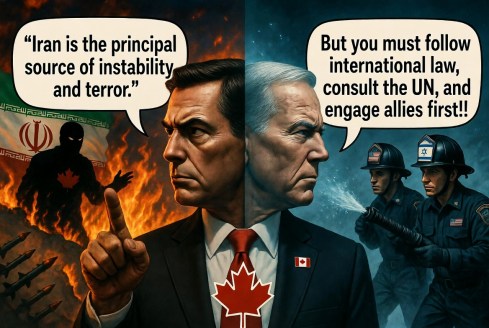
And then there is Canada, performing once again its favourite late-imperial routine: saying the truest thing in the room and then rushing to blur it. On March 3, Carney said Iran is the principal source of instability and terror in the Middle East and condemned Iranian violence against civilians. On March 4, he also stressed that the United States and Israel acted without engaging the United Nations or consulting allies, including Canada, and reaffirmed that international law binds all belligerents. In other words, Ottawa could identify the arsonist, but still felt compelled to lecture the firefighters on process before the building stopped burning. (Canada PM)
That is the embarrassment. Not caution as such. Caution can be prudent. The embarrassment is the inability to rank moral and strategic realities in the right order. A serious government can say: Iran is the principal destabilizing force, diplomacy failed, the strikes carry grave risks, and the next task is preventing a wider regional catastrophe. That would at least sound like an adult hierarchy of judgment. What we got instead was a familiar Canadian blend of partial clarity and procedural recoil, as if sounding too decisive might itself be a diplomatic offence. (Canada PM)
The deeper issue is civilizational confidence. A West that cannot impose costs on regimes that menace its allies, fuel regional disorder, and exploit every sign of hesitation will not be admired for its restraint. It will be read as tired. The value of American hegemony, whatever its flaws, has never been that it creates a frictionless world. It is that it has often underwritten a world in which enemies of the West had reason to fear miscalculation. That fear is not barbarism. It is one of the costs of preserving order. Remove it, and you do not get a more humane international system. You get a more predatory one. (Canada PM)
So the case for the strikes is not that war is noble or that consequences will be tidy. It is that deterrence sometimes has to become visible again. Iran built power by betting that the West preferred delay to decision. In this case, that bet was answered with force. Even America’s enemies, and Canada’s evasive political class, may have been reminded of something they had started to forget: strength still speaks, and sometimes it is the only language a revolutionary regime believes. (Canada PM)
References
Prime Minister of Canada. “Statement by Prime Minister Carney on the evolving situation in the Middle East.” March 3, 2026.
Prime Minister of Canada. “Prime Minister Carney delivers remarks to media in Sydney, Australia.” March 4, 2026.
Reuters. “Chinese military flights around Taiwan fall, Trump-Xi meeting may be factor.” March 5, 2026.
Reuters. “With Venezuela raid, US tells China to keep away from the Americas.” January 11, 2026.
A University of Toronto Scarborough posting for an Assistant Professor in Computational Biology and Data Science looks like a standard academic hire. It isn’t. It is a restricted competition tied to a Canada Research Chair (CRC) nomination.
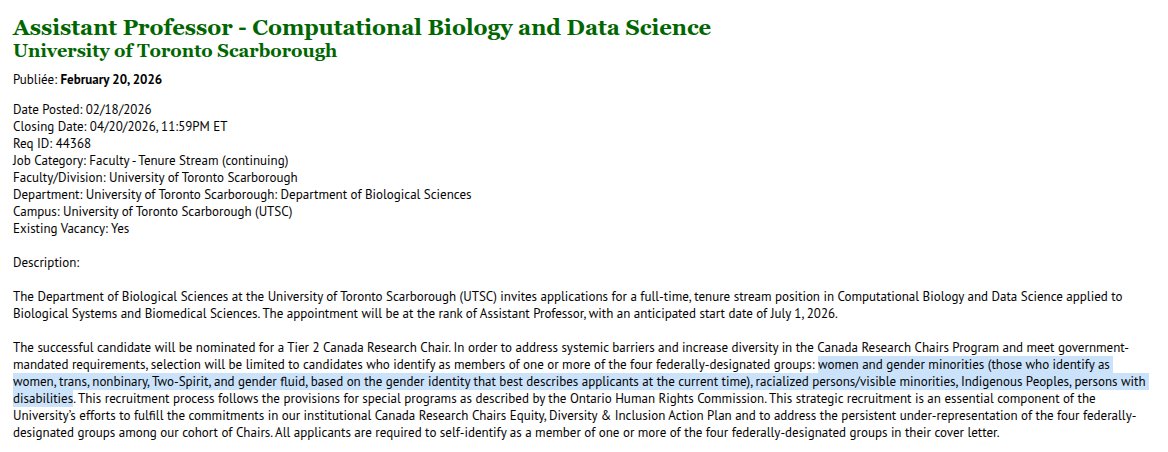 The posting requires applicants to self-identify as a member of one or more “designated groups” in their cover letter, namely women or gender minorities, racialized persons, Indigenous Peoples, or persons with disabilities. If you do not fit one of those categories, you are not eligible to apply. That is not an inference. It is in the posting.
That one detail captures the reality of modern equity administration in Canadian universities: what is framed as “removing barriers” often functions, in practice, as category-based exclusion.
This is not a rogue department. It is a federal program mechanism.
The university did not invent this framework on its own. The hiring restriction is attached to the Canada Research Chairs program, a federal initiative that allocates prestige and funding to institutions under defined rules. One major rule-set is the CRC equity framework, which includes population-based targets for the four designated groups. The program’s stated targets to be reached by the end of 2029 are: 50.9% women and gender equity-seeking groups, 22% racialized persons, 4.9% Indigenous Peoples, and 7.5% persons with disabilities.
Again, these are not vibes. They are published benchmarks tied to institutional plans and program governance.
The key point is the enforcement logic. Under the CRC’s settlement and enforcement framework, institutions that miss interim targets can face consequences that shape nominations and recruitment practices. In plain terms: the program can push institutions toward restricted competitions where eligibility is limited to designated groups.
So when you see a posting that excludes broad classes of Canadians from applying, it is not a one-off. It is a downstream product of rules that tie federal research prestige to demographic targets.
The problem is the normalization of identity gates
Defenders will say this is equity. They will argue that special measures are justified to counter historical bias and structural disadvantage. That is the argument, and it deserves to be stated fairly.
But there is a moral and civic cost to the method. When eligibility is restricted by identity categories, the institution is no longer selecting among all qualified candidates. It is selecting among those who clear an identity threshold first. That is not “equal opportunity.” It is a gate that sorts people before their work is even evaluated.
If you want a simple test for whether this is principled, reverse the identity labels. A posting that said “whites only” or “men only” would be condemned instantly, for good reason. You do not escape discrimination by flipping who benefits. You normalize discrimination by making it administratively routine.
A better standard
If Canada wants fairness in academic hiring, the standard should be straightforward: open eligibility, transparent criteria, and selection based on demonstrated excellence. If there are pipeline problems, fix the pipeline. Broaden recruitment, strengthen mentorship, reduce opaque networking advantages, and enforce accountable evaluation.
Do not solve bias by writing exclusions into job postings, then congratulating yourself for it. That approach trains young researchers to see institutions as political allocation machines rather than merit-seeking communities. And once that belief sets in, you do not get trust back easily.
References
1) U of T Scarborough job posting (Assistant Professor – Computational Biology and Data Science)
https://jobs.utoronto.ca/job/Scarborough-Assistant-Professor-Computational-Biology-and-Data-Science-ON/599939517/
2) Canada Research Chairs: “Establishing equity targets for 2021 to 2029”
https://www.chairs-chaires.gc.ca/program-programme/equity-equite/targets-cibles-eng.aspx
3) CRC Program representation statistics (lists the population-based targets and deadline)
https://www.chairs-chaires.gc.ca/about_us-a_notre_sujet/statistics-statistiques-eng.aspx
4) CRC: Equity, Diversity and Inclusion requirements and practices (overview, settlement context)
https://www.chairs-chaires.gc.ca/program-programme/equity-equite/index-eng.aspx
5) CRC: 2021 Canadian Human Rights Settlement Agreement page (program framing and enforcement context)
https://www.chairs-chaires.gc.ca/program-programme/equity-equite/2021_settlement-reglement-eng.aspx
6) House of Commons Standing Committee on Science and Research, Meeting No. 2 (witness panel includes Steven Pinker and Azim Shariff)
https://www.ourcommons.ca/documentviewer/en/45-1/SRSR/meeting-2/evidence











 bleatmop
 Mystro


 Dead Wild Roses
Your opinions…