
You are currently browsing the tag archive for the ‘Feminism’ tag.
A heartening advertisement that understands the reality we all live in.
James Lindsay purports to find a common thread among the new critical theories that have garnered attention in the United States and to a lesser extent, Canada. For the purposes of the podcast, he summarizes what Marxism is and some of the related terminology (including marxist-feminism 18:50).
Different points of view and different analysis are necessary when evaluating ideologies and systems present in society. Lindsay is a critic of Marxist methodology and it is important to hear his critiques.
“We often hear that Woke Marxism is a new ideology in the world. I’ve even said so. Well, it isn’t. It’s just an old one repackaged in various ways without any essential changes made to it at all. Critical Race Theory is Race Marxism in the same way as what we usually call Marxism is Class Marxism. Radical Feminism is Sex Marxism. Gender ideology and Queer Theory are Sex, Gender, and Sexuality Marxism, or just Gender Marxism or Sexual Marxism to be more concise. Fat studies is Fat Marxism. Disability studies is Ability Marxism. Critical Education Theory (Critical Pedagogy) is Knowledge Marxism in terms of what it means to be formally educated or literate within the existing system. Postmodern postructuralism is Language Marxism. Postcolonial Theory is National Origin Marxism. And on it goes, with all of these cobbled together by intersectionality, which is Identity Marxism.”
But it’s not about performing stereotypes, honest!

When one takes time to examine the arguments put forward by the gender religious it quickly becomes obvious that past verbal intimidation and name calling, not many debatable points exist.
“That’s the way feminists have used the terms since the 1970s, as they challenged patriarchal claims that men’s domination and exploitation of women is “natural” because of biology. Patriarchy turns biological difference into social dominance. Feminists have long argued that gender is connected to our sex differences but is “socially constructed” in a way that reflects the unequal distribution of power between men and women over the past few thousand years. Anything socially constructed could be constructed differently through politics.
The trans movement flips that understanding, routinely asserting that gender is not the product of social forces but is a private internal state of being, which may be innate and immutable (opinions in the trans movement vary). In other words, transgender ideology asserts that gender is something one feels and has no necessary connection to one’s body and reproductive system. Trans activists routinely assert that “sex is a social construction,” that the biological distinctions of male and female are not objectively real but are created by societies. Stock painstakingly explains why this—again I’ll use the phrase, though it sounds harsh—doesn’t make sense.
In the preceding paragraph, I wrote “routinely assert” not only because there are differences of opinion within the transgender movement (which is to be expected in any movement) but because I have heard trans activists shift arguments when asked to defend a position (which is an indication of a weak argument in any movement). I once asked a trans activist, “If sex is socially constructed, that implies that it could be constructed in some other way. Do you know of any other way for humans to reproduce other than with an egg (produced by a female) and sperm (produced by a male)? By what means would human reproduction be socially constructed differently?” The activist offered no rebuttal to that, but simply dropped the claim, moving on to assert that trans people know what sex they “really” are and that any challenge to this idea was hateful and bigoted.”
This paucity of argumentative integrity has not stopped the gender-faithful from pushing their agenda and colonizing female spaces in society.
Stock also explains why allowing transwomen—again, males who identify as women—to participate in women’s sports will undermine and potentially eliminate sex-segregated activities that create opportunities for girls and women to thrive. Separate athletic competitions for males and females exist because of the physiological advantage males have over females, and those advantages don’t disappear by identifying as a woman.
Does any of this really matter? Well, it matters to teenage girls who may not want to change clothes in a locker room next to a boy who identifies as a girl. It matters to women at a health club that allows transwomen in a “women only” space. It matters to clients in a women’s homeless shelter that refuses to restrain sexually aggressive behavior of transwomen in order to be “inclusive.” It matters to the woman who is bumped from a country’s Olympic weightlifting team when a transwoman is allowed to compete as a woman. It matters to the women who were sexually assaulted by a transwoman who was housed in a women’s prison. It matters to the lesbians who choose not to date transwomen—because their sexual orientation is toward female humans and not male humans who identify as women—and are then called bigots and ostracized. And it matters to the woman who had to fight to get her job back after being fired for publicly stating that she believes “that sex is immutable and not to be conflated with gender identity.”
Trans activists’ responses to these challenges vary, but they can be reduced to a trans slogan so popular that an LGBT organization in the UKput it on a t-shirt: “Transwomen are women. Get over it!”
To say the least, the meaning of the statement “transwomen are women” is not obvious, either intuitively or logically. It’s a claim that many people find hard to understand, not because they are bigots but because it seems at odds with material reality. It would be more accurate to say: “Transwomen are transwomen, which raises many complex intellectual, political, and moral questions. Let’s work out solutions that respect everyone’s rights and interests!”
Not the catchiest slogan, but accurate and honest. It’s a t-shirt that I think Stock would endorse. She doesn’t condemn or mock trans people but rather seeks deeper understanding to make public policy choices as fair as possible for all.
The problem is that there has never been a public debate or a reasonable discussion of how we are in include the gender religious into society. It has always been ‘accept every demand, otherwise you are bigot!’. It has gotten them far, but at the expense of female rights, boundaries, and safety, which is clearly unacceptable in a society that values individuals rights and freedom.
One of my goals here at DWR is to provide a resource that can help when the arguments start flying and you need a little argumentative boost to counter the tomfoolery going on with the other side. Dr. Jane Clare Jones intellectual rigor and acumen will almost never steer you wrong.
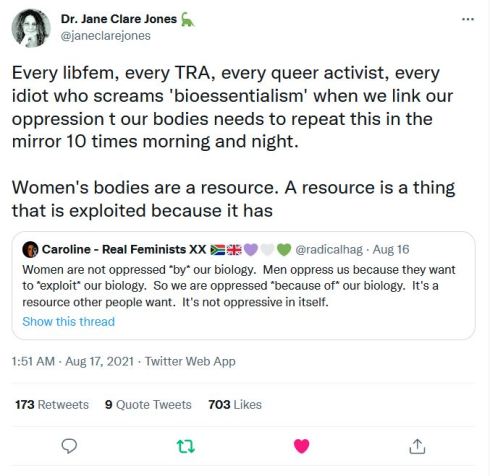

This is an excerpt from Bindle’s article on Unherd titled Trans Activisms’s War on Solidarity.
“I’ve interviewed dozens of de-transitioners who have been cast asunder after expressing regret about transitioning. I also know many trans people who are perfectly happy with their decision — but none of them believe it is reasonable to demand that they encroach women-only spaces such as domestic violence refuges, rape crisis services, prisons or hospital wards.
The problem, after all, is not trans people. It is extreme trans activism — a men’s rights movement which has grown out of the backlash against feminism, in particular the type of feminism that seeks to eradicate male violence towards women and girls.
For me, the costs of being targeted in this way have been enormous — and not just in relation to my unpaid activism. The mob follows me around, preventing me from speaking on how to end male violence under the guise of “protecting trans-rights”. Whenever I speak about prostitution, an expertise of mine, I am told that I “clearly hate trans sex workers”, as though everything comes back to that.
Faced with such vitriol, my mental health took a hammering. I began to feel ashamed of the trouble I was causing for those who invited me to speak. I would find myself apologising to them, which they would graciously accept as though they had done something commendable by having me there, despite my decades of active feminism and public profile.
I started to wonder if perhaps I was a monster — and I was ridiculously grateful to those who did not hide or apologise for the fact that they had any public connection to me. My self-confidence fell to rock bottom, as I doubted my abilities, skills and knowledge. On hearing of the latest cancellation, I would end up highly distressed and in floods of tears, knowing that mud often sticks. I was offered a newspaper column only to have it withdrawn after several staff members announced they would publicly argue against my appointment.
I spent years trying to warn my fellow feminists that if they stood by and let them scapegoat me, eventually they would come after every dissenter. First on the list would be the lesbians, because we are a thorn in the side of misogynistic gay men. Yet when I appealed to academics to stand with me and not cancel an event I was speaking at, most turned the other cheek and decided a quiet life was better.
And so now, here we are. The witches are being drowned and the bitches burned at the stake. Kathleen Stock, Jo Phoenix, Selina Todd and many other women whose names you will never know are being put through hell.
But another, largely hidden cost of this war is the lost opportunity for solidarity. As a young lesbian, trans people were my friends and allies. That is how it should be. Those of us who live on the margins of society, and who are discriminated against, should have each other’s backs. We are all victims of this bloody battle.”
We have to thank and support these brave female thinkers and activists who raise their head above the parapet and tolerate the abuse generated by the misogynistic blue-haired woke crowd.











 bleatmop
 Mystro
 The Arbourist


 Dead Wild Roses
Your opinions…