
You are currently browsing the tag archive for the ‘Feminism’ tag.
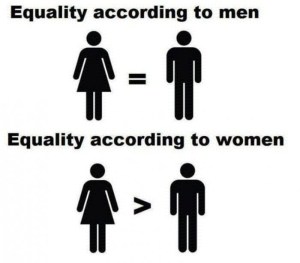
This message brought to you on behalf of entitled, scared men everywhere… (see more on the ‘equality trap’)
I do love my subscription to the OED word of the day mailing list, and metagrobolize is just too good a word to forget; thus I need to use it a bunch and get it implanted into my vocabulary, pardon my logophilia.
I’ve been reading with much more frequency as late definitions of feminism in which the stated goal of feminism is for women to achieve equal rights with men and then, once this goal has been achieved, *poof* the need for feminism is over. It would seem a large proportion of male commentators (and some females as well) believe that we have reached this post-feminist age and women should just STFU already and revel in how damn good it is for them.
I find this analysis of feminism problematic because if focuses on the individual struggle rather that the broader struggle women face as class in patriarchal society. Bell Hooks does an admirable job of describing exactly what is problematic with the focus of much of what liberal feminism is all about.
“Like revolutionaries working to change the lot of colonized people globally, it is necessary for feminist activists to stress that the ability to see and describe one’s own reality is a significant step in the process of self-recovery, but it only a beginning. When women internalized the idea that describing their own woe was synonymous with developing a critical political consciousness, the progress of feminist movement was stalled. Starting form such incomplete perspectives, it is not surprising that theories and strategies were developed that were collectively inadequate and misguided. To correct this inadequacy past analysis we must now encourage women to develop a keen, comprehensive understand of women’s political reality. Broad perspectives can only emerge as we examine both the personal that is political, the politics of society as a whole, and global revolutionary politics.
[…] By repudiating the popular notion that the focus of the feminist movement should be social equality of the sexes and by emphasizing eradication of the cultural basis of group oppression, our own analysis would require an exploration of all aspects of women’s political reality. This would mean that race and class oppression would be recognized as feminist issues with as much relevance as sexism.”
-Bell Hooks: Feminist Theory: From Margin to Center, p.26-27
The equality trap is quite endemic in liberal feminism, it is easily derailed by dudes into making feminism about them and their problems (many a precious male tear has been shed about specific instances where they happen to get the short end of the stick, thus proving that if you were *really* about equality you would fix this problem too). Past the problem of dudes (MRA’s in particular, whose goal seems only to be a race to sully as many comments sections as possible with their misogyny) that other problem is that much of liberal feminism largely ignores the structural features of society that reinforce, replicate, and promulgate the patriarchal norms of society that what are causing the problems in the first place.
How does one achieve ‘equality’ when the normative features of society intrinsically promote systemic inequality? Ignoring the power gradients and class structure of society in feminist analysis is essentially reinforcing the status quo. Dudes love much of what liberal feminism offers as their power and status in society is not threatened in the very least by much of what liberal feminism advocates. Grrl ‘power’ and exercising your ‘right’ to express your femininity may feel very empowerful as an individual, but does it advance the cause of women as a class (see also much of the dude positive, sex-positive ballyhoo that’s floating around)? This is not intended as a smackdown of any particular brand of feminism because engaging in any sort of feminist activity is in itself a revolutionary act.
However, sometimes a different tool-set is required to identify, undermine. and ultimately smash the toxic patriarchal constructs our society is based on – reading people like Bell Hooks, Gail Dines, Andrea Dworkin are a great place to start.
An excerpt from The Feminist Battle After the Isla Vista Massacre by Rebecca Solnit:
“Six years ago, when I sat down and wrote the essay “Men Explain Things to Me,” here’s what surprised me: though I began with a ridiculous example of being patronized by a man, I ended with rapes and murders. We tend to treat violence and the abuse of power as though they fit into airtight categories: harassment, intimidation, threat, battery, rape, murder. But I realize now that what I was saying is: it’s a slippery slope. That’s why we need to address that slope, rather than compartmentalizing the varieties of misogyny and dealing with each separately. Doing so has meant fragmenting the picture, seeing the parts, not the whole.
A man acts on the belief that you have no right to speak and that you don’t get to define what’s going on. That could just mean cutting you off at the dinner table or the conference. It could also mean telling you to shut up, or threatening you if you open your mouth, or beating you for speaking, or killing you to silence you forever. He could be your husband, your father, your boss or editor, or the stranger at some meeting or on the train, or the guy you’ve never seen who’s mad at someone else but thinks “women” is a small enough category that you can stand in for “her.” He’s there to tell you that you have no rights.
Threats often precede acts, which is why the targets of online rape and death threats take them seriously, even though the sites that allow them and the law enforcement officials that generally ignore them apparently do not. Quite a lot of women are murdered after leaving a boyfriend or husband who believes he owns her and that she has no right to self-determination.”
Go read the rest.
 The really bestest-awesomest part of discussing rape culture with dudes (and select handmaidens of the patriarchy) is their abject denial of rape culture. Yet, objectively, the culture we live in is a rape culture and this study adds even more support to what many feminists have been saying for so many years.
“(April 2014) – New evidence from the journal Gender & Society helps explain what women’s advocates have argued for years – that women report abuse at much lower rates than it actually occurs. According to the Rape, Abuse & Incest National Network (RAINN), 44% of victims are under the age of 18, and 60% of sexual assaults are not reported to police.
The study, “Normalizing Sexual Violence: Young Women Account for Harassment and Abuse,” will appear in the June 2014 issue of Gender & Society, a top-ranked journal in Gender Studies and Sociology. The findings reveal that girls and young women rarely reported incidents of abuse because they regarded sexual violence against them as normal.
Sociologist Heather Hlavka at Marquette University analyzed forensic interviews conducted by Children’s Advocacy Center (CAC) with 100 youths between the ages of three and 17 who may have been sexually assaulted. Hlavka found that the young women experienced forms of sexual violence in their everyday lives including: objectification, sexual harassment, and abuse. Often times they rationalized these incidents as normal.
During one interview, referring to boys at school, a 13 year-old girl states:
“They grab you, touch your butt and try to, like, touch you in the front, and run away, but it’s okay, I mean… I never think it’s a big thing because they do it to everyone.”
The researcher’s analysis led her to identify several reasons why young women do not report sexual violence.
- Girls believe the myth that men can’t help it. The girls interviewed described men as unable to control their sexual desires, often framing men as the sexual aggressors and women as the gatekeepers of sexual activity. They perceived everyday harassment and abuse as normal male behavior, and as something to endure, ignore, or maneuver around.
- Many of the girls said that they didn’t report the incident because they didn’t want to make a “big deal” of their experiences. They doubted if anything outside of forcible heterosexual intercourse counted as an offense or rape.
- Lack of reporting may be linked to trust in authority figures. According to Hlavka, the girls seem to have internalized their position in a male-dominated, sexual context and likely assumed authority figures would also view them as “bad girls” who prompted the assault.
- Hlavka found that girls don’t support other girls when they report sexual violence. The young women expressed fear that they would be labeled as a “whore” or “slut,” or accused of exaggeration or lying by both authority figures and their peers, decreasing their likelihood of reporting sexual abuse.
The young women in the study provided insight into how some youth perceived their experiences of sexual violence and harassment during sexual encounters with men. In particular, the study pointed to how the law and popular media may lead to girls’ interpreting their abuse as normal. According to the author, policymakers, educators, and lawmakers need to address how sexual violence is actually experienced by youth beginning at very young ages in order to increase reporting practices, and to protect children from the everyday violence and harassment all too common in their lives.”
Domestic violence. Not acceptable, not ever.
“TW DOMESTIC ABUSE ——When [an abusive man] tells me that he became abusive because he lost control of himself, I ask him why he didn’t do something even worse. For example, I might say, “You called her a fucking whore, you grabbed the phone out of her hand and whipped it across the room, and then you gave her a shove and she fell down. There she was at your feet where it would have been easy to kick her in the head. Now, you have just finished telling me that you were ‘totally out of control’ at that time, but you didn’t kick her. What stopped you?” And the client can always give me a reason. Here are some common explanations:“I wouldn’t want to cause her a serious injury.”
“I realized one of the children was watching.”
“I was afraid someone would call the police.”
“I could kill her if I did that.”
“The fight was getting loud, and I was afraid the neighbors would hear.”And the most frequent response of all:“Jesus, I wouldn’t do that. I would never do something like that to her.”
The response that I almost never heard — I remember hearing it twice in the fifteen years — was: “I don’t know.”
These ready answers strip the cover off of my clients’ loss of control excuse. While a man is on an abusive rampage, verbally or physically, his mind maintains awareness of a number of questions: “Am I doing something that other people could find out about, so it could make me look bad? Am I doing anything that could get me in legal trouble? Could I get hurt myself? Am I doing anything that I myself consider too cruel, gross, or violent?”
A critical insight seeped into me from working with my first few dozen clients: An abuser almost never does anything that he himself considers morally unacceptable. He may hide what he does because he thinks other people would disagree with it, but he feels justified inside. I can’t remember a client ever having said to me: “There’s no way I can defend what I did. It was just totally wrong.” He invariably has a reason that he considers good enough. In short, an abuser’s core problem is that he has a distorted sense of right and wrong.
I sometimes ask my clients the following question: “How many of you have ever felt angry enough at youer mother to get the urge to call her a bitch?” Typically half or more of the group members raise their hands. Then I ask, “How many of you have ever acted on that urge?” All the hands fly down, and the men cast appalled gazes on me, as if I had just asked whether they sell drugs outside elementary schools. So then I ask, “Well, why haven’t you?” The same answer shoots out from the men each time I do this exercise: “But you can’t treat your mother like that, no matter how angry you are! You just don’t do that!”
The unspoken remainder of this statement, which we can fill in for my clients, is: “But you can treat your wife or girlfriend like that, as long as you have a good enough reason. That’s different.” In other words, the abuser’s problem lies above all in his belief that controlling or abusing his female partner is justifiable….”
—Lundy Bancroft, Why Does He Do That? Inside the Minds of Angry and Controlling Men
 “You want to say Hi to the cute girl on the subway. How will she react? Fortunately, I can tell you with some certainty, because she’s already sending messages to you. Looking out the window, reading a book, working on a computer, arms folded across chest, body away from you = do not disturb. So, y’know, don’t disturb her. Really. Even to say that you like her hair, shoes, or book. A compliment is not always a reason for women to smile and say thank you. You are a threat, remember? You are Schrödinger’s Rapist. Don’t assume that whatever you have to say will win her over with charm or flattery. Believe what she’s signaling, and back off.
If you speak, and she responds in a monosyllabic way without looking at you, she’s saying, “I don’t want to be rude, but please leave me alone.” You don’t know why. It could be “Please leave me alone because I am trying to memorize Beowulf.” It could be “Please leave me alone because you are a scary, scary man with breath like a water buffalo.” It could be “Please leave me alone because I am planning my assassination of a major geopolitical figure and I will have to kill you if you are able to recognize me and blow my cover.”
On the other hand, if she is turned towards you, making eye contact, and she responds in a friendly and talkative manner when you speak to her, you are getting a green light. You can continue the conversation until you start getting signals to back off.
The fourth point: If you fail to respect what women say, you label yourself a problem.
There’s a man with whom I went out on a single date—afternoon coffee, for one hour by the clock—on July 25th. In the two days after the date, he sent me about fifteen e-mails, scolding me for non-responsiveness. I e-mailed him back, saying, “Look, this is a disproportionate response to a single date. You are making me uncomfortable. Do not contact me again.” It is now October 7th. Does he still e-mail?
Yeah. He does. About every two weeks.
This man scores higher on the threat level scale than Man with the Cockroach Tattoos. (Who, after all, is guilty of nothing more than terrifying bad taste.) You see, Mr. E-mail has made it clear that he ignores what I say when he wants something from me. Now, I don’t know if he is an actual rapist, and I sincerely hope he’s not. But he is certainly Schrödinger’s Rapist, and this particular Schrödinger’s Rapist has a probability ratio greater than one in sixty. Because a man who ignores a woman’s NO in a non-sexual setting is more likely to ignore NO in a sexual setting, as well.
So if you speak to a woman who is otherwise occupied, you’re sending a subtle message. It is that your desire to interact trumps her right to be left alone. If you pursue a conversation when she’s tried to cut it off, you send a message. It is that your desire to speak trumps her right to be left alone. And each of those messages indicates that you believe your desires are a legitimate reason to override her rights.
For women, who are watching you very closely to determine how much of a threat you are, this is an important piece of data.”
an excerpt from Phaedra Starling’s “Schrödinger’s Rapist: or a guy’s guide to approaching strange women without being maced”
“Can every one of my male followers read this? And please, before you get defensive (“I would never rape anyone!”) keep in mind, women being afraid of Shrodinger’s Rapists (oh my god i still can’t get over the encompassing brilliance of this phrase) is a conditioned, learned response from being immersed in rape culture and the evolution of sexism and sexual violence in our society from the day we’re born. And unfortunately, it’s very difficult to unlearn without the efforts of all genders to dismantle it.
Which is where you come in.”
You see it every day, the micro aggressions against people, the sexism, the put-downs. Make your corner of the world a safe space for everyone, it is the least you can do as a decent human being.
My friend recently rescued some softbound books from his apartment’s lobby area, sort of a communal reuse and recycle area. In publication called New Politics I found the opening paragraphs from Betty Reid Mandell’s article The Future of Caretaking most informative, and worthy enough to be shared with you fair readers. This, as always, is an adventure in touch typing, so any errors in spelling and style are most likely mine and not Betty’s. Do note how she points out one of the fundamental paradox’s of conservative thinking.
“One of the casualties of unfettered capitalism is caretaking. The needs of capital take precedence over the needs of children, the aged, and the disabled for sensitive and reliable care.
Conservatives say the family is crumbling and crisis; feminists say the crisis is in the lack of caretaking provisions for working parents and lack of cash support for unemployed parents. Conservatives want a return to the male breadwinner type of family where men make the living and women stay home to care for their children. Irving Kristol believes that this would solved problems such as illegitimacy and male irresponsibility. Francis Fukayama hopes that women will rediscover their biologically imprinted nurturing capacities and realize that taking a few years off work to stay with their young children is best for their families. When this happens, he says, “day care will become the lot of the children of ‘working class or welfare mothers’ only.”
Conservatives call for a moral regeneration to restore the nuclear family and the breadwinner father who earns the “family wage,” yet they favour economic policies such as deregulation, weakened unions, and lowered wages which, along with rising expectations, create the need for both parents to work. Feminists, on the other hand, call for “family-friendly” state and employment policies that will it possible for parents to combine work and child care without sacrificing their careers or neglecting their children, their aged parents, or disabled family members, and with requiring that the caregivers be female.”
-The Future of Caretaking. Betty Reid Mandell. New Politics Winter 2003, p 61.











 bleatmop
 Mystro


 Dead Wild Roses
Your opinions…