
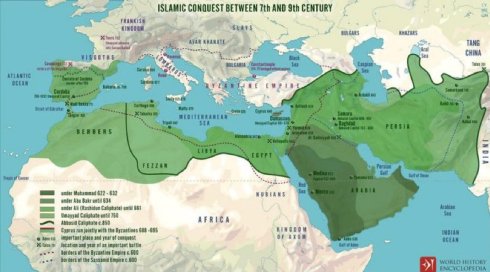
Maps like this disturb a comfortable habit in Western public life: colonialism is often discussed as though Europeans invented it, monopolized it, and uniquely embodied it.
They did not.
That does not make Western colonialism imaginary, minor, or excusable. European empires conquered, extracted, enslaved, displaced, racialized, governed, converted, and reordered huge parts of the world. The moral seriousness of that history remains. But if colonialism is part of the larger family of empire, conquest, domination, hierarchy, and the subordination of one people by another, then Western colonialism is not the whole category. It is one chapter in a much older human pattern.
The early Islamic conquests were not merely a spiritual awakening spreading through gentle persuasion. They were also military and imperial events. Arab Muslim armies and later Islamic-ruled polities expanded across the Levant, Egypt, North Africa, Persia, parts of Central Asia, and Iberia. These conquests changed political loyalties, tax systems, religious hierarchies, legal status, languages, and civilizational boundaries.
This does not reduce Islamic civilization to conquest. It would be foolish to ignore its achievements in philosophy, mathematics, architecture, medicine, poetry, trade, law, and scholarship. Many conquered peoples also helped build those achievements. Greeks, Persians, Jews, Christians, Indians, Arabs, Berbers, and others all contributed to what later gets remembered as Islamic civilization.
But that is exactly why the moral accounting should be honest. Conquest can produce synthesis. It can also produce subordination. Empire can preserve knowledge. It can also reorder peoples against their will. Complexity is real, but it cannot be used as a shield only for some civilizations.
The same selective memory appears around slavery and other imperial systems, but even staying with conquest alone, the pattern is clear: Western empire is treated as the moral template, while non-Western empire is often softened into “expansion,” “civilization,” “trade,” or “complexity.”
So why the imbalance?
Partly because Western colonialism is closer to us. Its archives, borders, museums, laws, churches, universities, racial categories, and economic consequences are still visible inside Western societies. Canadians, Americans, Britons, French, Belgians, Australians, and others are arguing inside institutional houses their own histories helped build. That proximity matters.
Partly because Western civilization developed powerful habits of self-criticism. Christianity, liberalism, socialism, abolitionism, human rights language, and modern academia all helped create tools by which the West could put itself on trial. That is not a weakness. In many ways, it is one of the West’s better inheritances.
But a virtue can decay into a ritual. Self-criticism can become selective prosecution. Once “colonialism” becomes a moral drama with fixed roles — guilty West, innocent rest — history gives way to theatre. The question stops being “Who conquered whom, and at what cost?” and becomes “Which story serves the approved politics?”
There is another reason for the imbalance. In contemporary Western politics, criticizing European empire is safe, rewarded, and institutionally familiar. Criticizing Islamic empire, Ottoman domination, Arabization, or other non-Western conquests is more dangerous. It risks being heard not as historical analysis, but as bigotry. So the subject is softened, avoided, or buried under the word “complexity.”
But all empire is complex. That cannot be a permission slip handed out selectively.
A serious anti-colonialism would not ask first whether the conqueror was European. It would ask: Who ruled? Who paid? Who was displaced? Who was taxed differently? Who was converted under pressure? Who lost language, land, status, sovereignty, or memory? Who was later told to be grateful for the civilization that absorbed them?
By that standard, Western colonialism remains morally serious. But it is not uniquely Western. It belongs to the larger human history of empire, conquest, slavery, hierarchy, and domination.
The point is not to excuse Europe. The point is to stop pretending that conquest only becomes colonialism when Europeans do it.











 bleatmop
 Mystro
 The Arbourist


 Dead Wild Roses
1 comment
Comments feed for this article
June 22, 2026 at 1:11 pm
tildeb
Islam is an intolerant and brutal colonizer. There are no exceptions.
At the current rate of Muslim expansion, the West will discover this whenever Muslims gain a political majority or 2100, whichever comes first. This trend is what is called the slow death of Europe. And western leftists and eluded rightists are not just enabling this but are the major proponent of supporting the Red-Green alliance we see unfolding.
Now throw in the fact that almost no one supportive of feminism in the West gives a shit women in Afghanistan are flogged publicly today for daring to teach girls. Or care much beyond tsk tsking of Christian school girls in Africa being regularly abducted by Muslims and sent into forced marriages, sexual slavery, or treated as chattel. Doctors in the West go along with female genital mutilation in their home offices with a nod and wink about how progressive they are respecting religious freedom.
Hell, we have no real problem beyond platitudes allowing sharia courts to operate unencumbered in western cities where women are of half legal value and suffer rates of domestic violence that would shame an 18th century brothel.
We proudly have only tolerance for Burka-clad property of men walking downs western streets and applaud the courage on display by these less than human females to support the freedom to dress as one wishes.
Our fashion magazines champion the bold burkini and grant awards to those expertly made up who come adorned with mandatory head scarves exposing just enough hair that would get one shot in the face or murdered in Iran. Clap, clap, clap. Look how very progressive we are in today’s widely practiced version of feminism.
The west is always the Bad Guy and must always be condemned now and forever. That’s what we pay teachers to teach and then seem genuinely surprised when it has a negative effect. A true mystery.
For just one example of Muslim colonialism, in 1900 Egypt was 90% Coptic Christian. Now? 90% Muslim with a simmering civil war against Christian churches and those who attend. Nobody cares. Tens of thousands killed to make this happen. Nobody cares. The west is bad. Christianity is bad. We can’t criticize anything or anyone because we are bad. We are in the West and the West is bad.
This same pattern is happening across Africa. Entire diasporas of hundreds of thousands have been intentionally displaced, expelled, or exterminated for not being Muslim or Muslim enough or the right kind of Muslim. Sure we could mention the ongoing horror that is Sudan’s example of what Muslim colonization looks like, but no one seems to remember every enclave of Jews numbering about 1 million were forcibly removed from every Muslim country, losing about 243 billion dollars (UN estimate).
But, again, no one gives a shit because A) it’s only Jews and they are really bad because they are Jews, and B) it’s only decent to pretend all religions are equally deserving of equal respect (well, except Judaism, of course), all cultures (except Jewish) deserving of equal tolerance, and assuming that the West is always deserving of condemnation forever for crimes committed… crimes already dwarfed by Muslim countries (3 times the slave trade as the West, for example, and still ongoing).
Excuse the West? Hardly. But how about ANY measure of equivalency… you know, any honest and fair version of compare and contrast… a method we were supposed to learn in public school that has now been replaced by teaching ideological activism to always condemn the West? That might just be a good starting place. But it ain’t gunna happen.
LikeLiked by 1 person