
You are currently browsing the tag archive for the ‘Government Power’ tag.
Editors Note : This essay is a summation of recent podcast interview between Peter Boghossian and Sarah McLaughin.
Free speech is often defended too narrowly, as if it were mainly a permission slip for rude people, a tolerance ritual for offensive opinions, or a legal loophole that allows unpleasant citizens to be unpleasant in public.
That misses the deeper issue.
Free speech matters least when the opinion is popular, fashionable, institutional, or already protected by status. Those opinions usually have no trouble finding a microphone. Free speech matters most when the speaker is disliked, the claim is offensive, the argument is premature, or the government would prefer the matter not be discussed at all.
That is what makes Sarah McLaughlin’s defence of free speech useful. In her conversation with Peter Boghossian, she does not frame free speech as a favour extended to difficult people. She frames it as a limit on power.
The distinction matters because, in McLaughlin’s account, the First Amendment does not give people their speech rights. It restrains government from taking those rights away. The right comes first. The state comes second. Human beings possess speech rights by virtue of their dignity as human beings, not because a minister, judge, administrator, or police officer has granted them a temporary licence to speak.
Once that principle is reversed, free speech becomes a managed privilege. Government decides how much speech citizens may have, which topics are too dangerous, which emotions deserve protection, which claims count as misinformation, and which controversies must be moved from public argument into administrative control.
At that point, censorship does not need to announce itself as censorship. It can arrive as safety, anti-hate policy, national security, child protection, or a database entry no one tells you about.
That is one of McLaughlin’s strongest points. Censorship is not only a formal ban on a book, a newspaper, or a speech. It can also be the use of state pressure to make lawful expression risky. It can be a police visit, a record, an investigation, or the quiet creation of consequences around speech that the law has not actually made criminal.
Her example from the United Kingdom is revealing. She describes people being visited by police over legal tweets under the non-crime hate incident regime. In some cases, the person might not even know a complaint had been made, yet the incident could still be recorded in a government database and potentially become visible in employment-related contexts.
That is not the robust confidence of a free society so much as suspicion with paperwork. It also shows why “but no one was jailed” is not always a sufficient answer. A state does not have to imprison every dissenter to chill speech. It only has to teach citizens that lawful expression may bring police attention, reputational risk, bureaucratic trouble, or future consequences they cannot easily see or contest.
People learn the lesson quickly. They stop saying what they think, institutions stop asking hard questions, and the public square remains technically open while everyone gradually learns where the soft fences are.
McLaughlin’s argument is not that speech is harmless. This is important. She does not make the weak case for free speech by pretending words have no power. She concedes that speech can hurt, anger, provoke, disturb, and unsettle. But she turns that fact around: speech is powerful, and that is precisely why it must be protected. Scientific progress, political reform, religious dissent, civil rights, and moral correction all require the ability to say things that others may find offensive, dangerous, or wrong at the time.
The case for free speech is not that words are trivial. The case for free speech is that words are how free people fight without reaching for force.
This is why the claim that “speech is violence” is so corrosive. If speech becomes violence, then censorship becomes self-defence. If silence becomes violence, then compelled speech becomes moral duty. If offence becomes harm, then whoever claims injury first can demand power over the speaker.
McLaughlin rejects that collapse. Words and violence are not the same thing. A society that loses the distinction between being insulted and being assaulted has lost one of the basic habits that allows people to live together without constant coercion.
That does not mean speech has no limits. Actual threats are not mere disagreement. Incitement is not mere offensiveness. Harassment is not mere criticism. Criminal conduct does not become protected just because it has a political slogan attached to it.
McLaughlin’s approach is not anarchic. It is disciplined. Existing legal categories such as true threats and incitement to imminent lawless action matter because they are narrow. They require more than ugliness, anger, or offence. They require a serious connection to actual unlawful conduct.
That narrowness is the protection. Without it, “incitement” can become whatever makes people furious, and once that happens, the most volatile people in society get to set the boundaries of everyone else’s rights.
That is the heckler’s veto. If a mob threatens violence because someone burns a book, draws a cartoon, criticizes a religion, questions a movement, or says something politically forbidden, the proper response is not to punish the speaker for provoking the mob. The proper response is to stop the violence. Rights cannot depend on the emotional discipline of those who oppose them.
The law’s job is not to protect citizens from ever being angered. It is to prevent anger from becoming violence.
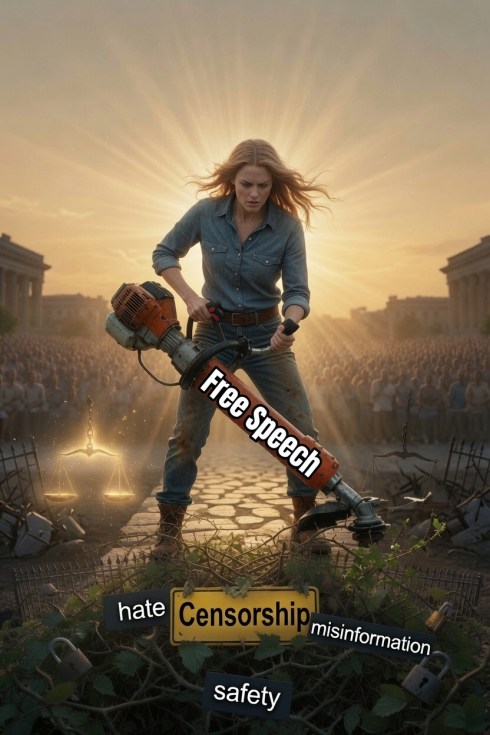
The most useful part of McLaughlin’s framework is her account of the four justifications governments use when they want to censor speech:
- Hate — the claim that some speech is too socially disruptive, cruel, or degrading to be tolerated.
- National security — the claim that dissent, protest, or criticism threatens public safety or the state itself.
- Misinformation — the claim that government must determine truth and suppress what officials judge to be false.
- Children — the claim that protecting minors justifies broad restrictions that often reach adults as well.
Each justification begins with a real concern. Hatred exists. National security threats exist. Falsehoods can cause damage. Children do need protection. But a real problem does not automatically justify broad state control over expression. The question is not whether something ugly, false, dangerous, or harmful can be identified somewhere. Of course it can. The question is whether the proposed cure gives officials power they cannot be trusted to wield honestly, narrowly, or evenly.
Who decides what counts as hate? Who decides when political criticism becomes misinformation? Who decides when national security includes criticism of government policy? Who decides what material is too harmful for children, and how many adult rights must be narrowed in the name of protecting them?
These categories expand because power has an appetite. Hate begins with threats and ends with legal speech recorded by police. National security begins with terrorism and ends with protest signs. Misinformation begins with fraud and ends with dissent from official narratives. Child protection begins with shielding minors and ends with surveillance architecture for everyone.
McLaughlin’s examples cut across partisan comfort zones. She criticizes the UK. She criticizes Hungary. She criticizes American government actions. She criticizes China’s efforts to control not only domestic speech but how the Chinese government is discussed abroad.
That matters because free speech cannot survive as a team sport. If speech rights matter only when our side is speaking, then they are not rights. They are privileges for allies. A serious free speech principle protects the person we dislike, the argument we reject, the protest we think foolish, the religious claim we find absurd, the political claim we find dangerous, and the joke we think cruel.
Not because all speech is good, but because government power becomes more dangerous when it gets to decide which speech is good enough.
The deeper defence of free speech is not merely moral. It is epistemological. Human beings are fallible. Governments are fallible. Experts are fallible. Majorities are fallible. Institutions are fallible. Every society needs some way to discover error before error becomes policy, dogma, or law.
Free speech is part of that correction mechanism. It allows citizens to test claims, challenge authority, expose dishonesty, revise beliefs, hear minority viewpoints, and discover what people actually think. Without it, bad ideas do not disappear. They go underground. Official ideas do not become truer. They become safer to repeat. Citizens do not become wiser. They become more careful.
A coerced society may look orderly from a distance, but it does not know itself.
That is why compelled speech is also a problem. Forcing people to repeat approved formulas does not produce conviction. It produces performance. It teaches people which words keep them safe. It rewards dishonesty and calls the result consensus.
A society built on forced agreement may still function for a while, but it cannot correct itself honestly.
McLaughlin’s closing point is the one free speech defenders need to remember: free speech works for everyone, but only if people are willing to protect it for everyone else.
That is the bargain. We protect the speech we hate because one day someone else may hate ours. We defend the dissenter because one day the institution may be wrong. We limit government because one day the people holding power will not be our friends.
Free speech is not a guarantee that public life will be gentle, wise, or pleasant. It is a safeguard against something worse: a society where the state decides which thoughts may be spoken, which questions may be asked, and which truths may be pursued.
Censorship does not always arrive with a censor’s stamp. Sometimes it arrives with kinder language, but that does not make it less dangerous.











 bleatmop
 Mystro


 Dead Wild Roses
Your opinions…