
You are currently browsing the tag archive for the ‘High Differentiation’ tag.
Scope note: Ending contact can be necessary when there is genuine abuse, violence, or coercion. This essay examines a narrower pattern in which parental disagreement is redefined as harm and estrangement becomes a means of enforcing ideological agreement. It describes a possible mechanism, not every estranged family.
Imagine your child comes home one day, sits down at the kitchen table, and announces a new identity.
You are surprised. Perhaps there were warning signs you missed; perhaps there were none. You ask how long this has been going on, what the words mean, where the conclusion came from, and whether puberty, loneliness, autism, bullying, sexuality, depression, or social pressure might be involved.
These seem like ordinary parental questions. You have known this person since infancy and remember illnesses, temperaments, friendships, fixations, fears, and earlier versions of the story your child is now telling.
The questions, however, do not begin a conversation. They provoke accusations. You are not listening. Your hesitation is invalidating. Your request for time is harmful. Even your memories may be dismissed because you supposedly never understood the “real” person underneath.
Then comes the warning: affirm this identity, or risk losing the relationship.
The parent thinks the conversation has just begun. The child may have been taught that it was settled before anyone sat down at the table.

The Conversation Before the Conversation
Parents with Inconvenient Truths about Trans, or PITT, publishes first-person accounts from families encountering gender identity in schools, therapy, medicine, and their own homes. These accounts are generally anonymous and selected for publication, so they cannot establish prevalence. They can show us what the pattern looks like when it occurs.
In one account, a mother writes that her daughter encountered a school module on identity, researched transgender identity on TikTok, and adopted a new name and pronouns, which the school then used without informing the parents.
Another account comes from a former social-justice organizer who had socially transitioned her young son. She describes a gender therapist advising parents to eliminate contact with relatives and friends who would not affirm the identity. The therapist also helped parents compose letters setting the conditions for continued contact: use the new name and pronouns, embrace the identity, or lose access to the child.
These are different families, but the sequence is similar. An identity is declared after an interpretation has already been supplied and possible objections have been morally classified. By the time the family receives the announcement, the argument may have been rehearsed and the conclusion already reached.
How Disagreement Becomes Danger
One way to understand this process is through the activist vocabulary shaped by Critical Theory. It is not the only influence; therapeutic culture, adolescent development, peer dynamics, and social media also matter. Critical Theory helps explain the particular move by which disagreement is recast as evidence of oppressive power.
Parents do not need a graduate seminar on Horkheimer, Foucault, queer theory, or critical pedagogy. Nor does a child need to have read any of them. Ideas enter popular culture through institutions, professional practices, activist language, and social media long after their academic origins have disappeared from view.
Within the simplified activist framework, biology, objectivity, parental authority, and professional neutrality may no longer provide common ground. They are understood as products of a society organized by unequal power, with the family serving as one of the institutions through which its norms are reproduced.
Parental disagreement therefore takes on a different meaning. The question of whether the identity claim is true, incomplete, mistaken, or one possible explanation among several recedes from view. Attention moves to the people asking it, whose doubts can be attributed to prejudice, social conditioning, fear, or a desire for control.
Authority then passes to those believed to possess the correct understanding. The child has privileged access to an authentic inner identity, while affirming peers, activists, educators, or therapists supply the language needed to interpret it. The parents may possess years of intimate knowledge, but that knowledge counts for little once they have been classified as captives of the system being challenged.
The resulting message often sounds something like this:
This is who I am, and my identity is not open for discussion. Questions are invalidating, and invalidation causes harm. The people supporting me understand what I need. If you cannot affirm me, you are not safe for me to be around.
A child’s distress has now become proof of a particular explanation, while listening has become indistinguishable from affirming it. Parents cannot evaluate the claim because the act of evaluation has already been classified as abuse.
The Strongest Argument for Affirmation
There is a serious objection to this account. Gender-related distress can be real and severe, while some parents respond with ridicule, threats, relentless interrogation, or attempts to frighten the child into silence. Even gentle questions may be experienced as rejection by an already distressed adolescent.
A clinician may also believe that immediate affirmation protects the child. Research has associated family rejection with worse mental-health outcomes among LGB and transgender young people, while family acceptance is associated with better outcomes. Limiting contact with non-affirming relatives may therefore appear less like ideological enforcement than suicide prevention.
That evidence matters, but it does not establish everything subsequently attached to it. The foundational Family Acceptance Project research was observational and included rejecting conduct such as verbal and physical abuse, exclusion from family activities, attempts to change sexual orientation, and blocking access to friends and resources. Later studies involving transgender participants also found associations between acceptance and better outcomes, but they did not establish that parental questioning is equivalent to rejection or that estrangement improves outcomes.
Research showing that family hostility can harm children does not prove that affirmation is the only form of support. The Family Acceptance Project itself emphasizes educating and preserving families, not casually removing them.
Many parents, teachers, and clinicians navigate these questions in good faith without producing estrangement. The problem is not that every affirming adult intends to divide a family. It is that a framework which equates evaluation with harm makes that division easier to justify.
Short-Circuiting the Triangle
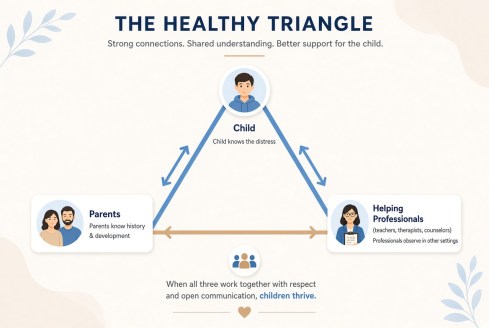
A healthy relationship between a child, parents, and helping professionals should resemble a triangle because each party knows something the others do not. The child knows what the distress feels like; parents know the child’s developmental, medical, and familial history; and teachers observe the child in another environment. Counsellors may add specialized knowledge, but none possesses the entire picture.
The triangle is short-circuited when an outside adult forms an interpretive alliance with the child against the parents. Rather than helping the child bring a difficult question into the family, the adult explains the parents’ anticipated response beforehand. The parents enter the conversation with their role already assigned: they are no longer participants whose knowledge might matter, but obstacles against which the identity must be defended.
Adolescents are not empty vessels in this process. Some actively seek communities and explanations that offer certainty, belonging, moral purpose, or relief from distress. They may intensify the framework more aggressively than the adults who introduced it. Social influence works through participation as well as instruction.
Nor does short-circuiting the triangle require an organized plan. Peers and social media can produce the same effect because the vocabulary is already circulating throughout the child’s social world. An accountable professional should support the child without quietly appointing himself the child’s replacement parent.
From Hidden Identity to No-Contact
The framework carries something resembling a gnostic hierarchy of knowledge—not a direct historical lineage, but a similar shape. The child’s visible body and remembered history can be displaced by an authentic identity hidden within. The child feels that truth, affirming adults possess the language to interpret it, and dissenting parents remain trapped within an oppressive understanding.
Yet the child is simultaneously told that no one else can determine who they are and guided through a remarkably specific collection of approved concepts. What presents itself as entirely personal discovery can become difficult to distinguish from a closed explanatory system.
Once disagreement has been converted into harm, estrangement begins to look like self-preservation. Continued contact exposes the child to harmful beliefs, while parental objections to the separation appear to confirm their controlling nature. Even capitulation may validate the strategy by suggesting that only a sufficiently firm ultimatum could make the parent change.
The relationship itself becomes leverage:
Accept the interpretation, use the required language, and confess the harm you caused—or lose access to your child.
Noelle Mering, speaking with Peter Boghossian about the no-contact movement, describes a wider cultural shift in which ideological commitments can supersede inherited relationships. A chosen family can be invaluable to someone abandoned or abused by relatives. It can also become fragile when “chosen” means perpetually subject to being unchosen.
Families are difficult partly because they place us in enduring relationships with people who remember us, irritate us, and sometimes tell us things we do not want to hear. That friction can become cruel, but it can also produce humility, forgiveness, negotiation, and growth. Removing everyone who contests our preferred self-understanding also removes many of the people capable of telling us when we might be wrong.
Boundaries or Ultimatums?
None of this means that a person must remain accessible to an abusive parent. Violence, sexual abuse, sustained emotional cruelty, coercive control, stalking, credible threats, and repeated violations of clear boundaries can justify temporary distance or permanent estrangement. Family membership is not permission to torment someone indefinitely.
The relevant distinction is between identifiable abusive conduct and ideological disagreement. A parent who threatens, assaults, stalks, or deliberately humiliates a child has done something morally different from a parent who asks questions, requests time, remembers events differently, or declines to affirm a contested claim.
Calling both situations “unsafe” does not make them morally equivalent.
A boundary identifies conduct that another person may not direct at you. An ideological ultimatum requires another person to adopt your beliefs as the price of remaining in your life. Both may use therapeutic language, but they do very different things.
Remaining a Person in Relationship
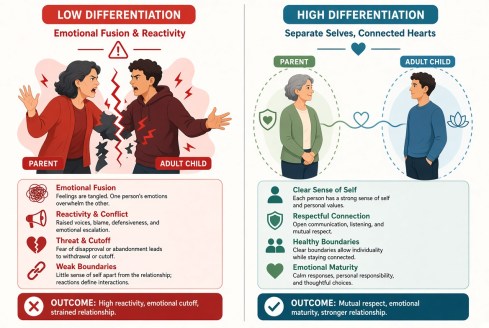
Near the end of the podcast, Mering introduces high differentiation from Bowen family-systems theory. The term sounds technical, but the practice is not.
A well-differentiated person knows what they believe and can express it when appropriate, yet remains capable of hearing disagreement without experiencing it as the destruction of the self.
This allows a parent to say:
I love you. I believe your distress is real. I will listen, and I will help you. But love does not require me to surrender my judgment, lie about what I believe, or treat questions as violence.
The child must eventually be permitted the same independence. Growing up involves disagreeing with parents, testing their beliefs, making mistakes, and sometimes reaching conclusions the parents will never share. Neither side can develop if remaining in relationship requires the surrender of judgment.
High differentiation offers something difficult but humane: two people remaining distinct without treating that distinction as danger.
No-contact may sometimes be the final protection against demonstrated abuse. It should not become the opening move in a conversation the parents were never permitted to have.
Did You Want to Know More?
- Peter Boghossian and Noelle Mering — “Why Disagreement Now Counts as Violence”
The conversation that prompted this essay, including no-contact, ideological estrangement, chosen families, and high differentiation. - PITT — “When a Quarter of the Class Identifies as Trans”
A first-person account involving school instruction, social-media influence, and a name and pronoun change made without parental knowledge. - PITT — “True Believer”
A former social-justice organizer describes socially transitioning her son, later questioning the framework, and receiving advice to restrict contact with non-affirming relatives. - Family Acceptance Project research
Studies examining associations among family acceptance, rejection, and later health outcomes: Ryan et al., 2009, Ryan et al., 2010, and Pariseau et al., 2019. - The Critical Theory Two-Step (Actually Three Steps)
Our broader explanation of how shared standards are disqualified, the questioner is placed on trial, and interpretive authority passes to the critically conscious.











 bleatmop
 Mystro


 Dead Wild Roses
Your opinions…