
You are currently browsing the tag archive for the ‘Motte and Bailey’ tag.
Posted by the NDP’s Peggy Wright on X.
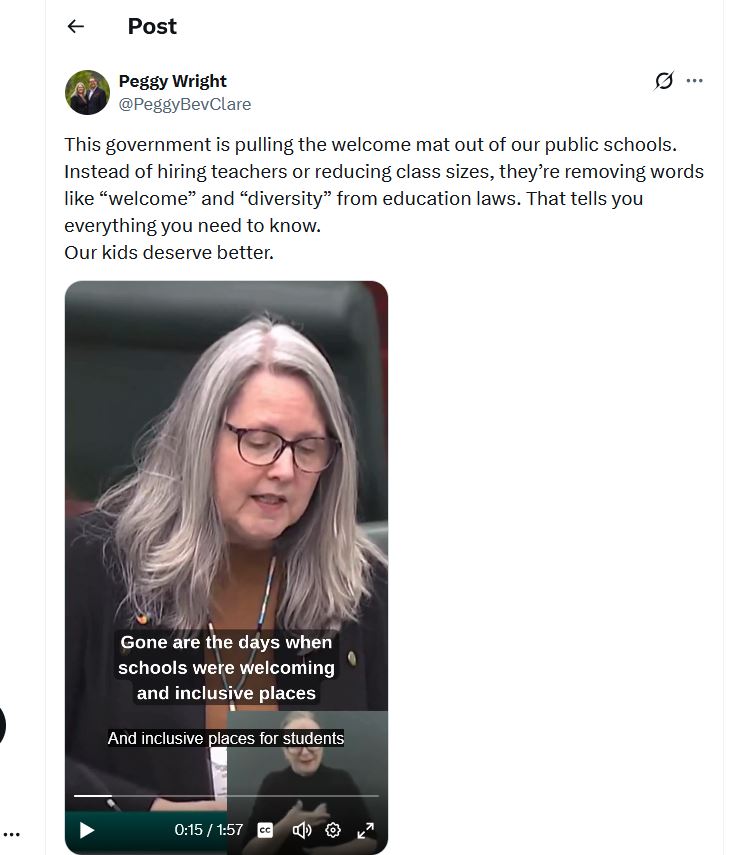
There is a recurring pattern in modern policy debates that most people sense but struggle to name. The argument presented to the public is not the policy that gets implemented. Instead, a broadly agreeable claim—something no reasonable person would oppose—is used to carry a far more specific and contested agenda into law. By the time the details become visible, the argument has already been won at the level that matters.
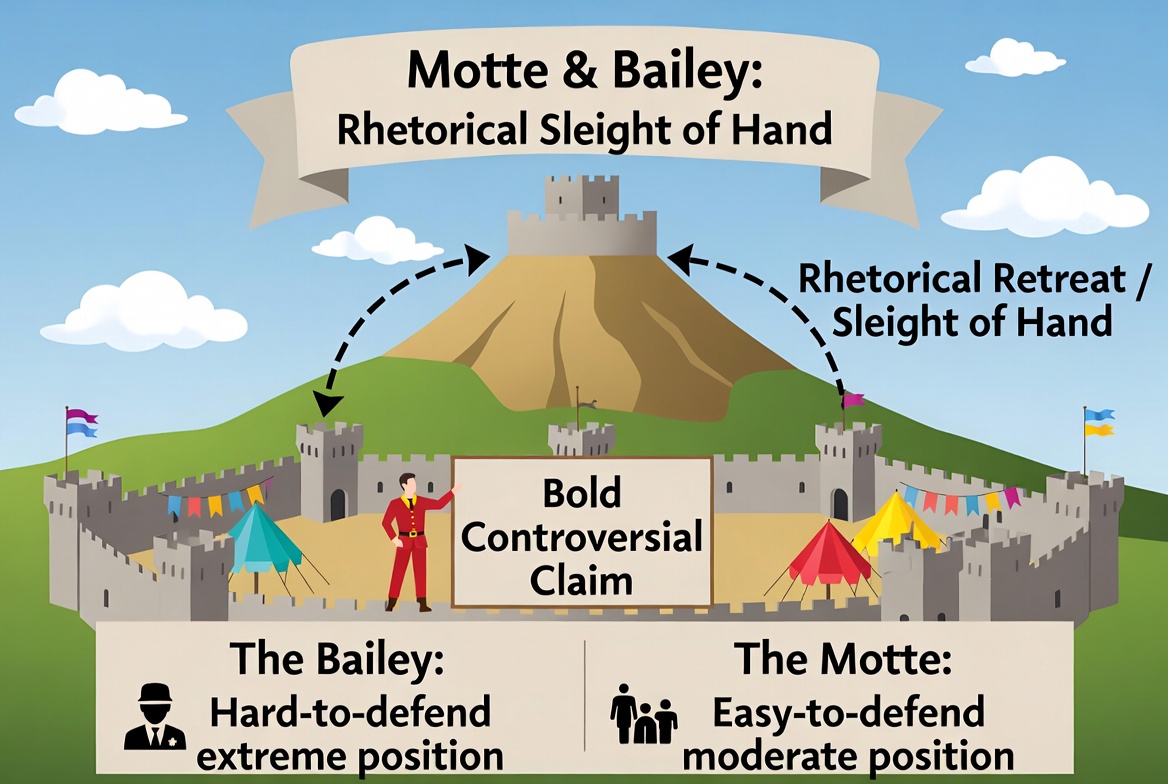
This is the structure known as the motte and bailey. The “motte” is the safe, defensible position: a statement so benign it feels almost churlish to resist. The “bailey” is the real position—the one with consequences, tradeoffs, and enforcement mechanisms. The move is simple. Sell the motte. Build the bailey. When challenged, retreat to the motte and accuse critics of attacking something obviously good.
You can see the pattern clearly in the recent dispute over education language. The public claim is that schools should be “welcoming,” “inclusive,” and respectful of “diversity.” No serious person objects to that in the abstract. But those terms are not operating as neutral descriptions. They have acquired specific policy meanings, often tied to particular ideological frameworks, institutional practices, and expectations placed on teachers and students. When legislation attempts to narrow or neutralize that language—shifting toward behavior-based standards like “safe and caring” environments grounded in responsibility and respect—the response is immediate: the government is “removing welcome,” attacking “diversity,” harming children. The motte is invoked as if it were the policy itself. The bailey disappears from view.
Watch the Move
In a recent legislative speech, MLA Peggy Wright provides a clean example of how this works in practice. She begins with a familiar image:
“Albertans put welcome mats in front of their doors. It means ‘come on in’ and we’re glad you are here.”
No disagreement is possible there. It is a moral and cultural baseline. But then the shift occurs. A change in statutory language becomes:
“the UCP is pulling up the welcome mat from all public schools.”
A metaphor replaces the policy. The audience is invited to react to exclusion rather than examine the legislation. The escalation continues:
“Gone are the days when schools were welcoming and inclusive places… celebrating diversity and uniqueness.”
At this point, the argument is no longer about wording. It is about intent, character, and harm. The key moment follows:
“the latest amendments… would strip words like ‘welcoming’ and ‘diversity’ from it.”
This is where the real question should be asked: does removing those words remove the underlying protections, or does it replace one framework of description with another? That question is never addressed. Instead, the speech returns immediately to moral framing:
“Diversity is a strength.”
In the abstract, yes. But the dispute is not over the abstract claim. It is over what “diversity” means in policy and practice. By collapsing the contested meaning into the harmless one, the argument avoids defending the actual implications. Criticism of the policy is recast as opposition to a universal good.
“The argument people agree to is not the policy that gets implemented.”
The most revealing line in the speech is this:
“Words are important… because they set the tone.”
That is true—and it explains the entire strategy.
This pattern isn’t random. It reflects a broader shift in how language is used in politics. Words like “diversity,” “inclusion,” and “safety” are no longer just descriptive. They function as instruments. If language helps shape how institutions operate and how people interpret reality, then controlling definitions becomes a form of power. Under that logic, you don’t need full public agreement on the details of a policy. You need agreement on the framing. Once that is secured, the content can expand behind it.
That helps explain why the motte and bailey is so effective. It allows advocates to operate on two levels at once. The public-facing level is morally attractive and broadly supported. The operational level is narrower, more contested, and often insulated from direct scrutiny. When the two are conflated, consent is manufactured. People believe they are endorsing a general principle when, in practice, they are enabling a specific program.
It works because most people are not trained to interrogate language this way. “Inclusion” sounds like inclusion. “Diversity” sounds like a mix of backgrounds and perspectives. “Safety” sounds like protection from harm. The terms carry moral weight before any definition is examined. By the time someone asks what they actually entail in practice, the rhetorical ground has already shifted. Opposition can be framed as hostility to the value itself rather than disagreement with its implementation.
The cost is not just confusion. It is the erosion of honest disagreement. If every critique of a policy can be recast as an attack on a universally accepted good, then meaningful debate becomes impossible. Language stops clarifying differences and starts concealing them. Institutions drift, not because the public has clearly chosen a direction, but because the terms of choice were never presented plainly.
This is why the technique matters. It is not just sharp rhetoric. It is a way of bypassing consent. If citizens cannot distinguish between the principle they are being asked to affirm and the policy that will follow from it, then they are no longer participating in a genuine democratic process. They are being managed through language.
If you think this reading is unfair, read the full remarks below and decide for yourself.
Appendix: Full Speech Transcript (April 2, 2026)
How to read this: Watch for the shift between general claims (“welcome,” “diversity”) and the specific policy being discussed. The argument depends on treating them as the same.
Full transcript of the video (Alberta Legislative Assembly session, ~1:57 long):
“Mr. Speaker, Albertans put welcome mats in front of their doors. It means ‘come on in’ and we’re glad you are here. And welcome to our house.But now the UCP is pulling up the welcome mat from all public schools.Gone are the days when schools were welcoming and inclusive places for students, celebrating diversity and uniqueness.That’s because the latest amendments to the Education Act would strip words like ‘welcoming’ and ‘diversity’ from it.This government combed through that bill and pulled the word ‘welcoming’ out eight times.Not satisfied with making our public schools less inviting — even as they function as important community hubs for many of our communities — then they went through and chopped the word ‘diversity’ out five times.Diversity is a strength.It used to say so in government policy, in legislation. But I guess not anymore.Words are important, Mr. Speaker, and that’s because they set the tone.When those in charge are threatened by words like diversity, welcome, and sense of belonging, there’s a problem. Because this is then about ideology and politics outside the classroom, not within.Instead of focusing on reducing class sizes, hiring teachers, and ensuring supports are there for all kids who need them, we get this distraction from a bill and government intent to narrow the frame so much that there is room for only one worldview: the UCP’s.And that’s the point.Straight out of the authoritarian playbook, Mr. Speaker.But, Mr. Speaker, our kids deserve that welcome mat back. I, for one, am extremely happy to let them know that they can expect it come next election, when it’s NDP in government and UCP — not our kids — who will find themselves unwelcome.”











 bleatmop
 Mystro
 The Arbourist


 Dead Wild Roses
Your opinions…