
You are currently browsing the tag archive for the ‘Schools’ tag.
Some children are genuinely vulnerable, atypical, or distressed, and they deserve careful support.
That should be easy to say. It should also be the beginning of the conversation, not the end of it.
The problem starts when a narrow duty of care is expanded into a broad teaching mandate. Support for a small number of children becomes a reason to saturate schools, children’s media, and online spaces with contested identity frameworks. What begins as accommodation becomes doctrine. What begins as care becomes a general lens for everyone.
That is the central move.
It is usually framed in soft language: inclusion, visibility, affirmation, making room. Sometimes that language is fair. But it can also hide a scope change. A real minority need is used to justify population-level exposure. The existence of some children who need unusual support does not, by itself, justify turning child-facing institutions into delivery systems for anti-normative identity scripts many children are not developmentally ready to evaluate.
Put simply: support is not the same thing as saturation.
A useful heuristic is the inoculation model. The implicit argument often sounds like this: expose everyone early and often to the framework so harm is prevented later. But that assumes the framework is age-appropriate, conceptually clear, and socially harmless when applied at scale. Those assumptions are usually asserted, not argued.
You can see the pattern in school frameworks like SOGI 123. SOGI 123 describes itself as an initiative to help educators make schools safer and more inclusive for students of all sexual orientations and gender identities, with tools spanning policy, school culture, and teaching resources. In British Columbia, SOGI 123 has been broadly integrated through educator networks and district participation structures. In Alberta, similar SOGI 123 resources and supports exist and are used, but public acceptance and implementation have been more contested and uneven. (Your local framing here is fine; if you want, we can add a specific Alberta anchor in the next pass.)
The point is not that every teacher using these materials has radical intentions. Most likely do not. The point is structural. A framework introduced in the name of protecting a minority of vulnerable students can become a general lens for shaping the environment of all students. That is exactly where support turns into saturation.
None of this requires pretending there are no benefits. Anti-bullying frameworks and school supports can reduce harassment and improve school climate for vulnerable students, and in some cases for other students as well. Recent SOGI 123 evaluation reporting in B.C. has explicitly claimed reductions in some forms of bullying and sexual-orientation discrimination, including effects observed for heterosexual students in studied schools. But that is a different question from whether a framework is well-bounded, developmentally fitted, and appropriate as a general lens for all children. A program can produce some good outcomes and still be overextended in scope.
This is also where ordinary parents often feel morally cornered. They are told the framework is simply about kindness and safety. Then they discover it also carries contested claims about identity, norms, and development. When they raise questions about age, fit, or timing, the objection is treated as hostility rather than prudence.
That rhetorical move matters. It is how debate gets shut down.
Some activist frameworks are not just asking for tolerance or non-harassment. They are more ambitious. They treat ordinary social norms as presumptively suspect—or as things to be actively challenged—rather than mostly inherited and refined. Adults can debate that in adult spaces. The problem is when those frameworks are translated into child guidance and presented as common sense before children are developmentally ready to sort through the concepts.
You do not need a graduate seminar to see the issue. Children imitate. Children seek belonging. Children absorb prestige cues. Children are shaped by what trusted adults celebrate. That is not bigotry. That is basic reality.
This is why developmental fit matters. Children do not process abstract identity questions the way adults do. Identity formation is gradual. Social context matters. Timing matters. Adult authority matters. Age appropriateness is not a slogan; it shifts across developmental stages, and what may be discussable at 16 is not automatically suitable at 6. When institutions present contested frameworks in a celebratory register first and a cautionary register later (or never), adults should worry.
The usual public binary is false. The choice is not between cruelty and total affirmation. It is not between neglect and ideological immersion. A sane society can do both things at once: provide targeted support for the children who truly need it, while refusing to reorganize the symbolic environment of all children around contested anti-normative frameworks.
That is not repression. It is proportion.
And proportion is exactly what gets lost when every concern is moralized and every request for limits is treated as harm.
We should be able to say, plainly, that some children need exceptional care without turning exceptional cases into the template for everyone else. We should be able to protect the vulnerable few without swamping the many. We should be able to teach kindness without requiring ideological inoculation.
If we cannot make those distinctions, then we are not practicing compassion. We are practicing scope creep with moral language.
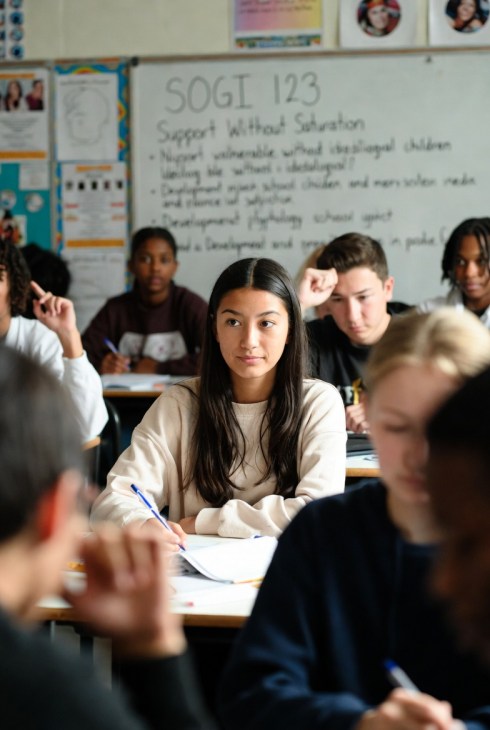
Support for vulnerable students is necessary. But targeted care is not the same as saturating schools with contested identity frameworks for all children.
References
- SOGI 123 / SOGI Education. “SOGI 123 | Making Schools Safer and More Inclusive for All Students.”
https://www.sogieducation.org/ (SOGI 123) - SOGI Education. “What Is SOGI 123?”
https://www.sogieducation.org/question/what-is-sogi-123/
(official explainer page) - SOGI Education. “British Columbia.”
https://www.sogieducation.org/our-work/where-we-support/british-columbia/
(B.C. implementation / network context) - ARC Foundation. “UBC Evaluation of SOGI 123 (October 2024).”
https://www.arcfoundation.ca/ubc-evaluation-sogi-123-october-2024
(evaluation / outcomes framing from SOGI-supportive side) - Alberta Teachers’ Association. “What is SOGI 123?”
https://teachers.ab.ca/news/what-sogi-123 (teachers.ab.ca) - Keenan, H., and Lil Miss Hot Mess. “Drag Pedagogy: The Playful Practice of Queer Imagination in Early Childhood.” Curriculum Inquiry 51, no. 5 (2021): 578–594.
https://doi.org/10.1080/03626784.2020.1864621 - Gender Report (opinion/critical perspective). “We need to take ideological gender rhetoric out of education.” (Jan. 28, 2021).
https://genderreport.ca/sogi-gender-curriculum-queer-theory/ (CANADIAN GENDER REPORT) - Global News. “Duelling protests held in Edmonton over sexual orientation and gender identity policies in schools” (Sept. 20, 2024).
https://globalnews.ca/news/10766483/edmonton-gender-identity-sexual-orientation-alberta-schools/ (Global News)
“Trans kids didn’t exist until we created them” is blunt phrasing, but the mechanism underneath it is real: kids don’t merely reveal identities; they adopt the identity-models a culture supplies and rewards. Adolescence is a meaning-factory. Pain looks for an explanation. Alienation looks for a tribe. If adults and institutions elevate one interpretive story for distress and then attach moral prestige, protection-from-questioning, and instant community to that story we should expect more kids to step into it. Not because every child is “lying,” but because this is how social scripts spread: they simplify suffering, convert it into status, and offer belonging on demand.
Proponents will tell a cleaner story. They claim “trans kids have always existed” and we’re simply seeing higher visibility in a less stigmatizing age. They claim affirmation is harm reduction. They claim the clinical pathway is cautious, selective, and evidence-informed. And they claim the “social contagion” frame is just a pretext to dismiss real dysphoria. That’s the best version of their public narrative: visibility + safety + compassion + careful medicine. The problem is that this narrative asks society to treat disputed assumptions as settled truth and then to treat moral confidence as a substitute for evidence – precisely in the domain where evidence must be strongest: irreversible interventions for minors.
That’s where the ideology runs aground. The evidence base for pediatric medical transition—especially puberty suppression—has repeatedly been assessed as weak and low-certainty. The York-led systematic review published in Archives of Disease in Childhood concluded there is a lack of high-quality research on puberty suppression in adolescents with gender dysphoria/incongruence, and that no firm conclusions can be drawn about impacts on dysphoria or mental/psychosocial outcomes. A 2025 systematic review in the same journal similarly characterized the best available evidence on puberty blockers’ effects as mostly very low certainty. This isn’t a minor academic quibble. It’s the difference between “we have strong reasons to believe this helps, on balance” and “we cannot be confident what this does to developing bodies and minds.” When the confidence level is that low, the ethical default is not acceleration; it’s restraint.
And restraint is exactly what some public health systems have moved toward—because the claims didn’t cash out in robust evidence. In the UK, the NHS stopped routine prescribing of puberty blockers for under-18s and restricted them to research context, and the government moved to make restrictions indefinite after expert advice citing insufficient evidence of safety. NHS England’s Cass implementation materials also frame puberty blockers as part of a research program with long-term follow-up, alongside evaluation of psychosocial interventions. That is not what “settled science” looks like. That is what a field looks like when it is finally admitting—late—that it has been making high-stakes moves on thin ice.
Now zoom out from the clinic to the culture, because this is the part people keep refusing to say out loud: the social environment is not neutral. Once schools, media, and professional bodies moralize one framework (“affirmation is care”) and stigmatize alternatives (“questioning is harm”), you get a one-way ratchet. A child declares an identity; the adults are trained that the declaration must be treated as authoritative; “exploration” becomes suspect if it doesn’t begin with affirmation; and any friction is rebranded as abuse. That moral framing isn’t compassion—it’s epistemic closure. And epistemic closure is exactly how you end up routing heterogeneous adolescent distress into a single explanatory funnel.
Because the presenting population isn’t one thing. It’s a mix: anxiety, depression, trauma, obsessive traits, social contagion dynamics, autism-spectrum features, sexual discomfort, body dysmorphia, internalized homophobia, loneliness, and the general misery of puberty in a screen-soaked status economy. Give that mix one glamorous story with institutional backing, and you will pull more children into it. You will also make it harder for them to exit, because the identity becomes socially defended and medically reinforced. Once irreversible steps begin, doubt becomes expensive. Regret becomes unspeakable. The “care model” becomes self-protecting: the deeper you go, the harder it is to admit the initial certainty was misplaced.
This is why I don’t treat “gender-affirming care” as a neutral phrase. It’s marketing language for a clinical posture that—too often—front-loads conclusion and back-loads caution. Real care for minors under uncertainty looks boring: slow assessment, serious differential diagnosis, treatment of comorbidities, family stability, and time. Real care doesn’t require anyone to be cruel. It requires adults to resist the temptation to turn a child’s distress into an adult moral performance. It requires institutions to stop rewarding certainty and punishing skepticism. It requires the basic humility to say: “We might not know what’s going on yet, and that means we don’t get to make irreversible bets with children.”
If we don’t change course, the end state is predictable. More kids will be swept into an identity pipeline that confers instant meaning but demands escalating commitment. More parents will be coerced by policy and stigma rather than persuaded by evidence. More clinicians will practice defensively in a moralized climate. And the backlash won’t stay polite or surgical; it will arrive as a blunt instrument, because careful critics were dismissed as hateful for too long. That’s the social damage: not merely the trend itself, but the institutional refusal to admit uncertainty until the human costs become impossible to ignore.

This is call to action by one parent who is very concerned about the pernicious effects of gender ideology on children. Apparently, he lost his child to the transgender cult – because that is what cults do – insert a wedge between parents and their children to break the bonds of family and support networks to increase the likelihood of gaining a convert to the cause.
Visit his website to find out more.
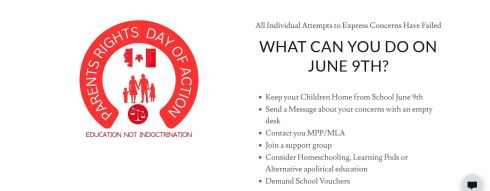
As a Canadian teacher I won’t promote this ideology while I teach. It is corrosive and harmful to child development and a stable childhood identity – that in itself should give Educators pause.
This debate needs to happen in society. Parents, teachers, and educational institutions must speak honestly and freely about what gender ideology is and what is being taught in schools.
Find out exactly what SOGI is and how (if) it is being taught to your children. Huge red flag right off the bat when you visit the website. It states – “Everyone has a sexual orientation and gender identity.” Gender identity is the risible bullshit that the activist Left is attempting to enforce and codify into our society. Gender, simply, are the stereotypes associated with the sexes. Most sex stereotypes (gender) are inaccurate and harmful for those forced to live within their bounds. Get rid of gender and the toxic stereotypes that hurt people. SOGI embraces the exact opposite of this.
From the Substack Woke Watch – Parents Push Back Hard in Western Canada:
“According to Executive Director Reg Krake, SOGI 123 is “a set of tools and resources to help create safer and more inclusive schools for students of all sexual orientations and gender identities. They include policies and procedures, inclusive learning environments, and age-appropriate teaching resources that are aligned to BC’s K-12 curriculum to help educators create a school environment where students feel safe, accepted, respected and welcome.”
From the SOGI resource website the “three essentials for SOGI-Inclusive schools” are laid out:
- Policies & Procedures that explicitly reference SOGI have been proven to reduce discrimination, suicidal ideation, and suicide attempts for all students.
- Inclusive Environments. Inclusive learning environments—including SOGI-inclusive signage, word choices, and extra-curricular opportunities—create a positive and welcoming space for all students.
- Teaching Resources. Lesson plans that teach diversity and respect and include examples of SOGI topics and 2SLGBTQ+ community members reflect the SOGI diversity in students’ lives and society.
The red flags become apparent when you consider that SOGI 123 is designed for K-12 students. The first question I have is why is sexual orientation, sexuality in any form and gender identity something children in grades K-6 are being taught about or exposed to? Why are SOGI 123 approved books which contain age inappropriate sexual content made available to this cohort via school libraries? There are also many questions concerning the appropriateness of material taught or made accessible to students in grades 7-12 as well.”
Find out what is going on in your school with your children. See if the person you have entrusted your children with for 5 hours a day is using age inappropriate materials to adversely affect their cognitive and social development.
In Canada, the struggle will have to be at the grassroots level, and unfortunately against the organizations that many of us once called home.
Politics: Federal, Provincial, Local
“Ultimately this will be won or lost based on real politics, and elections at the Municipal, Provincial and Federal levels. While it is helpful overall to have not-woke people at City hall, the thrust of municipal elections for schools is done through the school board elections. More on this below.
Realistically, given the current slate of political parties, left, right or centre, the only prospects for pushback against woke ideology will come from the right- that means conservative and populist parties. The NDP has been predominantly identity politics focused since the 1990s, and has gone almost completely woke – they are no longer the voice of the working class. The Green Party, once a refuge for the not-woke left, submitted rapidly over the past few years. The Liberals have generally succumbed, especially with the current Prime Minister, and while there may be many members who do not like woke ideology they feel their hands are tied. Even the conservative parties are questionable with little support in Ontario from the pretend populist Doug Ford, – some are wavering elsewhere. Only the populist parties (People’s Party, UCP, Sask United Party, New Blue, Ontario Party and now CAQ) have shown reliability in opposing wokeism.
It is a tough pill to swallow for those of us who have traditionally been left to support right wing parties, but it is now no longer possible to expect the woke movement to simply fall out of fashion. The only way to save the left is to punish it. Across the English speaking world, every party not on the right is culturally incapable of pushing back against wokeism.”
As always, definitions are important. This is what ‘woke’ actually is, as opposed to what is members claim it to be:











 bleatmop
 Mystro
 The Arbourist


 Dead Wild Roses
Your opinions…