
You are currently browsing the monthly archive for July 2011.
He’s been gone a long while, but I am thrilled to say that NonStampCollector has returned with another fantastic cartoon. And for his triumphant return he has treated us all with a two parter looking at the story of Noah. I have missed NSC’s formidable skill at highlighting how immensely ludicrous christian stories are, all the while being hysterically funny. Bow your heads and give thanks to tonight’s patron saint of ripping religion a new one: NonStampCollector
Summer vacation is never complete without a trip to Kaslo, British Columbia. Packing up the fiancee and parental unit we embarked on the 12 hour car trip (Oh, and a stop off at Radium Hotsprings as well) to the funky/quaint town known as Kaslo. It is a week of intensive learning, singing and general revelry. This year, as last, was a good time. Let the photoblogging begin!

Getting to Kaslo from Alberta requires a ferry ride. Woo!

In a valley surrounded by mountains and lakes (Kootaney lake in photo), oh the horror.

The Moyie, one of the largest paddle wheel boats in existence. Now a museum.

Kaslo is a hamlet that sees some rain, evidenced by the mossy roof.

A sample of the flowers at the Kaslo townsite.
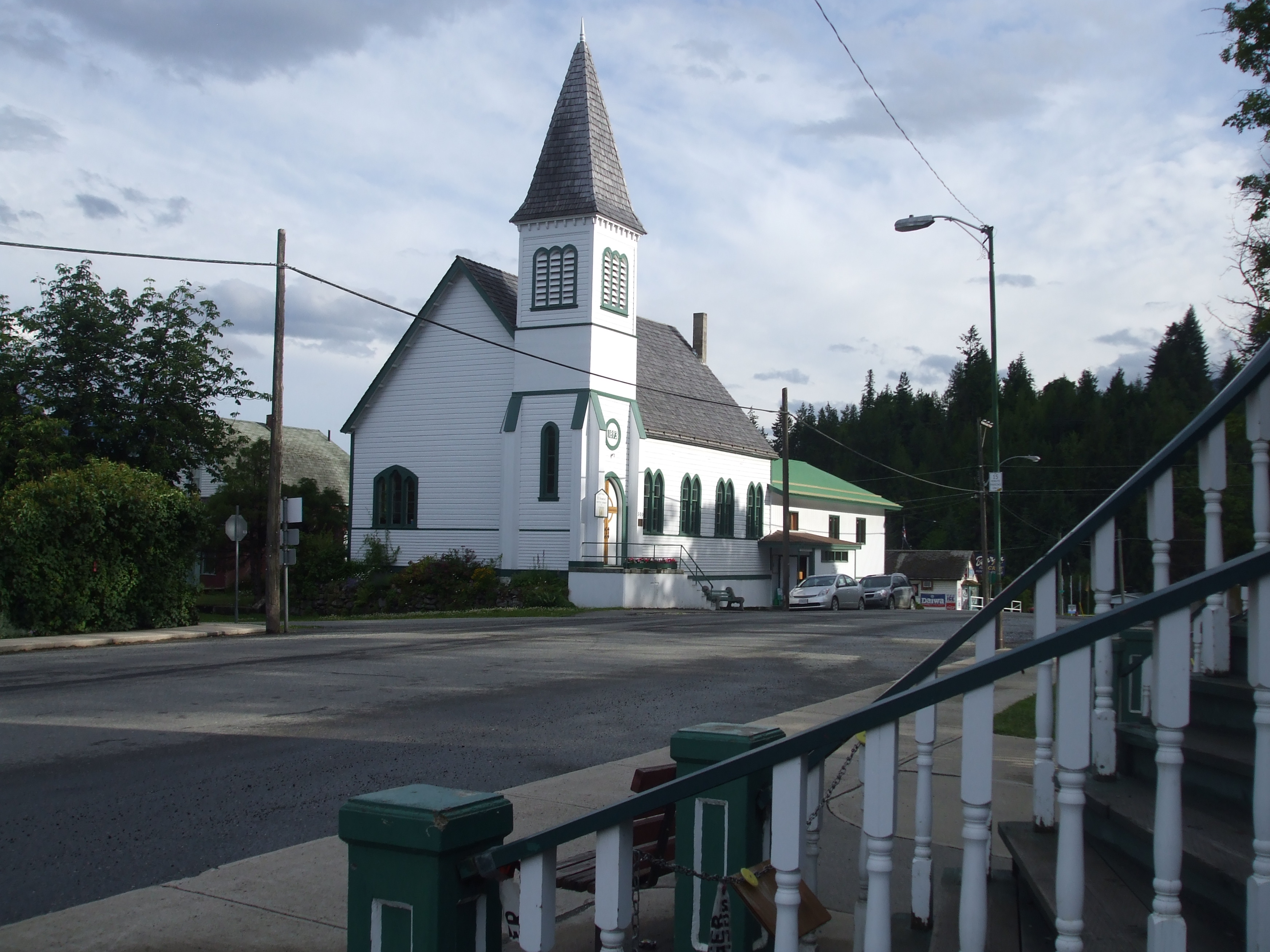
Ah, singing central, everyday from 10 till 3 of drilling and singing and more singing.

Our trusty steed and lodging for the week at Kaslo. The local ravens decided that our jeep was a great place for their bird-doo.

The beach was a five minute walk away from our lodging. It was lovely, except for the rain. :)

One of the singers brought her Shetland Sheepdog "Mcduff" along for the week. And as in most cases, the experience is always enhanced when dog is added.

Looking North at the continental divide on the Kootenay ferry, and so endeth our Kaslo trip for the year
It is nice knowing that you are fairly right about something. Evolution happens to be one of those topics in that category. The funny/sad part is running across people who still “don’t get it” and either are deluded or have let their misplaced skepticism get the better of them. I try unsuccessfully to hide my incredulity when people put their ignorance on display, it probably gets me in trouble as I have had these “you’re really saying that moments” with people who are in positions of authority and they are friends/respected peers.
Too bad, so sad; I’m getting way too old to varnish the truth for those who want to clutch the wizened pearls of their shoddy religions and spout nonsense.
The Große Fuge (or Grosse Fuge, also known in English as Grand Fugue), Op. 133, is a single-movement composition for string quartet by Ludwig van Beethoven. A massive double fugue, it originally served as the final movement of his Quartet No. 13 in B♭ major (Op. 130) but he replaced it with a new finale and published it separately in 1827 as Op. 133. It was composed in 1825, when Beethoven was completely deaf, and is considered one of his late quartets. It was first performed in 1826, as the finale of the B♭ quartet, by the Schuppanzigh Quartet.
The Große Fuge is famous for its extreme technical demands and its unrelentingly introspective nature,[1] even by the standards of his late period. It is the largest and most difficult of all of Beethoven’s string quartet movements.[2]
History of composition
Beethoven originally composed the Große Fuge as the final movement of his String Quartet No. 13 (Op. 130). When the work was first performed, the audience demanded encores of only two of the middle movements of the quartet. Beethoven, enraged, was reported to have growled, “And why didn’t they encore the Fugue? That alone should have been repeated! Cattle! Asses!”[6]
However, the fugue was so demanding of contemporary performers and unpopular with audiences that Beethoven’s publisher, Matthias Artaria,[7] urged him to write a new finale for the string quartet. Beethoven, although notorious for his stubborn personality and indifference to public opinion or taste, acquiesced to his publisher’s request on this occasion. He composed a replacement finale in late 1826. In May 1827, about two months after Beethoven’s death, Artaria published the first edition of Op. 130 with the new finale, and the Große Fuge as Op. 133, as well as a four-hand piano arrangement, Op. 134.[8]
Analysis
The Große Fuge opens with a 24-bar Overtura, which introduces one of the two subjects of the fugue, a tune closely related to the one which opens the String Quartet No. 15, Op. 132. The music of the Overtura consists of a series of unresolved fragments separated by long pauses. The fragments anticipate the main sections of the fugue, but in reverse order.[2]
Beethoven then plunges into a violent and dissonant double fugue, with a second subject of dramatically leaping tones, and the four instruments of the quartet bursting out in triplets, dotted figures, and cross-rhythms.
Following this opening fugal section is a series of sections, in contrasting keys, rhythms and tempi. Sections often break off suddenly, without real preparation, to create a structural texture that is jagged and surprising. Toward the end, there is a slowing, with long pauses, leading into a recapitulation of the overture, and on to a rushing finale that ends the movement.
Like some of Beethoven’s other late finales, such as the “Ode to Joy” from the Ninth Symphony, the Fugue can be seen as a multi-movement form contained within a single large movement. Each of the smaller sections is built on a transformation of the original theme. In addition, the Große Fuge is an example of a compositional process Beethoven explored late in life: a combination of elements of variation form, sonata form, and fugue. The lyrical section in G♭ has the weight of an independent slow movement; some commentators have even attempted to analyze the entire piece in terms of sonata form.
During the 20th century, quartets came to play Op. 130 with the original Große Fuge finale. Opinion today is decisively in favor of using the fugue; most musicians would agree that the quartet is stronger in its original form.[9]
We are currently being plagued by the malicious little bloodsuckers. The rainy summer has opened the floodgates for these pests. Sometimes bug spray is just not enough…
I am feverently awaiting the day when this becomes a consumer product.
Ah, if politics for us humans could be just as easy…

What? We're comfy!
Religion is bad. Fundamentalist religion is even worse, as contact with the outside world and reality is even more tenuous. Education saved Carolyn Jessop’s life. That is the power of education; to gain perspective, to think critically and learn facts about the world we inhabit. Education is the antithesis of religion as enlightened people rarely fall victim to religion’s tattered stories and bogus wish-fulfillment. This clip is just an excerpt, see the entire interview here.











 bleatmop
 Mystro
 The Arbourist


 Dead Wild Roses
Your opinions…