
You are currently browsing The Arbourist’s articles.
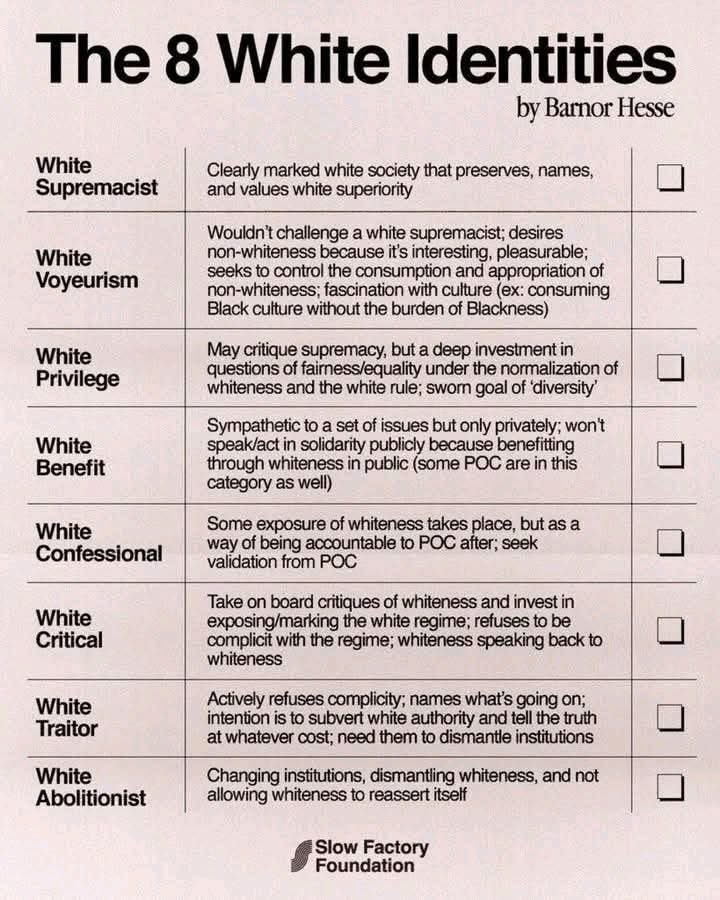
This “8 White Identities” chart (attributed to Barnor Hesse) looks like education, but it functions like a moral sorting machine. It offers eight labels that appear descriptive while quietly guiding you to one approved destination: “traitor/abolitionist,” meaning active participation in dismantling institutions so “whiteness” cannot “reassert itself.” That isn’t neutral analysis; it’s a disciplinary ladder. The key tell is the structure: most categories are not stable identities but staged accusations: if you don’t end at abolition, you’re still “benefiting,” “confessing,” “complicit,” or “voyeur.” It’s less “here are ways people relate to race” and more “here is your moral rank, move upward.”
Where does this method come from? In plain terms, it’s downstream of critical theory which is a family of approaches associated with the Frankfurt School, including Max Horkheimer, which treats social life as saturated with power and aims not merely to interpret society but to critique and transform it. Suspicion becomes the starting posture: norms, institutions, and “common sense” are read as mechanisms that reproduce domination. That posture can be illuminating when it identifies genuine structural incentives or hidden rules. The problem is what happens when the posture hardens into a closed moral cosmology: every institution is presumed guilty, every norm is presumed cover, and disagreement is presumed self-interest.
This particular pop-form is best described as CRT-style reasoning (even when it’s outside law schools): “whiteness” treated as an institutionalized advantage; disparities treated as presumptive evidence of systemic bias; “neutrality” treated as camouflage; and moral legitimacy tied to “anti-racist” alignment rather than truth-tracking. The flaw isn’t “not caring about racism.” The flaw is an a-historical compression: it collapses different eras, actors, and institutions into one continuous regime (“whiteness”) and treats complex tradeoffs as one moral story with one villain. You stop seeing plural motives, competing goods, and reformable failures; you see only complicity versus resistance.
The chart also relies on social coercion, not argument. It invites “accountability,” but what it means in practice is public performance under threat of moral demotion. Ask for evidence and you’re “centering yourself.” Disagree and you’re “invested.” Stay quiet and you’re “benefiting.” Even agreement becomes suspect if it’s the “wrong” kind (confessional, validation-seeking). That’s the unfalsifiable core: the framework is built so that any response can be converted into proof of guilt or complicity. A theory that cannot lose contact with counterevidence doesn’t guide understanding; it guides conformity.
If you actually want a model that helps rather than coerces, start with falsifiable claims and reformable mechanisms: identify specific policies, incentives, or gatekeeping practices; compare outcomes across institutions; test interventions; keep individual dignity intact; and treat moral status as something earned by conduct, not assigned by category. You can still talk about bias and history without turning identity into original sin. The danger of charts like this isn’t that they “teach empathy.” It’s that they train people to swap evidence for ritual, and dialogue for denunciation—and that trade makes every institution worse, not better.
If a government’s job is to steward the conditions for ordinary people to build, trade, invest, and plan a life, then our federal leadership has been doing that job badly.
Not because Canadians are lazy. Not because the world is easy. But because the governing reflex is wrong: when something breaks, Ottawa reaches for a new program, a new credit, a new rebate, a new subsidy, a new “strategy.” It treats the economy like a patient that can be stabilized indefinitely with IV drips.
That approach can buy headlines. It cannot buy prosperity.
The best indicator is per-person performance. We can argue about which yardstick matters most, but the story is consistent: Canadians are producing less per person than we should be, relative to peers and especially relative to the United States. When per-capita output stagnates, everything gets harder at once: housing feels unaffordable, healthcare feels strained, wages feel thin, and every problem becomes a fight over slices instead of a discussion about baking more bread.
The policy style matters because it shapes incentives. When governments patch symptoms with cash transfers while leaving the cost structure and the approval structure untouched, they teach the country the wrong lesson: don’t fix the machine; keep bribing the machine not to squeal.
The mechanism: why “more programs” keeps failing
Here’s the basic mechanism, stripped of moral drama:
- High costs and slow approvals choke supply.
Housing, energy, infrastructure, major projects, even small-business expansions: Canada is a country that says “no” and “later” far more often than it says “yes” and “go.” Every delay is a tax. Every duplicated review is a tax. Every veto point is a tax. - Government then tries to “help” people pay the tax it created.
Rebates, credits, subsidies, targeted relief. It’s a strange kind of compassion that insists on first inflating the cost of living and then offering a coupon to survive it. - Those programs don’t increase productivity.
They redistribute purchasing power. Sometimes that’s justified in emergencies. But as a governing model it becomes a treadmill: you need ever-larger transfers to offset the same underlying frictions. - Meanwhile investment goes elsewhere.
Capital avoids uncertainty, delays, and politicized approvals. If the return on effort is higher across the border, it doesn’t matter how many committees we convene about “competitiveness.” The money leaves. So do the high-productivity jobs.
That’s the loop.
Steelman: “But the government is trying to protect people”
Yes. There are real hardships and real shocks: pandemic aftershocks, energy volatility, inflation waves. A modern state can’t pretend none of that exists.
But a serious government distinguishes relief from policy habit.
Relief is temporary and humble. It treats symptoms while it removes the causes.
Policy habit is permanent and proud. It treats symptoms and declares victory.
Canada’s problem is not that government ever helps. It’s that government too often helps in a way that replaces fixing the constraints. Then it wonders why the constraints keep biting.
The verdict
If your economic model is “make life expensive, then subsidize the expense,” you don’t get abundance. You get dependency, resentment, and a widening gap with jurisdictions that still know how to build.
You also get a politics where every election becomes a bidding war over who will mail the bigger cheque, because structural reform has been quietly taken off the table.
That’s not leadership. It’s managed decline with better graphics.
Three solutions that trust Canadians
These aren’t “one weird trick” fixes. They’re principles that put choice back in the hands of households and entrepreneurs rather than bureaucracies.
1) Let people keep more of what they earn, especially on essentials
If Ottawa wants to help with affordability, it should stop pretending price pressures are solved by “targeted” programs. The cleanest help is broad, simple tax relief that lets people choose.
- Cut taxes that hit basics hardest (and stop layering cost-pushers into the production chain).
- Prefer lower rates and fewer carve-outs over boutique credits that require a rulebook and a caseworker to access.
- If a policy goal requires a price signal, keep it simple and transparent, not buried across permits, compliance, and pass-through.
This trusts Canadians because it doesn’t tell them what to buy. It stops taking their money and then re-selling it back to them with a government logo.
2) Slash approval times and regulatory duplication so builders can build
Canada does not have a “housing feelings” problem. It has a permission structure problem.
- Set hard timelines for approvals and treat missed deadlines as automatic escalation or approval, not “we’ll get back to you.”
- Collapse overlapping reviews and require agencies to coordinate rather than serially veto.
- Align incentives so provinces and municipalities that approve homes and infrastructure fast aren’t punished for growth.
This trusts Canadians because it assumes the default answer to a lawful project is “yes,” and it lets builders, trades, and communities respond to demand without waiting years for permission.
3) Open the country internally: real competition, real mobility, real choice
A country shouldn’t feel like 10 small markets with paperwork toll booths between them.
- Remove internal trade barriers so goods, services, and workers can move freely across provinces.
- Make credential recognition faster for skilled trades and professionals so talent isn’t trapped behind provincial gatekeeping.
- Reduce the habit of picking “future sectors” by subsidy and instead create conditions where any sector can win if it serves customers.
This trusts Canadians because it relies on competition and mobility, not bureaucratic selection. It lets consumers choose, lets workers move, and lets businesses scale without needing a lobbyist.
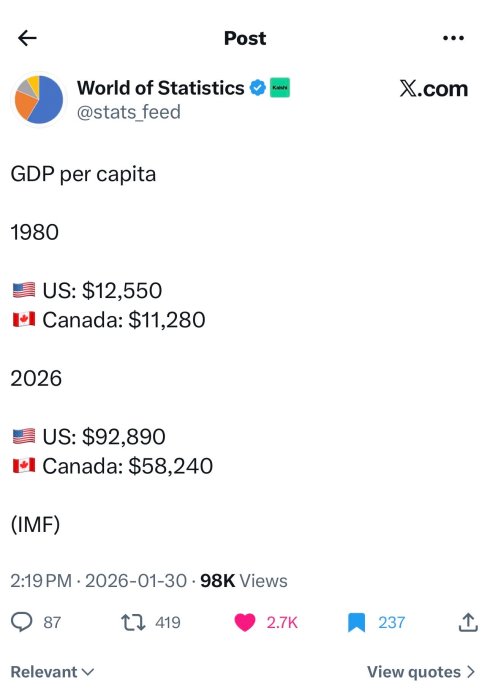
If Ottawa keeps governing by bandage, the next few years will look like the last: higher spending, louder announcements, thinner per-person results, and a country that feels like it’s working harder for less. The gap won’t close by intention. It will close only when we stop confusing “more government activity” with “more national competence.”
Tyler Cowen once tried to name the biggest “revolutions” he’s lived through—moon landing, collapse of communism, the internet, and now AI. In the middle of that list he drops one that most people still don’t treat like a revolution at all: “Feminization.” (Marginal REVOLUTION)
That word isn’t a complaint. It’s a category. It says: a long-run compositional change is underway, and it matters.
Helen Andrews’ “Great Feminization” thesis—popularized in a talk and elaborated in her Compact essay—takes the next step: as women become a larger share of institutions, institutions don’t merely “include” women; they become substantively feminized, and what we call “wokeness” is basically the cultural exhaust of that process. (Compact)
Here’s my position up front: the demographic shift is real and measurable in Canada; the “feminization = wokeness” equation is an overconfident master key.
It explains too much, too easily, by psychologizing demographics instead of interrogating incentives.
Canadian anchors: the shift is measurable (not vibes)
Start with a handful of Canadian facts you can actually point to.
- Parliament: the House of Commons sits at 104 women out of 343 MPs (30.3%). (IPU Parline)
- Judiciary: the share of federally appointed judges who are women rose from 43.8% (2021) to 46.7% (2023), per Statistics Canada. (Statistics Canada)
- Universities: women are 43.7% of full-time teaching staff in 2024/2025, up from 15.9% in 1984/1985. (Statistics Canada)
- Management: women are 51.9% of public-sector managers but 35.2% of private-sector managers (2023), and hold 42.7% of middle management vs 30.8% of senior management (2021). (Statistics Canada)
- Psychology (Alberta snapshot): Job Bank puts psychologists at 81% women / 19% men in Alberta. (Job Bank)
You don’t need to think any of this is good or bad to recognize the basic point: elite and semi-elite Canadian pipelines have changed composition in living memory. The “Great Feminization,” at minimum, names something real.
Why composition changes institutions (and why noticing this isn’t misogyny)
Here’s the move that poisons discussion: someone observes a demographic shift and asks what it does to norms; the response is to treat the question itself as hatred.
That’s not an argument; it’s a veto.
Institutions aren’t just rulebooks. They are reward systems: what gets you promoted, what gets you ostracized, what gets you hauled into a meeting, what everyone learns not to say out loud. When composition changes, the informal equilibrium can change too—sometimes for the better, sometimes not.
Before anyone reaches for the “misogyny” stamp, three obvious distinctions:
- Descriptive claims aren’t moral verdicts. Saying “X is now 47% female” is not saying “women ruined X.”
- Group averages aren’t destinies. Even if differences exist on average, overlap is huge. Plenty of women are rule-first and combative; plenty of men are harmony-first and censorious.
- The target is incentives, not women. If a system rewards reputational risk-avoidance and punishes open conflict, it will drift toward soft enforcement and speech management—regardless of who staffs it.
Those distinctions don’t sanitize the topic. They make it discussable.
Where Andrews helps—and where her thesis becomes a master key
Steelman Andrews first: she’s right that the shift is large, and she’s right that institutions can be remade through changes in who occupies them. If you pretend otherwise, you’re pretending humans don’t do social enforcement.
Where she overreaches is the claim (often treated as self-evident) that “feminization = wokeness.” (Compact)
Two problems.
1) One variable can’t carry a multi-cause phenomenon
The rise of “woke” managerial dynamics tracks at least four forces that are not reducible to gender composition:
- social media: instant reputational escalation; permanent records of mistakes; a public audience for internal disputes
- liability culture: institutions optimizing to avoid lawsuits, complaints, and scandal
- bureaucratic expansion: more compliance, more policy, more internal language policing
- credential sorting: ideological clustering in certain professional strata
In Canada, you can see the basic direction without naming villains: risk management becomes a career track; “process” becomes protection; disputes become “incidents”; leaders learn to value quiet over truth because quiet is legible as safety.
You can believe feminization is one contributor. But treating it as the engine is an interpretive leap, not an established causal law.
2) It tempts essentialism even when it gestures at nuance
If “wokeness” is “women’s morality,” you’ve turned a complex institutional pathology into a personality profile of half the species. That’s analytically brittle and politically stupid: it hands critics the easiest rebuttal (“you’re essentializing women”) and it blinds you to male-led versions of the same pathologies (purges, conformity spirals, status policing), which history supplies in bulk.
If you want to criticize a norm regime, criticize the regime. Don’t smuggle in contempt.
What the evidence can support—more modestly
A defensible claim, one that doesn’t require you to psychologize women as a class, looks like this:
- Some sex-linked preference gaps show up in some contexts, especially around speech, conflict, and social sanction. For example, a Knight Foundation/College Pulse study reports large gender differences among U.S. college students: 41% of college women prioritized protecting free speech versus 71% of college men, while women were more likely to prioritize promoting an inclusive society.
- Institutions are sensitive to preference distributions because norms are enforced socially, not just formally.
- Incentives decide which preferences become “policy.” Liability, reputation, and managerial bureaucracy amplify harm-avoidance.
And this is the part Andrews gestures at, but doesn’t fully own: if you want to understand modern speech policing, HR creep, and the new professional fearfulness, start with incentives. The incentives turn every controversy into a corporate emergency; then people behave accordingly.
On that view, feminization isn’t the whole story. It’s a relevant input—and its effects depend on the system it enters.
The real Canadian question: can we preserve hard virtues mid-transition?
Canada is useful here because we’re visibly mid-shift rather than at some imagined endpoint. Parliament is at 30% women, not parity. (IPU Parline) The federal judiciary is closing on parity. (Statistics Canada) Universities have moved dramatically since the 1980s, but remain below parity in full-time teaching staff. (Statistics Canada) Management splits sharply by public vs private sector, and senior leadership remains male-skewed. (Statistics Canada)
So the live question isn’t “should women be here?” They are here, and they belong here.
The question is narrower and more urgent:
As composition changes, what norms do we want to protect because they are fragile?
A short list:
- due process and evidence standards (law)
- viewpoint tolerance and intellectual risk-taking (academia)
- candid disagreement and non-performative conflict (organizations)
- the capacity to make decisions that feel “unkind” but are necessary (policy)
If you think those virtues are real and fragile, you don’t need to scapegoat women. You need to design institutions that reward truth-telling and competence more than “harm management” and reputational prophylaxis. That means fewer performative “values” rituals and more procedural backbone: clear standards, clearer speech norms, and leaders who can say “no” without laundering it through therapy language.
Verdict and prediction
The Great Feminization is real in Canada. The numbers are not subtle. (IPU Parline)
But “feminization = wokeness” is a bad master key. It explains too much, too easily, by psychologizing demographics rather than interrogating incentives. (Compact)
My bet is that the next decade won’t be settled by shouting “misogyny” or shouting “women did this.” It will be settled by whether our institutions relearn a difficult skill: distinguishing “this feels harmful” from “this is false,” and building cultures where adults can endure disagreement without turning every conflict into a moral emergency.

Glossary
- Confounders — other factors that could be the real cause, making cause-and-effect hard to prove.
- Essentialism / essentialize — treating a group as if it has one fixed “essence” (“women are X”), ignoring variation.
- Epiphenomenon — a byproduct; something that looks important but is really “exhaust” from a deeper cause.
- Monocausal — blaming one cause for a complex outcome.
- Pathology (institutional pathology) — a recurring dysfunctional pattern inside an institution.
- Prophylaxis — preventative action; here, pre-emptive “avoid scandal” behavior.
- Psychologizing — explaining political/institutional behavior by reducing it to personality traits or “mental makeup.”
A pocket field guide to the tells, the vibes, and the escape hatches 🧭
This one is deliberately not an essay. It’s a field guide. If “The Woke Machine” was the engine diagram and “The Woke Machine in the Wild” was the road test, this is the laminated card you keep in your purse/wallet so you can recognize the pattern in real time.
Rule of thumb: you’re not looking for left or right. You’re looking for a script. The woke script, as used in this series, shows up when a conversation shifts from “what’s true?” to “who gets to speak?” to “if you disagree, you’re guilty.”
The three-check test (10 seconds)
If you hear these three moves stacked together, you’ve found it:
- Identity first: “This is about who we are and what’s been done to us.”
- Standing first: “Some people speak; other people defer.”
- Sealed loop: “Disagreement proves the harm.”
One of these is normal politics. All three together is the machine.
The Field Guide Cards 📇
Each card has: vibe → what it’s doing → escape hatch
Card 1: The Credential Swap
Vibe: “It’s not my job to educate you.”
What it’s doing: Turns your question into an offense so the claim never has to be defended.
Escape hatch: “Fair. Point me to the best source you trust. I’ll read it, then we can discuss the claim and the remedy.”
Card 2: The Motive Trap
Vibe: “Intent doesn’t matter. Only impact matters.”
What it’s doing: Makes every mistake equally condemnable. Eliminates proportionality.
Escape hatch: “Impact matters. Intent matters for what response is fair. What change would satisfy you, and what would be excessive?”
Card 3: The Moral Draft Notice
Vibe: “Silence is violence.”
What it’s doing: Forces instant alignment. Neutrality becomes guilt.
Escape hatch: “I’m open to discussion. I don’t do coerced declarations.”
Card 4: The Sacred Testimony Upgrade
Vibe: “Listen to marginalized voices.”
What it’s doing: Sometimes an honest corrective. Sometimes a command to treat testimony as unquestionable.
Escape hatch: “I’m listening. After listening, are we allowed to test general claims with shared evidence standards?”
Card 5: Harm as a Veto
Vibe: “That’s harm.” / “That’s violence.”
What it’s doing: Replaces argument with a stop sign.
Escape hatch: “Let’s specify. What concrete harm, to whom, at what threshold, and what rule follows from it?”
Card 6: The Implementation Shaming
Vibe: “You’re centering yourself.”
What it’s doing: Turns practical questions into moral failure.
Escape hatch: “Implementation questions protect people from unintended damage. Let’s talk tradeoffs.”
Card 7: The Purity Shortcut
Vibe: “If you were a good person, you’d already agree.”
What it’s doing: Makes moral worth depend on agreement.
Escape hatch: “Good people disagree. Let’s talk reasons, evidence, and costs.”
Card 8: The Story-to-System Leap
Vibe: “My lived experience proves the system is X.”
What it’s doing: Jumps from testimony to total causation without the hard middle step.
Escape hatch: “I accept the experience. Now show how we know the cause. What alternative explanations did we check?”
Card 9: The Sealed Loop
Vibe: “Your disagreement is proof.”
What it’s doing: Objections become confirmation. Nothing can be corrected.
Escape hatch: “If disagreement counts as proof, we’ve left reasoning. What would count as disconfirming evidence?”
Card 10: The Reality Sabotage
Vibe: “Objectivity is a tool of oppression.”
What it’s doing: Undermines common standards so the frame can’t lose.
Escape hatch: “If we can’t share standards, we can’t make fair rules. What standards apply to everyone equally?”
Card 11: The Venue Laundering Move
Vibe: “Deplatforming isn’t censorship.”
What it’s doing: Uses technicalities to deny coercion while doing coercion.
Escape hatch: “Maybe it isn’t state censorship. It’s still a power move. What principle makes this consistent?”
Card 12: The Totalizing Story
Vibe: “The whole system is rigged.”
What it’s doing: Converts a hypothesis into a worldview. Every counterexample becomes cover-up.
Escape hatch: “Maybe. What evidence would make you revise that, and what would count as a genuine counterexample?”
The “Woke in the Wild” Bingo Strip 🎯
If you hear three of these in one conversation, slow down:
- “Do the work.”
- “That’s not up for debate.”
- “I don’t feel safe.” (used as policy veto)
- “Platforming equals harm.”
- “Your questions are violence.”
- “You’re asking for emotional labor.”
- “We can’t center comfort.”
- “The data is racist.”
- “That’s tone policing.”
- “You’re on the wrong side of history.”
Some of these are sometimes fair complaints. The tell is when they function as argument substitutes.
Three calm moves that work in almost any room 😌
- Falsifiability: “What would change your mind?”
- Symmetry: “Does this rule apply to your side too?”
- Category check: “Are we discussing evidence, or are we assigning moral status?”
You’re not trying to dunk. You’re trying to keep the conversation inside reality.
Mini-glossary (translation for normal humans) 📘
- Standing: who is treated as allowed to speak and be believed.
- Self-sealing: a belief that treats objections as confirmation.
- Moral sorting: dividing people into good/bad based on frame acceptance.
- Harm (as used here): sometimes real injury; sometimes a rhetorical stop sign.
- Deplatforming: removing access to a venue; not always illegal, often still coercive.

Endnote
This field guide simplifies the framework outlined in “The Woke Machine” and “The Woke Machine in the Wild” prompted by James Lindsay’s New Discourses discussion of “woke” as an identity-and-epistemology posture rather than a simple political label.
[This is second in an expository series on how “Woke” works, see here for the foundational essay on what woke is]
1) The claim
“Woke” is not a single policy or a stable tribe. It is a portable political form: a way of converting friction into identity, and identity into a special way of knowing.
A practical diagnostic:
- Ontological grievance: the dispute becomes about who we are and what is being done to us.
- Positional knowing: standing determines what can be known; dissent becomes suspect.
- Self-sealing loop: objections are reinterpreted as proof of corruption.
When those stack, persuasion decays into control-seeking.
2) The Left, steelmanned (and where the machine bites)
Start with the best version. There are reasonable claims on the Left:
- Institutions can have blind spots that matter in real lives.
- Listening to marginal voices can correct systematic inattention.
- Some norms exclude people unnecessarily, and reform can reduce that.
That’s ordinary liberal reform.
Machine activation begins when “correction” turns into “jurisdiction.” Disagreement becomes “harm,” procedural neutrality becomes “violence in disguise,” and the argument becomes uncorrectable because argument itself is reclassified as aggression.
You can see the pattern in soft-power settings where programming becomes legitimacy warfare. The Adelaide Writers’ Week / Randa Abdel-Fattah controversy escalated into resignations, withdrawals, cancellation, institutional apology, and a promised reinvitation. The conflict stopped being “who should speak” and became “who has moral authority to decide who speaks.” (ABC)
Now the policy-adjacent version (harder, more consequential): Canada’s Bill C-9 (Combatting Hate Act). Steelman: protecting people’s access to religious/cultural spaces from intimidation and addressing hate-motivated conduct are serious public-order aims. (Canada)
But the same machine-shaped risk appears in the surrounding rhetoric: once “speech boundary” disputes are treated as a moral sorting test (good people vs haters), it becomes harder to argue about scope, definitions, and safeguards without being read as suspect. Civil-liberties groups explicitly warn about Charter impacts and overreach risks. (CCLA)
The point is not “hate laws are woke.” The point is: when moral urgency turns into epistemic privilege, the debate stops being corrigible.
3) The Right, steelmanned (and where the machine bites)
Start with the best version. There are reasonable claims on the Right:
- Borders, civic trust, and state capacity matter.
- Institutions sometimes overreach and launder ideology through “neutral” language.
- Recent years have trained people to doubt official narratives too easily.
That is not conspiracism. It’s ordinary suspicion in a messy age.
Bridge sentence (the crucial distinction): distrust becomes machine-shaped when it flips into a total explanatory key, where suppression itself is treated as evidence of truth (“they don’t want you to know”), and disagreement is recoded as complicity.
That’s the turn that makes replacement-style narratives so sticky: anxiety about cohesion gets converted into a unified dispossession story with hidden directors. Watchdogs and explainer sources describe “Great Replacement” ideology as a white nationalist conspiracy frame, often with antisemitic variants, and as a driver for radicalization. (Al Jazeera)
(One more steelman note: people can argue about immigration levels, integration, and public confidence without endorsing any of that. The machine is not “caring about borders.” The machine is the sealed metaphysics move.)
4) Shared outputs (what the form produces on either side)
Once the form locks in, the outputs converge:
Friend–enemy sorting
People are judged less by arguments than by whether they accept the frame. “Ally” becomes an obedience category.
Exception ethics
Rules become “context.” Double standards become “justice.” Coercion becomes “self-defense.”
Platform war
Institutions become terrain: universities, HR offices, granting bodies, publishers, professional colleges.
A Canadian micro-case: the York University Student Centre dispute around MP Garnett Genuis shows how a procedural venue decision can become a symbolic censorship war, with different accounts emphasizing policy requirements versus ideological suppression. The ambiguity itself becomes fuel. (CityNews Edmonton)
5) The discriminator (reform vs machine)
Reform politics says: we can be wrong; show what would change our mind.
Machine politics says: disagreement proves you are contaminated.
That shift is the warning. Not that every Left claim is woke, or every Right claim is woke, but that any movement becomes uncorrigible once it adopts the form.
When that happens, societies stop arguing and start purging. 🧯

Glossary
- Ontological grievance: a complaint treated as core to being, not a fixable dispute.
- Positional knowing / standpoint: the view that social position determines access to truth; some “lived experience” claims function as trump cards.
- Self-sealing loop: a reasoning loop where objections become confirmation.
- Friend–enemy sorting: political classification that treats opponents as existential threats.
- Exception ethics: moral rules are suspended because “we’re under siege.”
- Platform war: institutions become the main battleground for power.
- Corrigible: open to correction by evidence and argument.
Endnotes
- James Lindsay, “What Woke Really Means” (New Discourses podcast, Jan 21, 2026).
- Adelaide Writers’ Week controversy: ABC coverage and Adelaide Festival statement (apology + 2027 reinvitation), plus reporting on cancellation after withdrawals. (ABC)
- Bill C-9 (Combatting Hate Act): Government summary + bill text; civil-liberties critiques and legal-professional analysis. (Canada)
- York University Student Centre / Garnett Genuis dispute (policy vs free-speech framing). (CityNews Edmonton)
- “Great Replacement” explainer coverage describing it as a conspiracy frame and discussing radicalization risk. (Al Jazeera)
This week’s “book I want to read (but haven’t yet)” is Raymond Ibrahim’s Sword and Scimitar: Fourteen Centuries of War between Islam and the West. The book is pitched as a long, battle-driven military history: landmark encounters, vivid narration, and a claim that these wars illuminate modern hostilities. It’s explicitly framed as “Islam vs. the West” as a historical through-line, and it advertises heavy use of primary sources (notably Arabic and Greek) to tell that story. (Barnes & Noble)
The thesis, as Ibrahim presents it in descriptions and interviews, is that the conflict is not merely politics or economics—it’s substantially religious and civilizational in motive and self-understanding across centuries. In short: jihad (as an animating concept) and sacred duty are treated as durable drivers; key episodes are used to argue continuity rather than accident. Even the “origin story” in some blurbs is framed in explicitly religious terms (conversion demand → refusal → centuries-long jihad on Christendom), which signals the interpretive lens: ideas and theology matter, and they matter a lot. (Better World Books)
Why I’m flagging it for the DWR Sunday Religious Disservice: it’s a strong claim, not a neutral survey—and it’s the kind of claim you should read with a second book open beside it. Supportive reviews praise it as a bracing corrective to “sanitized” histories; skeptical academic commentary warns that it can function as an intervention that frames Islam first and foremost through antagonism and “civilizational conflict,” which can flatten variation across time, place, and Muslim societies. So the honest pitch is: this is Ibrahim’s argument; it may sharpen your sight—or narrow it—depending on what you pair it with. (catholicworldreport.com)

Endnotes
- Publisher/retailer description (scope + primary sources framing): (Barnes & Noble)
- “Origin story” / jihad framing in overview copy: (Better World Books)
- Interview-style framing of “landmark battles” thesis: (Middle East Forum)
- Critical scholarly pushback (civilizational conflict lens): (Reddit)











 bleatmop
 Mystro


 Dead Wild Roses
Your opinions…