
You are currently browsing The Arbourist’s articles.
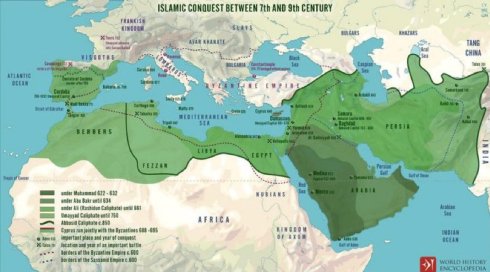
Maps like this disturb a comfortable habit in Western public life: colonialism is often discussed as though Europeans invented it, monopolized it, and uniquely embodied it.
They did not.
That does not make Western colonialism imaginary, minor, or excusable. European empires conquered, extracted, enslaved, displaced, racialized, governed, converted, and reordered huge parts of the world. The moral seriousness of that history remains. But if colonialism is part of the larger family of empire, conquest, domination, hierarchy, and the subordination of one people by another, then Western colonialism is not the whole category. It is one chapter in a much older human pattern.
The early Islamic conquests were not merely a spiritual awakening spreading through gentle persuasion. They were also military and imperial events. Arab Muslim armies and later Islamic-ruled polities expanded across the Levant, Egypt, North Africa, Persia, parts of Central Asia, and Iberia. These conquests changed political loyalties, tax systems, religious hierarchies, legal status, languages, and civilizational boundaries.
This does not reduce Islamic civilization to conquest. It would be foolish to ignore its achievements in philosophy, mathematics, architecture, medicine, poetry, trade, law, and scholarship. Many conquered peoples also helped build those achievements. Greeks, Persians, Jews, Christians, Indians, Arabs, Berbers, and others all contributed to what later gets remembered as Islamic civilization.
But that is exactly why the moral accounting should be honest. Conquest can produce synthesis. It can also produce subordination. Empire can preserve knowledge. It can also reorder peoples against their will. Complexity is real, but it cannot be used as a shield only for some civilizations.
The same selective memory appears around slavery and other imperial systems, but even staying with conquest alone, the pattern is clear: Western empire is treated as the moral template, while non-Western empire is often softened into “expansion,” “civilization,” “trade,” or “complexity.”
So why the imbalance?
Partly because Western colonialism is closer to us. Its archives, borders, museums, laws, churches, universities, racial categories, and economic consequences are still visible inside Western societies. Canadians, Americans, Britons, French, Belgians, Australians, and others are arguing inside institutional houses their own histories helped build. That proximity matters.
Partly because Western civilization developed powerful habits of self-criticism. Christianity, liberalism, socialism, abolitionism, human rights language, and modern academia all helped create tools by which the West could put itself on trial. That is not a weakness. In many ways, it is one of the West’s better inheritances.
But a virtue can decay into a ritual. Self-criticism can become selective prosecution. Once “colonialism” becomes a moral drama with fixed roles — guilty West, innocent rest — history gives way to theatre. The question stops being “Who conquered whom, and at what cost?” and becomes “Which story serves the approved politics?”
There is another reason for the imbalance. In contemporary Western politics, criticizing European empire is safe, rewarded, and institutionally familiar. Criticizing Islamic empire, Ottoman domination, Arabization, or other non-Western conquests is more dangerous. It risks being heard not as historical analysis, but as bigotry. So the subject is softened, avoided, or buried under the word “complexity.”
But all empire is complex. That cannot be a permission slip handed out selectively.
A serious anti-colonialism would not ask first whether the conqueror was European. It would ask: Who ruled? Who paid? Who was displaced? Who was taxed differently? Who was converted under pressure? Who lost language, land, status, sovereignty, or memory? Who was later told to be grateful for the civilization that absorbed them?
By that standard, Western colonialism remains morally serious. But it is not uniquely Western. It belongs to the larger human history of empire, conquest, slavery, hierarchy, and domination.
The point is not to excuse Europe. The point is to stop pretending that conquest only becomes colonialism when Europeans do it.

The Taliban understand something too many Western progressives pretend not to: the education of women is civilization-level power.
That is why they ban it. That is why they silence girls. That is why they bury half the country alive and call it virtue.
A society that fears educated women is not protecting tradition. It is confessing its own cowardice.
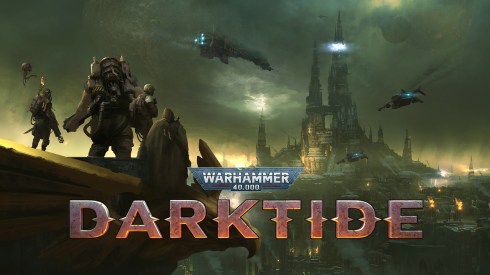
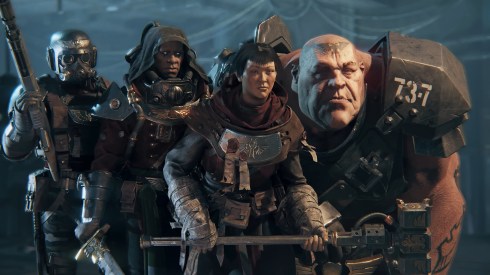
Fatshark’s Warhammer 40,000: Darktide is one of those frustrating games that is much easier to criticize than to stop playing.
I have around 1200 hours in it. That alone says something. Not everything, but something. A game does not hold my attention for that long on atmosphere alone, brand loyalty, or because I happen to like Warhammer 40K. The truth is simpler: Darktide is fun. It remains fun despite the slow content drip, despite Fatshark’s habit of making the same design mistakes more than once, and despite some baffling quality-of-life omissions that should have been fixed ages ago.
The core loop still works.
That is the review in miniature. Darktide is a flawed live-service game wrapped around one of the best co-op combat systems in the industry.
This is not a launch review. It is a long-term player review. That matters because Darktide is a very different game depending on when you meet it. A new player sees the grind, the early gear friction, the uneven explanation of systems, and the long climb toward weapons that feel properly alive. A veteran sees the deeper game underneath: buildcraft, sound cues, armor solutions, class roles, coherency discipline, and the strange joy of turning a doomed mission into a recovery.
The Pressure Dial
The reason I keep coming back is that the game lets me choose the kind of pressure I want. If I want endgame sweat and build optimization, there is Havoc. If I want something more experimental, there are the newer side modes. If I want a more open objective-focused experience, Expeditions add variety outside the usual hive corridors. But most of the time I hover around Heresy and Damnation. Level 4 is where I can relax without turning my brain off. Level 5 is where the game challenges me without always demanding full sweat-mode concentration.
That flexibility matters. Darktide is not just “run mission, kill horde, repeat.” It is a pressure dial. Some nights I want to optimize. Some nights I want to survive. Some nights I just want to smash heretics and not embarrass the Emperor too badly.
When Darktide is at its best, a mission feels like a combat situation that almost got out of control.
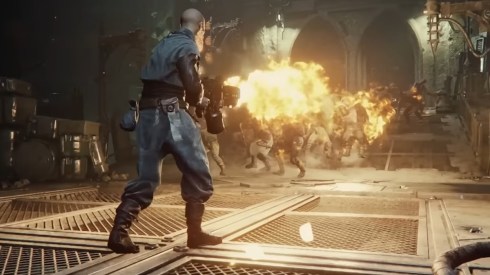
That “almost” is doing a lot of work. The best missions are not clean. They are not smooth. They are not four players casually deleting the map. They are the runs where an unexpected spawn of heavy armor nearly wipes the team, then everyone’s role snaps into place. The Psyker locks down a pack with tickle lightning. The Veteran drops Krak grenades into the biggest threats and tags another for extra damage. The Zealot dodge-dances around lethal swings, keeping the armored enemies focused away from the squishy backline. The frontliners do their job, the ranged damage dealers get a pocket to work from, and the whole team recovers from the edge of disaster.
That is the magic of the game. Darktide is not really a power fantasy. It is a chaos-stabilization fantasy.
A great run feels like four rejects turning panic into procedure.
The Dance
The melee combat is a major reason that still works. Darktide borrows a lot from Vermintide 2, and that is a good thing. Your head needs to be on a swivel. Audio cues matter. Target priority matters. The dodge, block, push, slide, and stamina systems all give you tools to survive, but they do not let you mash your way out of bad decisions forever. Spamming dodge gets you killed. Doing the dance lets you live.
That distinction is important. Darktide is not a pure twitch shooter. Fast reflexes help, obviously, but the game rewards situational awareness first, teamwork second, and high mechanical skill third. A player with good aim but poor awareness is cooked. The better player is the one who hears the trapper before seeing it, notices the flank forming, sees the armor pack gathering, stops chasing damage numbers, and returns to coherency before the run collapses.
The coherency system reinforces that lesson. Staying with the team is not just polite co-op etiquette. It is mechanically rewarded with better survivability and group support. Running off alone has a real cost, both for the solo player and for the team left behind. This is one of Darktide’s better design choices because it pushes against main-character syndrome. You can have hero moments, but the game keeps reminding you that solo heroics are fragile. Hounds, trappers, and other disablers exist to punish isolation. One net, one pounce, one bad corner, and all your skill suddenly requires someone else’s help.
Guns With Personality
The gunplay is also excellent, especially when the weapons have strong identity. The bolt weapons are the obvious stars. They have heft, recoil, noise, and consequence. They feel like miniature RPGs being fired at heretics, which is exactly what they should feel like. Lasguns are in a good place too, though they ask more from the player. You have to build toward them and do the skill-ceiling thing, but they can work very well in the right hands. The plasma gun remains a monster: high damage, high cleave, serious work output, offset by that strange firing delay you have to learn. The Arbites shotgun is another standout, clearing rooms for days.
The weaker side of the arsenal is the standard bullet weapon category. A lot of those weapons feel niche at best and underpowered at worst. They may function, but they do not always feel like they have the same reason to exist as the better-designed weapons. Darktide is strongest when a weapon has a personality. When a gun feels generic, the whole thing loses some charge.
Classes and Buildcraft
The classes do a lot to keep the game fresh. The four original classes remain clear and readable. Zealot is zippy melee damage. Veteran is ranged pain and problem-solving. Ogryn is the frontline beef wall. Psyker is fragile, high-risk, high-reward ranged pressure. The added classes complicate that roster in good ways. Arbites, despite nerfs, remains a durable hybrid damage dealer in both ranged and melee combat. Hive Scum is more of a glass cannon: you do great until you get cornered, and then the game reminds you what “glass” means.
I was late to Hive Scum because the class felt like a letdown after the Arbites launch. Having spent more time with it, I think it is a good addition, but it has a higher skill ceiling than Psyker. You need to understand spacing, threat priority, and exit routes. When Hive Scum works, it can feel fantastic. When it fails, it fails quickly.
The build system is also much better than it used to be. At launch, progression and buildcraft were in rough shape. The move to full skill trees rescued a lot of the game’s class identity. Players now have more ways to shape roles, emphasize strengths, and create meaningfully different approaches to combat.
But the meta sharpens as the difficulty rises. At mid difficulties, you can experiment. You can bring comfort builds, strange weapons, or off-meta choices and still succeed through good play. In Havoc and high-end content, the sandbox narrows. The game has a balance problem where “harder” too often means flooding the field with heavy carapace armor. If your team is not built to crack armor, you are not merely challenged; you may be functionally dead on arrival. Creativity gives way to optimization. Bring the armor solution or become scenery.
The Grind and the Better Game Underneath
Progression is where Darktide still struggles.
There is a real grind and climb to this game. As a veteran player, I can spend saved resources to get over some gear humps, and even then it can be annoying. Newer players do not have that cushion. Gear moves through the usual gray, green, blue, purple, and orange tiers, and those tiers matter because perks and blessings make weapons feel dramatically better. A gray weapon can feel nerfed compared to a fully tricked-out orange version. Several people I wanted to bring into the game simply stopped because the grind to the good stuff felt like too much.
That is a serious onboarding problem. Darktide may be at its best hundreds of hours in, but new players are being asked to trust that the better game is coming.
Crafting, thankfully, is in a much better place than it used to be. Fatshark has taken most of the worst RNG out of the system. You can now build perks and blessings how you want instead of praying to the slot-machine servitor. There is also a weapon progression system that unlocks those perks and blessings. At high level, you can essentially buy your way to weapon mastery through a series of inconvenient steps. That is very Fatshark: much improved, basically functional, and somehow clunkier than it needs to be.
Long-term progression still needs another layer. Account-wide resources were a good change, and they made playing multiple characters less punishing. The game does have titles you can earn and pieces of armour tied to achievements, so it is not fair to say there is nothing to chase. But after 1200 hours, the game still needs more ways to acknowledge time invested. A paragon-style system would be welcome. It would not need to break balance. Small account-wide ranks, class prestige, expanded earnable cosmetics, or minor customization rewards would help preserve that feeling of “I am still earning something.”
The cosmetic economy makes this more irritating. The in-game currency cosmetics exist, but too often they feel lackluster compared to the paid cosmetic shop. That does not ruin the game, and cosmetics are not the main reason to play Darktide, but the imbalance is noticeable. When the best-looking cosmetic pipeline feels tilted toward paid options while meaningful content arrives slowly, it lands poorly.
Fatshark Keeps Building Sideways
Fatshark’s bigger pattern is that it keeps building sideways instead of inward.
This was a problem in Vermintide 2 with Weaves. The mode had separate progression and rewards that did not properly enrich the base game, so it split the community. Darktide risks repeating the same mistake. Side modes add variety, but if they do not feed meaningfully into the main game, they become separate lanes rather than true expansion.
Expeditions help because they push the game outside the usual hive corridors and into more open spaces beyond Tertium. That variety is welcome. But the larger design question remains the same: does new content strengthen the whole game, or does it create another lane for players to sort themselves into?
Havoc has the opposite problem. It is clearly endgame content, but the separate queue, promotion and demotion structure, rank decay, and meta pressure make it feel like its own ladder. Players who enter the Havoc loop can peel away from regular difficulties. Everyone else remains in the standard mission pool.
Fatshark keeps finding ways to split its own audience when the game would benefit from deeper integration.
Maps, Story, and the Grime
The maps are another mixed bag. They still work. The hive-city aesthetic is strong, and the combat spaces are usually readable once you understand them. But repetition shows. Many missions are different routes through familiar spaces, and after hundreds of hours the hive can start to feel less like a vast world and more like rearranged corridors.
Modifiers help. Lights Out and Ventilation Purge can transform a familiar mission into something tense again. They also reward the institutional map memory veteran players build over time. When visibility collapses, experienced players can still navigate by layout memory, audio cues, spawn expectations, and team positioning. A new player, though, can be completely lost in those conditions.
The larger problem is the lack of new maps and weak connective tissue between missions. Fatshark has made attempts to backwrite a campaign into the mission structure, but it still feels patchwork. The story is not the reason to play Darktide. The mood is.
And the mood is excellent.
The grit, grim, and grime do a lot of work. The 40K lorekeepers will have complaints. Plague exposure, Chaos monstrosities, and the general survivability of these rejects all invite some lore eyebrow-raising. But it is a video game. What matters is that Darktide understands the atmosphere of 40K. The banter between characters is good. The voice lines get expanded over time. The religious madness, industrial decay, filth, chanting, machinery, and oppressive hive architecture all give the combat flavour.
Could you replace the heretics with zombies and make a Left 4 Dead 2-style game out of this structure? Technically, yes. But it would feel off. The setting is not just decoration. It gives the violence weight.
There is also the usual Fatshark technical grit. Spawns can feel strange, performance can wobble, and bugs still appear often enough that veteran players learn to absorb them as part of the weather. None of this ruins the core loop for me, but it does matter for new players. A veteran can shrug off jank because the combat high is already proven. A new player encountering grind, weak onboarding, and technical rough edges all at once may not stick around long enough to see the better game underneath.
Enemies and Sound
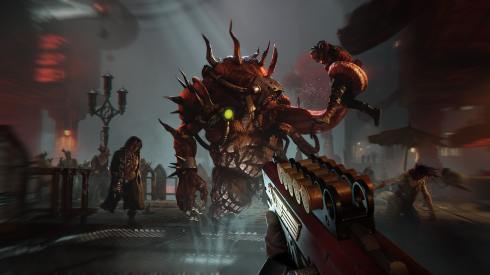
The enemies are well-designed. Almost every enemy has a purpose. Gunners shred you at distance and punish exposure. Shotgunners close and tear you apart if allowed into range. Ragers teach dodge discipline and attack-pattern recognition. Bombers deny space and split the group. Trappers and hounds punish isolated characters. Bursters ruin your day if you miss the audio cue or botch the push block.
Trappers are probably the most annoying because one net can start a failure cascade if the team is not aware. But even then, the annoyance has a purpose. The enemy roster is not random noise. It is a set of pressure tools. Each one tests a different part of player discipline.
The bosses are fine, but we need more of them. Chaos Spawn, Plague Ogryn, and Beast of Nurgle all work, but veteran players know their attack patterns too well now. More monstrosities, or more meaningful boss variation, would help keep that pressure fresh.
Sound design deserves special mention. It is huge in Darktide. Fatshark took the lessons of Left 4 Dead 2 and built an even richer threat language. Good players learn to identify danger by ear before they see it. Specials announce themselves through distinct cues, and the soundscape becomes part of the combat interface. The soundtrack is also outstanding: dark, industrial, techno-liturgical, and perfectly matched to the feeling of fighting through a diseased cathedral-factory. It slaps.
Friends, Randoms, and Failure Cascades
The random-player experience is variable.
Darktide really sings with a group of four on comms. Coordinated players can call specials, focus armor, manage revives, and recover from disasters that would wipe a silent group. With randoms, roll the dice. Sometimes matchmaking gives you disciplined teammates who stay together and understand the assignment. Sometimes it gives you someone auditioning for a solo YouTube montage in the next room.
Still, the community is not all bad. Most mistakes are forgiven by the end of the run because every veteran has had a streak of doing exactly the wrong thing at exactly the wrong time. Everyone has dodged into disaster. Everyone has missed the sound cue. Everyone has chased the wrong target. Better with friends, workable with randoms, but your mileage will vary.
The Annoyances
My biggest annoyances are specific.
First, Fatshark still refuses to give players proper UI tools to improve, especially a real scoreboard. In a co-op shooter built around specials, elites, rescues, damage taken, target priority, and team play, post-mission feedback should not require mods. A scoreboard does not have to be an ego board. Done properly, it teaches players what happened.
Second, the content pace remains painfully slow. The lack of new maps hurts, and class-specific neglect makes it worse. When a class like Ogryn goes a long stretch without a new weapon, veteran players notice. It is not just “give me more stuff.” It is that some parts of the roster can start to feel stale.
Third, the character-name problem is ridiculous. You can change nearly everything about your character except the name. If you hate the name, you reroll and start from scratch. That is not design philosophy. That is stubbornness wearing a purity seal.
Verdict
So would I recommend Darktide in 2026?
Yes, but with warnings.
If you like demanding co-op games, Darktide is very easy to recommend. The grind for new players is real, but it is no longer the RNG nightmare it used to be. The crafting system is much better. The classes are more interesting. The combat loop remains exceptional.
But this is not a cozy game. Darktide requires concentration, situational awareness, target priority, and a willingness to stay with the team. It is high tempo and high engagement. If you hate switching between melee and ranged weapons, this is not the game for you. You need to weave both into your playstyle, often within the same fight and sometimes within the same few seconds.
The biggest warning for new players is that Darktide asks for patience before it shows its best self. Early weapons can feel weak, early builds are incomplete, and the game does not always explain why something feels bad. The combat loop becomes far more satisfying once perks, blessings, class talents, and player awareness start working together. That is a real ask. Some players will not want to push through it, and I cannot blame them.
The story is weak. The connective material is patchy. The content drip is slow. Fatshark remains Fatshark, for better and worse.
But after 1200 hours, I am still coming back.
That matters. When the content drip hits, it is usually good. More importantly, the core loop of smashing heretics with three teammates while the whole mission threatens to come apart has not really been equaled elsewhere in the industry.
Final score: 87/100.
A flawed, stubborn, occasionally baffling game — and still one of the best co-op action experiences available.
Some choral pieces do not argue. They simply enter the room, lower the temperature, and remind everyone that beauty does not need to raise its voice.
Maurice Duruflé’s Ubi caritas is one of those pieces. It is short, restrained, and almost dangerously gentle. Like Bruckner’s Locus iste, it creates a sacred space without over-explaining itself. Like Tallis’s If ye love me, it trusts clarity more than drama. And like Rheinberger’s Abendlied, it seems to glow from within rather than shine from the outside.
The text is ancient: “Where charity and love are, God is there.” That could easily become sentimental, but Duruflé avoids sweetness. The music is tender, yes, but also disciplined. Its roots are in Gregorian chant, and that matters. The melody does not behave like a modern tune trying to impress you. It moves with the calm inevitability of something older than performance.
For singers, the challenge is not volume or range. The challenge is control. The phrases need line, breath, and trust. If the choir pushes too hard, the piece becomes heavy. If it sings without intention, it becomes decorative. The right sound is somewhere between prayer and memory: supported, blended, alive, but never theatrical.
That is what makes Ubi caritas such a useful piece for amateur and semi-professional choirs. It teaches restraint. It asks the choir to listen across the ensemble, to tune gently, and to shape the Latin without turning it into marble. The altos and inner voices matter enormously; the harmony only works if the middle of the texture is warm and honest.
There is also something quietly corrective about the piece. In an age where public language is often inflated, moralized, and weaponized, Ubi caritas offers a different grammar. Charity is not announced as a program. Love is not converted into branding. The music simply makes a place where the words can be heard without being shouted.
That may be why the piece endures. It does not flatter the listener. It does not beg for emotional reaction. It gives us a few minutes of ordered tenderness, and then leaves the silence better than it found it.
For this week’s choral interlude, Duruflé’s Ubi caritas: modest, luminous, and almost unbearably humane.
Canada has entered the space race, and by “entered” I mean we appear to have placed a rectangle of concrete in the woods and surrounded it with gravel.

Canada’s space race appears to be stuck in Phase One: gravel.
This is not nothing. In government terms, it may already count as Phase One.
Somewhere, no doubt, there is a strategic framework, a ministerial announcement, a regional development grant, a climate lens, an Indigenous consultation pathway, a diversity procurement plan, and a glossy PDF featuring a child looking up at the stars. Canada loves a working group. It is how we convert urgency into chairs.
Meanwhile, private industry keeps doing the irritating thing it sometimes does: building things. Not perfectly, not gently, not without waste, ego, or spectacle. But the rockets exist. The launches happen. The failures produce data. The next version gets built. The machine moves.
Government moves too, but differently. It studies, regulates, announces, pauses, re-announces, commissions, rebrands, and eventually unveils a pad of poured concrete as evidence that the future has been properly consulted into existence.
This is the broader Canadian problem. We have become excellent at the language of ambition and strangely bad at the discipline of execution. We can describe innovation. We can fund innovation. We can convene panels on innovation. We can produce national strategies about innovation. But at some point, a serious country has to build the thing.
The comparison is unfair, of course. SpaceX is a private company with immense capital, a high tolerance for risk, and a founder constitutionally incapable of leaving well enough alone. Government has different responsibilities: accountability to citizens, laws, budgets, safety rules, and public interest.
Fair enough.
But accountability cannot become an alibi for paralysis. Regulation cannot become a substitute for competence. Process cannot become the product.
A country that wants a space industry needs more than a space-shaped clearing in the gravel. It needs permission to fail, speed to iterate, and institutions that understand the difference between managing decline and building capacity.
Canada does not lack talent, land, brains, or engineering ability. What it lacks is a governing culture that can still turn intention into machinery.
Until that changes, our space program may remain perfectly Canadian: safe, inclusive, fully consulted, and still waiting for liftoff.
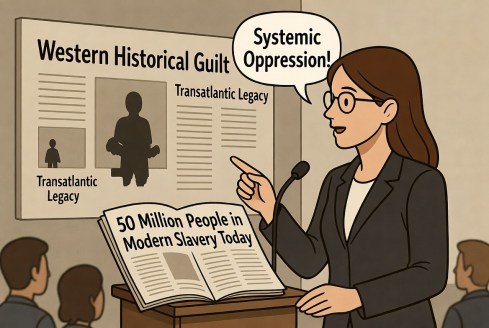
The most revealing thing about modern slavery is not only that it exists. It is that so many people who invoke slavery as a moral category seem oddly uninterested in it when it is happening now.
In contemporary activist politics, slavery is often treated as a permanent indictment of the West. It is invoked to explain present inequality, assign inherited guilt, rewrite institutional language, justify symbolic rituals, and discipline dissent. Some of that history matters. The transatlantic slave trade was real, brutal, and morally indefensible. A serious civilization should be able to tell the truth about its crimes.
But truth has a tense. If slavery matters morally, then slavery matters now.
According to the latest Global Estimates from the International Labour Organization, Walk Free, and the International Organization for Migration, roughly 50 million people were living in modern slavery on any given day in 2021: 27.6 million in forced labour and 22 million in forced marriage. Walk Free estimates that about 7 million people in Africa were living in modern slavery.
If slavery is invoked as a living moral category when it indicts the West, then slavery should also matter when people are being coerced, trafficked, forced into marriage, or trapped in labour today.
These are not metaphors. Modern slavery includes forced labour, forced marriage, trafficking, sexual exploitation, debt bondage, and other forms of coercion that people cannot freely refuse or leave.
Many human-rights groups do serious work on these abuses. That should be acknowledged. But the cultural volume is not the same. Western institutions pour energy into land acknowledgements, reparations debates, decolonization seminars, symbolic renamings, privilege workshops, and inherited-guilt rituals. Meanwhile, present-tense slavery struggles to command anything like the same moral attention.
Mauritania, for example, formally abolished slavery, yet descent-based slavery and slavery-like practices remain serious concerns. That should disturb anyone who claims to care about domination and human dignity. It should not be a niche humanitarian footnote.
The strongest activist reply is not ridiculous. Historical slavery did not vanish without consequence. The transatlantic slave trade, colonial rule, segregation, and legal exclusion shaped wealth, institutions, geography, and inherited disadvantage. A society does not become innocent simply because the worst laws are repealed.
That is a serious point. But it does not answer the problem of moral selectivity. If slavery is invoked as a living moral category when it indicts the West, then slavery should also matter when people are being coerced, trafficked, forced into marriage, or trapped in labour today.
This is where much contemporary anti-racism becomes revealing. In theory, it opposes domination and exploitation. In practice, it often functions as a selective solvent. It dissolves confidence in Western institutions, Western history, Western moral achievement, and Western civic inheritance, while offering little concrete help to people being dominated right now.
The predictable reply is that this is whataboutism. It is not. Whataboutism says, “Ignore this evil because that evil also exists.” The argument here is the opposite: if slavery is evil, then concern should become more urgent when slavery is happening now. Historical truth matters, but it cannot become a substitute for present-tense moral attention.
Nor is this answered by saying critics do not understand critical theory properly. If a theory constantly produces institutional rituals of guilt, suspicion, deconstruction, and accusation, ordinary citizens are allowed to judge it by its public effects. A politics that requires specialist initiation before anyone may notice its consequences has already left democratic argument behind.
The issue is not whether the West has sins in its history. It does. The issue is whether anti-racism is actually against domination, exploitation, and slavery as human evils, or whether those evils are useful mainly when they can be arranged into an indictment of Western society.
If slavery matters only when it can be used to shame the West, then slavery is not the real object of concern. The West is.
References
International Labour Organization, Walk Free, and International Organization for Migration. Global Estimates of Modern Slavery: Forced Labour and Forced Marriage.
https://www.ilo.org/publications/major-publications/global-estimates-modern-slavery-forced-labour-and-forced-marriage
Walk Free. Global Slavery Index 2023 — Global Findings.
https://www.walkfree.org/global-slavery-index/findings/global-findings/
Walk Free. Global Slavery Index 2023 — Modern Slavery in Africa.
https://www.walkfree.org/global-slavery-index/findings/regional-findings/africa/
Anti-Slavery International. What is Descent-Based Slavery?
https://www.antislavery.org/slavery-today/descent-based-slavery/
Anti-Slavery International. Mauritania: Descent-Based Slavery.
https://www.antislavery.org/what-we-do/mauritania/
Arab Reform Initiative. Racialized Hereditary Slavery in Mauritania: Interview with Activist Abidine Maettalla.
https://www.arab-reform.net/publication/racialized-hereditary-slavery-in-mauritania-interview-with-activist-abidine-maettalla/
The Globe and Mail did not merely publish a bad headline. It published a small moral confession.

“SpaceX IPO makes Elon Musk the first trillionaire. Here’s how to properly hate him” was not serious analysis. It was an invitation to contempt. The newspaper later admitted the headline failed its editorial standards and replaced it. That was the right decision, but also the minimum.
The article itself may have been more nuanced than the headline. That distinction matters. But headlines are not decorative. They are the public face of an argument, the thing most readers see first, and often the only part that travels across social media. When a major Canadian newspaper packages an opinion piece as a lesson in how to “properly hate” someone, it tells us something about the institution’s instincts.
Billionaires, especially those wielding enormous cultural, economic, and political influence, deserve scrutiny. Questions about wealth concentration, government contracts, labour practices, market power, and political access are legitimate. Elon Musk is not above criticism.
But hatred is not scrutiny.
This episode reveals something important about the Overton window in Canadian legacy media. A headline encouraging readers to hate a prominent figure would normally be condemned as toxic polarization if it came from random voices online. When it appears under a respected masthead and targets the approved villain of the moment, it becomes clever commentary, at least until the backlash forces a correction.
Some will say the headline was ironic, exaggerated, or merely provocative. Fine. But institutions do not get to spend years warning the public about extremism, misinformation, online toxicity, and the collapse of civil discourse, then shrug when their own opinion pages dress contempt up as wit. Irony does not launder hatred into analysis.
Canadian media frequently complain about declining trust. This is one reason trust declines. Ordinary readers can see the double standard. They are told to be civil, careful, and responsible, while prestige outlets permit themselves moral indulgences they would condemn in others.
This is not about shielding Musk from criticism. It is about defending the line between rigorous critique and sanctioned contempt. A serious newspaper should sharpen readers’ thinking. It should not tutor them in how to hate more elegantly.
The Globe’s correction is welcome. But Canadians are entitled to ask what editorial culture allowed such a headline to go live in the first place.
If hatred is corrosive when it bubbles up from the public, it does not improve when it flows down from the opinion pages.











 bleatmop
 Mystro


 Dead Wild Roses
Your opinions…