
You are currently browsing the category archive for the ‘Alberta’ category.
On September 1, Alberta’s Fairness and Safety in Sport Act came into force, marking a decisive step in a global debate over equity in athletics. The law—formerly Bill 29—requires athletes aged 12 and older to compete in categories aligned with their sex as recorded at birth. Out-of-province visitors remain exempt, and younger children are unaffected. The aim is not blanket exclusion, but to preserve a level playing field for female competitors.
The rationale rests on clear evidence: even after hormone therapy, biological males often retain advantages in strength, speed, and endurance. A 2021 study in the British Journal of Sports Medicine found that transgender women maintained a measurable edge in running times even after two years of testosterone suppression. High-profile cases—from swimmer Lia Thomas in the NCAA to weightlifter Laurel Hubbard at the Olympics—have underscored how even rare instances can shape competition outcomes and displace female athletes.
Opposition has been swift. Groups like Egale and Skipping Stone argue the Act is discriminatory, casting it as a rollback of human rights protections. Their concern is not trivial: trans youth already face higher rates of marginalization, and exclusion from sport can exacerbate social isolation. For activists, the law sends a stigmatizing signal that identity is secondary to biology, undermining inclusion.
But here the clash of principles becomes unavoidable. Protecting the integrity of women’s sports means acknowledging physiological differences that identity alone cannot erase. Alberta’s law draws that boundary: co-ed and male divisions remain open to all, while female categories are safeguarded for those born female. Critics frame this as erasure; supporters see it as necessary equity.
The deeper problem lies in public discourse. Too often, debate polarizes into caricatures—claims of “rights apocalypse” on one side, or blanket dismissal of trans athletes on the other. Alberta’s legislation is imperfect but pragmatic: it carves out space for participation without sacrificing fairness. Future court challenges will test whether the balance holds, but the principle is clear. True progress in sport must protect all athletes’ opportunities, not just the loudest voices in the debate.

The Edmonton Public School Board’s (EPSB) sweeping book ban has erupted into a quintessential Alberta debacle: a government directive mangled by overzealous implementation, corroding trust in educational oversight.
In July, the UCP government under Premier Danielle Smith ordered schools to remove “inappropriate” materials from libraries, targeting explicit sexual content to protect children. Instead of applying a common-sense filter, EPSB produced a blacklist of more than 200 titles—including The Handmaid’s Tale, The Color Purple, and The Godfather. Even Jaws and works by George R.R. Martin didn’t escape the purge. Critics dubbed it “vicious compliance”: technically following the order, but in a way designed to spark outrage.
Smith quickly condemned the overreach, pausing the ban and pledging clarifications so that classics remain available. The government’s vagueness deserves criticism, but EPSB’s reaction exposed something deeper: Alberta’s educational establishment either failed to grasp the policy’s intent—or chose to deliberately misapply it, then leak the story to embarrass the UCP. In either case, it is professional negligence.
The fallout has been swift. Margaret Atwood ridiculed the move, bookstores report surging sales of “banned” books, and the episode has reinforced suspicions that education officials are more interested in scoring political points than serving students.
Irony abounds: in trying to shield children from explicit content, the government gave its critics ammunition; in trying to follow the directive to the letter, EPSB managed to turn itself into the villain. What should have been a straightforward matter of removing genuinely pornographic material has spiraled into a culture-war sideshow, eroding public confidence in both policymakers and educational leaders.
The lesson is plain: sloppy governance is bad—but bad-faith compliance from those entrusted with education is worse.

In the machinery of modern media, false narratives do not emerge spontaneously. They are the product of deliberate groundwork: the careful shaping of public perception before an event occurs. Borrowing from military doctrine this tactic is called operational preparation of the environment (OPE) which are defined as activities that enhance situational awareness and set conditions for future operations.1 When adapted to the information domain, OPE becomes narrative control: seeding frames, priming audiences, and conditioning reflexive responses that can be triggered later for maximum effect.
Adversaries whether geopolitical rivals, activist networks, or opportunistic elites exploit this tactic by sowing division. The result is a public primed for outrage, where engineered crises and isolated incidents ignite prearranged narratives. Spotting these patterns is the first step toward resisting them.
Repetition and Priming
Narrative preparation often begins with repetition. Specific terms are echoed across platforms until they seem self-evident. Phrases like “stochastic terrorism” or “rising anti-LGBTQ hate” do not spread organically; they are priming devices. For instance, drag events framed as battlegrounds for “bigotry” and “inclusion” gain prominence not because of isolated incidents alone, but because media amplification primes audiences to see a pattern of systemic oppression.2
Consider also the long arc of the “racist policing” narrative. From Ferguson in 2014, through the cases of Michael Brown and Breonna Taylor, to the killing of George Floyd in 2020, framing evolved but the groundwork ensured predictable outrage.3 Media studies confirm that such coverage often prioritizes framing over fact, shaping reflexive responses rather than reasoned analysis.4
Selective Amplification
Once the ground is prepared, selective amplification takes over. An isolated incident for instance, graffiti on a council office, a slur at a rally—balloons into emblematic proof of a “hate wave.” Counter-evidence, such as a shooter’s non-binary identity, often disappears from coverage because it disrupts the narrative arc.5
This is not journalism as truth-seeking; it is journalism as engineering. Narrative amplification corrodes credibility, manufacturing crises that serve political and cultural goals. International rivals such as Russia and China employ similar techniques, weaponizing narrative dominance in conflicts and domestic politics alike.6
Case Study: Edmonton Public Schools
A recent example illustrates how this process operates in Canada. In 2025, the Edmonton Public School Board (EPSB) was accused of “book banning” after it questioned the suitability of certain titles with explicit sexual themes. Activist networks and sympathetic media framed the issue as a matter of “queer affirmation” and censorship. Yet, as I argued in a prior essay, this was not about censorship at all but about narrative warfare; casting parental concerns as bigotry while advancing a predetermined ideological script.7 The case demonstrates how operational preparation of the environment works at the local level: emotional language, repetition of “book ban” rhetoric, and selective omission of context primed audiences for outrage.
Building Inoculation
What does media literacy look like in this landscape? It means detecting the telltale signs of OPE:
- Uniform Surges: Are identical phrases appearing simultaneously across news outlets and social media?
- Emotive Frames: Does coverage push outrage before evidence is fully presented?
- Suppressed Counterpoints: Are inconvenient facts downplayed or omitted?
- Pre-seeded Narratives: Does the framing seem rehearsed, echoing earlier campaigns?
The solution is not paranoia but discipline. Verify facts independently, resist outrage cycles, and name the tactic when you see it—“this is OPE unfolding.” Exposing the method robs it of its power. In the contested terrain of fifth-generation warfare, awareness is both shield and sword.

End Notes
- U.S. Department of Defense, Dictionary of Military and Associated Terms, s.v. “Operational Preparation of the Environment.”
- Britannica, “Stochastic Terrorism,” and GLAAD, “Accelerated Rhetoric and Anti-LGBTQ Incidents” (2023).
- The Conversation, “Media Narratives and the George Floyd Protests” (2020).
- Reny, T. & Newman, B. (2021). “The Opinion-Mobilizing Effect of Frames: Media Narratives in the Black Lives Matter Movement.” American Political Science Review.
- NBC News, “Nonbinary Identity of Colorado Springs Shooting Suspect Raises Questions” (2022).
- Canadian International Governance Innovation (CIGI), “Narrative Dominance in the Information Age” (2021); Army University Press, “Information Operations and the Modern Battlespace” (2020).
- The Arbourist, “Book Bans and Narrative Warfare: How the Edmonton Public School Board Plays the Queer Pedagogy Script,” Dead Wild Roses (August 30, 2025).
Picture a library, its shelves stripped of Orwell and Atwood, replaced by outrage: this is the activist’s trap. Critical social constructivism—commonly branded as “woke ideology”—does not depend on truth-seeking but on the imposition of narrative, luring well-meaning observers into excusing captured institutions as merely inept (Kincheloe, 2005). To extend such charity is to enable agendas that corrode trust in public institutions and divide communities.
The Edmonton Public School Board’s (EPSB) recent book removal controversy exemplifies this dynamic. In late August 2025, a leaked list of more than 200 titles slated for removal from K–12 school libraries ignited national outrage. The list included canonical works such as Margaret Atwood’s The Handmaid’s Tale and Aldous Huxley’s Brave New World. Media coverage swiftly framed the list as a right-wing purge: a literary witch-hunt torching academic freedom and signaling Alberta’s dystopian slide.
Yet this spectacle obscures the actual policy. In July 2025, Education Minister Demetrios Nicolaides issued a directive requiring school boards to remove sexually explicit materials by October 1, 2025, to ensure age-appropriate resources in K–12 libraries (Alberta Ministry of Education, 2025). The directive does not ban classics nor prohibit parents from providing controversial works privately. Its scope is limited: public schools, funded by taxpayers, must not circulate sexually explicit material to children.
Seen in this light, the EPSB’s list appears less a bureaucratic stumble than a narrative maneuver. By placing revered classics alongside contested titles such as Maia Kobabe’s Gender Queer—which contains explicit illustrations of sexual acts—and Jonathan Evison’s Lawn Boy, which describes sexual encounters between minors, the Board ensured the reaction would focus on “censorship” rather than explicit content. The outrage generated by the supposed “banning” of Atwood and Huxley distracts from the substantive question: whether K–12 libraries should carry graphic sexual material at all.
To be fair, some argue this was an honest misstep. Officials under pressure may have over-applied vague guidelines, fearing punishment if they erred on the side of permissiveness. From this perspective, the inflated list reflects incompetence, not ideology. This interpretation has surface plausibility—and acknowledging it is crucial. Yet it falters when weighed against the broader intellectual context.
The precise inclusion of classics alongside sexually explicit texts mirrors the rhetorical tactics of queer pedagogy, which openly embraces provocation as a teaching tool. In their influential article Drag Pedagogy: The Playful Practice of Queer Imagination in Early Childhood, Harper Keenan and Lil Miss Hot Mess (2021) describe initiatives such as Drag Queen Story Hour as “strategic defiance” designed to “disrupt normative understandings of childhood” (p. 433). Drawing on José Esteban Muñoz’s Cruising Utopia (2009), they frame queerness as a “future-oriented ideality” (p. 1), using performance and play to challenge authority, destabilize binary categories, and cultivate “embodied kinship” rather than passive empathy (Keenan & Lil Miss Hot Mess, 2021, pp. 434–436).
This framework is not hypothetical. It explicitly advocates the use of aesthetics, provocation, and imaginative unruliness to reshape children’s perceptions. In their words, “Drag pedagogy embraces an unruly vision of childhood as a site of potentiality” (p. 437). Texts like Gender Queer or Lawn Boy, with their focus on sexual exploration and destabilization of normative boundaries, can be read as curricular extensions of this agenda. Their presence in K–12 libraries is not incidental but reflects a coherent intellectual project to prioritize queer cultural forms over developmental appropriateness.
From this perspective, the EPSB’s list functions as a narrative cudgel. By spotlighting Orwell and Atwood, defenders can recast the government’s directive as authoritarian censorship while obscuring the ideological drive to embed queer pedagogy in public institutions. The effect is the same whether activists deliberately curated the list or whether bureaucrats, steeped in activist frameworks, reproduced them unconsciously: outrage is amplified, and the debate is reframed on activist terms.
This is the trap of charitable interpretation. To dismiss the list as simple incompetence is to ignore its functional alignment with queer pedagogy’s playbook: provoke, inflate, and obscure. Even if intent cannot be definitively proven, the effect is unmistakable—a shift of public discourse away from the legitimate question of protecting children’s developmental environments and toward a defensive posture about “book banning.”
The consequences are corrosive. Communities fracture, as defenders of childhood innocence are painted as censors, and activists wield “inclusivity” as a battering ram against parental concerns. Public trust in schools erodes further. And children—the supposed beneficiaries—are caught in the crossfire of ideological contestation.
Children deserve age-appropriate materials in their school libraries—full stop. No law prevents parents from accessing contested works privately, but schools should not be battlegrounds for ideological conquest. The EPSB controversy demonstrates how critical social constructivism (woke) thrives not on truth but on narrative imposition. To resist this, we must reject the activist trap of charitable interpretation and confront directly how such narratives are engineered. Only by doing so can we restore unity, rebuild trust, and protect the integrity of public education.

“Queer is by definition whatever is at odds with the normal, the legitimate, the dominant. There is nothing in particular to which it necessarily refers. It is an identity without an essence.”
(Halperin, 1995, p. 62)
References
-
Alberta Ministry of Education. (2025). Ministerial Order No. 2025-07: Age-Appropriate Resources in School Libraries. Edmonton, AB: Government of Alberta. Retrieved from https://www.alberta.ca/ministerial-orders
-
Keenan, H. B., & Lil Miss Hot Mess. (2021). Drag pedagogy: The playful practice of queer imagination in early childhood. Curriculum Inquiry, 51(5), 433–452. https://doi.org/10.1080/03626784.2020.1864621
-
Kincheloe, J. L. (2005). Critical constructivism. New York: Peter Lang.
-
Muñoz, J. E. (2009). Cruising utopia: The then and there of queer futurity. New York: NYU Press.
The Alberta government’s recent initiative to establish provincewide standards for school library materials, announced on May 26, 2025, underscores the critical role of parental input in ensuring that educational resources align with community values and developmental needs. The online survey, open until June 6, 2025, seeks feedback from Albertans to create consistent guidelines for selecting age-appropriate materials, particularly addressing concerns about sexually explicit content in K-12 school libraries. Parental involvement is essential because parents, as primary caregivers, have a vested interest in their children’s moral and intellectual development. They possess unique insights into their children’s emotional and psychological readiness, which standardized systems may overlook. By involving parents, the government ensures that library materials reflect the values and expectations of the families they serve, fostering trust and transparency in the education system. As Education Minister Demetrios Nicolaides emphasized, the goal is to create “guardrails” to protect students from accessing inappropriate content, such as graphic novels containing explicit depictions of sexual acts, molestation, or self-harm, which were found in some Edmonton and Calgary school libraries.
Ensuring age-appropriate materials in school libraries is paramount to safeguarding children’s well-being and supporting their developmental stages. Young students, particularly in elementary and junior high schools, are at formative stages where exposure to graphic content—such as nudity, explicit sexual acts, or themes of molestation—can be confusing or harmful. The Alberta government’s survey highlights specific concerns about four graphic novels, including Gender Queer by Maia Kobabe and Fun Home by Alison Bechdel, which contain explicit content deemed inappropriate for K-9 students. Age-appropriate materials should align with cognitive and emotional maturity, providing resources that educate without overwhelming or exposing children to mature themes prematurely. School libraries must balance fostering a love for reading with ensuring content is suitable for the intended age group, as outlined in the government’s call for developmentally appropriate resources to meet diverse student needs. This approach not only protects students but also supports teachers and librarians in curating collections that enhance learning while respecting parental expectations.
Critics often argue that restricting access to certain materials constitutes censorship or a “book ban,” potentially limiting students’ exposure to diverse perspectives, especially on topics like 2SLGBTQ+ identities. This perspective, voiced by the Alberta Teachers’ Association (ATA) and others, suggests that such standards could disproportionately target marginalized communities and stifle students’ ability to see themselves represented in literature. While diversity in literature is important, this argument overlooks the distinction between censorship and age-appropriate curation. The Alberta government explicitly states that the initiative is not about banning books but about establishing consistent standards to ensure materials are suitable for specific age groups. For instance, Nicolaides clarified that content related to 2SLGBTQ+ themes is not the target; the focus is on graphic sexual content, regardless of subject matter. A book on astrophysics with explicit imagery would face the same scrutiny, demonstrating that the policy aims to protect, not exclude. Moreover, existing school board processes, like those in Edmonton and Calgary, already include mechanisms for reviewing content, suggesting that standardized guidelines would enhance, not replace, professional judgment.
Another common counterargument is that restricting access to certain materials could hinder students’ ability to access information about sensitive topics, such as sexual abuse, which may be critical for their safety. Some, including voices on social media, argue that libraries provide a safe space for students to explore topics that parents might not address at home, citing cases where books helped children identify and report abuse. While this concern is valid, it does not negate the need for age-appropriate standards. Libraries can still provide educational resources on sensitive topics, such as body safety or abuse prevention, without including graphic depictions unsuitable for young readers. The government’s survey asks who should determine appropriateness—options include teachers, librarians, parents, or students—indicating a collaborative approach that values professional expertise alongside parental input. By setting clear standards, schools can ensure that resources on critical topics are accessible in a manner that respects developmental readiness, thus maintaining a balance between safety and education.
In conclusion, the Alberta government’s survey on school library materials reflects a commitment to balancing parental input with the need for age-appropriate resources, ensuring that school libraries remain safe and supportive environments for students. By involving parents, the government acknowledges their role in shaping educational content that aligns with community values and protects children from inappropriate material. While critics raise concerns about censorship or restricted access to vital information, these arguments fail to account for the nuanced approach of setting consistent, transparent standards rather than outright bans. The initiative, set to inform policies for the 2025-26 school year, aims to create a framework where professional judgment, parental concerns, and student needs converge. Albertans’ participation in the survey will be crucial in shaping a system that prioritizes both educational freedom and the well-being of young learners.

 Edmonton’s public transit system has become a crucible of violence, and the stats don’t lie—crime is spiking at a rate that demands urgent action. In 2022, the Edmonton Police Service reported a staggering 53% increase in violent crime calls on transit compared to 2021, with incidents like assaults and robberies plaguing LRT stations and buses. That’s not just a number; it’s a reality where four percent of the city’s violent crime now happens on transit, a space meant for safe commuting. Without more security—whether that’s additional peace officers or better surveillance—this trend risks turning every ride into a roll of the dice for passengers.
The human cost behind these numbers is what’s truly alarming. In early 2023 alone, Edmonton saw 35 violent occurrences on transit property, including nine weapon-related incidents, reflecting a broader national crisis but hitting hard locally. These aren’t just stats on a page—they’re stabbings, threats, and beatings that leave people scared to take the bus or LRT. Riders aren’t imagining this; their fear is backed by a 12% higher crime severity index in transit areas compared to the city average in 2022. More security isn’t just a nice-to-have; it’s a necessity to protect vulnerable folks who rely on public transit daily, especially when 70% of these attacks are random, striking without warning.
Throwing our hands up and saying “it’s a social problem” doesn’t cut it—action does. Sure, the city added 22 more transit peace officers in 2023, but when calls for service are still climbing (up 12% in 2024 despite a slight dip in crime severity), it’s clear that’s not enough. Stations like Eaux Claires saw a 133% spike in dispatched calls in 2022, showing hot spots are still burning unchecked. More boots on the ground, better real-time monitoring, and tougher enforcement aren’t luxuries—they’re the bare minimum to stop this freefall and give Edmontonians a transit system that doesn’t feel like a battlefield. Anything less is just ignoring the obvious.
Males should not be in female changing rooms because these spaces are designed to provide women and girls with privacy, safety, and comfort—needs rooted in biological and social realities. Allowing males, regardless of identity, undermines this by introducing potential risks, from voyeurism to assault, as evidenced by cases like the 2021 Wi Spa incident in Los Angeles, where a registered sex offender exploited lax policies. Women’s boundaries deserve respect, not erosion under the guise of inclusivity, especially when separate facilities can accommodate everyone without compromising female security. Data backs this up: a 2018 UK study found 90% of sexual offenses in changing rooms occurred in mixed-sex spaces. Single-sex areas aren’t about exclusion—they’re about protection.
From Reduxx.info :
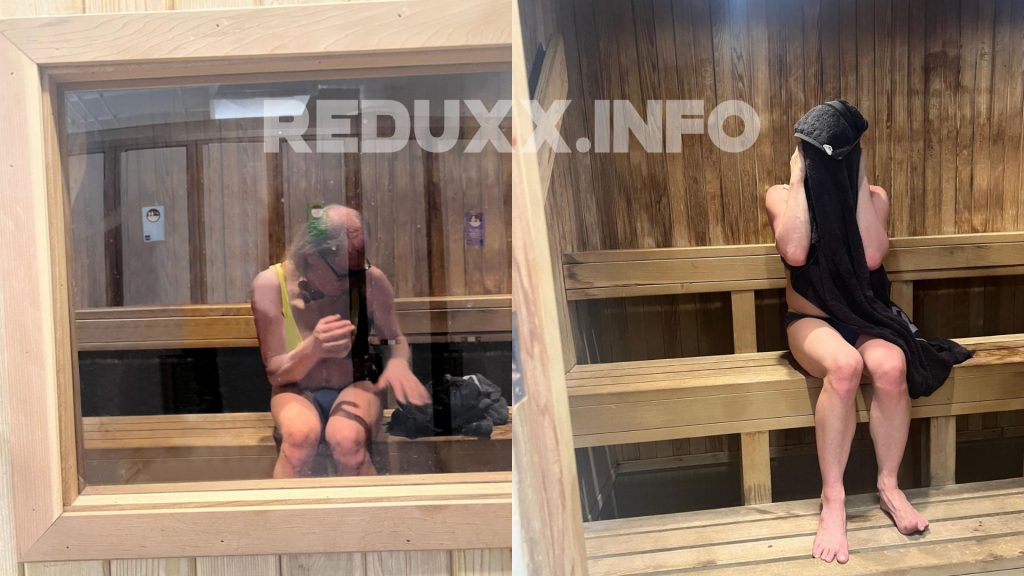
“A Canadian mother has come forward to reveal that she was chastised by staff at her local recreation center after reporting that a balding man wearing “fetish gear” was in the women’s changing room. Despite feeling so frightened that she called the police, the mother was told that the man had a right to self-identify into whatever changing room he felt like.
The incident occurred on February 18, when Keri* and her 14-year-old daughter visited the Bonnie Doon Leisure Centre in Edmonton, Alberta. Their plans to have a fun-filled afternoon at the local pool quickly took a turn for the worse after the two entered the changing area to see an adult man “naked except for fetish gear” standing in the center of the room.
Keri tells Reduxx that the man, who appeared to be in his mid-forties, was wearing a “black penis sling” and an exposed rubber breast form. So shocked by the sight, Keri immediately began to usher her daughter out of the changing area.
“My daughter was behind me… I backed up quickly so she would not keep walking forward and yelled ‘help, there is a man in the change room.’” Keri says she went back to the front desk, where she had just paid for the admission to the pool. After explaining what she had seen in the women’s changing area, a male staff member dismissed her concerns.
“He said something like: ‘yes, this is an inclusive facility, what are you afraid will happen?’ and so I told him I was calling the police. He asked me why I felt the need to call the police, but did not try to stop me.”
While waiting for an officer from Edmonton Police Service to arrive, a female staff member approached Keri to ask her about the situation. Keri recorded the conversation with the staff member, and provided the audio to Reduxx for review.
In the recording, Keri is heard giving a statement to the staff member and explaining precisely what she had experienced.
“I am telling you right now – he is a balding man, in his forties, wearing a penis sling and rubber breasts around his neck… fetish rubber breasts slung around his neck,” Keri is heard telling the staff member. “He is in the women’s washroom. I walked in with my 14-year-old daughter… I am 54, I should not have to put up with it. But she should definitely not be exposed to a man enjoying his fetish in the women’s washroom.”
In response, the staff member explains that “it is the city of Edmonton’s policy that you can use whatever changing room you are most comfortable using.” She goes on to defend the man’s attire, saying “they can wear whatever they are comfortable wearing.”
Let’s not forget the CBC and it’s startling(?) lack of coverage of this.
Bless the Canadian Broadcasting Corporation—our noble guardians of progressive virtue—turning a blind eye to fetish-driven males sashaying into female changing rooms with all the grace of a tax-funded diversity seminar. Why bother reporting on something as trivial as women’s safety when you can churn out another glowing piece on inclusivity, eh? It’s not like the CBC would dare risk its pristine reputation as Canada’s woke megaphone by admitting that some dudes in fishnets might not belong where girls are undressing—nah, that’d clash with the narrative. Besides, who needs pesky facts or viewer trust when you’ve got government cheques and a mandate to keep the maple syrup flowing smoothly over any hint of controversy?











 bleatmop
 Mystro


 Dead Wild Roses
Your opinions…