
You are currently browsing the category archive for the ‘Canada’ category.
On December 3, 2025, Calgary pastor Derek Reimer was arrested for breaching the conditions of his conditional sentence order after refusing to write a court-mandated letter of apology to a public library manager and members of the LGBTQ+ community. The apology stemmed from his earlier conviction for criminal harassment related to protests against Drag Queen Story Hour events at Calgary libraries in 2023, where he had confronted organizers and posted videos online.
Reimer, citing his sincerely held religious beliefs, argued that complying would constitute compelled speech in violation of Canada’s Charter of Rights and Freedoms; however, the court deemed his refusal a breach, leading to his immediate detention.At a bail hearing on December 5-6, 2025, no decision was reached on Reimer’s release, and he remains in custody awaiting a further hearing on Tuesday, December 9. The case highlights the extraordinary nature of the original sentencing requirement: court-ordered apologies are rare in Canadian criminal law and typically reserved for restorative justice or defamation contexts, not as a tool to enforce ideological conformity. By jailing a citizen for refusing to express remorse that contradicts his conscience, the justice system effectively punishes thought and belief rather than solely actions, raising serious concerns about state overreach.
This incident exemplifies growing authoritarian tendencies in Canada’s legal approach to dissent on cultural issues, where protections for freedom of expression and religion appear subordinated to enforcing compliance with progressive orthodoxies. Forcing individuals to voice insincere apologies—or face imprisonment—echoes compelled speech regimes in totalitarian systems, undermining the Charter’s guarantees and signaling that the government views certain religious convictions as incompatible with public order. As of December 6, 2025, Reimer’s continued detention without resolution further illustrates how such measures can be used to silence opposition through prolonged pre-trial incarceration.

Here are some reliable sources for readers seeking more details on Pastor Derek Reimer’s case, including the original protests, the court-ordered apology, his December 3, 2025 arrest for non-compliance, and the ongoing bail proceedings as of December 6, 2025:
- Original X post highlighting the case: https://x.com/RealMattA_/status/1997166177433321898 (Quotes journalist Chris Dacey’s update on the bail hearing delay.)
- Video update from the December 6 bail hearing (posted by
@chrisdacey
): https://x.com/chrisdacey/status/1997152423396204956 (Confirms no bail decision was reached and Reimer remains in custody until December 9.)
- Western Standard – Arrest coverage: https://www.westernstandard.news/news/watch-calgary-pastor-arrested-after-refusing-to-apologize-to-librarian/69520 (Includes details on the breach and compelled speech concerns.)
- Rebel News – Breaking arrest report: https://www.rebelnews.com/derek_reimer_arrested_after_refusing_court_ordered_apology (Features video of the arrest and background on the conditional sentence order.)
- Caldron Pool – Analysis of compelled speech: https://caldronpool.com/compelled-speech-canadian-pastor-arrested-for-refusing-to-issue-court-ordered-apology/ (Discusses Charter violations and Reimer’s religious objections.)
- LifeSiteNews – Recent developments: https://www.lifesitenews.com/news/canadian-pastor-arrested-for-refusing-to-write-apology-to-librarian-who-hosted-drag-queen-story-hour/ (Covers the arrest and broader context of protests against drag events for children.)
This is a great piece that has not done in Canada until this upcoming weekend! On December 14th at 4:00pm at the First Presbyterian Church, 10025 105 St NW. (Edmonton, Alberta)
If you’re looking for a fresh, heartwarming way to experience the Christmas story, Bob Chilcott’s Christmas Oratorio is an absolute gem that’s quickly becoming a modern classic. Premiered in 2019 at the Three Choirs Festival to rave reviews as “a palpable success… and utterly new,” this majestic work weaves the familiar biblical narrative from St Luke and St Matthew with beautiful 16th- to 19th-century poetry, creating a compelling and deeply moving retelling of the Nativity.
Chilcott, one of the world’s most beloved choral composers (and a former King’s Singer), brings his signature accessibility and lyrical beauty to every movement. From moments of rapt stillness—highlighted by the Evangelist’s intimate storytelling accompanied by harp and flute—to soaring choral sections and brand-new hymn tunes that invite the audience to sing along, the music is warm-hearted, joyful, and perfectly Christmassy. Standouts include the sweet harmonies of “Jesus Christ the Apple Tree,” the tender “Love Came Down at Christmas,” and an energetic finale that leaves you glowing with festive spirit.Critics have called it “irresistible,” “internally warming,” and “as Christmassy as it gets,” praising its blend of tradition and innovation that captures the magic, wonder, and joy of the season.
Whether you’re a lifelong choral fan or just seeking an uplifting holiday experience, this Oratorio is balm for the soul—accessible yet profound, with melodies that linger long after the final note.I’m thrilled to be singing in an upcoming performance, and I’d love for you to join us! Come celebrate the true spirit of Christmas through this exquisite music—it’s the perfect way to fill your heart with peace and joy. Tickets are available now—don’t miss out!

– Evidence from the Harper Era in CanadaIn Canadian political discourse, it’s a common trope—often repeated in partisan debates—that “Conservatives hate the poor.” This accusation implies that conservative governments prioritize the wealthy at the expense of low-income families, offering little to no support for those in need. However, a closer look at the record of Stephen Harper’s Conservative government (2006–2015) reveals a different story: a series of targeted policies designed to put more money directly into the pockets of low-income Canadians, working families, and vulnerable groups.
This was powerfully illustrated in a recent X post by user@GreatBig_Sea, which directly refuted the claim in response to another user’s assertion that “Conservatives have always hated the poor and working class.” The post compiled a detailed, evidence-based list of 15 major Harper-era initiatives, backed by official records and Statistics Canada data showing measurable reductions in poverty and low-income rates during that period.Key Harper-Era Policies Supporting Low-Income CanadiansThe Conservative approach emphasized tax relief, direct cash transfers, and incentives to encourage work and family stability—rather than large-scale institutional programs. Here are some highlights from the post:
- Universal Child Care Benefit (UCCB, 2006; expanded 2015): Provided $100/month per child under 6 (later $160), plus $60/month for ages 6–17. This universal payment went to all families, delivering $1,200–$1,920 annually per young child to help with living or childcare costs—directly benefiting low-income households without means-testing stigma.
- Working Income Tax Benefit (WITB, 2007; precursor to Canada Workers Benefit): A refundable credit topping up earnings for low-wage workers (up to $1,000 for singles, $2,000 for families), reducing the “welfare wall” and making work more rewarding.
- Registered Disability Savings Plan (RDSP, 2008): Government matching grants up to 300% plus bonds up to $1,000/year for low-income families with disabled members.
- Tax-Free Savings Account (TFSA, 2009): Allowed tax-free growth and withdrawals, helping low-income Canadians build emergency savings.
- Children’s Fitness and Arts Tax Credits (2006–2014 expansions): Up to $500–$1,000 per child, made partially refundable for low-income families.
Other measures included enhanced GST/HST credits, public transit tax credits, caregiver credits, and increased funding for First Nations child welfare. These weren’t trickle-down theories—they were direct transfers and credits that disproportionately aided lower-income groups.Measurable Impact: Poverty and Low-Income Rates DeclinedStatistics Canada data corroborates the effectiveness of these policies:
- Child poverty under the Market Basket Measure (MBM, Canada’s official poverty line since 2018) showed improvement during the Harper years, with overall poverty at 14.5% in 2015 (the benchmark year for federal targets).
- Low-income rates using the after-tax Low Income Measure (LIM-AT) fell from around 13–14% in the mid-2000s to 11.2% by 2015.
- After-tax incomes for the bottom income quintile rose approximately 17% from 2006 to 2015, driven by tax cuts and benefits.
While poverty dropped more sharply after 2015 with the introduction of the Canada Child Benefit (which built on and reformed some Harper-era programs), the Harper government laid groundwork with direct supports that helped stabilize and reduce low-income rates amid the 2008 global recession.Why the Myth Persists—and Why It’s MisleadingCritics often prefer expansive government-run programs (e.g., national daycare) over direct cash to families, viewing the latter as insufficient.
Yet the Harper policies empowered parents to choose how to use the money—whether for childcare, essentials, or work incentives—while avoiding bureaucracy. As one reply to the X post noted, Conservatives focus on growing the economy and providing targeted relief to encourage participation, rather than broad welfare expansion.The original X post (available here: https://x.com/GreatBig_Sea/status/1982121517665137029) serves as a valuable, fact-checked resource in heated debates, reminding us that policy differences aren’t about “hating the poor” but about differing philosophies on how best to help them.

References:
- Original X thread and policy list: https://x.com/GreatBig_Sea/status/1982121517665137029
- Statistics Canada Dimensions of Poverty Hub (MBM and LIM trends): https://www.statcan.gc.ca/en/topics-start/poverty
- Government of Canada background on Harper-era family measures: https://www.canada.ca/en/news/archive/2015/07/today-parents-get-child-care-payments-harper-government-1003359.html
- Wikipedia summary of Universal Child Care Benefit (with sources): https://en.wikipedia.org/wiki/Canada_Child_Benefit
In the end, actions speak louder than slogans. The Harper record shows a commitment to practical support for low-income families—not indifference.
In British Columbia, a dangerous woke ideology masquerading as “reconciliation” is being weaponized by Premier David Eby and his inner circle to dismantle the foundations of Canadian society. As Caroline Elliott reveals in her piercing National Post opinion piece, Eby’s advisors—figures like Doug White and Dr. Roshan Danesh—promote a worldview that treats Canada’s formation as an “original sin” demanding atonement through “turbulent transition,” “rupture,” “sacrifice,” and the “utter transformation of human affairs.” This is not benign progressivism; it is extremist zealotry that views Western civilization as inherently oppressive, requiring painful societal upheaval to achieve absolution.
By framing non-Indigenous Canadians as “settlers,” “colonizers,” or “uninvited guests,” these ideologues sow division and guilt, paving the way for the erosion of property rights, economic stability, and democratic norms.
At the heart of this agenda lies the Declaration on the Rights of Indigenous Peoples Act (DRIPA), which mandates aligning B.C. laws with the United Nations Declaration on the Rights of Indigenous Peoples (UNDRIP), including taking “all measures necessary” to enforce it. Elliott highlights how this has led to precedents like the Haida agreement, which recognizes Aboriginal title over private property for the first time, and the B.C. Supreme Court’s Cowichan decision, creating profound uncertainty for landowners. Advisors like Danesh explicitly link this to colonialism’s “domino effect,” where ignoring Indigenous title “knocks down much of the foundation for certainty of fee simple property title.” What woke zealots celebrate as justice is, in reality, a calculated assault on private ownership—the bedrock of a free society—turning secure homes and businesses into contested territories subject to Indigenous jurisdiction.
This radical push extends to land-use and resource development, where officials demand Indigenous consent as the “rightful owners,” effectively halting projects and ceding control over vast public lands. NDP figures like Spencer Chandra Herbert and Christine Boyle openly advocate for the “LandBack” movement, criticizing government ownership and calling for jurisdiction to be handed over to Indigenous groups. Elliott quotes the advisors’ chilling vision of reconciliation as a “coming of age” process that renders “widely accepted practices and conventions, cherished attitudes and habits… one by one being rendered obsolete.” Such language betrays the true intent: not coexistence, but the deliberate obsolescence of Canadian traditions, values, and economic prosperity in favor of a reorganized society built on perpetual atonement.
The consequences of this woke extremism are already manifesting in an “ungovernable province,” where economic devastation looms from blocked development, property values plummet amid title uncertainty, and social cohesion fractures under the weight of imposed guilt. By prioritizing ideological purity over the public interest, Eby’s government treats disagreement as complicity in oppression, dismissing concerns as veiled racism. This is the hallmark of authoritarian zealotry: silencing opposition while pursuing a transformative agenda that benefits a narrow elite of activists and bureaucrats at the expense of ordinary citizens.
Ultimately, British Columbia’s radical reconciliation agenda exemplifies how woke ideology seeks the destruction of society as we know it—replacing merit, individuality, and rule of law with collective guilt, tribalism, and state-enforced rupture. If unchecked, this precedent will spread, undermining Canada’s sovereignty and prosperity nationwide. True reconciliation requires mutual respect and practical solutions, not the painful demolition demanded by these extremists. Citizens must resist this zealotry before the foundations of our civilized order are irrevocably shattered.

Bill C-9, officially titled the Combatting Hate Act and introduced in September 2025, amends the Criminal Code to address rising hate crimes by creating new offences, codifying a definition of “hatred,” and streamlining prosecutions. Key provisions include a new hate-motivated crime offence applicable to any Criminal Code violation (potentially carrying enhanced penalties, including life imprisonment in severe cases), criminalizing the willful promotion of hatred through public display of certain hate or terrorism symbols, and removing the requirement for Attorney General consent in hate propaganda cases. The bill also introduces offences for intimidating or obstructing access to places of worship, schools, or community centres used by identifiable groups. While presented as a response to increased antisemitism, Islamophobia, and other hatreds, critics argue it expands state power over expression in ways that threaten fundamental freedoms.
A particularly alarming development is the proposed amendment—supported by the Liberals in a deal with the Bloc Québécois—to repeal section 319(3)(b) of the Criminal Code. This longstanding defence protects individuals from conviction for wilfully promoting hatred if, in good faith, they express an opinion on a religious subject or based on a religious text. Removing it would expose pastors, priests, imams, and everyday believers to prosecution for faithfully teaching or quoting sacred scriptures on contentious issues like marriage, sexuality, or morality. The Canadian Conference of Catholic Bishops has warned that this risks criminalizing core religious doctrine, disproportionately targeting Christianity’s traditional teachings while undermining freedom of religion under the Charter.
Beyond religious discrimination, Bill C-9 erodes cognitive liberty—the right to hold and express unpopular thoughts without fear of state punishment—and free speech more broadly. By codifying a definition of “hatred” as detestation or vilification (explicitly stating it does not include mere dislike, disdain, or offence), the bill arguably lowers the high bar set by Supreme Court precedents like R. v. Keegstra and Whatcott, potentially chilling debate on public issues. Removing Attorney General oversight for prosecutions invites politically motivated charges, while broad new offences around symbols and obstruction could capture peaceful protest or artistic expression, despite carve-outs for legitimate purposes like education or journalism.
This bill exemplifies a broader authoritarian drift in Canada, where the state increasingly polices thought and belief under the guise of combating hate. Existing laws already prohibit incitement to violence and genuine hate propaganda; expanding them risks turning disagreement into crime and faith into liability. Cognitive liberty demands that Canadians can think, speak, and worship freely, even when offensive to others—yet Bill C-9 subordinates these rights to subjective interpretations of “hatred.”
As Parliament debates this legislation amid reports of a Liberal-Bloc agreement to strip religious protections, citizens must demand its rejection or substantial amendment. True tolerance protects unpopular speech, including religious conviction; suppressing it paves the way for tyranny. Canada’s Charter promises freedom of conscience, religion, thought, and expression—Bill C-9 puts them all at grave risk.

References
- Official text of Bill C-9: https://www.parl.ca/DocumentViewer/en/45-1/bill/C-9/first-reading
- Department of Justice summary: https://www.justice.gc.ca/eng/csj-sjc/pl/c9/index.html
- Charter Statement on Bill C-9: https://www.justice.gc.ca/eng/csj-sjc/pl/charter-charte/c9_2.html
- Canadian Conference of Catholic Bishops on religious exemption removal (December 2025): https://www.cccb.ca/media-release/proposed-restrictions-on-religious-freedom-bill-c-9/
- CBC News on Bloc-Liberal deal to remove religious defence (December 2025): https://www.cbc.ca/news/politics/c9-hate-speech-religion-9.7001891
- National Post on implications for faith (December 2025): https://nationalpost.com/opinion/changes-to-bill-c-9-arent-combating-hate-theyre-criminalizing-faith
- LEGISinfo page for Bill C-9: https://www.parl.ca/legisinfo/en/bill/45-1/c-9
- Canadian Civil Liberties Association concerns: https://ccla.org/press-release/ccla-bill-c-9-risks-criminalizing-peaceful-protest/
Canada finds itself at a crossroads. In recent years, per capita GDP growth has stalled, productivity remains sluggish, and housing, healthcare, and infrastructure face mounting pressure. These trends have prompted urgent debate about the causes of stagnation, ranging from global economic shifts and demographic aging to domestic policy decisions. Among commentators, JD Vance recently sparked attention with pointed critiques of Canada’s immigration policies and multicultural model, framing them as principal contributors to declining living standards. Beyond the immediate provocation, his intervention highlights a deeper question: how should Canadians assess responsibility for the state of their economy?
Immigration, Policy Choices, and Economic Outcomes
Canada’s foreign-born population now stands at approximately 23 percent, the highest in the G7, reflecting a sharp rise over the past decade. This increase was accelerated by post-pandemic labor shortages and policy decisions prioritizing high-volume admissions. While immigration is a crucial driver of population growth and labor supply, recent evidence indicates that integration has lagged, particularly for newcomers with credentials or skills mismatched to domestic demand. Unemployment rates among recent immigrants are approximately twice those of Canadian-born workers, and overall productivity growth has remained below historical trends.
These outcomes underscore a key point: while external factors including global commodity cycles, trade dynamics, and U.S. policy affect Canada’s economy, domestic decisions regarding immigration volume, infrastructure investment, and skills integration exert primary influence over living standards. The choice to expand immigration without simultaneously scaling capacity for integration, housing, and healthcare has consequences that voters ultimately authorize at the ballot box.
Stoic Lessons for Civic Responsibility
Confronted with these structural and policy realities, Canadians might feel tempted to externalize blame to markets, foreign governments, or pundits. Here, the Stoic philosophers offer timeless guidance. Marcus Aurelius wrote in his Meditations: “You have power over your mind—not outside events. Realize this, and you will find strength.” Epictetus similarly asserted: “It’s not what happens to you, but how you react to it that matters.” These principles demand that citizens distinguish between factors within their control and those beyond it, focusing energy on the former.
Stoicism is not a creed of passivity. It insists on rigorous self-examination and deliberate action. In Canada’s context, this means acknowledging the consequences of policy choices and recognizing that solutions—whether adjusting immigration strategy, improving integration programs, or investing in productivity-enhancing infrastructure—lie within domestic capacity.
Pathways to Renewal
Practical measures aligned with these principles include:
- Aligning immigration targets with absorptive capacity: Recent adjustments to temporary resident admissions, reducing projected numbers by approximately 43 percent, illustrate the potential for recalibration.
- Prioritizing skill-aligned integration: Investing in credential recognition, language training, and targeted labor placement can ensure that new arrivals contribute effectively to productivity.
- Strengthening domestic infrastructure and services: Housing, healthcare, and transportation require proportional investment to match demographic growth.
- Informed civic engagement: Voting with awareness of policy consequences is fundamental to maintaining democratic accountability and ensuring long-term economic stability.
By taking responsibility, Canadians act in accordance with Stoic precepts: focusing on what they can control rather than scapegoating external forces. The challenge is not merely economic—it is moral and civic. Prosperity depends as much on deliberate collective action as on external circumstance.
Conclusion
Canada’s stagnating living standards are the product of complex factors, yet domestic choices remain decisive. While commentary from external observers like JD Vance may provoke discomfort, the underlying lesson is clear: sovereignty entails responsibility, and agency begins at home. To confront stagnation, Canadians must embrace candid assessment of policy outcomes, deliberate reform, and disciplined civic engagement. In the words of Seneca: “We suffer more often in imagination than in reality.” Facing the realities we have constructed—and acting to improve them—is the first step toward renewal.

References
- Statistics Canada. Labour Force Survey, 2025. https://www150.statcan.gc.ca/n1/en/type/data
- Government of Canada. Immigration, Refugees and Citizenship Canada: Annual Report to Parliament on Immigration, 2024. https://www.canada.ca/en/immigration-refugees-citizenship/corporate/publications-manuals/annual-report-parliament-immigration.html
- Marcus Aurelius. Meditations. Trans. Gregory Hays, 2002.
- Epictetus. Enchiridion. Trans. Elizabeth Carter, 1758.
- Seneca. Letters from a Stoic. Trans. Robin Campbell, 2004.
Glossary
- Per Capita GDP: The average economic output per person, often used as a measure of living standards.
- Productivity: Output per unit of input; a key driver of sustainable economic growth.
- Integration Programs: Policies and services designed to help immigrants participate effectively in the labor market and society.
- Absorptive Capacity: The ability of a system (economy, infrastructure, institutions) to accommodate growth without adverse effects.
- Stoicism: Philosophical framework emphasizing rational control over one’s mind and actions rather than external circumstances.
See Jonathan Kay’s X thread on the queering of outdoor education.
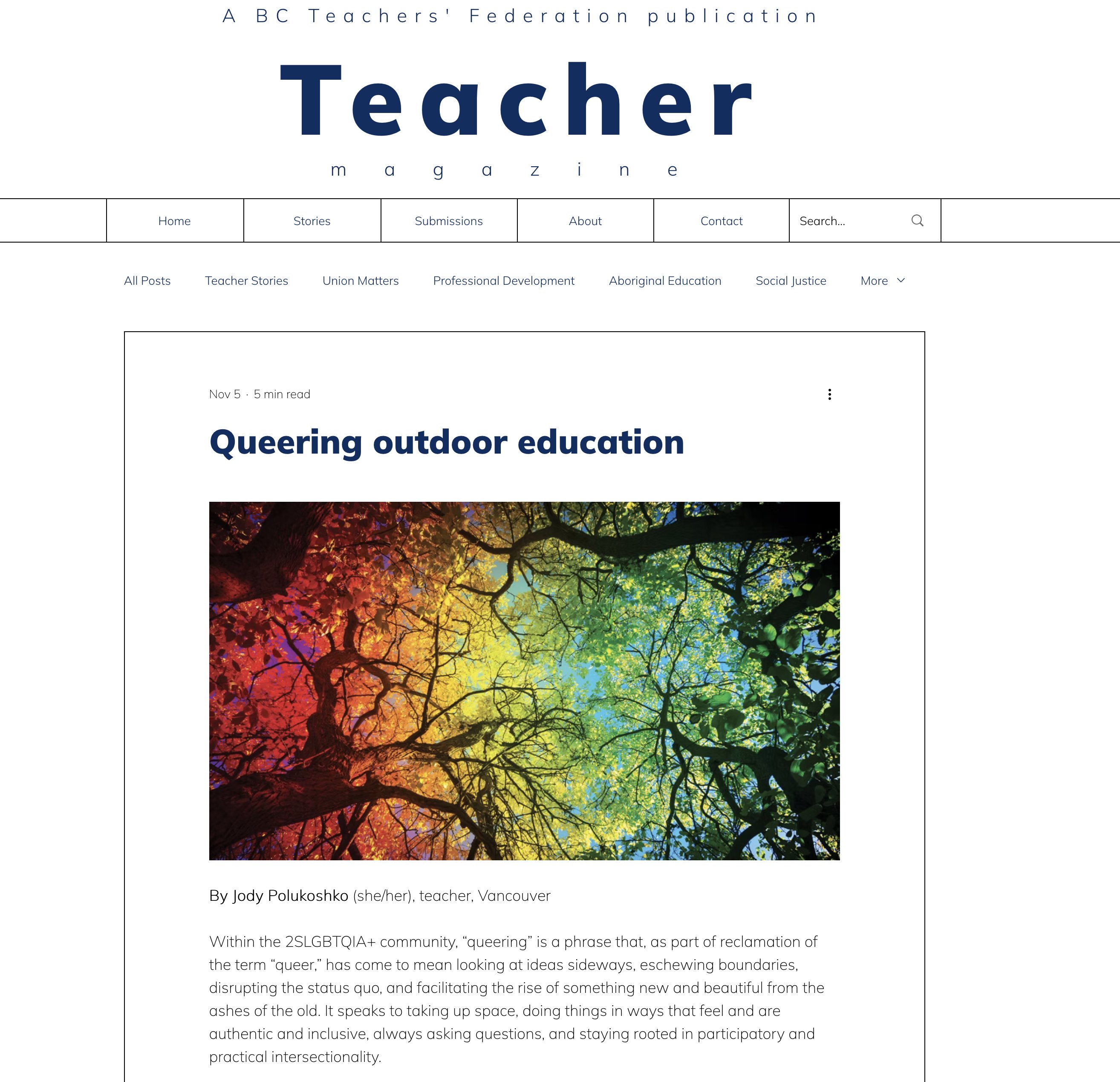
The British Columbia Teachers’ Federation (BCTF) has introduced a framework termed “Queering Outdoor Education,” which integrates queer theory, drag pedagogy, and decolonial approaches into environmental learning. This curriculum comprises lessons that encourage students to interpret natural phenomena through the lens of fluid identities, anti-normative critique, and social justice. While the framework is promoted as fostering inclusivity and challenging colonial and heteronormative assumptions, it raises substantive concerns regarding developmental appropriateness, educational clarity, and the potential for early ideological enculturation.
Metaphor and Conceptual Instability
The initial lessons employ metaphor as a primary pedagogical tool. Students are encouraged to draw analogies between natural elements—such as clouds, logs, or plants—and human identities, emphasizing fluidity and anti-essentialist perspectives. While metaphor can be valuable in education, these lessons risk overextending conceptual abstraction, replacing concrete environmental observation with ideological instruction. For children, particularly in early or middle childhood, excessive abstraction can hinder cognitive development by conflating empirical phenomena with normative social and political constructs.
Additionally, the curriculum critiques conventional linguistic frames, including metaphors like “birds and the bees,” positioning them as instruments of colonial and heteronormative power. Such framing may introduce complex sociopolitical interpretations into contexts traditionally reserved for foundational biological and ecological learning, potentially overwhelming young learners.
Moralizing Nature and Identity
Subsequent lessons extend these metaphorical frameworks into moral and social instruction. Students are asked to emulate the perceived allyship of natural objects and to conceptualize human identities in terms of ecological hierarchies, categorizing queer identities as “native” and others as “invasive.” While intended to promote reflection on inclusion and belonging, these exercises risk essentializing human worth according to ideologically charged criteria, substituting experiential learning with prescriptive social norms. By conflating ecological systems with social hierarchies, the curriculum may foster confusion rather than ethical understanding, undermining both environmental literacy and social cohesion.
Sexualization and Performative Instruction
The later lessons introduce overtly sexualized and performative elements, including the celebration of non-reproductive animal behaviors and the incorporation of drag-based exercises into outdoor activities. While drag pedagogy emphasizes self-invention and challenges normative binaries, its application to children’s environmental education raises questions of age-appropriateness. Embedding explicit discussions of sexuality and performative gender in contexts intended to cultivate observation, curiosity, and engagement with nature may distract from core learning objectives and impose adult conceptual frameworks onto immature cognitive and moral development.
Implications for Pedagogy
The queering of outdoor education exemplifies a broader pedagogical tension between radical inclusivity and the developmental needs of children. Integrating complex adult theoretical frameworks into early environmental education risks destabilizing students’ conceptual understanding, substituting guided inquiry with ideological instruction. While well-intentioned, such approaches may inadvertently limit children’s capacity for independent exploration, critical reasoning, and unmediated interaction with the natural world. Educational practice promote the idea of equality, not equity, along with the preservation of developmental appropriateness and cognitive accessibility.
Glossary
- Queer Pedagogy: An educational approach that incorporates queer theory to challenge traditional assumptions about gender, sexuality, and identity.
- Drag Pedagogy: A subset of queer pedagogy emphasizing performance, self-invention, and the destabilization of normative social roles.
- Decolonial Education: Curriculum frameworks aimed at addressing and countering the legacies of colonialism, often by centering Indigenous perspectives.
- Anti-Normative Critique: A critical approach that questions conventional social, cultural, or gender norms.
- Cognitive Development: The mental growth and acquisition of knowledge, reasoning, and understanding in children.
- Ideological Enculturation: The process of instilling a particular worldview or set of political beliefs, often through education.
References
- British Columbia Teachers’ Federation. Queering Outdoor Education Newsletter. 2025.
- Lacandona, Gaia. Drag Pedagogy: Performance and Learning. 2018.
- Polukoshko, Jody. Queer and Decolonial Approaches to Outdoor Learning. BCTF publication, 2024.
- Sumara, Dennis. Alternative Pedagogies and Cognitive Development: A Critical Review. 2017.
Suggested Readings Critiquing Queer Pedagogy
- Lindsay, James & McEwen, Bob. Critical Pedagogy and the Limits of Ideological Education. 2021.
- Wood, Peter. The Manipulation of Youth: How Ideology Enters the Classroom. 2019.
- Scholes, Robert. Childhood, Ideology, and the Limits of Social Theory. 2018.
- Davies, Belinda. Rethinking Radical Curricula: Balancing Innovation with Developmental Appropriateness. 2020.











 bleatmop
 Mystro
 The Arbourist


 Dead Wild Roses
Your opinions…