
You are currently browsing the category archive for the ‘Canada’ category.
One of the quiet functions of a healthy political system is rotation.
Not because one party is virtuous and the other corrupt, but because time in power changes incentives in ways that are predictable, even if they are not always obvious in the moment. Networks deepen, relationships harden, and what begins as governance slowly shifts toward maintenance—of position, of access, of advantage.
Canada does not impose formal term limits on governments, but it has long relied on something that functions similarly in practice. Parties rise, govern for a period, accumulate political and institutional cost, and are eventually replaced. The pattern is not mechanical, and it is not guaranteed, but it has been consistent enough to act as a kind of informal corrective.
That corrective matters because it interrupts accumulation.
Given enough time, any governing party begins to operate within a system that is increasingly shaped by its own presence. Decision-making becomes more insulated. Access becomes more selective. The line between public purpose and political survival, while never erased, becomes easier to move in small ways that rarely register as decisive in isolation.
Recent Canadian politics illustrates the point without needing to overstate it. Controversies such as the ArriveCAN app controversy and the SNC-Lavalin affair do not require an assumption of uniquely bad actors to be understood. They are better read as symptoms of what tends to happen when a government remains at the centre of power long enough for incentives to drift and institutional friction to thin.
This is not a claim about one party. Given enough time, any governing party will face the same structural pressures. The names change. The pattern does not.
This is not, in the first instance, a question of intent. It is a question of structure. The longer a party governs, the more the system begins to orient toward its continuation. That orientation does not appear all at once. It develops through small accommodations, repeated often enough that they begin to feel normal.
“Given enough time, any governing party begins to operate within a system that is increasingly shaped by its own presence.”
Historically, Canadian politics has corrected for this through turnover. Governments change, and with that change comes a reintroduction of uncertainty. New actors enter. Old networks loosen. Decisions that once passed quietly are re-examined under a different set of incentives. The system does not become pure, but it becomes less settled.
That correction is not without cost. Rotation introduces instability, resets institutional memory, and can produce policy whiplash as new governments relearn old lessons. These are not trivial drawbacks. The question is whether the discipline imposed by credible exit outweighs the friction introduced by change.
That distinction matters.
When the expectation of rotation weakens, the effect is not immediate collapse. What changes first is the texture of the system. Power becomes less contingent, less exposed to disruption, and therefore less disciplined by the possibility of loss. The longer that condition persists, the more governance begins to resemble continuity rather than contest.
A system does not need dramatic failure to drift in this direction. It only needs the mechanisms that interrupt accumulation to operate less reliably than before.
If that is true, then the health of the system depends less on who governs than on whether the expectation of replacement remains credible.
High-trust societies depend, in part, on the belief that power circulates and that no position is permanently secured. That belief does not rest on rhetoric. It rests on repeated demonstration.
When that demonstration becomes less frequent, trust does not vanish overnight. It thins, gradually, as the gap between expectation and experience widens.
And once that gap becomes large enough, the system is no longer experienced as dynamic.
It is experienced as fixed.

We feel safe in places like Alberta for a simple reason. Not because the system is especially gentle, and not because people are unusually kind, but because we believe the rules will be enforced, reliably and without fear or favour.
That belief does most of the work. It sits quietly in the background of daily life, doing its job precisely because it rarely has to announce itself. You don’t need to know the Criminal Code in detail. You only need to trust that when someone breaks it in a serious way, the response will reduce the chance of it happening again.
When that belief weakens, the shift is subtle at first. It doesn’t arrive as a declaration. It shows up in patterns. Arrest, release, reoffend, repeat. People notice, not as legal experts, but as observers of outcomes. The conclusion they draw is not complicated: the system is no longer reliably containing those who break its rules.
That is where trust begins to erode.
In Canada, this question intersects with a specific and sensitive legal reality. Sentencing is not strictly uniform. Courts are required to consider the unique systemic and historical circumstances of Indigenous offenders through what are commonly called Gladue factors, originating in R v Gladue and reaffirmed in R v Ipeelee. These rulings direct judges to account for the effects of residential schools, displacement, and intergenerational trauma when determining an appropriate sentence.
The intent here is not trivial. Indigenous Canadians make up roughly 4 to 5 percent of the population, yet account for over 30 percent of those in custody, with incarceration rates approaching ten times that of non-Indigenous Canadians. A justice system that ignored that disparity entirely would risk perpetuating injustice under the banner of neutrality.
That is the strongest case for Gladue principles, and it deserves to be taken seriously.
“A system that adjusts sentencing to account for historical injustice may be justified in principle. But if those adjustments affect how long repeat offenders are incapacitated, the question is not ideological. It is practical: does the system reduce harm?”
But a justice system is not judged by intent alone. It is judged by outcomes, particularly where public safety is concerned. And those outcomes sit alongside another set of facts that are harder to keep in view.
Indigenous women experience violent victimization at more than double the national rate. They are killed at rates several times higher than non-Indigenous women. Much of this violence occurs within known social networks rather than as random acts, which places the question of repeat offending and system response directly at the centre of the issue.
At the same time, recidivism is not a marginal phenomenon. Data from Correctional Service Canada shows that a significant proportion of offenders reoffend after release, with rates notably higher among Indigenous offenders. That does not make reoffending inevitable. It does establish that risk is real, and that it clusters.
Placed together, these realities create a tension that cannot be resolved by appeal to intent alone. A system that adjusts sentencing to account for historical injustice may be justified in principle. But that same system operates in a world where victimization is not evenly distributed, and where recidivism is not negligible. If those adjustments meaningfully affect how long repeat offenders are incapacitated, then the question is not ideological. It is practical: does the system, in aggregate, reduce harm?
To ask that question is not to deny the moral foundation of the policy. It is to take it seriously enough to test it against reality.
This is where the conversation often breaks down. Raising the issue is treated as a signal of bias rather than a request for evaluation. But a high-trust society cannot function on selective clarity. It has to be able to hold two things in view at once: that historical injustice matters, and that the primary function of a justice system is to protect the public from repeat harm. These aims are not mutually exclusive. But neither are they automatically aligned.
If they come into tension, and in some cases they do, the answer cannot be to ignore the friction because it is uncomfortable. Nor can it be to retreat into abstract claims about equality that bypass real differences in circumstance. The harder task is to examine whether the current balance is working as intended.
None of this implies that Gladue principles should be abandoned, nor that historical context should be ignored. It implies something narrower, and more demanding. Any system that modifies sentencing must also ensure that high-risk, repeat offenders, regardless of background, are reliably identified and contained. If those goals cannot be reconciled in practice, then the framework requires adjustment, not rhetorical defense.
Because the cost of getting this wrong is not abstract. It is paid in the quiet erosion of trust, and in the lived reality of those most exposed to harm.
High-trust societies are not sustained by kindness alone. They are sustained by the belief that rules are enforced, that serious harm is contained, and that the system works in the direction of protection. When that belief weakens through patterns rather than proclamations, trust does not collapse all at once.
It erodes.
And once it erodes far enough, it does not matter how compassionate the system intended to be.
It will no longer be believed.

Glossary
Gladue Factors
Legal considerations requiring Canadian judges to account for the unique systemic and historical circumstances affecting Indigenous offenders when determining a sentence. These can include the legacy of residential schools, intergenerational trauma, and community conditions.
R v Gladue
A Supreme Court of Canada decision establishing that courts must consider the background and systemic factors affecting Indigenous offenders under section 718.2(e) of the Criminal Code.
R v Ipeelee
A follow-up Supreme Court decision reinforcing that Gladue principles must be applied in all cases involving Indigenous offenders and clarifying their importance in sentencing.
Recidivism
The tendency of a convicted individual to reoffend after being released from custody or completing a sentence.
High-Trust Society
A society in which individuals broadly believe that institutions, laws, and fellow citizens operate predictably and fairly, reducing the need for constant vigilance or defensive behavior.
References
Statistics Canada – Indigenous victimization and incarceration data
https://www150.statcan.gc.ca/n1/pub/85-002-x/2023001/article/00006-eng.htm
https://www150.statcan.gc.ca/n1/pub/85-002-x/2023001/article/00004-eng.htm
Correctional Service Canada – Recidivism data
https://www.canada.ca/en/correctional-service/corporate/library/research/emerging-results/19-02.html
Department of Justice Canada – Gladue background and application
https://www.justice.gc.ca/eng/rp-pr/jr/gladue/p2.html
National Inquiry into Missing and Murdered Indigenous Women and Girls – Final report and findings
https://www.mmiwg-ffada.ca/final-report/
R v Gladue – Full decision (CanLII)
https://www.canlii.org/en/ca/scc/doc/1999/1999canlii679/1999canlii679.html
R v Ipeelee – Full decision (CanLII)
https://www.canlii.org/en/ca/scc/doc/2012/2012scc13/2012scc13.html
Nothing is breaking. That’s the problem.
Canada’s economy is not in crisis. There is no crash, no panic, no headline moment that forces a response. Instead, there is something quieter and more dangerous: hesitation.
Businesses are waiting. Hiring continues, but cautiously. Investment is delayed, not cancelled. Consumers are still spending, but with an edge of restraint. The numbers, taken individually, do not alarm. Together, they describe an economy that has lost its forward motion.
This is what a waiting economy looks like.
The mechanism is simple. When uncertainty rises—over trade, over energy, over rates—decision-making slows. Firms defer expansion. Employers hold off on adding staff. Households pause larger commitments. Each decision is rational in isolation. In aggregate, they compound into stagnation.
“When everyone waits, the slowdown compounds.”
The difficulty is that this kind of slowdown rarely triggers a clean policy response. Central banks do not cut aggressively because inflation risks remain. Governments hesitate to stimulate because nothing appears broken. The system drifts, and the cost accumulates in the background—missed growth, weaker productivity, fewer opportunities quietly foregone.
A crisis forces action the hesitation invites drift.
And drift, left long enough, becomes its own kind of shock.

Mark Carney is on the verge of a majority government. Not through an election, but through parliamentary drift—floor crossings, seat math, timing.
There is nothing illegitimate about this. Canada’s system allows it. MPs are not bound to their parties, and governments rise or fall on confidence, not sentiment. This is how the machine is designed to work.
But design is not the same as meaning.
A majority government is not just a number. It is a signal—of public consent, of direction, of political momentum. When that signal comes from an election, it carries weight. When it emerges mid-cycle, assembled rather than won, it carries ambiguity. The risk is not how the majority is formed. The risk is how it is interpreted.
This is where mandate inflation creeps in.
A government that reaches majority status without facing voters may begin to act as though it has received a fresh endorsement. It hasn’t. It has acquired power within the rules, but without a reset of public consent. That distinction matters, especially when decisions carry long time horizons or high political cost.
None of this requires outrage. It requires discipline. A government in this position should govern with an awareness of how it arrived where it is—carefully, incrementally, and with an eye toward legitimacy, not just legality.
Because the test is not whether the system allows it.
The test is whether the public continues to accept what follows.

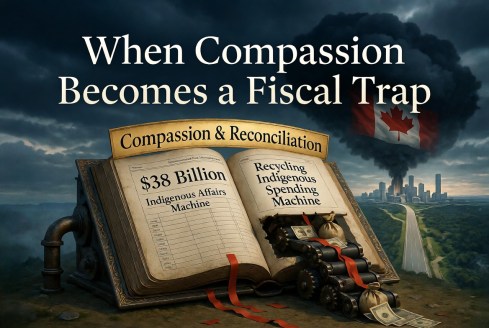
Canada’s Indigenous spending model has a problem it can no longer hide behind good intentions.
We are spending roughly $38 billion a year through core departments alone, after a decade of rapid expansion. The question is not whether that money is justified in principle. The question is whether it works.
On the outcomes that matter most—housing, child welfare, clean water reliability, and long-term economic independence—the answer is uneven at best and stagnant at worst. Progress exists. It is real. But it is not proportional to the scale of the spending. That gap between money spent and results achieved is the whole argument.
A system that cannot convert large, sustained spending into durable independence is not compassionate. It is failing.
The current model does not primarily produce independence. It manages dependency.
Spending has risen sharply, yet the Auditor General still found unsatisfactory progress on 53% of prior recommendations across core areas such as water, health access, emergency management, and socio-economic gaps. That is the mechanism in plain terms: more money flows, the system expands, compliance and administration thicken, and outcomes move slowly.
This is not just a funding shortage. It is a delivery failure.
And a delivery system that cannot convert major, repeated spending increases into reliable improvement is not neutral. It is misallocating resources at scale.
Canada is not bankrupt. But it is not insulated from fiscal reality either.
Federal spending is approaching half a trillion dollars. Debt-service costs are rising. Demographics are tightening the margin for error. You do not need a full sovereign-debt crisis for political choices to narrow. You just need pressure. A serious downturn, rising interest costs, or prolonged fiscal strain can force governments into reprioritization very quickly.
And when that happens, governments do not trim politely. They cut where they can.
That is where the current model becomes morally and fiscally dangerous at the same time. A system built on permanent federal transfers is stable only while those transfers keep flowing at politically tolerable levels. The moment that assumption weakens, those most dependent on the state become the most exposed to its limits.
That is the point too many sentimental arguments glide past. Dependency is not merely expensive. It is fragile.
A support model that only works while fiscal capacity keeps expanding is not a support model. It is a fair-weather dependency machine.
The present structure also rewards the wrong things. It rewards program expansion over completion, compliance over outcomes, announcements over maintenance, and federal management over local accountability. Money moves. Reports get written. Conditions improve, if they improve, far too slowly.
Look at drinking water. Ottawa rightly points to advisories lifted over the past decade. That progress matters. But Ottawa’s own figures also show that long-term advisories remain, and that many systems still require operational improvements before advisories can be lifted. That is not mainly a ribbon-cutting problem. It is a maintenance and systems problem. Building is politically photogenic. Sustaining is harder. The current model has often been better at funding capital headlines than at securing competent long-run operation.
The same broader pattern appears elsewhere. Indigenous children remain dramatically overrepresented in foster care. In 2021, Indigenous children made up 7.7% of children under 15, but 53.8% of children in foster care. A system that absorbs this much money and still leaves such ratios in place does not get to call itself successful because it can point to process, intent, or moral vocabulary.
If a model is expensive, underperforming, and fragile, it does not get preserved untouched. It gets triaged.
That means being willing to contemplate deep reductions—on the order of half to two-thirds over time—not as punishment, but as forced prioritization. The case is not for abandoning Indigenous communities. The case is for abandoning the fantasy that every current layer of spending is equally necessary, equally effective, or equally defensible.
Not everything should survive.
What should be protected is what is plainly essential: clean water systems with funded long-term maintenance, core health and emergency services, schooling, literacy, child protection, housing tied to credible upkeep plans, and communities that demonstrate effective local governance capacity.
What should be cut, compressed, or eliminated is the non-essential layer that accumulates in every morally protected spending regime: duplicative federal administration, consultant-driven program layers, pilot projects that never scale, compliance regimes that consume resources without clearly improving lives, and symbolic reconciliation spending detached from measurable outcomes.
If a program cannot show serious, durable improvement, it does not get to exist because it sounds compassionate in a press release.
This is where critics will predictably panic and moralize. They will say that Indigenous communities cost more to support because of historical injustice, geographic isolation, damaged infrastructure baselines, and the enduring effects of state misconduct. That is the strongest version of the opposing case, and parts of it are obviously true.
Historical injustice matters. Geographic isolation matters. Remote delivery costs are real. Weak starting conditions are real.
But that argument does not rescue the current model.
Historical injustice explains the starting line. It does not excuse a decade of rapidly expanding budgets with only partial and uneven progress. A moral claim to support is not the same thing as a proof that the delivery structure works. And after this much spending, defenders of the status quo still cannot point to outcome improvement proportionate to the scale of expenditure.
That matters because dependency wrapped in the language of reconciliation is still dependency. A model that leaves communities structurally tied to Ottawa’s fiscal condition is not empowering them. It is exposing them.
The answer, then, is not cuts for their own sake. It is reallocation.
Savings from the non-essential layer should be redirected in two directions. First, toward fiscal stabilization, because a state that loses control of its finances loses control of its choices. Second, toward connective infrastructure: roads, bridges, utilities, and other corridors that physically integrate isolated communities into provincial economies and reduce the permanent cost of remoteness.
Isolation is not an identity. It is, in significant part, an engineering and governance problem.
If you do not solve that problem, you will subsidize its consequences forever.
Historical injustice explains the starting line. It does not excuse ten years of bigger budgets with only marginal gap closure.
This is the part polite politics hates to say aloud. A country that refuses to discipline failing systems during periods of relative control increases the odds that future discipline will arrive under pressure instead. Markets impose limits. Debt-service costs impose limits. Fiscal stress imposes limits. In more extreme scenarios, countries lose the luxury of setting their own reform timetable and their own reform terms.
Better a hard reallocation now than a panicked contraction later.
Better to choose triage than to have it chosen for you.
The question is not whether Canada should support Indigenous communities. It should.
The question is whether Canada is willing to admit that the current model is not delivering enough, not fast enough, and not durably enough to justify its scale. Because the worst outcome is not reform. The worst outcome is drift: a system that consumes, reassures, and congratulates itself right up until the moment it cannot continue.
And then fails all at once.
References
- Indigenous Services Canada and Crown-Indigenous Relations and Northern Affairs Canada planned spending totals for 2025–26, approximately $38 billion combined.
- Office of the Auditor General of Canada follow-up finding that 53% of prior recommendations showed unsatisfactory progress.
- Indigenous Services Canada figures on long-term drinking water advisories, including advisories lifted and those still active.
- Statistics Canada figures showing Indigenous children as 7.7% of children under 15 but 53.8% of children in foster care in 2021.
- Federal spending and debt-pressure context from the budget and main estimates material summarized in the source text.
This is how activists frame their lies and misdirection.

Here is their bullshittery in full:
The introduction of new rules restricting participation in women’s sport categories to “biological females”, determined through mandatory genetic screening and testing, imposes exclusionary criteria. These measures not only bar transgender women from competition, but target and disqualify cisgender women with differences in sex development.
This policy will apply to the Los Angeles 2028 Olympic Games and beyond, despite the absence of clear evidence that any transgender women were poised to participate in those Games. The IOC’s approach aligns itself with the U.S. government’s 2025 executive order “Keeping Men Out of Women’s Sports” which threatened to withdraw funding from organizations that permit transgender athletes to compete and to deny visas to certain athletes seeking to participate in the Los Angeles Olympics. The convergence of international sport governance with exclusionary state policy raises serious concerns about the politicization of athletic participation and the erosion of independent, rights-respecting governance.
“While framed as a measure to ensure fairness, this policy imposes exclusionary criteria that will disproportionately harm transgender women and also place cisgender women at risk, particularly those with natural biological variations,” says Aaden Pearson, Trans Rights Legal Fellow at the Canadian Civil Liberties Association. “The policy authorizes intrusive scrutiny of women’s bodies and asserts authority over who gets to participate as a ‘real’ woman under the guise of regulation.”
This policy will have detrimental impact on Canadian athletes that may be barred from participating in the Olympics because of this policy who otherwise would qualify to represent Canada.
A rights-respecting approach to sport must be grounded in inclusion, evidence, and proportionality. Fairness and human dignity are not mutually exclusive. The legitimacy of sport depends on ensuring that all athletes are able to participate without discrimination.
The CCLA calls on the IOC and national sporting bodies to:
- Immediately reconsider the implementation of these eligibility rules;
- Ensure that any policies governing participation in sport are evidence-based, proportionate, and consistent with international human rights obligations; and
- Uphold the principle that sport must be accessible to all, without discrimination.
The legitimacy of sport depends not only on fairness in competition, but on fairness in access. Policies that exclude, surveil, and stigmatize athletes have no place in a rights-respecting sporting system.”
————————
When a civil liberties organization cannot define a category, it cannot defend a right.
That is the move.
The IOC’s policy does not abolish sport as a “human right.” It sets an eligibility rule for the female category: from LA 2028 onward, athletes in that category must pass a one-time SRY gene screen, using saliva, a cheek swab, or blood. Athletes who do not qualify are still eligible for male, mixed, or open categories. This is not exclusion from sport. It is boundary enforcement within sport.
That distinction is the entire argument, and the CCLA refuses to engage it.
Instead, it leans on the language of “inclusion” as though inclusion means entitlement to every category. But sport has never worked that way. Weight classes exclude. Age divisions exclude. Paralympic classifications exclude. Women’s sport exists because sex matters. Calling sex-based eligibility “exclusionary” does not answer that reality. It simply renames the boundary and hopes no one notices.
The claim that the policy “targets cisgender women with differences in sex development” is similarly evasive. The IOC framework uses SRY screening because it is strong evidence of male development. World Boxing’s policy is explicit: eligibility for the women’s category excludes athletes with Y-chromosome material or male androgenization. The relevant question is not whether someone identifies as a woman, but whether they have undergone male development. The CCLA substitutes sympathetic language for that question rather than answering it.
The argument about there being no “clear evidence” of transgender women poised to compete in LA 2028 is weaker still. Rules are not written only after a problem becomes numerically large. They are written to clarify the category before competition begins. “There aren’t many” is not an argument against having a rule. It is an admission that the rhetoric is disproportionate to the scale of the issue.
“It treats female sport as though it were an access program rather than a sex-based category.”
The claim of “intrusive scrutiny” is also inflated. The IOC’s first-line test is a one-time genetic screen using saliva, cheek swab, or blood. That is not the same thing as the mid-20th century abuses activists like to invoke. A serious civil-liberties analysis would distinguish between limited modern verification and historical excess. This statement deliberately blurs them.
And then there is the core contradiction. The CCLA says fairness and dignity are not mutually exclusive. That is true. But it follows that female athletes can be treated with dignity and retain a protected category that excludes males. The CCLA resolves this tension by dissolving the category instead. In practice, its position requires female athletes to absorb the cost: compromised fairness, weakened boundaries, and—in contact sports—elevated risk.
That is not a neutral rights framework.
It is a redefinition of rights in which access to the female category is prioritized, and the integrity of that category is treated as negotiable.
A civil liberties organization should be able to state the purpose of a category before it critiques its rules. The CCLA does not. It treats the female category as a site for validating identity claims rather than as a sporting class organized around sex.
Once that happens, the conclusion is pre-determined.
Female boundaries become suspect.
Enforcement becomes cruelty.
And reality becomes something to be managed with language.

The attack on Bill 25 has settled into a familiar script. Critics say it will make schools less welcoming, by which they mean that restricting ideological flag displays, limiting board activism, and requiring neutrality in certain forms of programming will make some students feel unseen or unwanted. It is an effective line because it hides a political claim inside the language of care. Nobody wants an unwelcoming school. The trick is that welcoming is being made to mean more than safety, decency, and respect.
A school should be safe, orderly, and humane. It should protect students from bullying, enforce standards of conduct, and make it possible for children to learn without fear or humiliation. What does not follow is the larger claim now being pushed by Bill 25’s opponents: that a public school must also visibly signal allegiance to a particular moral framework, and that if it stops doing so it has somehow become hostile.
“Protection is not the same as endorsement.”
That is the switch.
On the actual text, Bill 25 does not erase students, ban disagreement, or outlaw difficult topics. What it does is narrower, and more defensible, than its critics pretend. It pushes Alberta’s education law back toward institutional restraint. The bill revises parts of the Education Act’s language around school climate, requires courses and instructional materials to encourage a wide range of perspectives and foster critical thinking, says boards must refrain from taking political, social, or ideological positions unrelated to their duties, and requires certain non-approved programming to be impartial, fair, neutral, and free of personal bias. It also restricts school flags by default to the Canadian and Alberta flags, subject to later regulatory exceptions.
That is not a purge. It is a correction.
Now, the strongest version of the other side’s case is not hard to state. Some vulnerable students really do experience explicit symbols of affirmation as reassuring. Some will feel more at ease in an environment where support is made visible rather than merely promised in policy language. And because Bill 25 uses broad terms like “political, social or ideological” and refers to “common values and beliefs of Albertans,” it is fair to ask how those phrases will be applied in practice. A sloppy implementation could create confusion where schools need clarity.
Those are real concerns. They still do not settle the argument.
A public institution cannot make emotional reassurance the test for what it is allowed to endorse. The fact that some students feel comforted by visible institutional alignment does not mean the institution should align itself with a contested worldview. In a pluralistic public school, there will always be students who feel affirmed by one framework and alienated by another. The institution cannot solve that problem by choosing a side and calling the choice kindness. Its job is to protect students, maintain order, teach well, and show restraint in the use of its authority.
A public school is not a campaign office, a therapeutic identity space, or an activist workshop with a literacy block attached. It is a public institution. It belongs to families who do not agree with one another about politics, morality, religion, sex, identity, or the kind of society they want their children to inherit. Such an institution cannot remain trustworthy for long if it begins signaling that one contested framework has acquired official moral status.
This is why so much of the criticism of Bill 25 feels dishonest. It starts from a true premise and then quietly expands it. Some students are vulnerable. Fine. They deserve protection, dignity, and ordinary decency. But from that narrow duty of care, critics jump to a much broader demand: that the institution must visibly ratify a particular set of assumptions and display them as part of the school’s moral atmosphere. Protection becomes affirmation, affirmation becomes endorsement, and endorsement begins to drift into instruction.
“A school can protect a student without acting as a billboard for a worldview.”
That is the real dispute.
A teacher can treat every child with dignity without using classroom authority to suggest that contested beliefs about sex, identity, and society have already been settled beyond argument. A board can meet its legal obligations without issuing statements on every political controversy fashionable adults feel obliged to perform opinions about. Bill 25 does not solve all of this, but it does attempt to restore some institutional discipline where that discipline had plainly weakened.
As a teacher, that part is hard to ignore. I am not in the classroom to advertise my politics, recruit students into a moral sensibility, or drape school authority over my own preferred social vision and call the result compassion. I am there to teach. That means helping students read carefully, write clearly, listen seriously, and argue without slogans doing all the work for them. It also means knowing where my job ends.
That professional boundary now seems strangely difficult for some people to defend. They talk as though asking an institution to remain neutral is the same thing as demanding that individual students disappear. It is not. Bill 25 does not say students cannot exist as they are, think as they do, or discuss difficult questions. What it says, in substance, is that the institution itself should exercise more restraint in the positions it takes, the programming it allows outside the approved curriculum, and the symbolic alignment it displays as a public body.
That is a long way from the apocalyptic language being used against it.
None of this means the bill is perfect. It is not. The practical details will matter, and future regulations will matter even more. But arguing over those details is not the same as falsifying the centre.
And the centre is simple. A public school should not behave like an ideological camp that happens to issue report cards. It should teach students from many backgrounds under rules that are serious, fair, and publicly defensible. It should protect the vulnerable without demanding institutional allegiance to one faction’s beliefs. It should cultivate thought rather than posture, and trust rather than theatre.
The most dishonest move Bill 25’s opponents have made is to present neutrality as though it were hostility. That only works if one has already confused institutional discipline with emotional abandonment. Once every limit on symbolic activism is recast as an attack on children, no boundary remains. The institution becomes available for endless moral capture by whichever faction is best at translating its politics into therapeutic language.
That is not a school anyone should trust.
Bill 25 does not solve every problem in education. What it does do is move, however imperfectly, in the right direction. It treats the school as a public institution rather than a stage for institutional self-display. It reminds boards and educators that restraint is part of professionalism. It suggests, at long last, that children can be protected without making ideology the atmosphere everyone is expected to breathe.
That is not cruelty. It is maturity.

References
Bill 25 (official PDF):
Click to access 20251023_bill-025.pdf
Government of Alberta overview:
https://www.alberta.ca/removing-politics-and-ideology-from-alberta-classrooms











 bleatmop
 Mystro
 The Arbourist


 Dead Wild Roses
Your opinions…