
You are currently browsing the category archive for the ‘Canada’ category.
A University of Toronto Scarborough posting for an Assistant Professor in Computational Biology and Data Science looks like a standard academic hire. It isn’t. It is a restricted competition tied to a Canada Research Chair (CRC) nomination.
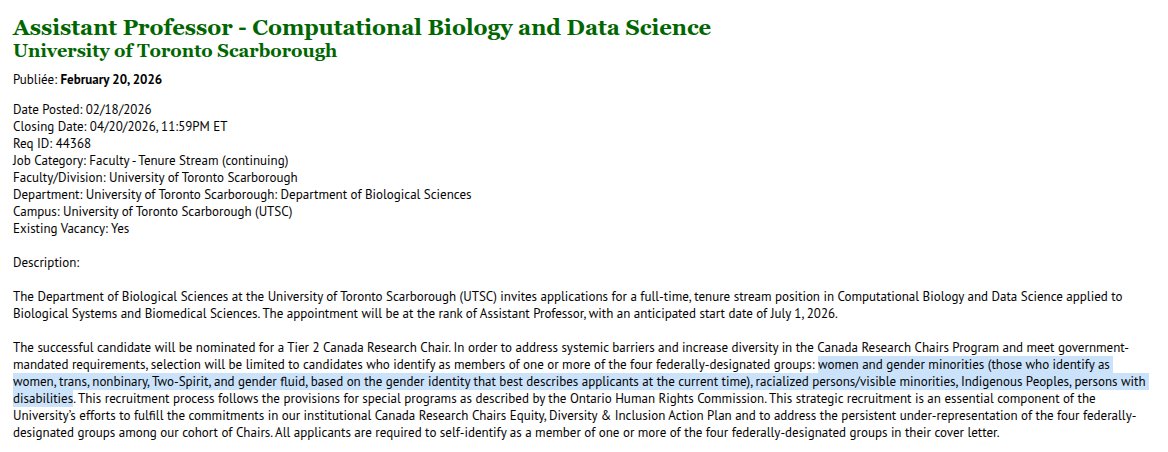 The posting requires applicants to self-identify as a member of one or more “designated groups” in their cover letter, namely women or gender minorities, racialized persons, Indigenous Peoples, or persons with disabilities. If you do not fit one of those categories, you are not eligible to apply. That is not an inference. It is in the posting.
That one detail captures the reality of modern equity administration in Canadian universities: what is framed as “removing barriers” often functions, in practice, as category-based exclusion.
This is not a rogue department. It is a federal program mechanism.
The university did not invent this framework on its own. The hiring restriction is attached to the Canada Research Chairs program, a federal initiative that allocates prestige and funding to institutions under defined rules. One major rule-set is the CRC equity framework, which includes population-based targets for the four designated groups. The program’s stated targets to be reached by the end of 2029 are: 50.9% women and gender equity-seeking groups, 22% racialized persons, 4.9% Indigenous Peoples, and 7.5% persons with disabilities.
Again, these are not vibes. They are published benchmarks tied to institutional plans and program governance.
The key point is the enforcement logic. Under the CRC’s settlement and enforcement framework, institutions that miss interim targets can face consequences that shape nominations and recruitment practices. In plain terms: the program can push institutions toward restricted competitions where eligibility is limited to designated groups.
So when you see a posting that excludes broad classes of Canadians from applying, it is not a one-off. It is a downstream product of rules that tie federal research prestige to demographic targets.
The problem is the normalization of identity gates
Defenders will say this is equity. They will argue that special measures are justified to counter historical bias and structural disadvantage. That is the argument, and it deserves to be stated fairly.
But there is a moral and civic cost to the method. When eligibility is restricted by identity categories, the institution is no longer selecting among all qualified candidates. It is selecting among those who clear an identity threshold first. That is not “equal opportunity.” It is a gate that sorts people before their work is even evaluated.
If you want a simple test for whether this is principled, reverse the identity labels. A posting that said “whites only” or “men only” would be condemned instantly, for good reason. You do not escape discrimination by flipping who benefits. You normalize discrimination by making it administratively routine.
A better standard
If Canada wants fairness in academic hiring, the standard should be straightforward: open eligibility, transparent criteria, and selection based on demonstrated excellence. If there are pipeline problems, fix the pipeline. Broaden recruitment, strengthen mentorship, reduce opaque networking advantages, and enforce accountable evaluation.
Do not solve bias by writing exclusions into job postings, then congratulating yourself for it. That approach trains young researchers to see institutions as political allocation machines rather than merit-seeking communities. And once that belief sets in, you do not get trust back easily.

References
1) U of T Scarborough job posting (Assistant Professor – Computational Biology and Data Science)
https://jobs.utoronto.ca/job/Scarborough-Assistant-Professor-Computational-Biology-and-Data-Science-ON/599939517/
2) Canada Research Chairs: “Establishing equity targets for 2021 to 2029”
https://www.chairs-chaires.gc.ca/program-programme/equity-equite/targets-cibles-eng.aspx
3) CRC Program representation statistics (lists the population-based targets and deadline)
https://www.chairs-chaires.gc.ca/about_us-a_notre_sujet/statistics-statistiques-eng.aspx
4) CRC: Equity, Diversity and Inclusion requirements and practices (overview, settlement context)
https://www.chairs-chaires.gc.ca/program-programme/equity-equite/index-eng.aspx
5) CRC: 2021 Canadian Human Rights Settlement Agreement page (program framing and enforcement context)
https://www.chairs-chaires.gc.ca/program-programme/equity-equite/2021_settlement-reglement-eng.aspx
6) House of Commons Standing Committee on Science and Research, Meeting No. 2 (witness panel includes Steven Pinker and Azim Shariff)
https://www.ourcommons.ca/documentviewer/en/45-1/SRSR/meeting-2/evidence
Canada still runs a legal category of “Indian” through federal law. Not as history. As operating code. The Indian Act governs registration, band governance, and the reserve framework. Identity becomes partly administered by statute, not only lived in community. (laws-lois.justice.gc.ca) When a state maintains a separate legal lane for a class of people, it does more than recognize difference. It reproduces difference through process and permanence.
Get the timeline right because this is where critics go hunting. The Indian Act was assented to on April 12, 1876, as a consolidation of laws “respecting Indians.” (sac-isc.gc.ca) Consolidation is not an accident. It is a choice to centralize control, define membership, and keep Indigenous life routed through Ottawa’s legal plumbing. Once you do that, you create a stable incentive loop. Governments manage liability and jurisdiction. Communities defend the gateways through which rights, services, and recognition pass. The system is not neutral simply because it is administrative.
Martin Buber’s vocabulary helps name the moral move without turning this into a sermon. An I–It posture treats people as objects. They become cases, stakeholders, units, problems to be managed. An I–Thou posture treats them as subjects with agency and dignity. A system that sorts people into different legal kinds makes I–It governance easier. Bureaucratic proxies replace encounter. Resentment follows because the relationship becomes instrumental even when the language stays compassionate.
You can watch the machine work in Alberta right now. Elections Alberta issued a Notice of Initiative Petition in late January 2026 for a citizen initiative proposing an Alberta independence referendum question. (elections.ab.ca) First Nations responded with litigation arguing the province had constitutional duties to consult on the impacts of such a referendum and failed to do so. (globalnews.ca) Alberta’s population reached 5.0 million in Q4 2025. (economicdashboard.alberta.ca) That is a large public, a loud politics, and a long list of grievances looking for a target. In that environment, it becomes easy to blame “Indians” as a block instead of blaming the architecture that turns every dispute into a status-mediated struggle over courts, duties, and jurisdiction.
The safest conclusion is also the strongest. Treat this as structure, not as villains. There are Indigenous voices, including William Wuttunee, who argued decades ago that the reserve-dependency model traps people and that integration on Indigenous terms was a path out. (uofmpress.ca) You do not need to adopt his full program to accept the warning. As long as legal status remains the main conduit for dignity, power, and money, Canada will keep reproducing otherness by design. Too many institutions cannot cash their cheques any other way.

References
Source Speech (YouTube)
Indian Act (R.S.C., 1985, c. I-5) — Justice Laws (official text)
https://laws-lois.justice.gc.ca/eng/acts/i-5/
Indian Act, 1876 (“amend and consolidate…”) — SAC-ISC archival text
https://www.sac-isc.gc.ca/eng/1100100010252/1618940680392
Martin Buber (I–It / I–Thou) — Stanford Encyclopedia of Philosophy
https://plato.stanford.edu/entries/buber/
Elections Alberta — Notice of Initiative Petition issued (Jan 27, 2026)
New Citizen Initiative Application Approved, Notice of Initiative Petition Issued
Alberta separation petition legal challenge context — Global News (Jan 23, 2026)
3 Alberta First Nations say separation petition is unconstitutional
Alberta population (5.0M in Q4 2025) — Government of Alberta Economic Dashboard
https://economicdashboard.alberta.ca/dashboard/population-quarterly/
William Wuttunee / Ruffled Feathers — University of Manitoba Press
https://uofmpress.ca/books/still-ruffling-feathers
Some children are genuinely vulnerable, atypical, or distressed, and they deserve careful support.
That should be easy to say. It should also be the beginning of the conversation, not the end of it.
The problem starts when a narrow duty of care is expanded into a broad teaching mandate. Support for a small number of children becomes a reason to saturate schools, children’s media, and online spaces with contested identity frameworks. What begins as accommodation becomes doctrine. What begins as care becomes a general lens for everyone.
That is the central move.
It is usually framed in soft language: inclusion, visibility, affirmation, making room. Sometimes that language is fair. But it can also hide a scope change. A real minority need is used to justify population-level exposure. The existence of some children who need unusual support does not, by itself, justify turning child-facing institutions into delivery systems for anti-normative identity scripts many children are not developmentally ready to evaluate.
Put simply: support is not the same thing as saturation.
A useful heuristic is the inoculation model. The implicit argument often sounds like this: expose everyone early and often to the framework so harm is prevented later. But that assumes the framework is age-appropriate, conceptually clear, and socially harmless when applied at scale. Those assumptions are usually asserted, not argued.
You can see the pattern in school frameworks like SOGI 123. SOGI 123 describes itself as an initiative to help educators make schools safer and more inclusive for students of all sexual orientations and gender identities, with tools spanning policy, school culture, and teaching resources. In British Columbia, SOGI 123 has been broadly integrated through educator networks and district participation structures. In Alberta, similar SOGI 123 resources and supports exist and are used, but public acceptance and implementation have been more contested and uneven. (Your local framing here is fine; if you want, we can add a specific Alberta anchor in the next pass.)
The point is not that every teacher using these materials has radical intentions. Most likely do not. The point is structural. A framework introduced in the name of protecting a minority of vulnerable students can become a general lens for shaping the environment of all students. That is exactly where support turns into saturation.
None of this requires pretending there are no benefits. Anti-bullying frameworks and school supports can reduce harassment and improve school climate for vulnerable students, and in some cases for other students as well. Recent SOGI 123 evaluation reporting in B.C. has explicitly claimed reductions in some forms of bullying and sexual-orientation discrimination, including effects observed for heterosexual students in studied schools. But that is a different question from whether a framework is well-bounded, developmentally fitted, and appropriate as a general lens for all children. A program can produce some good outcomes and still be overextended in scope.
This is also where ordinary parents often feel morally cornered. They are told the framework is simply about kindness and safety. Then they discover it also carries contested claims about identity, norms, and development. When they raise questions about age, fit, or timing, the objection is treated as hostility rather than prudence.
That rhetorical move matters. It is how debate gets shut down.
Some activist frameworks are not just asking for tolerance or non-harassment. They are more ambitious. They treat ordinary social norms as presumptively suspect—or as things to be actively challenged—rather than mostly inherited and refined. Adults can debate that in adult spaces. The problem is when those frameworks are translated into child guidance and presented as common sense before children are developmentally ready to sort through the concepts.
You do not need a graduate seminar to see the issue. Children imitate. Children seek belonging. Children absorb prestige cues. Children are shaped by what trusted adults celebrate. That is not bigotry. That is basic reality.
This is why developmental fit matters. Children do not process abstract identity questions the way adults do. Identity formation is gradual. Social context matters. Timing matters. Adult authority matters. Age appropriateness is not a slogan; it shifts across developmental stages, and what may be discussable at 16 is not automatically suitable at 6. When institutions present contested frameworks in a celebratory register first and a cautionary register later (or never), adults should worry.
The usual public binary is false. The choice is not between cruelty and total affirmation. It is not between neglect and ideological immersion. A sane society can do both things at once: provide targeted support for the children who truly need it, while refusing to reorganize the symbolic environment of all children around contested anti-normative frameworks.
That is not repression. It is proportion.
And proportion is exactly what gets lost when every concern is moralized and every request for limits is treated as harm.
We should be able to say, plainly, that some children need exceptional care without turning exceptional cases into the template for everyone else. We should be able to protect the vulnerable few without swamping the many. We should be able to teach kindness without requiring ideological inoculation.
If we cannot make those distinctions, then we are not practicing compassion. We are practicing scope creep with moral language.

Support for vulnerable students is necessary. But targeted care is not the same as saturating schools with contested identity frameworks for all children.
References
- SOGI 123 / SOGI Education. “SOGI 123 | Making Schools Safer and More Inclusive for All Students.”
https://www.sogieducation.org/ (SOGI 123) - SOGI Education. “What Is SOGI 123?”
https://www.sogieducation.org/question/what-is-sogi-123/
(official explainer page) - SOGI Education. “British Columbia.”
https://www.sogieducation.org/our-work/where-we-support/british-columbia/
(B.C. implementation / network context) - ARC Foundation. “UBC Evaluation of SOGI 123 (October 2024).”
https://www.arcfoundation.ca/ubc-evaluation-sogi-123-october-2024
(evaluation / outcomes framing from SOGI-supportive side) - Alberta Teachers’ Association. “What is SOGI 123?”
https://teachers.ab.ca/news/what-sogi-123 (teachers.ab.ca) - Keenan, H., and Lil Miss Hot Mess. “Drag Pedagogy: The Playful Practice of Queer Imagination in Early Childhood.” Curriculum Inquiry 51, no. 5 (2021): 578–594.
https://doi.org/10.1080/03626784.2020.1864621 - Gender Report (opinion/critical perspective). “We need to take ideological gender rhetoric out of education.” (Jan. 28, 2021).
https://genderreport.ca/sogi-gender-curriculum-queer-theory/ (CANADIAN GENDER REPORT) - Global News. “Duelling protests held in Edmonton over sexual orientation and gender identity policies in schools” (Sept. 20, 2024).
https://globalnews.ca/news/10766483/edmonton-gender-identity-sexual-orientation-alberta-schools/ (Global News)
Social media is not a neutral information pipeline. It is a distribution system for identity scripts, status incentives, and institutional messaging aimed at children and adolescents.
The internet matters, but the internet is not the first mover. The first mover is often the institution. Child-facing media packages contested identity-adjacent material in a glowing register—creativity, confidence, self-expression, empowerment—then platforms do what platforms do: amplify, repeat, and reward.
That sequence matters. Parents know the internet is porous and chaotic. Institutional children’s programming arrives pre-approved. It signals safety. It signals legitimacy. By the time a clip hits the feed, it is not just content. It is content stamped with adult authority.
Criticism of this pattern is routinely framed as hostility to “queer youth.” That framing is too convenient. The stronger criticism is about frameworks.
Some strands of queer activism are not simply asking for tolerance or protection from abuse. They are explicitly suspicious of norms as such, and in some cases treat norm disruption as a political good. Adults can debate that project in adult spaces. The problem begins when a norm-disruptive framework is repackaged as child guidance and presented as developmental common sense.
Developmental psychology matters here as a guardrail. Piaget’s core point still stands: children do not think like adults; reasoning develops in stages. Erikson likewise treats identity formation as developmental, social, and staged. Children and early adolescents are especially sensitive to imitation, belonging, prestige, and adult cues. That does not mean they lack an inner life. It means adults should not hand them high-status identity templates and call it pure self-discovery.
The question is not whether vulnerable youth exist. They do. The question is whether activist frameworks built to challenge adult social norms should be translated into child-facing institutional messaging as if they were straightforwardly age-appropriate. On that question, skepticism is not cruelty. It is adult judgment.
Public argument usually collapses here. One side calls it moral panic. The other calls it recruitment. Both are lazy.
Children are impressionable. Social learning is real. Status-seeking is real. Identity experimentation is real. None of that requires conspiracy thinking. It also does not justify a cartoon model of causation where one video produces one outcome. The serious concern is cumulative: repeated exposure, emotional framing, peer reinforcement, institutional endorsement, and algorithmic repetition shape what children perceive as admirable, normal, and socially rewarded.
That concern becomes more serious when the surrounding issue can become clinical. Once clinical pathways enter the picture, the adult burden of care rises. “Let kids explore” is not a sufficient standard when the surrounding culture is supplying scripts, rewards, and institutional validation at scale.
The evidence conversation has to stay honest. Research on social media and transgender or gender-diverse youth supports a mixed picture: online spaces can correlate with distress, discrimination, and problematic use, while also providing support, connection, and relief from offline isolation. Used carelessly, that literature gets abused in both directions—either as proof of “brainwashing” or as proof that social influence is irrelevant.
The more useful point is simpler: institutions increasingly present contested identity material to children in the language of celebration before they provide any framework for developmental caution. The sequencing is wrong. The tone is wrong. The confidence is often ahead of the evidence.
A sane standard is still available. Some online spaces help marginalized youth. Some online dynamics intensify confusion, distress, and imitation. Institutions should not present complex identity performance to children as if there are no downstream risks, tradeoffs, or developmental questions.
That is not cruelty. It is adult supervision.
The deeper problem is cultural, not merely digital. We outsource moral formation to feeds, then act surprised when children absorb what the feed rewards. Social media amplifies. Schools legitimize. Media narrates. Government ratifies. Then the shift is described as organic.
It is not fully organic. It is curated.
That does not mean every child in these spaces is inauthentic. It means authenticity itself is now being shaped inside an environment saturated with scripts, incentives, and prestige signals children are poorly equipped to evaluate critically.
If standards do not return, institutions will keep mistaking early exposure for compassion, and children will keep paying for adult vanity dressed up as progress.
References
-
Piaget, Jean, and Bärbel Inhelder. The Psychology of the Child.
-
Erikson, Erik H. Identity: Youth and Crisis.
-
Halperin, David M. Saint Foucault: Towards a Gay Hagiography. Oxford University Press, 1995.
-
Keenan, H., and Lil Miss Hot Mess. “Drag Pedagogy: The Playful Practice of Queer Imagination in Early Childhood.” Curriculum Inquiry (2021). DOI: 10.1080/03626784.2020.1864621.
-
CBC Kids News / Drag Kids segment (2017, resurfaced clip).
Canada’s Bill C-4 was sold as a targeted ban on abusive “conversion therapy.” That goal of ending coercive, shame-based attempts to “pray the gay away”is legitimate, and the harms from such practices are well documented. (Library of Parliament)
But C-4 didn’t stop at prohibiting coercion. It built contested premises about “gender identity” into the Criminal Code—then wrapped ordinary clinical caution in legal risk. For children, that’s not a symbolic problem. It’s a downstream harm problem.
1) C-4 hard-codes a contested concept into criminal scope
The Criminal Code definition of “conversion therapy” includes any “practice, treatment or service designed to… change a person’s gender identity to cisgender,” or “repress… a person’s non-cisgender gender identity.” (Department of Justice Canada)
That’s not the same category as sexual orientation. Whatever one’s politics, “gender identity” is not measured like blood pressure. In real child psychotherapy, you do differential diagnosis: you test hypotheses, you treat comorbidities, you watch patterns over time, you revisit interpretations.
C-4 makes one interpretive direction toward “cisgender”a uniquely danger to be seen as the “design” of therapy. (Department of Justice Canada)
2) The preamble signals something stronger than “don’t abuse people”
The Act’s preamble denounces “myths and stereotypes,” including “the myth that… cisgender gender identity… [and] gender expression that conforms to the sex assigned… are to be preferred over other… gender identities.” (Parliament of Canada)
Supporters will say this is a dignity claim: no one should be pressured to “be cis.” Fine. But when Parliament declares a core premise a “myth,” it doesn’t just condemn abuse it pressures institutions to treat skepticism as suspect.
In therapy, that matters, because the clinician’s job is not to recite a moral slogan. It’s to find the causal engine of distress in a specific child.
3) “Exploration” is permitted—until it looks like exploration with a destination
C-4 includes a “for greater certainty” carve-out for “exploration or development of an integrated personal identity… such as… gender transition,” provided the service is not “based on an assumption that a particular… gender identity… is to be preferred over another.” (Department of Justice Canada)
Here’s the problem: in actual clinical practice, the line between exploration and influence is not a clean statutory boundary.
A careful therapist might say:
- “Let’s treat anxiety/OCD first and see what remains.”
- “Let’s explore trauma and dissociation before we interpret identity claims.”
- “Let’s reduce online reinforcement and stabilize sleep, mood, and social stress.”
- “Let’s slow down—puberty is a confounder, not an oracle.”
That’s not “conversion.” That’s normal clinical sequencing.
But under C-4’s language, a motivated complainant (or risk-averse administrator) can reframe caution as an attempt to “repress” a non-cis identity, or as therapy “designed” to steer toward “cisgender.” (Department of Justice Canada)
Even if a prosecution is unlikely, the chilling effect doesn’t require convictions. It only requires enough ambiguity that clinicians and clinics decide it’s not worth the exposure.
4) This isn’t “college policy.” It’s Criminal Code territory.
Bill C-4 received Royal Assent on December 8, 2021 and came into force in January 2022. (Parliament of Canada)
It created Criminal Code offences around causing someone to undergo conversion therapy, promoting/advertising it, and profiting from it. (Parliament of Canada)
So when therapists ask, “Can I safely do exploratory work with this child without being accused of ‘conversion’?” they are not being melodramatic. They are doing what professionals do when lawmakers write broad definitions: they assume the worst plausible reading—and they self-censor.
5) Why this hits children hardest
Adults can absorb bad ideology and still have time to course-correct. Kids often can’t.
Children need therapy that is:
- exploratory (many hypotheses, not one script),
- developmentally sober (puberty changes the picture),
- comorbidity-first (anxiety, depression, autism traits, trauma, dissociation),
- family-systems aware (parents are usually the safety net, not “the enemy”),
- outcome-humble (no foreclosed conclusions).
C-4 subtly tilts the playing field: it makes “don’t be seen as steering away from trans identity” the safest institutional posture regardless of whether that posture serves the child in front of you.
6) Why this question is sharper now
After the February 10, 2026 Tumbler Ridge shootings, public attention has turned—again—to institutional failure chains: mental health, gatekeeping, warning signs, and what “care” actually means when a young person is unstable. The BC RCMP’s Feb 13 update refers to autopsies for “eight victims and the suspect” (nine deceased total), and notes ongoing review of prior interactions with the suspect. (RCMP)
A tragedy doesn’t “prove” a policy critique. But it does remove the luxury of pretending that scripts are the same thing as safeguards.
A better standard (without reviving abusive conversion practices)
If Parliament’s aim is to ban coercion and fraud, it can do so cleanly without criminalizing clinical caution.
A fix would explicitly protect:
- Open-ended psychotherapy for gender distress, including differential diagnosis and comorbidity treatment.
- Neutral therapeutic goals (reducing distress, improving functioning, strengthening self-acceptance) without predetermining identity outcomes.
- The clinician’s ability to discuss biological sex reality, uncertainty, and developmental pathways without that being treated as “preference” or “myth.” (Parliament of Canada)
- Bright-line prohibitions aimed at the actual evils: coercion, aversive techniques, confinement, threats, and misrepresentation.
Canada can still denounce abuse and defend evidence-based exploration. Kids deserve therapists unbound by ideology—not just ideology unbound by evidence.

References
- Bill C-4 — First Reading (House of Commons) — Nov 29, 2021
https://www.parl.ca/DocumentViewer/en/44-1/bill/C-4/first-reading
Source: (Parliament of Canada) - Bill C-4 — Third Reading (House of Commons) — Dec 1, 2021
https://www.parl.ca/DocumentViewer/en/44-1/bill/C-4/third-reading
Source: (Parliament of Canada) - Bill C-4 — Royal Assent (Chapter 24) — Dec 8, 2021
https://www.parl.ca/DocumentViewer/en/44-1/bill/C-4/royal-assent
Source: (Parliament of Canada)
Core legal text (Criminal Code, consolidated)
- Criminal Code — s. 320.101 (definition + exploration carve-out)
https://laws-lois.justice.gc.ca/eng/acts/c-46/section-320.101.html - Statutes of Canada 2021, c. 24 (Annual Statutes full text — includes preamble)
https://laws-lois.justice.gc.ca/eng/AnnualStatutes/2021_24/FullText.html
Official legislative record / metadata (timeline, status)
- LEGISinfo — Bill C-4 (44-1) (dates, stages, summary trail)
https://www.parl.ca/legisinfo/en/bill/44-1/c-4
Source: (Parliament of Canada)
Neutral institutional summary
- Library of Parliament — Legislative Summary (PDF)
https://publications.gc.ca/collections/collection_2022/bdp-lop/ls/YM32-3-441-C4-eng.pdf
Source: (Government of Canada Publications)
Government explainer / enforcement framing
- Justice Canada — “Conversion therapy” page (in-force date, offences overview)
https://www.justice.gc.ca/eng/rp-pr/jr/ct-tc/p1.html
Context reference used in the essay (Tumbler Ridge)
- RCMP — Tumbler Ridge investigative update (Feb 13, 2026)
https://rcmp.ca/en/bc/tumbler-ridge/news/2026/02/4350292
The most important part of the British Columbia Human Rights Tribunal’s decision in Chilliwack Teachers’ Association v. Neufeld (No. 10) is not the political noise around it. It is a short passage in page 19 paragraph 55. [attributed as paragraph 19, originally].
That passage matters because it appears to recode a contested idea as a condition of basic civic recognition. In plain terms, it moves from “do not discriminate against people” toward “you must affirm a specific theory to count as accepting them.”
This primer focuses on that point only. It does not attempt to relitigate the entire case.
The tribunal’s decision was issued February 18, 2026, indexed as 2026 BCHRT 49.
What this article argues in one paragraph
TL;DR: The BCHRT can punish discrimination without requiring Canadians to affirm a contested theory of sex and gender as the price of being considered non-discriminatory. Paragraph 19 matters because it blurs that line: it treats disagreement with a conceptual framework as “existential denial” of a person. That is a legal and civic problem, even for people who support anti-discrimination protections.
What this critique is not saying
Before the legal and logical analysis, a boundary line.
This critique is not saying:
- LGBTQ teachers cannot suffer real harm from public rhetoric.
- Human rights law cannot address discriminatory publications or poisoned work environments.
- Every criticism of SOGI, gender identity policy, or youth transition debates is lawful.
- Barry Neufeld’s rhetoric was prudent, fair, or wise.
The tribunal found multiple contraventions under the Code, including ss. 7(1)(a), 7(1)(b), and 13, and the decision contains detailed findings about workplace impact and discriminatory effects.
This primer makes a narrower claim:
Page 19 paragraph 55 uses an analogy that collapses the distinction between recognizing a person and affirming a contested ideological premise.
That distinction matters for free expression, legal clarity, and public trust.
The passage that changes the frame
Here is the core language from parge 19, paragraph 55 (including the definitional lead-in):
“Transpeople are, by definition, people ‘whose gender identity does not align with the sex assigned to them at birth’…”
“If a person elects not to ‘believe’ that gender identity is separate from sex assigned at birth, then they do not ‘believe’ in transpeople. This is a form of existential denial…”
“A person does not need to believe in Christianity to accept that another person is Christian. However, to accept that a person is transgender, one must accept that their gender identity is different than their sex assigned at birth.”
This is the paragraph Canadians should read for themselves.
The issue is not whether one can be civil. The issue is whether civil recognition is being redefined as mandatory assent to a disputed concept.
The core problem: equivocation on “accept” and “believe”
The tribunal’s analogy uses accept and believe as if they do the same work in both examples. They do not.
Christianity example
In the Christianity example, “accept that another person is Christian” usually means:
- acknowledging a descriptive fact about that person’s profession of faith,
- recognizing what they claim to believe,
- without requiring your own doctrinal agreement.
You can think Christianity is false and still accurately say, “Yes, that person is Christian.”
That is descriptive recognition.
Transgender example (as framed in para. 55)
In the tribunal’s wording, “accept that a person is transgender” is not left at description. It is tied to a required premise:
- that gender identity is separate from sex assigned at birth, and
- that this premise must be accepted in order to count as accepting the person at all.
That is not merely descriptive recognition. It is affirmation of a contested theory built into the definition.
That is the logical shift.
Why this matters legally and civically
A liberal legal order normally distinguishes between:
- Recognition of persons
- Protection from discrimination
- Compelled assent to contested beliefs
Paragraph 55 blurs those lines.
A person can acknowledge all of the following without contradiction:
- that someone identifies as transgender,
- that the person may experience distress, dysphoria, or social vulnerability,
- that harassment or discrimination against them is wrong,
while still disputing:
- whether sex is best described as “assigned” rather than observed,
- whether gender identity should override sex in all legal contexts,
- whether specific policies (sports, prisons, shelters, schools) should follow from that framework.
If disagreement on those latter questions is relabeled as “existential denial,” the public is no longer being asked to tolerate persons. It is being asked to affirm a framework.
That is the warning.
A concrete example most readers can use
Here is the distinction in everyday terms.
A teacher, coach, employer, or colleague can:
- treat a transgender person courteously,
- avoid harassment,
- maintain ordinary workplace civility,
- refrain from discriminatory conduct,
without conceding that sex categories disappear in every policy context.
For example, a person may choose to use a student’s preferred name in daily interaction and still argue that elite female sports should remain sex-based. A person may reject insults and harassment and still dispute whether “sex assigned at birth” is the best scientific language.
That is not incoherence. That is how pluralist societies work.
Paragraph 19 pressures this distinction by framing conceptual dissent as equivalent to non-recognition of the person.
The definitional trap in paragraph 55
Paragraph 19 does something subtle but powerful.
It defines “transpeople” using a specific conceptual framework (“gender identity” versus “sex assigned at birth”), then treats non-acceptance of that framework as non-acceptance of trans people themselves.
That is a question-begging structure:
- Premise (built into the definition): trans identity necessarily means gender identity distinct from sex assigned at birth.
- Conclusion: if you reject that premise, you deny trans people.
But the premise is precisely what is contested in public debate.
A tribunal can rule against discriminatory conduct. It can interpret the Code. It can assess workplace effects. But once it turns a contested framework into the test of whether one “accepts” a class of persons at all, it risks moving from adjudication into ideological gatekeeping.
Context matters, but it does not fix the analogy
To be fair to the decision, the tribunal is not writing in a vacuum.
The reasons frame Mr. Neufeld’s rhetoric as part of a broader pattern of statements the tribunal found denigrating, inflammatory, and connected to the work environment of LGBTQ teachers. The tribunal also found a direct connection between his public rhetoric and a school climate that felt unsafe to many LGBTQ teachers.
That context may explain the tribunal’s forceful language.
It does not solve the logic problem in paragraph 19.
Even in hard cases, legal reasoning should preserve key distinctions:
- personhood vs. theory,
- conduct vs. belief,
- discrimination vs. disagreement.
When those lines blur, institutions may satisfy partisans while losing credibility with ordinary readers who can still detect the category error.
Remedies matter too (and should be stated plainly)
This was not a symbolic ruling.
The tribunal ordered multiple remedies, including a cease-and-refrain order, $442.00 to Teacher C for lost wages/expenses, and a $750,000 global award for injury to dignity, feelings, and self-respect to be paid to the CTA for equal distribution to class members. It also ordered interest on monetary amounts as specified.
The tribunal also states that the dignity award is compensatory and “not punitive.”
Readers can disagree about the amount. They should still understand that paragraph 19 sits inside a decision with real legal and financial consequences.
Why Canadians should pay attention
Most Canadians will never read a tribunal decision. They will hear summaries.
That is why paragraph page 19 paragraph 55 deserves attention.
If public institutions begin treating disagreement with a contested theory as “existential denial,” the zone of legitimate disagreement shrinks by definition. The public is no longer told only, “Do not discriminate.” It is told, in effect, “Affirm this framework, or your dissent may be treated as denial of persons.”
That is not a stable basis for pluralism.
A rights-respecting society needs a better rule:
- protect people from discrimination,
- punish actual harassment and unlawful conduct,
- preserve space for lawful disagreement on contested concepts.
Paragraph 55, as written, weakens that line.

Glossary for readers
Page 19, Paragraph 55
A specific paragraph in the tribunal’s reasons that contains the Christianity analogy and the “existential denial” language. This primer focuses on that paragraph.
“Existential denial”
The tribunal’s phrase in para. 19 for refusing to “believe” that gender identity is separate from sex assigned at birth, which it links to not “believing in transpeople.”
Section 7(1)(a) (BC Human Rights Code)
A Code provision dealing with discriminatory publications (as applied by the tribunal in this case).
Section 7(1)(b) (BC Human Rights Code)
A Code provision dealing with publications likely to expose a person or group to hatred or contempt (the tribunal found some publications met this threshold).
Section 13 (BC Human Rights Code)
A Code provision dealing with discrimination in employment, including discriminatory work environments (the tribunal found a poisoned work environment for the class of LGBTQ teachers).
“Poisoned work environment”
A human rights / employment law concept referring to a workplace atmosphere made discriminatory through conduct, speech, or conditions connected to protected grounds.
SOGI 1 2 3
Resources discussed in the decision in connection with BC public education and inclusion policies; the tribunal notes they are resources and addresses their role in the factual background. (See source map below.)
Source map so readers can verify for themselves
Use this map to read the decision directly and check each claim the PDF is available here.
Case identification and issuance
- Paras. 1–3 (intro/citation/date/caption)
- Verified from the front matter: issued February 18, 2026, indexed as 2026 BCHRT 49.
Overview of findings and what was decided
- Paras. 4–6 (high-level findings; which Code sections were violated)
- Tribunal later reiterates finding the complaint justified in part and violations of ss. 7(1)(a), 7(1)(b), and 13.
Freedom of expression framework / limits
- Paras. 8–10 (overview-level framing)
- Also see Part VII heading “Freedom of expression and its limits” in the table of contents.
SOGI factual background
- Paras. 13–15 (background on SOGI 1 2 3 in public education)
- See TOC references to “SOGI 1 2 3 in public education” and Neufeld’s response.
The key analogy and “existential denial”
- Para. 19 (full lead-in + Christianity analogy + “existential denial” language)
This is the central paragraph for the primer.
Tribunal’s “veneer of reasonableness” concern
- Para. 55 (same paragraph; immediate context of the analogy)
Workplace impact evidence / climate findings
- Paras. 38 onward (teacher evidence and climate effects)
- Example evidence and findings on climate and workplace effects are reflected in the teacher testimony excerpts and the tribunal’s acceptance of a direct connection to unsafe school climate.
s. 13 conclusion (employment discrimination)
- Para. 82 (and surrounding paras.) / section conclusion in Part V-C
- Tribunal concludes violation of s. 13 for the class.
Remedies overview (s. 37(2))
- Paras. 99 onward (remedies discussion starts in the remedies part)
- Includes declaration, cease/refrain order, expenses, dignity award, and interest.
Cease and refrain order
- Remedies section, Part A (paras. around 100–101)
- “We order him to cease the contravention and refrain from committing the same or a similar contravention…”
Training remedy requested but declined
- Part B (ameliorative steps) (paras. around 102)
- Tribunal says it was not persuaded mandatory training would have a beneficial effect in this case.
Teacher C expenses ($442)
- Part C (expenses incurred) (paras. around 103)
- Tribunal orders $442.00 to Teacher C.
Dignity award ($750,000 global)
- Part D (compensation for injury to dignity…) (paras. around 104–111)
- Tribunal says the purpose is compensatory, not punitive; later orders $750,000 to the CTA for equal distribution to class members.
Interest orders
- Part E (Interest) (paras. around 112)
- Tribunal orders interest as set out in the Court Order Interest Act.











 bleatmop
 Mystro


 Dead Wild Roses
Your opinions…