
You are currently browsing the category archive for the ‘Culture’ category.
From a Stoic perspective, which emphasizes virtue, reason, and living in accordance with nature, Canadian values can be interpreted through the lens of universal principles rather than cultural specifics alone. However, reflecting on commonly recognized Canadian traits—such as respect for diversity, community, fairness, resilience, and a connection to nature—we can distill these into a Stoic framework. The Stoics, like Marcus Aurelius or Seneca, would likely admire values that align with justice, courage, wisdom, and temperance, and these can guide our understanding of Canadian ideals. Below is a list of five key values, interpreted stoically, with practical ways to embody them.
1. Respect for Diversity as Justice**: Stoicism teaches that all humans share a common reason and are part of the same cosmopolitan community. In Canada, this resonates with the value of embracing diversity—cultural, linguistic, and ideological. To practice this, exercise justice by treating all individuals with equal respect, regardless of background, as Seneca advised: “Associate with those who will make a better man of you; welcome those whom you yourself can improve.” Engage in conversations with people different from you, listen without judgment, and challenge your biases daily.
2. Community as Mutual Support**: The Stoic concept of *oikeiôsis*—a natural affiliation with others—parallels Canada’s emphasis on collective well-being, seen in things like universal healthcare or community-driven initiatives. Marcus Aurelius wrote, “What brings no benefit to the hive brings no benefit to the bee.” To live this, contribute to your community without expecting reward: volunteer locally, support neighbors in need, or simply offer a kind word. Recognize that your well-being is tied to the whole, and act accordingly.
3. Fairness as Wisdom**: Canadians often pride themselves on fairness, a value Stoics would tie to wisdom and impartiality. Epictetus reminds us to focus on what is in our control and accept what is not, judging situations rationally rather than emotionally. In practice, this means resolving conflicts calmly, advocating for equitable treatment in your workplace or social circles, and refusing to let personal feelings cloud your decisions. When faced with injustice, respond with reasoned arguments rather than anger.
4. Resilience as Courage**: Canada’s harsh winters and vast geography have bred a cultural resilience that aligns with Stoic courage—the ability to endure hardship without complaint. Seneca noted, “Sometimes even to live is an act of courage.” To embody this, face challenges head-on: whether it’s a tough job, a bitter cold day, or personal setbacks, adopt a mindset of endurance. Practice discomfort deliberately—take cold walks, limit indulgences, or tackle hard tasks first—to build your inner strength.
5. Connection to Nature as Temperance**: Canadians often feel a deep bond with their natural surroundings, from forests to mountains. Stoics, who urged living in harmony with nature, would see this as temperance—moderation in desires and appreciation of what is. As Zeno taught, align your life with the natural order. Practically, this means spending time outdoors mindfully: walk in parks without distractions, reduce wasteful consumption, and cultivate gratitude for the environment. Let nature remind you of life’s simplicity and your place within it.

Males should not be in female changing rooms because these spaces are designed to provide women and girls with privacy, safety, and comfort—needs rooted in biological and social realities. Allowing males, regardless of identity, undermines this by introducing potential risks, from voyeurism to assault, as evidenced by cases like the 2021 Wi Spa incident in Los Angeles, where a registered sex offender exploited lax policies. Women’s boundaries deserve respect, not erosion under the guise of inclusivity, especially when separate facilities can accommodate everyone without compromising female security. Data backs this up: a 2018 UK study found 90% of sexual offenses in changing rooms occurred in mixed-sex spaces. Single-sex areas aren’t about exclusion—they’re about protection.
From Reduxx.info :
“A Canadian mother has come forward to reveal that she was chastised by staff at her local recreation center after reporting that a balding man wearing “fetish gear” was in the women’s changing room. Despite feeling so frightened that she called the police, the mother was told that the man had a right to self-identify into whatever changing room he felt like.
The incident occurred on February 18, when Keri* and her 14-year-old daughter visited the Bonnie Doon Leisure Centre in Edmonton, Alberta. Their plans to have a fun-filled afternoon at the local pool quickly took a turn for the worse after the two entered the changing area to see an adult man “naked except for fetish gear” standing in the center of the room.
Keri tells Reduxx that the man, who appeared to be in his mid-forties, was wearing a “black penis sling” and an exposed rubber breast form. So shocked by the sight, Keri immediately began to usher her daughter out of the changing area.
“My daughter was behind me… I backed up quickly so she would not keep walking forward and yelled ‘help, there is a man in the change room.’” Keri says she went back to the front desk, where she had just paid for the admission to the pool. After explaining what she had seen in the women’s changing area, a male staff member dismissed her concerns.
“He said something like: ‘yes, this is an inclusive facility, what are you afraid will happen?’ and so I told him I was calling the police. He asked me why I felt the need to call the police, but did not try to stop me.”
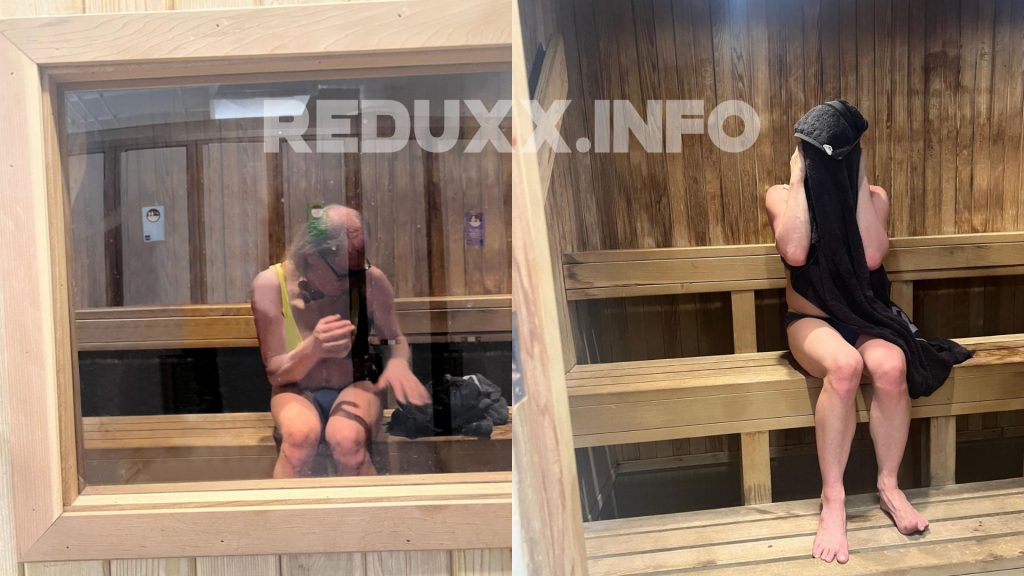
While waiting for an officer from Edmonton Police Service to arrive, a female staff member approached Keri to ask her about the situation. Keri recorded the conversation with the staff member, and provided the audio to Reduxx for review.
In the recording, Keri is heard giving a statement to the staff member and explaining precisely what she had experienced.
“I am telling you right now – he is a balding man, in his forties, wearing a penis sling and rubber breasts around his neck… fetish rubber breasts slung around his neck,” Keri is heard telling the staff member. “He is in the women’s washroom. I walked in with my 14-year-old daughter… I am 54, I should not have to put up with it. But she should definitely not be exposed to a man enjoying his fetish in the women’s washroom.”
In response, the staff member explains that “it is the city of Edmonton’s policy that you can use whatever changing room you are most comfortable using.” She goes on to defend the man’s attire, saying “they can wear whatever they are comfortable wearing.”
Let’s not forget the CBC and it’s startling(?) lack of coverage of this.
Bless the Canadian Broadcasting Corporation—our noble guardians of progressive virtue—turning a blind eye to fetish-driven males sashaying into female changing rooms with all the grace of a tax-funded diversity seminar. Why bother reporting on something as trivial as women’s safety when you can churn out another glowing piece on inclusivity, eh? It’s not like the CBC would dare risk its pristine reputation as Canada’s woke megaphone by admitting that some dudes in fishnets might not belong where girls are undressing—nah, that’d clash with the narrative. Besides, who needs pesky facts or viewer trust when you’ve got government cheques and a mandate to keep the maple syrup flowing smoothly over any hint of controversy?
To unpack the Kamloops unmarked graves story, we need a French philosopher—Jean Baudrillard. He loved poking holes in modernity, especially how culture twists itself around shaky narratives. His big idea, hyperreality, describes a state where the line between reality and representation blurs so much the representation becomes more real—a world of signs pointing to other signs, not facts. It’s a four-stage slide into a simulation that outshines truth. Let’s see how Kamloops fits.
The Four Stages of Hyperreality
First Stage (A Sign Reflects Reality): You’ve got a symbol that points to something real. A photo of a mountain—it’s not the mountain, but it shows what’s out there. Clear connection, no tricks.
Second Stage (A Sign Distorts Reality): Now the symbol starts messing with the real. Think of a touched-up Instagram pic—still a photo of a mountain, but filters make it look “better” than the actual thing. Reality’s skewed, but you can still trace it back.
Third Stage (A Sign Pretends to Reflect Reality): Here’s where it gets dicey. The symbol acts like it’s tied to something real, but that real thing doesn’t exist. Baudrillard uses Disneyland as an example—a fake Main Street that sells nostalgia for a past that never was. It’s not reflecting reality; it’s inventing one.
Fourth Stage (Hyperreality—Signs Without Reality): Now the symbol doesn’t even pretend to care about reality—it’s a closed loop, a simulation of a simulation. Think reality TV: scripted drama sold as “real life,” but nobody’s asking what’s real anymore—they’re just hooked on the drama. The loop’s all that matters.
Got all that? Now let’s strap on our simulacra goggles and map this onto the Kamloops unmarked graves story—watch how reality gets buried.
Kamloops Through the Hyperreal Lens
First Stage: Sign Reflects Reality
If this were just about the radar findings, we’d start here—a report saying, “Hey, we found some weird soil patterns, might be graves, might not.” It’d point to a real investigation, grounded in facts. Residential schools left real scars, no question—but the Kamloops story spun into something else: a hyperreal mess where symbols outran facts. We didn’t linger here long.
Second Stage: Sign Distorts Reality
The initial framing—calling them “unmarked graves of children”—already stretched things. Ground-penetrating radar doesn’t show bodies; it shows anomalies. Media outlets, hungry for clicks, and activists, hungry for justice, ran with the graver version (pun intended). Headlines screamed “mass graves” (think CBC’s early “215 children found”), even though Tk’emlúps clarified it wasn’t that. Reality got airbrushed into something more dramatic.
Third Stage: Sign Pretends to Reflect Reality
Here’s where it gets spicy. The “215 children” became a cultural artifact—orange ribbons, vigils, government apologies—all built on a reality that wasn’t confirmed. It wasn’t lying outright; it just acted like the graves were a done deal. The media and public didn’t need proof—they needed a symbol. And boy, did they get one. Every Child Matters morphed into a movement, not a question.
Fourth Stage: Hyperreality—Signs Without Reality
Now we’re in 2025, and the simulation’s running the show. The “graves” aren’t just unproven—they’re beside the point. The story’s spawned funding (millions allocated for searches), laws (like bills to criminalize “denialism”), and endless X debates where “deniers” and “believers” slug it out over a phantom. It’s not about what’s under the ground anymore; it’s about what the idea of those graves does—how it shapes identity, guilt, policy, and power. That’s hyperreality: the menu’s tastier than the meal, and we’re all eating it up.
The Canadian Media’s Role
The media should be our first defense against false narratives and hyperreal incursions. Our Canadian media—particularly the CBC—ran headlong away from their duty to inform with facts. They chose style over substance, leaning hard into emotional hooks—“215 children,” “mass graves”—with little reporting on what ground-penetrating radar can reliably identify or the ground’s composition (leading to false positives). Objective reporting got tossed aside to boost the narrative and reactions to it. Stories about protests, church burnings, and government responses fed the loop, making the “graves” realer in discourse than in dirt. The simulacra’s at stage four—no reality needed for the story to keep going.
In Baudrillard’s world, this is how hyperreality wins—when the media trades facts for feelings, the simulation doesn’t just obscure reality; it replaces it. What happens when the next narrative rolls in—no dirt, all discourse?
The reporting around Kamloops isn’t about graves anymore; it’s about what simulacra we’ll fall for next. Baudrillard’s spinning in his grave—wherever that happens to be. So what’s the next simulacrum Canada’s media will peddle—more graves, more guilt, or something fresh? Drop your guess below.

Well it seems we’re rapidly approaching this point.

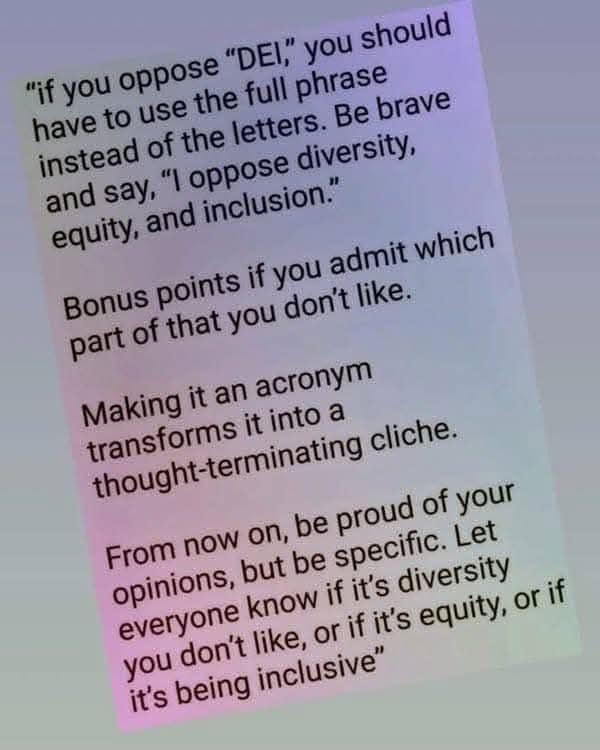
Activists use polysemy to make their corrosive ideas sound palatable to people not versed in their conversational inanity. The play is usually a cloak and dagger affair where they use the commonly accepted definition of a particular word, in this case ‘Diversity’ and use it in a dishonest setup that is really about pushing their specialist meanings into society and society’s institutions.
Here is great example.
Diversity (M1): Generally refers to the presence of variety within an organizational workforce, encompassing differences in identity, such as race, gender, sexual orientation, disability, age, culture, class, religion, or opinion. It’s about having a mix of different people.
Diversity(M2): Some critics argue that in “woke” contexts, diversity might be seen more as a means to an end rather than an end in itself, potentially focusing on increasing representation of certain politically aligned marginalized groups. This view suggests that diversity is less about broad inclusion and more about specific group representation.
The woke will push M1 and be morally outraged if you speak against Diversty(M1). How could you oppose having a different mix of people involved in a situation/task?
How could one indeed? But the pushback isn’t against Diversity(M1) it is pushback against Diversity(M2) which is infused with identity politics and the oppressor/oppressed narrative. It is the Diversity(M2) narrative that calls for a diversity of group identities with the proviso that they share the same ideological beliefs. This idea is illustrated by the fact that, for example, Black Conservatives are not considered to be a ‘diverse choice’ since they often opposed the oppressor/oppressed narrative.
How deep does the polysemic rabbit hole go? Well…
The term “diversity” in the context of social justice advocacy often exhibits polysemy, where the word has multiple related or unrelated meanings. Here are three examples of how the term “diversity” is used:
Diversity as Representation: Meaning: This refers to the inclusion of different racial, ethnic, gender, and sexual orientation groups within organizations, institutions, or media.
Usage: In this context, “diversity” is often used to describe efforts to ensure that various demographic groups are represented in workplaces, schools, and public life. For example, a company might strive for diversity in its hiring practices to reflect the broader community’s composition.
Diversity as Ideological Uniformity:
Meaning: Some critics argue, as seen in posts on X, that “diversity” in certain circles is used to mean a variety of backgrounds but with a uniform set of political or social views, particularly those aligned with progressive or “woke” ideologies.
Usage: This interpretation suggests that while there might be diversity in appearance or demographic markers, there’s an expectation of conformity in thought, especially in terms of social justice issues. This usage is often highlighted in debates over free speech and ideological diversity.
Diversity as a Tool for Inclusion vs. Exclusion:
Meaning: “Diversity” can sometimes be perceived as inclusive when it pertains to groups historically underrepresented or marginalized, but it can also be seen as exclusive if it’s interpreted as excluding certain groups (like straight white males) from consideration for diversity initiatives.
Usage: This dual interpretation can lead to confusion or contention, where diversity initiatives are praised for broadening perspectives but criticized by others for being exclusionary based on identity rather than merit or broader inclusivity.
These examples show how “diversity” can be a multifaceted term within social justice discourse, with its meaning shaped by context, intent, and perspective. The web results and posts on X suggest that while the term is generally used positively to advocate for broader representation, there’s a significant debate around its implications and actual practice.
We must return to the rule of law and have the courage to enforce the laws in our societies.
-
Extent of Abuse: The scandal involved the organized sexual exploitation of hundreds, if not thousands, of children, primarily young girls, over several decades in various towns across northern England, including Rotherham, Rochdale, Telford, and Oldham. A notable example is the Rotherham scandal where an estimated 1,400 children were abused between 1997 and 2013.
-
Ethnic Dimensions: Many of the perpetrators in these cases were identified as being of British Pakistani heritage, leading to significant debate and controversy over the intersection of race, culture, and crime. This has fueled discussions about multiculturalism, integration, and the fear of being labeled racist when addressing these issues.
-
Institutional Failures: There were severe criticisms directed at local authorities, including police, social services, and councils, for failing to act on the abuse. Reports highlighted that these institutions often ignored or downplayed the problem due to concerns about racial tensions or political correctness. This failure allowed the abuse to continue unchecked for years.
-
Public and Political Reaction: The scandal has repeatedly resurfaced in public discourse, often driven by media coverage and political figures. Recent calls for a national inquiry have been contentious, with figures like Elon Musk and various UK politicians engaging in debates about the handling of the cases and accountability. The political aspect includes criticism of former officials and demands for comprehensive investigations into past and present handling of these crimes.
-
Legal and Policy Consequences: Over time, there have been multiple legal actions, including convictions of many perpetrators, but also broader systemic changes. For instance, laws were amended in 2012 to facilitate investigations into child sexual exploitation, and there has been an ongoing push for better protection mechanisms, reporting requirements, and police training. Despite these efforts, there’s a consensus that more needs to be done to prevent future occurrences and to adequately address past failures.These points encapsulate the complexity of the scandal, highlighting the scale of the abuse, the societal implications, institutional failures, political reactions, and the legal response to these deeply troubling events.
We have been catering to unstable fragile people for far – far – too long. Let’s hope and do what we can to ensure this trend continues.
“Then there was the American author, Hesse Phillips, who apparently uses “she/they” pronouns. “This decision was not taken lightly,” she/they declared in a lengthy statement this week. “I’ve conferred with other queer and trans authors, cis and straight authors, friends and family, and in the end I feel that stepping down from my panel is the only way forward, both for my personal safety and my conscience.”
At one level, it’s hard to take this nonsense seriously. But the reference to “personal safety” implies that the mere presence of gender-critical authors in the same city as adherents of the cult of identity politics puts the latter in danger. It’s a disgraceful slur, as is the suggestion that Joyce and Bindel are calling for the “eradication of an entire class of human beings”. Phillips has also smeared the organisers of the festival, accusing them of prioritising “hate speech over the safety of LGBTQ+ speakers and attendees”. It’s intended, I suspect, as a warning to other festivals of what to expect if they dare to platform heretics.
Pressure has worked far too often. Last year the Hay and Edinburgh book festivals announced they were suspending sponsorship from a company deemed unacceptable by activists against climate change and Israel’s conflict in Gaza. The Cheltenham Literature Festival went so far as to compare a belief in biological sex with racism and homophobia. The bullies appeared to be firmly in charge, as organisers in effect ceded a veto to groups of people who regard themselves as more important than anyone else.
Signs that the mood is changing, swinging against censorship disguised as inclusion, has evidently come as a shock. When gender warriors obsess about threats to their “safety”, they’re actually revealing that they can’t bear to be challenged. They’ve got used to mixing with people who stroke their egos and don’t question the ludicrous claim that their lives are in danger.”











 bleatmop
 Mystro


 Dead Wild Roses
Your opinions…