
You are currently browsing the category archive for the ‘Culture’ category.
In the first post of this series, we traced the roots of the oppressor/oppressed lens to the Combahee River Collective, Paulo Freire, and Kimberlé Crenshaw, who gave us tools like intersectionality to understand systemic injustice. We also saw how Freire’s focus on class consciousness prioritized ideological awakening over factual learning, setting the stage for a binary moral framework. Today, this lens is everywhere—on X, in workplaces, in classrooms—shaping how we judge right from wrong. But as it’s gone mainstream, it’s often been stretched beyond its original purpose, turning a tool for analysis into a blunt moral weapon. In this post, we’ll explore how thinkers like Judith Butler, Robin DiAngelo, and John McWhorter reveal the lens’s strengths and its modern misuses, showing why it falls short as a universal moral guide.
The Lens in Action: From Insight to Ideology
The oppressor/oppressed lens is powerful because it names systemic harms—like racism, sexism, or classism—that shape daily life. It’s why a Black woman like Maya, from our last post, can use intersectionality to explain her unique workplace barriers. But as the lens has spread, it’s often applied in ways that oversimplify complex realities, fostering division over dialogue. Three thinkers help us unpack this shift: Judith Butler, who shows the fluidity of power; Robin DiAngelo, who mainstreamed the lens but risks coercive moralism; and John McWhorter, who critiques its dogmatic turn.
Judith Butler: Power and Performativity
Judith Butler’s groundbreaking work, particularly Gender Trouble (1990), challenges the idea of fixed identities within the oppressor/oppressed framework. Butler argues that gender is not a static trait but a performance—something we “do” through repeated social acts, shaped by power structures. For example, a woman might feel pressure to act “feminine” to avoid judgment, reinforcing societal norms. This performativity extends to other identities, like race or class, showing how power operates dynamically, not just through rigid categories of oppressor or oppressed.
Butler’s ideas enrich the lens by revealing how oppression is sustained through everyday practices, not just top-down systems. But they also complicate it. If identities are fluid and constructed, the binary of oppressor vs. oppressed can feel too simplistic. For instance, a white woman might face sexism (oppression) while benefiting from racial privilege (oppressor status). Butler’s work suggests that power shifts with context, yet the lens is often applied as a static moral rule, ignoring this nuance. On X, you might see someone labeled “privileged” based on one identity, erasing the complexity Butler highlights.
Robin DiAngelo: Mainstreaming the Lens, Repopularizing Struggle Sessions
Robin DiAngelo’s White Fragility (2018) brought the oppressor/oppressed lens to a wider audience by framing systemic racism as an everyday reality. She argues that white people, by virtue of their race, uphold oppression through unconscious biases and defensive reactions (like discomfort when discussing racism). Her work popularized the idea that oppression isn’t just overt acts but subtle behaviors—like a white manager overlooking Maya for a promotion without realizing why. By making systemic issues accessible, DiAngelo urged people to examine their role in oppression, a valuable step for many.
But DiAngelo’s approach has serious flaws, particularly in how it’s applied in workshops and trainings. Her methods often resemble modern-day “struggle sessions,” where participants are pressured to publicly confess their moral failings—like admitting to “white privilege” or “unconscious racism”—to prove their commitment to justice. In a typical DiAngelo-inspired DEI session, employees might be asked to share personal biases in front of colleagues, creating a high-stakes environment where refusal risks being labeled “fragile” or complicit. Critics, including John McWhorter, argue this echoes the coercive self-criticism of Maoist struggle sessions, prioritizing performative guilt over genuine learning. By focusing on group identity (e.g., “whiteness”) as inherently oppressive, DiAngelo’s framework reduces people to moral categories, sidelining individual actions or context. This not only alienates participants—imagine a low-income white worker being told to “check their privilege”—but also stifles dialogue, as dissent is framed as denial. Like Freire’s ideological focus, DiAngelo’s lens emphasizes awareness over solutions, turning moral inquiry into a ritual of confession.
John McWhorter: The Dogmatic Turn
John McWhorter, in Woke Racism (2021), takes aim at the lens’s modern misuse, arguing it’s become a performative ideology that stifles progress. He contends that the oppressor/oppressed framework, when applied dogmatically, fosters a “religion-like” moralism where dissent is heresy. For example, on X, a user might be “canceled” for questioning a social justice claim, not because they’re wrong but because they’re seen as defending “oppressor” views. McWhorter argues this shuts down debate and alienates potential allies, like people who support racial justice but disagree with specific tactics.
McWhorter doesn’t dismiss systemic oppression—he acknowledges its reality—but critiques how the lens prioritizes moral purity over solutions. In a workplace, a DEI trainer might focus on calling out “microaggressions” without offering ways to address structural issues, like hiring biases. This echoes Butler’s insight: power is complex and contextual, not a simple binary. McWhorter’s critique shows how the lens, when rigid, becomes less about understanding and more about signaling virtue, amplifying the coercive dynamics DiAngelo’s methods often foster.
Why It Falls Short
Butler, DiAngelo, and McWhorter reveal the oppressor/oppressed lens’s double edge. Butler shows that power and identity are too fluid for a binary framework. DiAngelo’s mainstreaming makes oppression visible but risks coercive moralism, repopularizing struggle session-like practices that prioritize guilt over dialogue. McWhorter warns that dogmatic applications turn the lens into a divisive ideology. Together, they suggest that while the lens can illuminate systemic wrongs, it often fails to navigate the messy, contextual nature of human morality. When it’s used to judge people as “good” or “bad” based on identity—like in viral X posts or rigid DEI programs—it shuts down the very dialogue it once sparked.
What’s Next?
The oppressor/oppressed lens is a vital tool, but its modern applications, from DiAngelo’s struggle sessions to social media pile-ons, show its limits as a moral guide. In the next post, we’ll dig deeper into those limits with insights from bell hooks and Joe L. Kincheloe, exploring how the lens can foster division over solidarity. Then, we’ll propose a more nuanced framework for navigating morality. What are your experiences with this lens in today’s world? Share them in the comments—I’d love to hear your thoughts.
Sources: Judith Butler’s Gender Trouble (1990), Robin DiAngelo’s White Fragility (2018), John McWhorter’s Woke Racism (2021).

Postmodernity and the Absence of Objective Truth
Postmodernity is a philosophical and cultural movement that fundamentally challenges the existence of a single, objective truth. Rather than viewing truth as a universal constant that everyone can agree upon, postmodernism argues that reality is constructed through a multitude of competing narratives. These narratives—stories shaped by language, culture, and power dynamics—offer different versions of what is “true,” depending on the perspective of the individual or group telling them. In this worldview, there is no grand, overarching narrative (often called a “metanarrative”) that can explain everything. Instead, truth becomes fragmented, subjective, and contingent on the context in which it is understood, emphasizing the diversity of human experience over a unified reality.
Truth Denominations and Their Lenses
This rejection of a singular truth gives rise to what can be described as “truth denominations”—distinct groups or communities that each operate with their own set of beliefs and methods for determining what is true. Much like religious denominations differ in their doctrines, these truth denominations use unique “lenses” or interpretative frameworks to shape their understanding of the world. For instance, one group might rely heavily on scientific evidence and empirical data as the basis for truth, while another might prioritize personal experiences, cultural traditions, or spiritual insights. These lenses are not just passive filters; they actively construct the reality that each group accepts, meaning that truth varies widely between denominations. In a postmodern context, no single lens is deemed inherently superior—each is simply one of many valid ways to interpret existence.
Implications of a Pluralistic Truth Landscape
The result of this postmodern approach is a decentralized, pluralistic landscape where multiple truths coexist, each valid within its own narrative framework. This can lead to a form of relativism, where what is true for one person or community might not hold for another, depending on their chosen lens. While this perspective fosters diversity of thought and challenges rigid, dogmatic beliefs, it also complicates the idea of a shared reality. Societies must grapple with navigating these competing narratives without a common foundation, raising questions about coherence and cooperation. In a world of truth denominations, understanding and engaging with different perspectives becomes essential, as each group seeks legitimacy for its own version of reality amidst the absence of an absolute, unifying truth.
The Toxicity of Postmodernism to Classically Liberal Societies
The postmodern rejection of objective truth can be toxic to the classically liberal societies of the West, which depend on unifying objective truths to sustain their rational functioning. These societies, rooted in principles of individual liberty, reason, and the rule of law, have historically thrived by anchoring governance and social organization in a shared commitment to verifiable facts—evident in systems like the scientific method and evidence-based legal frameworks. Postmodernism’s elevation of subjective experiences and competing narratives undermines this bedrock, fracturing the common ground essential for rational discourse and democratic decision-making. This erosion fosters a fragmented society where truth claims compete without resolution, fueling polarization, identity politics, and a decline in social cohesion. Far from enriching these societies, postmodern relativism threatens the stability and prosperity enabled by reason and evidence, introducing a corrosive instability that jeopardizes the very foundations of Western liberal order.

In Canada, being quietly conservative often feels like navigating a tightrope in a society heavily influenced by left-leaning ideas, particularly those promoted by the mainstream media (MSM). The Liberal Party, a dominant political force since World War II, has shaped a cultural narrative that aligns with progressive values, as evidenced by their 2021 platform focusing on affordable childcare and aggressive climate action. This MSM alignment with liberal orthodoxy creates immense pressure for conservatives to conform, especially in public-facing roles like teaching or corporate environments. For many conservatives, staying silent becomes a survival tactic in a landscape where their beliefs are often viewed as out of step with the dominant ideology, forcing them to weigh the cost of speaking out against the need to maintain social harmony.
The risk to social and professional standing for voicing conservative opinions in Canada is both real and pervasive. A 2020 study found that 25% of Canadians feel uncomfortable sharing their opinions at work, with this figure rising to 31% for ethnic minorities, reflecting a broader culture of suppression. For conservatives, expressing non-liberal views—such as skepticism about rapid cultural shifts or government overreach—can lead to ostracism, career setbacks, or even job loss. In workplaces and social circles, conservatives often face the threat of being labeled as backward or intolerant, a stigma that can damage relationships and professional opportunities. This fear of repercussions creates a chilling effect, compelling many to remain silent to protect their livelihoods and social standing.
Left-leaning thinking dominates Canada’s social space, particularly in urban centers, educational institutions, and media outlets, creating an environment where conservative perspectives are frequently marginalized. The Liberal Party’s long-standing influence, especially under leaders like Pierre Elliott Trudeau, entrenched a “Just Society” vision that prioritizes equality and government intervention, a legacy that continues to shape public discourse. This dominance is reinforced by cultural narratives that often frame conservative views as outdated or unacceptable, leaving little room for dissent. Educational institutions, as noted in studies, have become breeding grounds for socialist ideas, further entrenching left-leaning ideologies among younger generations. Such an environment stifles open debate, enforcing conformity and limiting the diversity of thought necessary for a balanced society.
This ideological imbalance harms Canadians by restricting the range of ideas needed to address complex societal challenges. When conservative perspectives—often rooted in fiscal restraint, cultural preservation, or skepticism of rapid change—are silenced, policies lack the nuance required to serve a diverse population. Abacus Data’s 2025 report highlights a growing segment of Canadians who are economically progressive but culturally conservative, yet their voices are often overlooked. This suppression risks alienating rural and traditional communities, particularly in regions like Alberta, where conservative values have historically been strong, deepening national divides and fostering resentment. Without a diversity of perspectives, Canada misses out on innovative solutions and balanced governance, which are critical for long-term stability.
Ultimately, the suppression of conservative voices in Canada creates a more divided and less resilient society, undermining the nation’s ability to tackle pressing issues. When a significant portion of the population feels unable to express their views, trust in institutions erodes, and political polarization intensifies, potentially fueling populist movements. This lack of open discourse prevents Canada from addressing challenges—like housing affordability or immigration policy—with the pragmatism required for sustainable solutions. For Canadians as a whole, fostering an environment where all perspectives can be voiced without fear is essential to building a cohesive society. A nation that silences half its voices risks losing the very diversity and strength it claims to champion.

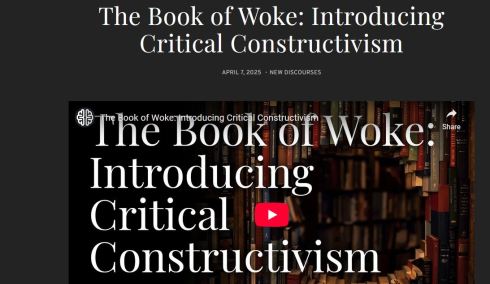
Critical Social Constructivism (CSC) underpins the ideology known as “woke,” as explained by James Lindsay on his New Discourses website. Lindsay (2025) describes CSC, or Critical Constructivism, as a framework where knowledge and reality are entirely socially constructed, devoid of any objective foundation beyond human perception and agreement. Within woke ideology, this perspective views social concepts like race, gender, and justice as products of narratives and power dynamics rather than universal truths. Woke activism uses this foundation to prioritize marginalized groups’ narratives, aiming to reshape societal truths to align with ideological goals. By rejecting objective reality, CSC enables woke activists to redefine reality based on who controls the dominant discourse.
Woke activists often avoid debate due to CSC’s logic, which Lindsay (2025) argues fosters a totalitarian power dynamic. Since CSC denies an objective reality accessible through reason or evidence, truth depends on social consensus shaped by power rather than rational dialogue. For woke activists, debating risks validating opposing views, which conflicts with their belief that truth emerges from enforcing the “correct” narrative. Instead of engaging in discussion, they employ social coercion through tactics like shaming, cancellation, or institutional pressure to silence dissent and ensure conformity. Lindsay emphasizes that this approach stems from viewing power as the ultimate determinant of accepted truth.
This reliance on coercion reflects a core CSC tenet: whoever holds power to enforce a narrative defines what is “true.” Lindsay (2025) notes that CSC’s rejection of objective reality implies truth is not discovered but created, and those controlling institutions, media, or cultural norms shape reality. In woke ideology, this translates to a relentless push to dominate discourse, equating narrative enforcement with truth establishment. By prioritizing power over reason, woke activists favor control over debate, using social force to validate their constructed realities and ensure their version of truth prevails.
Reference
- Lindsay, J. (2025). The Book of Woke: Introducing Critical Constructivism. Retrieved from https://newdiscourses.com/2025/04/the-book-of-woke-introducing-critical-constructivism
Critical Social Constructivism (CSC) emerged from the broader tradition of social constructivism, which posits that knowledge and reality are products of social processes and interactions. Social constructivism has its roots in the works of sociologists like Peter Berger and Thomas Luckmann, who, in their seminal book The Social Construction of Reality (1966), argued that reality is socially constructed through shared meanings and practices. This perspective was further developed by the strong programme in the sociology of scientific knowledge, with scholars such as David Bloor (1976) asserting that even scientific facts are socially constructed and inseparable from the social contexts in which they are produced. Critical Social Constructivism builds on these foundations by incorporating elements of critical theory, particularly the emphasis on power dynamics and ideologies. Influenced by the Frankfurt School’s critique of society, CSC highlights how dominant social and political forces shape what is accepted as knowledge or reality, thereby questioning the objectivity of knowledge claims.
As an anti-realist philosophy, Critical Social Constructivism rejects the notion of an objective reality that exists independently of human perception and social agreement. By claiming that all aspects of reality—including scientific facts, moral values, and social norms—are constructed through social processes, CSC challenges the realist position that there is a mind-independent world. However, CSC is more than just an ontological stance; it offers a comprehensive worldview that encompasses epistemology, ethics, and politics. Since knowledge is viewed as a social construct, the process of knowing is inherently embedded within social contexts, power relations, and cultural frameworks. This means that truth is not discovered but negotiated, and what is accepted as knowledge reflects the prevailing social and political dynamics rather than any objective standard. Thus, CSC provides a lens through which all human understanding and interaction can be analyzed.
Given that Critical Social Constructivism denies the existence of an objective reality, there is no external arbiter to settle disputes about what is true or real. Consequently, the acceptance of particular knowledge claims becomes a matter of social negotiation and consensus-building. In this context, adherents of CSC recognize that establishing a shared understanding of reality often involves the use of political and social mechanisms to persuade or coerce individuals and groups into adopting specific constructions of knowledge. This can range from rhetorical strategies and institutional support to more overt forms of social or political force, as dominant groups seek to impose their versions of reality onto others. Because there is no reality without human perception and social agreement, the validation of knowledge claims ultimately relies on the ability to garner social acceptance, which can be influenced by power structures and cultural hegemony.

References
- Berger, P. L., & Luckmann, T. (1966). The Social Construction of Reality: A Treatise in the Sociology of Knowledge. Anchor Books.
- Bloor, D. (1976). Knowledge and Social Imagery. Routledge & Kegan Paul.
The recent protests at McGill University, where anti-Israel activists physically blocked access to lecture halls and disrupted classes, represent a troubling departure from the principles of free speech and Canadian values. On April 2, 2025, as reported by B’nai Brith Canada, masked protesters in the Bronfman Building prevented students from attending classes, with chants of “McGill, McGill you can’t hide, you’re complicit in genocide” echoing through the campus. While protest is a protected right, these actions crossed into intimidation and coercion, as students were denied their fundamental right to education. Free speech in Canada is about expressing ideas without fear of retribution, not about obstructing others’ rights or creating a hostile environment. Such behavior is distinctly un-Canadian, as it undermines the nation’s commitment to mutual respect, dialogue, and the rule of law—values that have long defined Canadian society.
McGill University’s response to these protests highlights a glaring abdication of responsibility. Despite the disruptions, which forced some classes online and led to acts of vandalism, the university’s initial reaction was tepid, only implementing ID-based access controls on April 4, 2025, after days of chaos. Advocacy groups like the Canadian Friends of Simon Wiesenthal Center and concerned individuals have called for decisive action, pointing to the hostile environment created for Jewish students and the broader student body. McGill’s failure to swiftly address the physical blockades and ensure safe access to education sends a dangerous message: that the university prioritizes appeasing disruptive activists over protecting the rights of all students. This inaction not only erodes trust in the institution but also sets a precedent for tolerating intimidation under the guise of activism, further emboldening such behavior on Canadian campuses.
The protests at McGill reveal a deeper issue: a two-tier system of justice that is profoundly divisive for Canadian society. While the protesters faced little immediate consequence for their actions, students attempting to attend classes were left to fend for themselves, as seen in videos where individuals were physically blocked from entering lecture halls. This disparity in treatment—where one group’s “right” to protest is elevated above others’ rights to safety and education—creates a fractured campus environment. Jewish students, in particular, have reported feeling unsafe, with advocacy groups framing the protests as antisemitic. Meanwhile, some individuals with differing views supported the protesters, accusing Israel and its supporters of enabling genocide. This polarization reflects a broader societal trend where identity-based grievances are weaponized, pitting groups against each other rather than fostering unity, a core Canadian ideal.
My blog post *The Oblivious Irony of Canada’s Progressive Left* provides a stark illustration of this trend, noting, “The progressive left’s obsession with identity politics has created a hierarchy of victimhood, where certain groups are given carte blanche to act with impunity, while others are silenced or vilified.” This observation captures the essence of the McGill protests, where the activists’ cause—framed as a fight against oppression—seemingly justified their coercive tactics, while the rights of other students were dismissed. Identity politics, as I argue, has become a divisive force in Canada, eroding the shared values of fairness and equality that once united the nation. The McGill protests are a microcosm of this larger societal shift, where the pursuit of “justice” for one group comes at the expense of others, deepening divisions and resentment.
In conclusion, the actions at McGill University are not a legitimate exercise of free speech but a violation of the principles that define Canada as a nation. By allowing protesters to intimidate and obstruct, McGill has failed its students, particularly those who felt targeted or unsafe, and has contributed to a two-tier system of justice that undermines Canadian unity. The divisive impact of identity politics, as highlighted in previously, underscores the urgent need for a return to shared values—respect, dialogue, and equal treatment under the law. Canadian society cannot thrive when one group’s rights are prioritized over another’s, and institutions like McGill must take responsibility to ensure that campuses remain spaces for learning, not coercion. Only by upholding these principles can Canada reclaim its identity as a nation of fairness and inclusion for all.

 I think that getting to know the people of your neighbourhood is scary but necessary activity. I’m an introvert, but I’ve brainstormed some ideas to try out if you happen to be feeling extra adventurous. :)
1. **Organize a Neighborhood Clean-Up Day** – Rally a few neighbors for a group effort to tidy up parks, streets, or common areas. Bring some gloves, bags, and maybe even snacks to share afterward.
2. **Start a Little Free Library or Pantry** – Set up a small box where people can exchange books or non-perishable food items. It’s a simple way to encourage sharing and connection.
3. **Check In on Elderly or Isolated Neighbors** – A quick knock on the door or a friendly chat can brighten someone’s day and help them feel included. Offer to grab groceries if they need it.
4. **Plant Something Together** – Whether it’s flowers along a sidewalk, a tree in a yard, or a small community garden, greenery lifts everyone’s mood and improves the area.
5. **Host a Casual Get-Together** – A low-key barbecue, potluck, or even a coffee meet-up in a driveway can help neighbors get to know each other. Stronger bonds mean a stronger community.
6. **Share Skills or Tools** – Offer to teach something simple—like fixing a bike tire—or lend out a ladder or shovel. It builds trust and saves people money.
7. **Put Up Positive Signs** – Something as small as a “You’ve Got This!” or “Smile, Neighbor!” sign in your yard can spread good vibes.
These don’t have to be big projects—just small, consistent acts that show you care. What do you think might work best where you live?











 bleatmop
 Mystro
 The Arbourist


 Dead Wild Roses
Your opinions…