
You are currently browsing the category archive for the ‘Culture’ category.
To unpack the Kamloops unmarked graves story, we need a French philosopher—Jean Baudrillard. He loved poking holes in modernity, especially how culture twists itself around shaky narratives. His big idea, hyperreality, describes a state where the line between reality and representation blurs so much the representation becomes more real—a world of signs pointing to other signs, not facts. It’s a four-stage slide into a simulation that outshines truth. Let’s see how Kamloops fits.
The Four Stages of Hyperreality
First Stage (A Sign Reflects Reality): You’ve got a symbol that points to something real. A photo of a mountain—it’s not the mountain, but it shows what’s out there. Clear connection, no tricks.
Second Stage (A Sign Distorts Reality): Now the symbol starts messing with the real. Think of a touched-up Instagram pic—still a photo of a mountain, but filters make it look “better” than the actual thing. Reality’s skewed, but you can still trace it back.
Third Stage (A Sign Pretends to Reflect Reality): Here’s where it gets dicey. The symbol acts like it’s tied to something real, but that real thing doesn’t exist. Baudrillard uses Disneyland as an example—a fake Main Street that sells nostalgia for a past that never was. It’s not reflecting reality; it’s inventing one.
Fourth Stage (Hyperreality—Signs Without Reality): Now the symbol doesn’t even pretend to care about reality—it’s a closed loop, a simulation of a simulation. Think reality TV: scripted drama sold as “real life,” but nobody’s asking what’s real anymore—they’re just hooked on the drama. The loop’s all that matters.
Got all that? Now let’s strap on our simulacra goggles and map this onto the Kamloops unmarked graves story—watch how reality gets buried.
Kamloops Through the Hyperreal Lens
First Stage: Sign Reflects Reality
If this were just about the radar findings, we’d start here—a report saying, “Hey, we found some weird soil patterns, might be graves, might not.” It’d point to a real investigation, grounded in facts. Residential schools left real scars, no question—but the Kamloops story spun into something else: a hyperreal mess where symbols outran facts. We didn’t linger here long.
Second Stage: Sign Distorts Reality
The initial framing—calling them “unmarked graves of children”—already stretched things. Ground-penetrating radar doesn’t show bodies; it shows anomalies. Media outlets, hungry for clicks, and activists, hungry for justice, ran with the graver version (pun intended). Headlines screamed “mass graves” (think CBC’s early “215 children found”), even though Tk’emlúps clarified it wasn’t that. Reality got airbrushed into something more dramatic.
Third Stage: Sign Pretends to Reflect Reality
Here’s where it gets spicy. The “215 children” became a cultural artifact—orange ribbons, vigils, government apologies—all built on a reality that wasn’t confirmed. It wasn’t lying outright; it just acted like the graves were a done deal. The media and public didn’t need proof—they needed a symbol. And boy, did they get one. Every Child Matters morphed into a movement, not a question.
Fourth Stage: Hyperreality—Signs Without Reality
Now we’re in 2025, and the simulation’s running the show. The “graves” aren’t just unproven—they’re beside the point. The story’s spawned funding (millions allocated for searches), laws (like bills to criminalize “denialism”), and endless X debates where “deniers” and “believers” slug it out over a phantom. It’s not about what’s under the ground anymore; it’s about what the idea of those graves does—how it shapes identity, guilt, policy, and power. That’s hyperreality: the menu’s tastier than the meal, and we’re all eating it up.
The Canadian Media’s Role
The media should be our first defense against false narratives and hyperreal incursions. Our Canadian media—particularly the CBC—ran headlong away from their duty to inform with facts. They chose style over substance, leaning hard into emotional hooks—“215 children,” “mass graves”—with little reporting on what ground-penetrating radar can reliably identify or the ground’s composition (leading to false positives). Objective reporting got tossed aside to boost the narrative and reactions to it. Stories about protests, church burnings, and government responses fed the loop, making the “graves” realer in discourse than in dirt. The simulacra’s at stage four—no reality needed for the story to keep going.
In Baudrillard’s world, this is how hyperreality wins—when the media trades facts for feelings, the simulation doesn’t just obscure reality; it replaces it. What happens when the next narrative rolls in—no dirt, all discourse?
The reporting around Kamloops isn’t about graves anymore; it’s about what simulacra we’ll fall for next. Baudrillard’s spinning in his grave—wherever that happens to be. So what’s the next simulacrum Canada’s media will peddle—more graves, more guilt, or something fresh? Drop your guess below.

Well it seems we’re rapidly approaching this point.

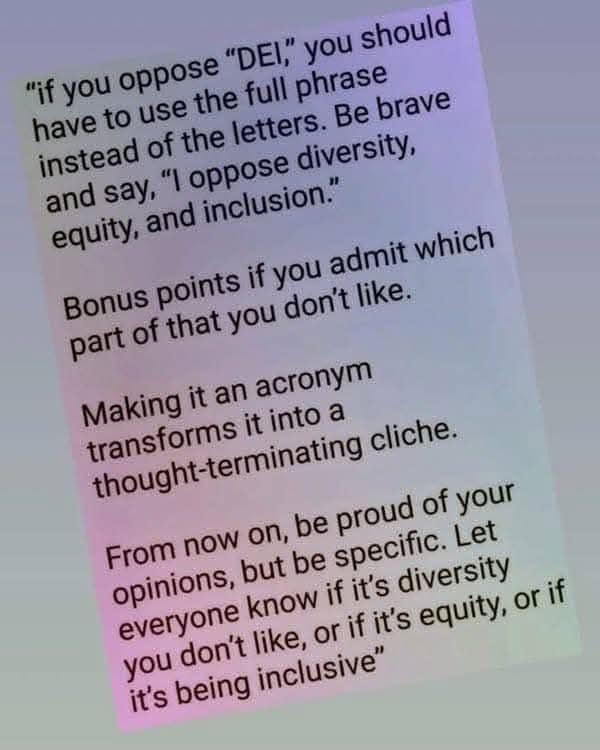
Activists use polysemy to make their corrosive ideas sound palatable to people not versed in their conversational inanity. The play is usually a cloak and dagger affair where they use the commonly accepted definition of a particular word, in this case ‘Diversity’ and use it in a dishonest setup that is really about pushing their specialist meanings into society and society’s institutions.
Here is great example.
Diversity (M1): Generally refers to the presence of variety within an organizational workforce, encompassing differences in identity, such as race, gender, sexual orientation, disability, age, culture, class, religion, or opinion. It’s about having a mix of different people.
Diversity(M2): Some critics argue that in “woke” contexts, diversity might be seen more as a means to an end rather than an end in itself, potentially focusing on increasing representation of certain politically aligned marginalized groups. This view suggests that diversity is less about broad inclusion and more about specific group representation.
The woke will push M1 and be morally outraged if you speak against Diversty(M1). How could you oppose having a different mix of people involved in a situation/task?
How could one indeed? But the pushback isn’t against Diversity(M1) it is pushback against Diversity(M2) which is infused with identity politics and the oppressor/oppressed narrative. It is the Diversity(M2) narrative that calls for a diversity of group identities with the proviso that they share the same ideological beliefs. This idea is illustrated by the fact that, for example, Black Conservatives are not considered to be a ‘diverse choice’ since they often opposed the oppressor/oppressed narrative.
How deep does the polysemic rabbit hole go? Well…
The term “diversity” in the context of social justice advocacy often exhibits polysemy, where the word has multiple related or unrelated meanings. Here are three examples of how the term “diversity” is used:
Diversity as Representation: Meaning: This refers to the inclusion of different racial, ethnic, gender, and sexual orientation groups within organizations, institutions, or media.
Usage: In this context, “diversity” is often used to describe efforts to ensure that various demographic groups are represented in workplaces, schools, and public life. For example, a company might strive for diversity in its hiring practices to reflect the broader community’s composition.
Diversity as Ideological Uniformity:
Meaning: Some critics argue, as seen in posts on X, that “diversity” in certain circles is used to mean a variety of backgrounds but with a uniform set of political or social views, particularly those aligned with progressive or “woke” ideologies.
Usage: This interpretation suggests that while there might be diversity in appearance or demographic markers, there’s an expectation of conformity in thought, especially in terms of social justice issues. This usage is often highlighted in debates over free speech and ideological diversity.
Diversity as a Tool for Inclusion vs. Exclusion:
Meaning: “Diversity” can sometimes be perceived as inclusive when it pertains to groups historically underrepresented or marginalized, but it can also be seen as exclusive if it’s interpreted as excluding certain groups (like straight white males) from consideration for diversity initiatives.
Usage: This dual interpretation can lead to confusion or contention, where diversity initiatives are praised for broadening perspectives but criticized by others for being exclusionary based on identity rather than merit or broader inclusivity.
These examples show how “diversity” can be a multifaceted term within social justice discourse, with its meaning shaped by context, intent, and perspective. The web results and posts on X suggest that while the term is generally used positively to advocate for broader representation, there’s a significant debate around its implications and actual practice.
We must return to the rule of law and have the courage to enforce the laws in our societies.
-
Extent of Abuse: The scandal involved the organized sexual exploitation of hundreds, if not thousands, of children, primarily young girls, over several decades in various towns across northern England, including Rotherham, Rochdale, Telford, and Oldham. A notable example is the Rotherham scandal where an estimated 1,400 children were abused between 1997 and 2013.
-
Ethnic Dimensions: Many of the perpetrators in these cases were identified as being of British Pakistani heritage, leading to significant debate and controversy over the intersection of race, culture, and crime. This has fueled discussions about multiculturalism, integration, and the fear of being labeled racist when addressing these issues.
-
Institutional Failures: There were severe criticisms directed at local authorities, including police, social services, and councils, for failing to act on the abuse. Reports highlighted that these institutions often ignored or downplayed the problem due to concerns about racial tensions or political correctness. This failure allowed the abuse to continue unchecked for years.
-
Public and Political Reaction: The scandal has repeatedly resurfaced in public discourse, often driven by media coverage and political figures. Recent calls for a national inquiry have been contentious, with figures like Elon Musk and various UK politicians engaging in debates about the handling of the cases and accountability. The political aspect includes criticism of former officials and demands for comprehensive investigations into past and present handling of these crimes.
-
Legal and Policy Consequences: Over time, there have been multiple legal actions, including convictions of many perpetrators, but also broader systemic changes. For instance, laws were amended in 2012 to facilitate investigations into child sexual exploitation, and there has been an ongoing push for better protection mechanisms, reporting requirements, and police training. Despite these efforts, there’s a consensus that more needs to be done to prevent future occurrences and to adequately address past failures.These points encapsulate the complexity of the scandal, highlighting the scale of the abuse, the societal implications, institutional failures, political reactions, and the legal response to these deeply troubling events.
We have been catering to unstable fragile people for far – far – too long. Let’s hope and do what we can to ensure this trend continues.
“Then there was the American author, Hesse Phillips, who apparently uses “she/they” pronouns. “This decision was not taken lightly,” she/they declared in a lengthy statement this week. “I’ve conferred with other queer and trans authors, cis and straight authors, friends and family, and in the end I feel that stepping down from my panel is the only way forward, both for my personal safety and my conscience.”
At one level, it’s hard to take this nonsense seriously. But the reference to “personal safety” implies that the mere presence of gender-critical authors in the same city as adherents of the cult of identity politics puts the latter in danger. It’s a disgraceful slur, as is the suggestion that Joyce and Bindel are calling for the “eradication of an entire class of human beings”. Phillips has also smeared the organisers of the festival, accusing them of prioritising “hate speech over the safety of LGBTQ+ speakers and attendees”. It’s intended, I suspect, as a warning to other festivals of what to expect if they dare to platform heretics.
Pressure has worked far too often. Last year the Hay and Edinburgh book festivals announced they were suspending sponsorship from a company deemed unacceptable by activists against climate change and Israel’s conflict in Gaza. The Cheltenham Literature Festival went so far as to compare a belief in biological sex with racism and homophobia. The bullies appeared to be firmly in charge, as organisers in effect ceded a veto to groups of people who regard themselves as more important than anyone else.
Signs that the mood is changing, swinging against censorship disguised as inclusion, has evidently come as a shock. When gender warriors obsess about threats to their “safety”, they’re actually revealing that they can’t bear to be challenged. They’ve got used to mixing with people who stroke their egos and don’t question the ludicrous claim that their lives are in danger.”
It’s the biggest crime—and cover-up—in British history. And most people, at least until recently, haven’t even heard of it.
Thousands of young girls, mostly children, were systematically groomed and raped by immigrant gangs across the UK over a period of decades. Police turned the girls away. Detectives were discouraged from investigating. Politicians and prosecutors did their best to sweep it under the rug. Journalists skipped the biggest story of their lives. A culture of silence enveloped the United Kingdom. Why?
Today, we talk to two women who spoke out years ago about what was happening while nearly everyone looked the other way: the British feminist and author Julie Bindel, and the author and activist Ayaan Hirsi Ali. Both took tremendous risks in highlighting the story while the legacy press largely looked away. Bindel is the author, most recently, of Feminism for Women and writes a popular Substack column. Hirsi Ali, a Free Press contributor, is the author of numerous books on radical islam, including Prey: Immigration, Islam, and the Erosion of Women’s Rights, which helped bring attention to the grooming gangs scandal in 2021.
Julie and Ayaan explain today what happened, how these rapes and murders were covered up in the name of preserving “social harmony,” how it’s still happening, why Elon Musk is suddenly tweeting furiously about it and how Britain’s ruling class is being forced to reckon with a scandal it had, until recently, successfully ignored.
It’s a story about “tolerance” run amok, and how a civilized country can convince itself to accept the most uncivilized crimes imaginable.
I think we all need a plan for organizing how we live life. I’m completely down with Stoicism. Have a Happy New Year Everyone!
The Stoic philosophy, originating from ancient Greece, emphasizes living in accordance with nature and reason. Here are seven key values or principles central to Stoicism:
Wisdom (Sophia): Stoics place a high value on wisdom, which includes understanding the nature of the world, ourselves, and the rational principles governing life. Wisdom helps in making sound judgments and living virtuously.
Courage (Andreia): This involves moral and physical courage to face dangers, difficulties, and uncertainties with fortitude. Stoicism teaches to confront fears and to act despite them, not to be reckless but to be brave in pursuit of what is right.
Justice (Dikaiosyne): Stoics believe in treating everyone with fairness and respect, living in accordance with societal laws and ethical norms. Justice here extends to all human interactions, advocating for equality, honesty, and integrity.
Temperance (Sophrosyne): Also known as self-control or moderation, this value encourages restraint in desires and appetites. It’s about achieving balance in life, avoiding excess, and maintaining discipline over one’s actions.
Acceptance of Fate (Amor Fati): Stoics advocate for loving or at least accepting one’s fate, understanding that some things are beyond our control. This acceptance helps in living without resentment or frustration over what cannot be changed.
Living in Accordance with Nature (Homologia tei Phusei): This principle suggests living in harmony with the natural world and human nature, which includes rational behavior. It’s about recognizing and fulfilling one’s role in the cosmos.
Mindfulness and Reflection (Prosoche): Stoicism encourages constant awareness of one’s thoughts and actions, often through daily reflection or meditation. This mindfulness helps in aligning one’s life with Stoic virtues and in making ongoing improvements to character.
These values guide Stoics towards a life of virtue, which they consider the only true good, and help in achieving inner tranquility (apatheia) and a life of purpose. Remember, Stoicism isn’t just about enduring hardship but about thriving through wisdom, courage, justice, and temperance.











 bleatmop
 Mystro


 Dead Wild Roses
Your opinions…