
You are currently browsing the category archive for the ‘Gender Issues’ category.
“The Springfield YMCA Typhoons Swim Team (SPY) in Springfield, Illinois now allows biological men who pretend to be women to enter the girls’ locker room—including when minor girls are present and undressing. The coaches and YMCA administrators began this practice without telling any girls or their parents.
Here is an excerpt from a summary provided by the father of one of the girl swimmers at the center of what should be a shocking event:
On April 27, 2023, my sixteen-year-old daughter, a member of the YMCA SPY Swim Team, entered the girl’s locker to change out of her swimsuit and noticed a couple transgender individuals sitting in the locker room. My daughter went back out on the pool deck and informed the head swim coach, Alex Totura, of the situation and he responded to her by stating, “There’s nothing I can do about it.”
On May 10, 2023, the SPY Swim Team held their monthly parent meeting where the issue of girls’ locker room use by biological males was brought up. The meeting was attended by Angie Sowle, Chief Executive Officer of the YMCA. The parents were told there’s nothing that can be done about it. Parents asked if the YMCA could ask the transgender members to use the Family Changing Area (private bathrooms with toilet, sink shower and changing area) instead of the girl’s locker room.
The YMCA staff said they could not do that because it is discrimination and against the law. Parents asked if the YMCA could send out a notification to swim team members that transgender people were using the girl’s locker room so that member could make informed decisions for their family. Again, the YMCA staff said that they could not do that because it is discrimination and against the law.
After the Parent Meeting, my daughter, her mom, and another swim mom approached Ms. Sowle and Coach Totura. My daughter said that she didn’t understand why this is happening and asked how long the YMCA knew about this. Coach Totura laughed and stated, “transgender people have been around a long time.” My daughter then stated, “That is not the question I asked.” She asked the question again and Ms. Sowle responded, “We have known for a while.” A meeting was set up by the YMCA staff for parents to attend and voice their concerns regarding this matter.
The meeting was to take place on May 18, 2023, and the YMCA Administrative office. Without reasonable notification, the YMCA canceled the meeting about two hours before it was to take place. Feeling dismissed without resolution, my daughter and one teammate hung signs in the girl’s locker room on May 23, 2023 in support of their position. My daughter’s signs read “Women’s Rights,” “Biological Women Only,” and “Safe Sport.” On May 24, 2023, at the beginning of the normal swim team practice, coach Totura and Kenzie Primus, Branch Director of the Kerasotes Branch (westside) pulled all the girls aside for a meeting to discuss the hanging of the signs.
They indicated that this was not acceptable, and it was “hate speech.” My daughter approached the coach Totura immediately after the meeting and indicated that she was involved in the hanging of the signs. She said that she did this because her previous attempts to correct this were dismissed by the YMCA staff and her coach. Coach Totura said that this was hate speech; she was not allowed to participate with the swim team; and was asked to leave the pool area.”
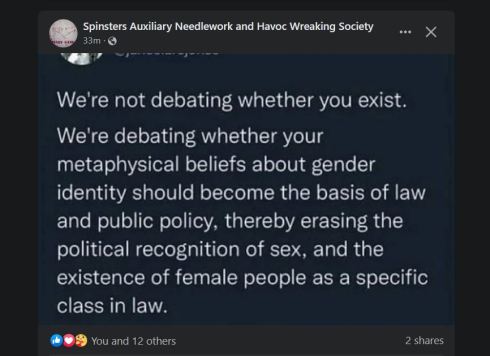
Speaking the truth about reality and sex can be considered hate speech. It is precisely situations like this in which independent objective reality MUST be the basis of law and how we operate our society. No law should be based on the shifting sands of ‘gender identity’ or ‘self-id’.
This is call to action by one parent who is very concerned about the pernicious effects of gender ideology on children. Apparently, he lost his child to the transgender cult – because that is what cults do – insert a wedge between parents and their children to break the bonds of family and support networks to increase the likelihood of gaining a convert to the cause.
Visit his website to find out more.

As a Canadian teacher I won’t promote this ideology while I teach. It is corrosive and harmful to child development and a stable childhood identity – that in itself should give Educators pause.
This debate needs to happen in society. Parents, teachers, and educational institutions must speak honestly and freely about what gender ideology is and what is being taught in schools.
From Christina Buttons’s Substack:
Here’s why it’s wrong
The majority of the studies on the “transgender brain” have a fatal flaw: they didn’t control for confounding variables like cross-sex hormone use and, most importantly, sexual orientation. When a study doesn’t control for confounding variables, it means that the researchers did not take into account other factors that could have affected the results of the study, which make it difficult or impossible to determine whether the relationship between the two variables being studied is truly causal or a byproduct of other unrelated factors.
Cross-sex hormone use can have effects on the brain, including changes in brain structure and function. But more importantly, many trans-identifying individuals are same-sex attracted, so the research on the “transgender brain” claiming to find structural regions that resemble the opposite sex are essentially rediscovering findings on the “gay brain” and reinterpreting the results to fit their preferred conclusion.
In the early nineties, neuroscientist and author Simon LeVay made the breakthrough discovery that the brains of homosexuals had structural differences that resembled that of straight members of the opposite sex. So it seems that while undertaking the hunt for the “transgender brain,” researchers have forgotten all about the discoveries made about the brains of same-sex attracted people.
The first “brain sex” study that did take into account the participants’ sexual orientation found that the brains of transgender individuals were similar to those of people of the same birth sex rather than the opposite sex.
When researchers scan the brains of heterosexual people who identify as transgender, they also find they are typical for their natal sex. Samuel Stagg, a U.K.-based Ph.D. student of neuroimmunology, explains: “The homosexual sub-group show brains skewed along the male-female dimension. However, this is predominantly due to their co-occurring homosexuality. When we scan the brains of the heterosexual type, we find they are more typical for their natal sex.”
“Gender identity” not gender dysphoria
Gender dysphoria, like other psychiatric conditions, may have some biological underpinnings. There are traits like neuroticism that can predispose people to psychiatric conditions and research suggests that neuroticism has a strong biological basis with both genetic and environmental factors contributing to its development.
But gender activists are not concerned with gender dysphoria, rather they aim to establish a biological basis for being transgender that ceases to categorize it as a mental illness. Activists have pushed for a more “inclusive” definition of what it means to be transgender that seeks to reduce stigma and perceived barriers to medical transition services.
After the legalization of same-sex marriage in 2015, civil rights and gay rights organizations that may have otherwise had to shutter their doors pivoted to championing “trans rights.” The success of the “born this way” campaign in promoting the idea that sexual orientation is an innate, immutable aspect of identity has prompted activists to also present being transgender as innate and immutable.
Manhattan Institute fellow Leor Sapir wrote his Ph.D. dissertation on the rapid proliferation of the “transgender rights movement” and its efforts to obtain civil rights jurisprudence for “gender identity.” To this end, they have attempted to prove that “gender identity” is an innate, immutable trait called “neurological sex” or “brain sex,” which they say should override natal sex.
“In the American civil rights tradition, if you can convince a judge that being transgender is like being black, then you can tap into this entire body of judicial precedent and civil rights laws that immediately applies and gives you all the policies you want,” Sapir told me. Leor Sapir has written a number of important articles on this topic for City Journal, be sure to read them for further understanding.
“Soon, I learned about nonbinary identities, and that some people – many people – were literally arguing that sex, not gender, was a social construct. I met people who evangelised a denomination of transgenderism that I had never heard of, one that included people who had never been gender dysphoric and who had no desire to medically transition. I met straight people whose ‘trans / nonbinary’ identities seemed to be defined by their haircuts, outfits and inchoate politics. I met straight women with Grindr accounts, and listened to them complain about the ‘transphobic’ gay men who didn’t want to have sex with women.
All around me, it seemed, straight people were spontaneously identifying into my community and then policing our behaviours and customs. I began to think that this broadening of the ‘trans’ and ‘queer’ umbrella was giving a hell of a lot of people a free pass to express their homophobia.
At Columbia, I took classes on LGBT history, but much of that history was delivered through the lens of queer theory. Queer theorists appropriate French philosopher Michel Foucault’s ideas about the power of language in constructing reality. They argue that homosexuality didn’t exist prior to the late 19th century, when the word ‘homosexual’ first appeared in medical discourse. Queer theorists proselytise a liberation that supposedly results from challenging the concepts of empirical reality and ‘normativity’. But their converts instead often end up adrift in a sea of nihilism. Queer theory, which has become the predominant method of discussing and analysing gender and sexuality in universities, seemed to me to be more ideological than truthful.
In my classes on gender and sexuality in the Muslim world, however, I discovered something else, too. I learned about current medical practices in Iran, where gay sex is illegal and punishable by death, and where medical transition is subsidised by the state to ‘cure’ gays and lesbians who, the theocratic elite insists, are ‘normal’ people ‘trapped in the wrong bodies’. I privately drew parallels between the anti-gay laws and practices of Iran and what I saw developing in the West, but I convinced myself I was just being paranoid.
Then, I learned about what was happening to gender-nonconforming kids – that they were being prescribed off-label drugs to halt their natural development, so that they’d have time to decide if they were really transgender. If so, they would then be more successful at passing as the opposite sex in adulthood. Even worse, I learned that these practices were being touted by LGBT-rights organisations as ‘life-saving medical care’.
It felt like I was living in an episode of The Twilight Zone. How long were these kids supposed to remain on the blockers? And what happens in a few years, if they decide they’re not ‘truly trans’ after all, and all of their peers have surpassed them? Are they seriously supposed to commence puberty at 16 or 17 years of age? These questions rattled my brain for months, until I learned the actual statistics: nearly all children who are prescribed puberty blockers go on to receive cross-sex hormones. Blockers don’t give a kid time to think. They solidify him in a trans identity and sentence him to a lifetime of very expensive, experimental medicalisation.
I wondered how different these so-called trans kids were from the little boy I had been. Obviously, I grew up to be a gay man and not a transwoman. But how could gender clinicians tell the difference between a young boy expressing his homosexuality through gender nonconformity, and someone ‘born in the wrong body’? I decided to dig deeper into the real history of medical transition.”











 bleatmop
 Mystro


 Dead Wild Roses
Your opinions…