
You are currently browsing the category archive for the ‘History’ category.
What makes our society run? Where does one begin?
Devon Eriksen tackles that question in a though provoking and I think useful way. During his discussion of this topic the concept of a Chesterson’s Fence is made several times and to understand Eriksen’s thinking you need to know what a Chesterson’s Fence is.
The concept of a Chesterson Fence is the notion that we need to engage in second order thinking when evaluating a problem or situation. Or to use the original analogy:
“Do not remove a fence until you know why it was put up in the first place.”
“Fences are built by people who carefully planned them out and “had some reason for thinking [the fence] would be a good thing for somebody.” Until we establish that reason, we have no business taking an ax to it. The reason might not be a good or relevant one; we just need to be aware of what the reason is. Otherwise, we may end up with unintended consequences: second- and third-order effects we don’t want, spreading like ripples on a pond and causing damage for years.”
So, we can already observe we’ll be tackling some second and even third order thinking in Eriksen’s work.
“It’s time we all admitted it.
Intolerance in pre-1900s western civilization was a load-bearing structure.
It stopped certain groups from doing certain anti-civilization things that they kinda wanted to do, because they were too busy trying to fit it, look harmless, and be accepted as normal.
Which people? What things?
Well, lots of people have opinions on that, but we’re not actually connected to any unbroken line of generational knowledge on the subject. Because somewhere along the line, some people learned to hack western civilization by pointing out that stereotyping, behavioral enforcement, and gatekeeping, are cruel.
Well, duh.
What these people are trying very hard to keep the rest of us from noticing is that civilization requires cruelty.
Civilization is an unnatural state. It is an bubble of peace and plenty, rising through a vast dark ocean of poverty and war.
That bubble is fragile. In order to prevent it from bursting, we have to prevent certain things from happening inside it.
Which means we have to tell the people inside that they can’t do certain things they want to do, even though they will be sad when they don’t get to do them.
Which is mean.
And it means we have to keep people outside the bubble if they won’t stop doing those things, even though they will be sad if they don’t get to come there, or stay.
Which is mean.
You cannot have civilization unless you are willing to be mean and make certain people sad.
But here’s the important question… which cruelties are load-bearing, and which are pointless and unnecessary?
Well, we don’t know.
And for this, I blame traditionalists. Every time they put up Chesterton’s Fence, they neglected to top it with Chesterton’s Signpost, explaining why the fence was there and what it was intended to do.
Instead, they stamped it with one of their two rubber stamps “we’ve always done it this way”, and “the will of {insert local deity here}”.
This makes it extremely difficult to defend the fence, and all but impossible to know which fences are load-bearing and need defending.
[Individual on twitter] appears to think that all the anti-traditionalist things she wants to do are okay, and forbidding or even disparaging them is pointless cruelty, but anti-traditionalist things she doesn’t want to do are horrific acts of civilizational destruction.
This is, of course, selfish and hypocritical, but what I’m noticing is that everyone else is, too.
All the way from tradcath freaks who want to ban IVF, forbid premarital sex, and kill all the Protestants, to tranny freaks who want to take your children away and sterilize them, everyone thinks their precise type and level of deviance is complete fine, and anything one step beyond what they personally want to do is anathema.
None of this is the least bit informative about which of the rules of the old world are actually load-bearing, and right now, we are all having such fun finding out the hard way.
If western civilization doesn’t survive, then neither does humanity, because the second world isn’t going to get us off this single fragile rock, and neither is the third.
Which means we have some serious house-cleaning to do. We’re going to have to derive civilization-preserving rules from first principles again, because every goddamned fence the Chestertons of the world put up in the past is labelled with unhelpful bullshit explanations, and not only are some of them necessary and some of them not, but a further some of them are so obsoleted by technological advancement that they are actually now anti-civilizational forces in and of themselves.
But what are these first principles?
I’m sure the comments are going to contain lots of answers where people suggest their favorite thing, be it liberty, or their version of morality, or their favorite religion, but most of the things that people think of as ends are actually means.
The end is preserving and advancing human civilization.
To that end, I can think of three first principles off the top of my head, things that civilization cannot exist without. There may be more that will occur to me later.
They are:
1. Investment.
Human civilization requires people to invest effort in things. People will not do this if the results of that effort can be taken from them more easily than they can be created. This means property rights. Any civilization which does not vigorously defend both individual and collective investment will fail.
2. Fertility.
This one is unique to humans. Our reproductive cycle is uniquely fragile, pushed to its extreme limits by evolutionary pressure to produce infants with giant heads. Women’s fertile years are such a small fraction of their total lifespan, pregnancy is so taxing and resource-intensive, and infants and children so helpless and vulnerable for so long, that the slightest interference, seemingly innocuous, can destroy a population’s ability to replace itself. Or, worse yet, it can selectively destroy the ability to replace the small sub-population of highly effective humans that drive civilization forward.
3. Innovation.
This is the whole point. This is how humans survive, and without it, we won’t. The whole evolutionary strategy of humanity is to use those huge brains which we pay such a fertility cost to obtain — use them to understand the universe, and leverage that understanding to control it. But tech innovation relies on many factors, which is why so few civilizations are able to get their shit together to consistently do it, and show up on the beach with sailing ships, guns, and steel while the natives are still hunting deer with stone-tipped arrows.
That’s my basic idea: for everything we forbid, and everything we permit, we need to understand how it impacts investment, fertility, and innovation.
Because those are the things we actually need.
[…]”
I think that Investment, Fertility, an Innovation are worthy contenders as first principles of civilization, but there are more that deserve to be on the list. :)
Bruce Gilley is a professor of political science at Portland State University. Bruce wrote an article in 2017 for Third World Quarterly titled, “The case for colonialism.” This enraged people who called for him to lose his academic position and be stripped of his PhD. The article was retracted due to credible death threats. In 2023, he published a book by the same name. Before his academic career, Bruce worked as a journalist in Hong Kong. This experience strongly influenced his views about colonialism. In 2021, we produced a series on my channel called, “Decolonize Explained” where Bruce debunks the myths around colonization. In this conversation, Bruce and I spoke about the Harvard plagiarism scandal, DEI, and the broader academic landscape.
I’m up to Chapter 3 so far and would highly recommend this book to those who want understand the ‘why & how’ of what is happening in our society. Understanding post-modernism is the first step. This is a short summary gleaned from ‘Goodreads’ is a part of what the book is explaining about Postmodern thought.
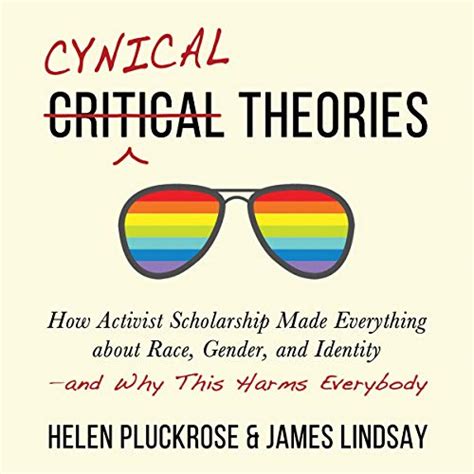
“The online Encyclopedia Britannica defines postmodernism as: “a late 20th-century movement characterized by broad scepticism, subjectivism, or relativism; a general suspicion of reason; and an acute sensitivity to the role of ideology in asserting and maintaining political and economic power.” The authors of this book mentions the two principles and four themes of postmodernism thus:
1. The postmodern knowledge principle: Radical skepticism about whether objective knowledge or truth is obtainable and a commitment to cultural constructivism.
2. The postmodern political principle: A belief that society is formed of systems of power and hierarchies, which decide what can be known and how.
The Four Major Themes
1. The blurring of boundaries
2. The power of language
3. Cultural relativism
4. The loss of the individual and the universalNow, to translate this to words of one syllable.
The first principle means that we can never know the objective truth: indeed, it is doubtful whether it exists at all. The second principle means that what is known as the truth is decided by the power hierarchy inside the system.
Thus, in one fell swoop, postmodernism dethroned science from its pedestal – because if we are not sure whether there is objective truth at all, why spend time looking for it? And in the colonial world, most of the objective knowledge was based upon colonial viewpoints; so a deconstruction of this was essential, especially as Orientalism was holding sway in the West.
(However, this doesn’t negate the power of science – but the fallout of postmodernism has engendered dangerously unscientific attitudes.)
Now let’s move on to the themes.
The blurring of boundaries means categorisations are no longer trusted. Not only the boundaries between objective and subjective and between truth and belief have been blurred, but also those between science and the arts, the natural and the artificial, high and low culture, man and other animals, and man and machine, and between different understandings of sexuality and gender as well as health and sickness. Everything is a spectrum.
The power of language emphasises that it is through language that we define power structures in a society. Under postmodernism, many ideas that had previously been regarded as objectively true came to be seen as mere constructions of language. In postmodern thought, language is believed to have enormous power to control society and how we think and thus is inherently dangerous. It is also seen as an unreliable way of producing and transmitting knowledge. To summarise: we create reality through language.
In a world where there is no objective truth, no boundaries, and where everything is created through how we speak and think, truth and knowledge are different for each and every culture and no one from outside that culture can comprehend it. This is called cultural relativism.
Consequently, to postmodern theorists, the notion of the autonomous individual is largely a myth. The individual, like everything else, is a product of powerful discourses and culturally constructed knowledge. Equally, the concept of the universal—whether a biological universal about human nature; or an ethical universal, such as equal rights, freedoms, and opportunities for all individuals regardless of class, race, gender, or sexuality —is, at best, naive. At worst, it is merely another exercise in power-knowledge, an attempt to enforce dominant discourses on everybody. This leads to the loss of the individual and the universal.
I totally get this. It’s a very nice intellectual exercise: and I must say that in the field of arts, literature and sociology, it has got valid uses. The only place I take the high road while postmodernists take the low road is when it comes to the concept of the individual and the universal, which I do believe are required as valid concepts if we need an equitable world. And also, for all our subjective perceptions, science has discovered many objective truths through its powerful method, which are not dependent upon language and/ or culture.
But now, the authors started talking about Theory (with a capital T: applied postmodernism) and the concept of Social Justice; and I started getting a bit alarmed – because I could now make sense of how I was annoying all those woke people.
“He argues that the dominant narrative of Western society as fundamentally negative stems from a misunderstanding of history. Murray also contends that there is a quasi-religious fervour in society, with attempts to create a new religion and enforce it in the public square.”
Douglas Murray’s arguments apply even more so now in 2024.

 Read on Twitter
 1/ Here’s a fun thread on how to ruin Western civilization. *Except it’s not so fun because it’s sort of happening…
Some might find my analysis and analogies somewhat controversial, but at least it will be thought provoking. 
2/ I’m going to borrow from the Nobel Prize winning philosopher Bertrand Russell’s “A History of Western Philosophy” (published 1945). It’s a dense read, but it’s packed with insights that help make sense of some of the more alarming ideological trends underway today. 
3/ One of the more interesting sections examines the differences between the society and dominant philosophy of Greek antiquity and that of early Christendom. Later on, I’ll tie this to some of the corrosive ideologies currently ascendant. 
4/ Whereas Greek society was concerned with the “joy and beauty” of present life, the early Christian world through the Middle Ages was concerned about sin and salvation. Russell persuasively argues that early Christian philosophy reflected the gloom of pre-Renaissance times.

5/ Life after the fall of the Roman Empire was tough: wars, pestilence and widespread poverty were a marked turn from the height of the Roman world (and before that the Greek city states). A philosophy focused on the afterlife was understandable, though it led to stagnation. 

6/ In an age of “ruin,” a strict approach to spiritual matters took precedent over more earthly concerns. If “earthly hopes seemed vain,” what good was it, after all, to focus on statesmanship as opposed to the soul? Left neglected, civilization decayed.

7/ In a world where life was harsh, the notion of original sin must have especially resonated with many and helped rationalize a difficult existence. Unfortunately, as Russell highlights, the doctrine of “universal guilt” gave rise to future ferocity in western institutions.

8/ Such gloom, pessimism, doctrinal strictness and guilt was not conducive to a thriving public life outside the Church. In Russell’s words, this philosophy of the early Church led to an age that “surpassed almost all other fully historical periods in cruelty and superstition.”

9/ The Greek world’s focus on the present naturally lended itself to making sense of it. Sciences, arts and philosophy flourished. Whereas the early Christian world’s focus on sin and afterlife resulted in neglect of the institutions necessary for civilization’s preservation.
10/ Positivity, curiosity and the motivation to improve (hallmarks of antiquity Greece) are, unsurprisingly, more helpful in sustaining civilization than embracing, rationalizing and even institutionalizing hardship.
11/ Sidenote: since Medieval times, Christian thought has evolved – spurred by the Reformation. The Renaissance, Enlightenment and Industrial Revolution (even America’s founding ethos) are testaments to its positive influence. [This was a focus of mine as a history student.]
12/ Now back to the decline of civilization. It’s happened before. It can happen again. I prefer it not! The main culprit long ago was an outlook that embraced and glorified victimization. It was borne out of real suffering, but only served to prolong struggling and malaise.
13/ Today, the doctrine of victimization and I’d add it’s close cousin – grievance – is again in vogue. Its destructive force caused a millennium of stagnation prior to the Renaissance and could very well hinder our current progress and living standards.
14/ These disastrous ideologies begin on society’s fringes before gaining broader acceptance. The most concerning today are “wokeness” and extreme progressivism (along with closely related democratic socialism). Likewise, the populist right has foolishly embraced grievance.
15/ Regrettably, the initial merit of these movements has been coopted by the masses for purposes antithetical to their origins. Wokeness and progressivism at one point focused on expanding civil liberties, not functionally curtailing them and undermining socioeconomic stability.
16/ Wokeness and extreme progressivism today no longer are ideologies seeking human improvement for its own sake, but are rooted in victimization and grievance, seeking vengeance in righting perceived wrongs – where only maligned groups benefit. It’s inherently divisive.
17/ Like the 4th and 5th Century Christians, they embrace victimization as a means to cope with life’s intrinsic challenges. However, instead of focusing on their own suffering and salvation, they turn their attention to the imagined source of original sin: systemic “inequities.”
18/ It’s a glorification of victimhood – even though much of the societal oppression is overblown. Rather than self-improve, the far left’s adherents seek to gain via the destruction of concocted sources of inequities: capitalism, the justice system, education, fossil fuels, etc.
19/ Sadly, in attempting to overthrow these very bedrocks of modern civilization, today’s far left activists fail to appreciate they are undermining any prospects for improving the lives of those for whom they “fight.” We should aspire to be equally prosperous, not miserable.
20/ The early Christian world’s embrace of victimization set back civilization 1,000 years. Today’s far left activists risk doing the same; and in their coercive process of doing so, they have become as true to the authoritarian and fascist spirit which they label their critics.
21/ Doctrines of victimization and grievance inevitably lead to destruction. Often violent, total and irrecoverable. In this regard, the most alarming ideological strain of the far left today is democratic socialism (history is not on their side):
22/ And for what it’s worth, Russell saw socialism in the same vein – a psychological offshoot of the doctrine of victimization. Little could he have known in 1945 how destructive socialism would prove – rivaling the civilizational collapse of the so called Dark Ages.

23/ Not that it’s worth much, but my advice to traditional liberals would be to disassociate from those peddling the malignant and divisive ideology of victimization. And to conservatives, to similarly disassociate from those whose politics are simply based on grievance.
24/ I’ve focused most of my criticism here at the far left, as that movement is most responsible for making life worse in my home of Chicago. But trends on the far right are troubling as well. For my longer take on US polity and politics, please see below:
25/ Civilization is precious and precarious. We should learn from history to ensure its future survival and our prosperity. We must combat malignant doctrines of victimization and grievance with Greek-like ones rooted in positivity. Otherwise, we’ll all burn down with Rome.

I guess this thread is resonating. For a brief exploration on why we may be prone to these ideologies, see below (approached it more in an investing context). Key point: across history, when life gets hard, people are more prone to psychological escape.
Bruce Gilley joins Douglas Murray on this episode to discuss one of the biggest criticisms of the west – Colonialism. From antiquity to modernity, the two give an in-depth examination of the practice. Should Colonialism stay cancelled?
Uncancelled History re-evaluates events, people, and ideas that have otherwise been cancelled from the past. Learn more at http://www.uncancelledhistory.com











 bleatmop
 Mystro
 The Arbourist


 Dead Wild Roses
Your opinions…