
You are currently browsing the category archive for the ‘Housekeeping’ category.
Man for a Day, Woot!


Female activists took a group of male swimmers by surprise on Friday evening when they attended a men-only swim session wearing just trunks and pink swimming caps.
Amy Desir, 30, was one of the two women to gain access to the south London pool session, as part of a protest against proposed changes to the Gender Recognition Act, which would enable men and women to choose their own gender.
Both women explained their attendance to staff at Dulwich Leisure Centre by saying they “identified as male” and subsequently had the right to be there.
Amy Desir: ‘Misogynistic and homophobic pro-self-ID policies are allowing men to appropriate women’s spaces, services and positions’ (Amy Desir)
They also used the male changing rooms before going into the session and were later asked by an elderly man if they realised it was a male-only session.
Their actions form part of a nationwide campaign formed…
View original post 668 more words
So no history, political analysis, or radical feminism today. Today is for highlighting my semi-annual consternation with the limitations of ‘acceptable’ men’s bottom wear.
Spring is tentatively arriving in Canada’s northern-most provincial capital. We are slowly emerging from the long dark of winter (no thanks to daylight savings time, as it is dark as of today, *again* when I wake up) and temperature are, ever so slowly, beginning to creep toward not hurting your face levels. For instance, today the high will be a balmy +2 degrees centigrade.
The hell that is winter-weather enforced trouser wearing is almost over. But at the same time, I would like to avoid situations like this:
 Well not really, but that cartoon is too good not to share. :) Blinding people with the pale luminescence of my legs is secondary however to the comfort concerns involved. Daily spring temperatures in e
dmonton The Great White North have an exceedingly wide temperature range depending on whether the sun happens to be out or not. Exhibit A: 
Yeah, so a high of plus 4, but then -12 as a low, then +2 as high then -8 as low. Climactic variability is quite problematic, as +4 degrees centigrade is clearly shorts weather, but -12 degrees centigrade clearly, is not (stop laughing/cringing right now equatorial friends this is warm weather).
So what is one to do while locked into the strict trouser/shorts binary? I’m more than ready to give the heave ho to long pants, but I’m also a big fan of not freezing my tuckus off in the cold mornings that typify the Edmonton spring cycle.
The 3/4 pant are not part yet a part of the mainstream male lexicon, and the tights + shorts option seems to be in a very specific context of people who enjoy torturing themselves by running at obscenely early in the morning, but not something one would want to teach in outside a of non physical education setting.
My usual solution, is to dress for the expected high temperature and let things fall as they may. But I can’t help but think that there must be a more elegant solution to my conundrum.
Reblogging in Solidarity – This quote from the post: “Feminists like Lise Meitner responded to continued insistence that gender is a matter of subjective identity (an idea that justifies medical experimentation on children and the bullying of lesbians), by insisting on evidence-based debate. Meitner wrote: “Words mean things and if someone uses a word improperly then I will correct them. If men could become women there would be no need to force women to accept them as such. Telling people to ignore their own senses & value patriarchal dogma over material reality is zealotry.”
Put another way, “Gotta love the men telling us women we don’t exist as a class: so we cannot protest the patriarchy” tweeted Kristina Vasaätten, in response to Young Greens convenor Max Tweedie’s insistence that there is no solid definition of what a woman is. “TRANSACTIVISM = FEMALE ERASURE”, she said.”

Note: GNC is an abbreviation for gender non-conforming.
On the evening of Saturday, February 17, Charlie Montague and I jumped the fence at Auckland Pride to lead the parade and conduct the first televised interview of the event. We – proudly – held a two metre banner reading STOP GIVING KIDS SEX HORMONES – PROTECT LESBIAN YOUTH: a statement that, however boldly made, should surely not be controversial. Other than the accidentally live streamed interview, the action was largely ignored by media: only Scoop published the press release. The main response has been on social media.
The social media response has included plenty of trashing, much of it amusing. I’ve been compared to Milo Yiannopoulos (though I collaborated, on this action, with a lesbian “ecofascist”). Anne Russell, who has previously published fabrications about me being an ‘abuser’, went so far as to coin the term “Genital Witch”. Threats…
View original post 1,965 more words
“I do know this: we cannot have this postmodernism and still have a meaningful practice of women’s human rights, far less a women’s movement. Ironically, and how postmodernism loves an irony, just as women have begun to become human, even as we have begun to transform the human so it is something more worth having and might apply to us, we are told by high theory that the human is inherently authoritarian, not worth having, untransformable, and may not even exist-and how hopelessly nineteenth-century of us to want it. (That few of the feminist postmodernists, had it not been for the theory of humanity they criticize, would have been permitted to learn to read and write-this is perhaps a small point.)”
| — | Catharine A. Mackinnon, “Points against Postmodernism“, Chicago-Kent Law Review, Volume 75 Issue 3, Symposium on Unfinished Feminist Business, Article 5 (June 2000) [PDF] |
According to legend, “Death” appears at midnight every year on Halloween. Death calls forth the dead from their graves to dance for him while he plays his fiddle (here represented by a solo violin). His skeletons dance for him until the rooster crows at dawn, when they must return to their graves until the next year. The piece opens with a harp playing a single note, D, twelve times (the twelve strokes of midnight) which is accompanied by soft chords from the string section. The solo violin enters playing the tritone, which was known as the diabolus in musica (“the Devil in music”) during the Medieval and Baroque eras, consisting of an A and an E♭—in an example of scordatura tuning, the violinist’s E string has actually been tuned down to an E♭ to create the dissonant tritone. The first theme is heard on a solo flute,[2] followed by the second theme, a descending scale on the solo violin which is accompanied by soft chords from the string section.[3] The first and second themes, or fragments of them, are then heard throughout the various sections of the orchestra. The piece becomes more energetic and at its midpoint, right after a contrapuntal section based on the second theme,[4] there is a direct quote[5] played by the woodwinds of Dies irae, a Gregorian chant from the Requiem that is melodically related to the work’s second theme. The Dies irae is presented unusually in a major key. After this section the piece returns to the first and second themes and climaxes with the full orchestra playing very strong dynamics. Then there is an abrupt break in the texture[6] and the coda represents the dawn breaking (a cockerel’s crow, played by the oboe) and the skeletons returning to their graves.
The piece makes particular use of the xylophone to imitate the sounds of rattling bones. Saint-Saëns uses a similar motif in the Fossils movement of The Carnival of the Animals.
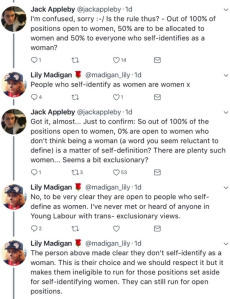
Watch female erasure in action. :/





Just saw the upcoming repertoire for next semester. Can’t wait to sing this one. :)
Josef Gabriel Rheinberger, whose father was the treasurer for Aloys II, Prince of Liechtenstein, showed exceptional musical talent at an early age. When only seven years old, he was already serving as organist of the Vaduz parish church, and his first composition was performed the following year. In 1849, he studied with composer Philipp M. Schmutzer (31 December 1821 – 17 November 1898) in Feldkirch, Vorarlberg.[1]
In 1851, his father, who had initially opposed his son’s desire to embark on the life of a professional musician, relented and allowed him to enter the Munich Conservatorium. Not long after graduating, he became professor of piano and of composition at the same institution. When this first version of the Munich Conservatorium was dissolved, he was appointed répétiteur at the Court Theatre, from which he resigned in 1867.[2]
Josef and Fanny shortly after their marriage
Rheinberger married his former pupil, the poet and socialite Franziska “Fanny” von Hoffnaass (eight years his senior) in 1867. The couple remained childless, but the marriage was happy. Franziska wrote the texts for much of her husband’s vocal work.
The stylistic influences on Rheinberger ranged from contemporaries such as Brahms to composers from earlier times, such as Mendelssohn, Schumann, Schubert and, above all, Bach. He was also an enthusiast for painting and literature (especially English and German).
In 1877 he was appointed court conductor, responsible for the music in the royal chapel. He was subsequently awarded an honorary doctorate by Ludwig Maximilian University of Munich. A distinguished teacher, he numbered many Americans among his pupils, including Horatio Parker, William Berwald, George Whitefield Chadwick, Bruno Klein and Henry Holden Huss. Other students of his included important figures from Europe: Italian composer Ermanno Wolf-Ferrari, and German composers Engelbert Humperdinck and Richard Strauss and the conductor (and composer) Wilhelm Furtwängler. See: List of music students by teacher: R to S#Josef Rheinberger. When the second (and present) Munich Conservatorium was founded, Rheinberger was appointed Royal Professor of organ and composition, a post he held for the rest of his life.
On 31 December 1892 his wife died, after suffering a long illness. Two years later, poor health led him to give up the post of Court Music Director.[3]
Rheinberger in his later years
Rheinberger was a prolific composer. His religious works include twelve Masses (one for double chorus, three for four voices a cappella, three for women’s voices and organ, two for men’s voices and one with orchestra), a Requiem and a Stabat Mater. His other works include several operas, symphonies,[4] chamber music, and choral works.
he following translation by Edward Caswall is not literal, and represents the trochaic tetrameter rhyme scheme, and sense of the original text.
Stabat mater dolorósa
juxta Crucem lacrimósa,
dum pendébat Fílius.
Cuius ánimam geméntem,
contristátam et doléntem
pertransívit gládius.
O quam tristis et afflícta
fuit illa benedícta,
mater Unigéniti!
Quae mœrébat et dolébat,
pia Mater, dum vidébat
nati pœnas ínclyti.
Quis est homo qui non fleret,
matrem Christi si vidéret
in tanto supplício?
Quis non posset contristári
Christi Matrem contemplári
doléntem cum Fílio?
Pro peccátis suæ gentis
vidit Iésum in torméntis,
et flagéllis súbditum.
Vidit suum dulcem Natum
moriéndo desolátum,
dum emísit spíritum.
Eia, Mater, fons amóris
me sentíre vim dolóris
fac, ut tecum lúgeam.
Fac, ut árdeat cor meum
in amándo Christum Deum
ut sibi compláceam.
Sancta Mater, istud agas,
crucifíxi fige plagas
cordi meo válide.
Tui Nati vulneráti,
tam dignáti pro me pati,
pœnas mecum dívide.
Fac me tecum pie flere,
crucifíxo condolére,
donec ego víxero.
Juxta Crucem tecum stare,
et me tibi sociáre
in planctu desídero.
Virgo vírginum præclára,
mihi iam non sis amára,
fac me tecum plángere.
Fac, ut portem Christi mortem,
passiónis fac consórtem,
et plagas recólere.
Fac me plagis vulnerári,
fac me Cruce inebriári,
et cruóre Fílii.
Flammis ne urar succénsus,
per te, Virgo, sim defénsus
in die iudícii.
Christe, cum sit hinc exíre,
da per Matrem me veníre
ad palmam victóriæ.
Quando corpus moriétur,
fac, ut ánimæ donétur
paradísi glória.
Amen.
At the Cross her station keeping,
stood the mournful Mother weeping,
close to her Son to the last.
Through her heart, His sorrow sharing,
all His bitter anguish bearing,
now at length the sword has passed.
O how sad and sore distressed
was that Mother, highly blest,
of the sole-begotten One.
Christ above in torment hangs,
she beneath beholds the pangs
of her dying glorious Son.
Is there one who would not weep,
whelmed in miseries so deep,
Christ’s dear Mother to behold?
Can the human heart refrain
from partaking in her pain,
in that Mother’s pain untold?
For the sins of His own nation,
She saw Jesus wracked with torment,
All with scourges rent:
She beheld her tender Child,
Saw Him hang in desolation,
Till His spirit forth He sent.
O thou Mother! fount of love!
Touch my spirit from above,
make my heart with thine accord:
Make me feel as thou hast felt;
make my soul to glow and melt
with the love of Christ my Lord.
Holy Mother! pierce me through,
in my heart each wound renew
of my Savior crucified:
Let me share with thee His pain,
who for all my sins was slain,
who for me in torments died.
Let me mingle tears with thee,
mourning Him who mourned for me,
all the days that I may live:
By the Cross with thee to stay,
there with thee to weep and pray,
is all I ask of thee to give.
Virgin of all virgins blest!,
Listen to my fond request:
let me share thy grief divine;
Let me, to my latest breath,
in my body bear the death
of that dying Son of thine.
Wounded with His every wound,
steep my soul till it hath swooned,
in His very Blood away;
Be to me, O Virgin, nigh,
lest in flames I burn and die,
in His awful Judgment Day.
Christ, when Thou shalt call me hence,
be Thy Mother my defense,
be Thy Cross my victory;
While my body here decays,
may my soul Thy goodness praise,
Safe in Paradise with Thee.
– Translation by Edward Caswall, Lyra Catholica (1849)











 bleatmop
 Mystro
 The Arbourist


 Dead Wild Roses
Your opinions…