
You are currently browsing the category archive for the ‘Politics’ category.
The Carney Liberals have cast themselves as vigilant guardians of democratic accountability, sounding alarms about the creeping threat of right-wing fascism undermining Canada’s institutions. However, their decision to prorogue Parliament in 2025 reveals a stark hypocrisy, as it silenced legislative debate and evaded scrutiny at a pivotal moment. While they might argue this was a pragmatic response to a crisis requiring a reset of the legislative agenda, the lack of a clear, specific rationale and their history of using prorogation to sidestep controversies suggest political expediency over necessity. This move, which stalls the democratic process they claim to protect, casts doubt on their commitment to transparency and accountability.
Their refusal to table a federal budget in 2025 further erodes their credibility as champions of responsible governance. By skipping this cornerstone of fiscal accountability, they’ve left Canadians without clarity on economic priorities during a time of global uncertainty, prioritizing political maneuvering over public trust. The Liberals might counter that global economic volatility demanded delaying the budget to ensure fiscal prudence, but their failure to provide interim fiscal updates or a timeline for a future budget undermines this claim. Such an omission hampers Parliament’s oversight role, contradicting their stated dedication to open and accountable governance.
The Liberals’ warnings about authoritarian threats ring hollow when their own actions weaken the democratic norms they vow to uphold. Proroguing Parliament and bypassing a budget are not mere procedural hiccups but deliberate retreats from accountability that echo the authoritarian tendencies they condemn. They may argue that these steps are minor compared to global populist threats, but this defense falters when their governance choices invite skepticism about their motives. For a party campaigning on safeguarding democracy, the Carney Liberals’ actions—prorogation and budget avoidance—reveal a troubling disconnect between their rhetoric and reality, fueling doubts about their true priorities.
In today’s polarized world, the oppressor/oppressed lens shapes how we talk about morality, justice, and power. From social media to workplaces, this framework—dividing society into oppressors (those with power) and oppressed (those without)—is often used to judge right from wrong. It’s a powerful tool, rooted in the struggles of marginalized groups, but is it enough to guide our moral decisions in a complex society? In this blog series, I’ll argue that while the oppressor/oppressed lens has been vital for naming injustice, it falls short as a universal moral compass. Over the next few posts, we’ll explore its origins, its modern applications, its limitations, and what a better framework might look like.
Where It All Began: The Roots of the Lens
The oppressor/oppressed lens emerged from thinkers and activists who sought to understand systemic inequality. One of its earliest articulations came from the Combahee River Collective, a group of Black feminist activists in 1977. In their groundbreaking statement, they argued that Black women faced “interlocking” oppressions—race, gender, class, and sexuality—that couldn’t be separated. Their work inspired the concept of intersectionality, a term coined by Kimberlé Crenshaw in 1989.
What Is Intersectionality?
Intersectionality is the idea that different forms of oppression (like racism, sexism, or classism) don’t exist in isolation—they overlap and compound each other. Crenshaw used the metaphor of a traffic intersection: a Black woman standing at the crossroads of race and gender faces dangers from multiple directions, often ignored by systems that focus on only one form of discrimination. Intersectionality asks us to see how identities interact to shape unique experiences of privilege or marginalization.
A Real-World Example
Consider a Black woman named Maya applying for a tech job. She’s highly qualified but faces rejection. A hiring manager might unconsciously favor candidates who fit a “tech bro” stereotype (often white and male). Maya’s race and gender intersect, creating barriers that neither a white woman nor a Black man might face to the same degree. If she complains, HR might dismiss her concerns, saying the company is “diverse” because it hires women or Black men. This misses how Maya’s specific experience—being both Black and a woman—shapes her reality. Intersectionality helps us understand and address these layered injustices.
Around the same time as the Combahee River Collective, Brazilian educator Paulo Freire was shaping the oppressor/oppressed lens through his 1970 book, Pedagogy of the Oppressed. Freire argued that oppression dehumanizes both the oppressed and the oppressor, and liberation comes through “critical consciousness”—understanding and challenging power structures. His problem-posing education model encouraged dialogue to awaken learners to their class-based oppression, rejecting the “banking model” where students passively absorb facts. However, Freire’s focus on class consciousness has drawn criticism. By prioritizing ideological awakening, his methods often de-emphasize factual knowledge and rigorous, open-ended critical thinking. Critics argue that his approach risks replacing one form of dogma with another, steering learners toward a Marxist view of oppression rather than fostering truly independent analysis. While empowering, Freire’s framework laid the groundwork for a binary lens that can oversimplify complex moral realities.
These thinkers made the oppressor/oppressed lens a revolutionary tool for giving voice to those silenced by racism, sexism, and classism. But even then, its binary framing—amplified by Freire’s ideological focus—had limits, often overlooking the messy realities of human experience.
Intersectionality Today: Misuse and Oversimplification
Intersectionality and the oppressor/oppressed lens are now mainstream, from corporate diversity trainings to online activism. But as they’ve spread, they’ve often been misused in ways that undermine their original purpose. In some settings, intersectionality is reduced to a checklist of identities—race, gender, sexuality—used to rank people as “more oppressed” or “less oppressed.” On social media, this can turn into a kind of moral one-upmanship, where individuals are judged not by their actions but by their demographic categories. For example, a viral X post might call out someone as “privileged” based solely on their race or gender, ignoring their personal struggles or context. This flattens intersectionality’s nuance into a rigid hierarchy of victimhood.
In corporate or academic spaces, the lens is sometimes applied dogmatically. Take a workplace DEI (Diversity, Equity, Inclusion) workshop: employees might be told to “check their privilege” based on broad categories like whiteness or maleness, without considering class, disability, or other factors. This can alienate people who might otherwise support justice efforts, fostering resentment instead of understanding. By treating the oppressor/oppressed lens as a moral absolute, these applications risk shutting down dialogue and oversimplifying complex issues.
The misuse of intersectionality doesn’t negate its value—it’s still a vital tool for understanding layered injustices like Maya’s. But when it’s wielded as a blunt instrument, it can divide rather than unite, turning a framework for empathy into a tool for judgment. This is why we need to question the oppressor/oppressed lens as a universal moral guide.
What’s Next?
The oppressor/oppressed lens, with intersectionality at its core and Freire’s class focus as a foundation, was born from real struggles. But its ideological roots and modern misapplications show it’s not the whole story. In the next post, we’ll explore how the lens is used today, drawing on thinkers like Robin DiAngelo and John McWhorter. Then, we’ll dig into its deeper limitations with insights from bell hooks and Joe L. Kincheloe. Finally, we’ll propose a more nuanced way to navigate morality in a complex world.
Have thoughts or experiences with intersectionality or the oppressor/oppressed lens? Share them in the comments—I’d love to hear your perspective.
Sources: Combahee River Collective Statement (1977), Paulo Freire’s Pedagogy of the Oppressed (1970), Kimberlé Crenshaw’s “Mapping the Margins” (1989), Peter Roberts’ “Paulo Freire and the Politics of Education” (1999).

Jacques Ellul’s Definition of Propaganda Compared to Common Understanding
Jacques Ellul, in his seminal work Propaganda: The Formation of Men’s Attitudes (1962), presents a nuanced and expansive definition of propaganda that diverges significantly from its common understanding. Commonly, propaganda is perceived as deliberate, often deceptive messaging by governments or organizations to manipulate public opinion for political ends, such as wartime posters or authoritarian regime broadcasts. Ellul, however, redefines propaganda as a sociological phenomenon inherent to modern, literate, industrial societies, encompassing not only overt political campaigns but also subtle, pervasive influences embedded in media, culture, and technology. This essay contrasts the popular perception of propaganda as obvious, old-style war propaganda with its modern, subtler form, clarifying how propaganda works today by marrying truth to a lie, providing truth out of context, or being misleading in ways that mask the propagandist’s true intent.
The Common Perception: Old-Style Obvious War Propaganda
Most people envision propaganda as the blatant, heavy-handed messaging seen during wartime or under authoritarian regimes. This “old-style” propaganda includes iconic examples like World War I and II posters—think “Uncle Sam Wants You” or “Loose Lips Sink Ships”—or Nazi broadcasts demonizing enemies. These efforts were characterized by:
- Clear Intent: The goal was unmistakable, whether to boost morale, recruit soldiers, or vilify opponents.
- Emotional Appeals: Fear, patriotism, or anger were leveraged to provoke immediate reactions.
- Obvious Bias: Exaggerations, stereotypes, or outright lies made the manipulation evident to a critical observer.
This type of propaganda was easy to spot due to its overt nature and reliance on simplistic, often deceitful narratives. The common perception thus frames propaganda as a tool of specific historical moments—wars or dictatorships—rather than an ongoing, everyday phenomenon.
Modern Propaganda: A Carefully Curated Truth
In contrast, modern propaganda operates with far greater subtlety, blending truth and deception in ways that obscure its manipulative intent. Rather than relying on obvious lies, today’s propaganda is a “carefully curated truth” that passes without immediate recognition of the propagandist’s agenda. Jacques Ellul emphasizes that effective propaganda must resonate with reality, using facts as its foundation while shaping them to serve a specific purpose. Here’s how it works:
- Marrying Truth to a Lie: Facts are paired with distortions to create a compelling, yet misleading, narrative. For example, a political ad might highlight a candidate’s charitable donations (truth) while implying they single-handedly solved a social issue (lie), glossing over broader context.
- Truth Out of Context: Information is presented accurately but stripped of critical details. A news report might cover a protest by focusing solely on isolated acts of violence, ignoring the peaceful majority or underlying grievances, thus skewing public perception.
- Strategic Framing: Emotional appeals and selective emphasis guide interpretation. An advertisement might use scientific data—like “9 out of 10 dentists recommend”—without clarifying the sample size or methodology, nudging consumers toward a biased conclusion.
Unlike old-style propaganda, modern forms avoid outright falsehoods because they risk exposure in an information-rich world. Instead, they exploit trust in factual reporting, slipping past scrutiny by appearing credible. As Ellul notes, “Propaganda must be based on facts… but facts are not enough; they must be interpreted” (1962, p. 52). This curation ensures propaganda aligns with pre-existing beliefs, making it harder to challenge.
Examples of Modern Propaganda
- Media: A news outlet reports a politician’s speech verbatim but highlights only inflammatory snippets, shaping audience outrage while claiming objectivity.
- Advertising: A skincare brand touts a product’s “clinically proven” benefits, omitting that the study was small, biased, or inconclusive.
- Social Media: Viral posts share real statistics—like crime rates—but frame them to stoke fear or division, leaving out mitigating factors.
These tactics illustrate how modern propaganda thrives on partial truths, emotional resonance, and strategic omissions, distinguishing it from the blunt lies of wartime posters.
Propaganda’s Inseparability from Modern Society
Ellul argues that propaganda is not just a tool of specific actors but a sociological phenomenon inherent to literate, industrial societies. Several factors make it pervasive today:
- Information Overload: With mass media and digital platforms, people face too much data to process critically, relying on simplified narratives that propaganda provides.
- Literacy and Technology: Educated populations trust written or broadcast information, while advanced tools—like targeted ads or algorithms—amplify propaganda’s reach.
- Complexity of Life: Industrial societies create uncertainty, driving individuals to accept curated truths that offer clarity, even if manipulated.
Unlike the common view, which ties propaganda to deliberate campaigns, Ellul sees it as a structural feature of modernity, thriving in democracies as much as authoritarian states. “Propaganda is a necessity for the functioning of a technological society,” he writes (1962, p. 87), highlighting its role in managing mass attitudes.
Conclusion
The popular image of propaganda as obvious, old-style war messaging—think posters and wartime broadcasts—captures only a fraction of its reality. Jacques Ellul’s broader definition reveals propaganda as a subtle, pervasive force in modern society, where truth is curated, contextualized, or paired with deception to serve hidden agendas. By contrasting the overt manipulations of the past with today’s sophisticated blending of fact and misdirection, we see that propaganda’s power lies in its disguise: a “carefully curated truth” that slips past without examination. Understanding this shift invites us to question not just blatant lies, but the subtler influences shaping our world daily.
Works Cited: Ellul, Jacques. Propaganda: The Formation of Men’s Attitudes. Translated by Konrad Kellen and Jean Lerner, Vintage Books, 1973.

April 29, 2025 — Pierre Poilievre campaigned with fire, drawing thousands to rallies, dismantling Trudeau’s legacy, and offering solutions for a Canada strained by inflation, crime, and a shrinking middle class. He should have crushed Mark Carney, the Liberals’ uninspiring banker propped up to preserve their grip on power. Yet, the Liberals clung to a minority government, and the Conservatives, despite a surge, fell just short.
What happened? Two factors: Donald Trump and a persistent gender gap.
The Trump Effect
Trump’s shadow loomed large. His threats of tariffs on Canadian goods and quips about Canada as the 51st state spooked Ontario voters, especially older boomers in auto towns. They prioritized pensions and job security over Poilievre’s vision of freedom and sovereignty. Carney, despite his globalist roots, was sold as the “steady hand” to manage Trump. Fear trumped policy, giving Carney the edge in key ridings.
The Gender Gap
Poilievre struggled with women voters, pulling only 29% support compared to Carney’s 34%, per Nanos polls. In Ontario, the gap widened to seven points. Why? A lingering distrust rooted in Poilievre’s voting record. Despite his clear campaign pledge not to restrict abortion, votes like Motion 312 (reviewing when life begins) and Bill C-233 (banning sex-selective abortion) fueled skepticism. The left framed these as “edging” toward pro-life policies, and the narrative stuck. Media and activists amplified it, drowning out Poilievre’s assurances. For many women, especially liberal-leaning ones, it was enough to vote against him.
The Conservative Surge
Despite the loss, the Conservatives gained 25 seats—a historic leap. The NDP lost 18, the Bloc Québécois dropped 9, and the Liberals scraped by with just 8 new seats. Poilievre’s campaign united the base, won independents, and restored fiscal sanity to the national conversation. But his Carleton riding loss, with 91 candidates on the ballot, reeks of sabotage. [**Clarification: Major Sabotage was most likely not the case in Poilievre’s riding, the ‘protest’ was about electoral form, and had minimal impact. See addendum below.] He was campaigning nationwide, not shoring up his own seat, and it cost him.
Carney’s Play
Carney, the Liberals’ polished fix, wasn’t brought in to innovate but to shield the establishment. Trudeau, battered by Poilievre’s relentless attacks, stepped aside. Carney leveraged Trump fears and his own charisma to stabilize the Liberal brand. He’s no reformer—just a rebrand of the same scandals, taxes, and censorship.
What’s Next?
Poilievre must stay as leader. He gutted Trudeau’s credibility, broke the Liberal-NDP alliance, and delivered a historic seat gain. His Carleton loss is a setback, not a defeat. A safe riding by-election can bring him back, as it did for John A. Macdonald. The Conservatives have momentum, a sharp message, and a public tiring of Liberal promises.
The Liberals face a reckoning. Without NDP cover, scandals will resurface. The Bloc will exploit weaknesses. And with Trump’s tariffs looming, Carney’s globalist loyalties won’t save Canada’s auto sector. Voters may soon see through his polished facade.
The Conservatives must stay aggressive, hold the Liberals accountable, and prepare for the next fight. This isn’t over—it’s just the beginning.

**Clarification –
Claims of “sabotage” in Pierre Poilievre’s Carleton riding during the 2025 federal election, particularly regarding the 91-candidate ballot orchestrated by the Longest Ballot Committee, are inaccurate and overstate the protest’s impact. The Committee’s action, intended to highlight flaws in Canada’s electoral system, created a lengthy ballot that may have caused minor voter confusion or vote fragmentation, but it was not a deliberate attempt to target Poilievre. His loss to Liberal Bruce Fanjoy, who secured 50.6% to Poilievre’s 46.1%, was primarily driven by Fanjoy’s robust local campaign, a Liberal surge under Mark Carney’s leadership in nearby Nepean, and Poilievre’s failure to counter Carney’s anti-Trump messaging. While the protest ballot added logistical complexity, calling it sabotage misrepresents its intent and exaggerates its role in the outcome.
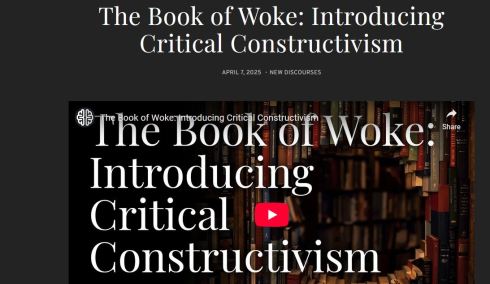
Critical Social Constructivism (CSC) underpins the ideology known as “woke,” as explained by James Lindsay on his New Discourses website. Lindsay (2025) describes CSC, or Critical Constructivism, as a framework where knowledge and reality are entirely socially constructed, devoid of any objective foundation beyond human perception and agreement. Within woke ideology, this perspective views social concepts like race, gender, and justice as products of narratives and power dynamics rather than universal truths. Woke activism uses this foundation to prioritize marginalized groups’ narratives, aiming to reshape societal truths to align with ideological goals. By rejecting objective reality, CSC enables woke activists to redefine reality based on who controls the dominant discourse.
Woke activists often avoid debate due to CSC’s logic, which Lindsay (2025) argues fosters a totalitarian power dynamic. Since CSC denies an objective reality accessible through reason or evidence, truth depends on social consensus shaped by power rather than rational dialogue. For woke activists, debating risks validating opposing views, which conflicts with their belief that truth emerges from enforcing the “correct” narrative. Instead of engaging in discussion, they employ social coercion through tactics like shaming, cancellation, or institutional pressure to silence dissent and ensure conformity. Lindsay emphasizes that this approach stems from viewing power as the ultimate determinant of accepted truth.
This reliance on coercion reflects a core CSC tenet: whoever holds power to enforce a narrative defines what is “true.” Lindsay (2025) notes that CSC’s rejection of objective reality implies truth is not discovered but created, and those controlling institutions, media, or cultural norms shape reality. In woke ideology, this translates to a relentless push to dominate discourse, equating narrative enforcement with truth establishment. By prioritizing power over reason, woke activists favor control over debate, using social force to validate their constructed realities and ensure their version of truth prevails.
Reference
- Lindsay, J. (2025). The Book of Woke: Introducing Critical Constructivism. Retrieved from https://newdiscourses.com/2025/04/the-book-of-woke-introducing-critical-constructivism
Social constructivism, a theory positing that reality is constructed through social processes and interactions rather than being an objective truth, lies at the core of what is commonly referred to as “woke” ideology. This perspective asserts that knowledge, identity, and societal norms—such as gender, race, and morality—are not rooted in any inherent or natural order but are instead products of human agreement and power dynamics. In the woke framework, this translates into a belief that all structures and hierarchies are arbitrary and must be relentlessly questioned or dismantled, particularly those perceived as oppressive. The emphasis on subjective experience and collective narrative over empirical evidence or universal principles defines woke ideology as a direct descendant of social constructivism, where truth becomes malleable and contingent upon the dominant social discourse.
This worldview inherently encourages coercive attitudes because it rejects the possibility of a shared, objective reality that can be appealed to in resolving disputes. If reality is socially constructed, then those who control the narrative wield ultimate power, and dissent becomes not just a disagreement but a threat to the constructed order. Woke adherents often demand conformity to their reimagined norms—such as language policing, mandatory ideological training, or the silencing of opposing views—under the guise of protecting marginalized groups or advancing justice. This coercion stems from the belief that alternative perspectives perpetuate harmful constructs, leaving no room for dialogue or compromise. The result is a moral absolutism that justifies silencing or punishing those who deviate from the prescribed narrative, as their very existence challenges the fragile consensus of the constructed reality.
The totalitarian tendencies of this approach emerge from its insistence on universal adherence to a singular interpretive framework. Social constructivism, as embraced by woke ideology, does not tolerate competing claims to truth; it seeks to monopolize the social construction process itself. Institutions—be they educational, corporate, or governmental—are repurposed as tools to enforce this orthodoxy, often through mechanisms like cancel culture, deplatforming, or the rewriting of history to align with the approved narrative. Dissenters are not merely wrong but dangerous, necessitating their exclusion or reeducation. This mirrors historical totalitarian regimes, where control over perception and belief was paramount, except here it is cloaked in the language of progress and equity rather than overt authoritarianism.
Fundamentally, social constructivism within woke ideology constitutes an anti-real ontology—an explicit rejection of an independent, knowable reality. By denying that there are facts or truths outside human interpretation, it undermines the foundations of science, reason, and even basic human experience. For instance, biological realities like sex differences are reframed as oppressive constructs to be transcended, while historical events are judged not by evidence but by their alignment with contemporary moral sensibilities. This anti-real stance dismisses the possibility of a world that exists beyond our perceptions, reducing everything to a power struggle over who gets to define the “truth.” In doing so, it sacrifices the pursuit of understanding for the imposition of ideology, leaving no anchor for objective inquiry or mutual coexistence.
In conclusion, social constructivism serves as the intellectual bedrock of woke ideology, driving its coercive and totalitarian impulses while cementing its status as an anti-real ontology. It transforms society into a battleground of competing narratives where power, not truth, determines legitimacy. The resulting culture of enforced conformity stifles dissent and erodes the possibility of a shared reality, replacing it with a fragmented, subjective landscape that demands constant vigilance and control. Far from liberating, this framework traps individuals in a cycle of perpetual reconstruction, where no truth is final and no freedom is secure. Ultimately, it reveals a paradox: a philosophy claiming to deconstruct oppression constructs its own rigid, unyielding system in its place.











 bleatmop
 Mystro


 Dead Wild Roses
Your opinions…