
You are currently browsing the category archive for the ‘Politics’ category.
 Edmonton’s public transit system has become a crucible of violence, and the stats don’t lie—crime is spiking at a rate that demands urgent action. In 2022, the Edmonton Police Service reported a staggering 53% increase in violent crime calls on transit compared to 2021, with incidents like assaults and robberies plaguing LRT stations and buses. That’s not just a number; it’s a reality where four percent of the city’s violent crime now happens on transit, a space meant for safe commuting. Without more security—whether that’s additional peace officers or better surveillance—this trend risks turning every ride into a roll of the dice for passengers.
The human cost behind these numbers is what’s truly alarming. In early 2023 alone, Edmonton saw 35 violent occurrences on transit property, including nine weapon-related incidents, reflecting a broader national crisis but hitting hard locally. These aren’t just stats on a page—they’re stabbings, threats, and beatings that leave people scared to take the bus or LRT. Riders aren’t imagining this; their fear is backed by a 12% higher crime severity index in transit areas compared to the city average in 2022. More security isn’t just a nice-to-have; it’s a necessity to protect vulnerable folks who rely on public transit daily, especially when 70% of these attacks are random, striking without warning.
Throwing our hands up and saying “it’s a social problem” doesn’t cut it—action does. Sure, the city added 22 more transit peace officers in 2023, but when calls for service are still climbing (up 12% in 2024 despite a slight dip in crime severity), it’s clear that’s not enough. Stations like Eaux Claires saw a 133% spike in dispatched calls in 2022, showing hot spots are still burning unchecked. More boots on the ground, better real-time monitoring, and tougher enforcement aren’t luxuries—they’re the bare minimum to stop this freefall and give Edmontonians a transit system that doesn’t feel like a battlefield. Anything less is just ignoring the obvious.
 China’s interference in Canada and its politics involves a mix of economic leverage, influence operations, and clandestine activities aimed at shaping outcomes to favor Beijing’s interests. Based on what’s been uncovered so far, here’s how it’s playing out.
Economically, China has sunk deep roots into Canada. They’ve snapped up significant chunks of Vancouver’s real estate and farmland in British Columbia’s interior, giving them a tangible stake in the country’s resources and infrastructure. This isn’t just investment—it’s leverage. When you control housing markets or food production, you’ve got a say in local pressures and politics without firing a shot. Add to that the 2014 FIPA deal—a 31-year agreement giving Chinese businesses in Canada special protections, including the right to secretly sue the government if laws hurt their profits. It’s a quiet foothold, locking in influence for decades.
Politically, the interference gets murkier. Canada’s spy agency, CSIS, has tracked China’s hand in the 2019 and 2021 federal elections. A February 2023 briefing straight to the Prime Minister’s Office laid it out: China “clandestinely and deceptively” meddled, pushing for candidates who’d either back Beijing or at least not rock the boat. Tactics included funneling cash—possibly $250,000 in one case—through proxies like community groups tied to the Chinese consulate in Toronto. They’ve also used disinformation, like WeChat campaigns smearing Conservative candidates as “anti-China” to scare Chinese-Canadian voters away from them. Think Kenny Chiu in 2021—his riding flipped after a barrage of messaging tied to Beijing’s playbook. The goal? Keep the Liberals in power, preferably with a minority government reliant on softer voices like the NDP.
Then there’s the personal angle. Take Michael Chong, a Conservative MP who got on China’s bad side by calling out their Uyghur policies. In 2021, Beijing allegedly targeted his family in Hong Kong, using a diplomat in Toronto to dig up dirt. Canada booted that guy, Zhao Wei, in 2023, but only after a stink was raised—showing how slow the response can be. And it’s not just MPs. CSIS says China’s Ministry of State Security and United Front Work Department have been cozying up to officials at all levels, sometimes with “honey pots” or trips to China funded by groups like the Chinese People’s Institute of Foreign Affairs. Between 2006 and 2017, parliamentarians took 36 of those sponsored jaunts.
Beyond elections, China’s reach extends to intimidation and control. Reports of “overseas police stations” in cities like Toronto and Vancouver—denied by China’s embassy—suggest they’re keeping tabs on the diaspora, pressuring Chinese nationals to toe the line or face family back home paying the price. CSIS calls this a “sophisticated tool kit”—cyberattacks, economic coercion, even military flexing—all to bend Canada’s democracy without leaving fingerprints.
The kicker? Despite all this, the interference often skates by legally. The Commissioner of Canada Elections found China’s 2021 voter influence didn’t break election laws—free speech, even if it’s foreign-orchestrated, gets a pass. And while CSIS says it’s the “greatest strategic threat” to Canada’s security, the government’s been criticized for dragging its feet. Trudeau’s team got warnings as early as 2017 about PRC agents infiltrating “all levels of government,” yet responses—like expelling Zhao—only came under pressure.
So, China’s playing a long game: buy influence, sway votes, intimidate dissenters, and exploit Canada’s openness. It’s not about flipping the whole system—just nudging it enough to keep Beijing’s interests safe. How much it’s changed actual outcomes is debated, but the stain on trust is real. What’s Canada doing about it? Not enough, if you ask the folks who’ve been targeted.
Harvard professor Roland Fryer discusses his research on police brutality in this video, focusing on the data regarding racial bias in police interactions.
Fryer’s study found no racial differences in lethal uses of force by police, which contradicted common narratives and led to significant backlash.
The conversation explores the academic and public response to his findings, highlighting the controversy and criticism he faced.
Fryer emphasizes his commitment to truth-telling despite the personal and professional repercussions, including being suspended by Harvard.
The Liberal Party of Canada’s decision to remove Chandra Arya from the leadership race is a concerning display of undemocratic behavior.
Arya, having met the necessary criteria and raised the required funds, should have been allowed to compete on an equal footing with other candidates. This exclusion smacks of internal manipulation, suggesting that the party leadership might be more interested in controlling the outcome than in fostering a fair and open contest.
Such actions raise serious questions about the integrity of the leadership selection process and whether it truly reflects the will of party members or is instead orchestrated by a select few. This move not only disenfranchises Arya’s supporters but also undermines the democratic ethos that the Liberal Party should champion.
It’s a clear indication that the party might prioritize maintaining a particular narrative or candidate over the democratic ideals it claims to uphold, thereby casting a shadow over the legitimacy of the entire leadership race and, by extension, the future governance of the country.
This is like when you really *really* wanted Santa Claus to be real. You look for information to confirm your beliefs (the exact opposite of you like doing the corresponding to reality thing).

Of course, the non EKOS polls show a rather different story.
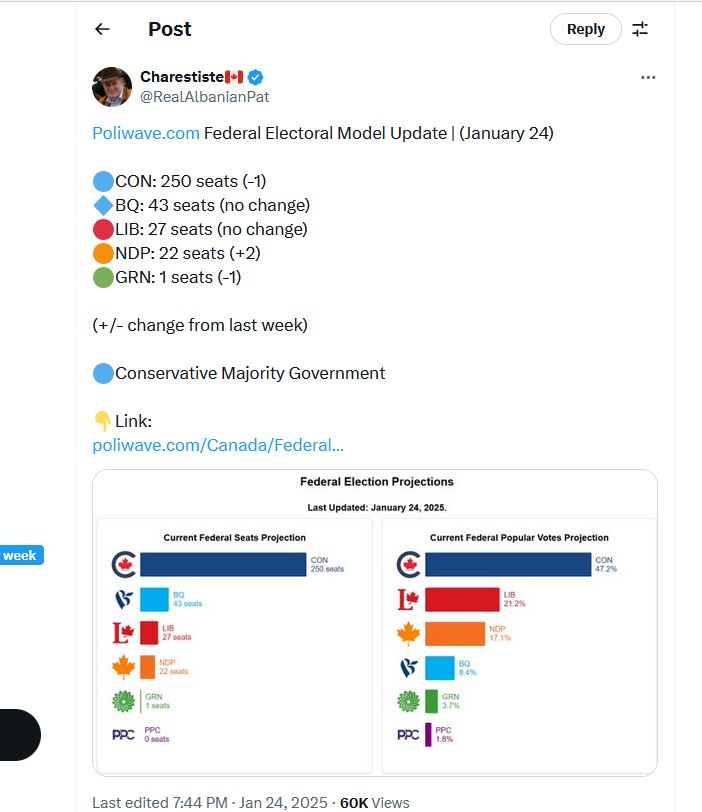
The take away for today: The easiest person to fool is yourself.
Reading an essay on Law and Liberty about Sir Roger Scruton – I’m going to have to look into his works as he seems to be grappling with the notion of how conservatism is necessary in order to keep liberalism from eating itself.
“The bonds of membership and the memories and loyalties of a self-governing people transcend what is chosen at any given moment of time or delineated in any original contract. With it comes duties to which one is honor-bound, and not just rights to do as one wills. To be sure, Scruton valued rights within their legitimate sphere. The rule of law, not soulless legalism, was a sacrosanct principle of his, and at the heart of the English liberty he loved. But he saw only a brutal diminution of both moral and political life under the new “ideology of human rights,” as he called it, a diminished understanding of “autonomy” that is shorn of moral and civic duty and hence of the mutual accountability that defines persons living in free and lawful political communities.”











 bleatmop
 Mystro


 Dead Wild Roses
Your opinions…