
You are currently browsing the category archive for the ‘Politics’ category.
Introduction
The dialectic—a philosophical method as dynamic as history itself—reveals change as a clash of opposites, forging new realities from their wreckage. It’s not mere argument but a structured process where contradictions propel progress, whether in ideas or societies. Crafted by Georg Wilhelm Friedrich Hegel and reshaped by Karl Marx, this framework illuminates how tensions—between freedom and order, or wealth and labor—drive transformation. For those new to these thinkers, the dialectic is a lens to see society’s churn as neither random nor inevitable but as a dance of conflict and resolution. This post, the first of a three-part series, traces the dialectic’s history through Hegel and Marx, highlighting its role as a cornerstone for social constructivists who view society as malleable, sculpted by human action. By grasping this method, we equip ourselves to dissect social movements—like third-wave feminism and gender ideology, the latter fraught with contention[^1]—probing whether they rise, clash, and fade in history’s relentless dialectical churn [Hegel’s Dialectics, Stanford Encyclopedia of Philosophy, https://plato.stanford.edu/entries/hegel-dialectics/].
Hegel’s Dialectic: The Pulse of Ideas
Georg Wilhelm Friedrich Hegel (1770–1831), a German philosopher, saw the dialectic as reality’s heartbeat, pulsing through ideas and history. Contrary to popular myth, Hegel never used the terms “thesis, antithesis, synthesis”—a simplification attributed to Johann Fichte. Instead, his method is a fluid interplay where concepts contain contradictions that demand resolution, birthing new, richer concepts. Take “Being,” pure existence: it’s so abstract it collapses into “Nothing,” its negation; their unity forms “Becoming,” capturing change itself. This process, which Hegel called Aufhebung (sublation), both negates and preserves what came before. His dialectic—less a formula, more a metaphysical rhythm—suggests that every idea or social stage carries the seeds of its own undoing, pushing toward a grander truth, the Absolute. Critics like Karl Popper decry its abstraction as mystifying, yet its influence endures, offering a lens to see history’s ceaseless evolution [Hegel’s Dialectics, Stanford Encyclopedia of Philosophy, https://plato.stanford.edu/entries/hegel-dialectics/].
Marx’s Materialist Revolution
Karl Marx (1818–1883), a radical thinker and Hegel’s intellectual heir, found idealism wanting—too ethereal, too divorced from gritty reality. He forged dialectical materialism, grounding change in material conditions: economics, labor, class. For Marx, history advances through contradictions in the mode of production—like capitalism’s clash between bourgeoisie (owners) and proletariat (workers). The exploitation of labor for profit creates inequality, a contradiction that foments class struggle, potentially sparking revolution toward socialism. Unlike Hegel’s dance of ideas, Marx’s dialectic is rooted in tangible conflicts: the factory’s grind, the worker’s plight. This materialist lens sees society’s “base” (economic system) shaping its “superstructure” (politics, culture), offering a blueprint for analyzing power dynamics. Though critics like Mario Bunge call it reductionist, Marx’s framework electrifies social constructivists, arming them to dissect and challenge societal structures [Dialectical Materialism, Wikipedia, https://en.wikipedia.org/wiki/Dialectical_materialism].
The Dialectic as a Social Constructivist Tool
Social constructivists—those who see society as a human creation, not a fixed truth—wield the dialectic to decode and reshape social realities. They view norms, like gender roles or racial hierarchies, as stages ripe for contradiction and transformation. For example, the Black Lives Matter movement, sparked by police violence in 2020, identified contradictions between America’s egalitarian ideals and systemic racism, pushing for reforms like defunding police or restructuring criminal justice. This mirrors the dialectic’s rhythm: a dominant structure (legal equality) meets its negation (racial injustice), yielding a synthesis (policy reform). Hegel’s idealism informs the conceptual evolution, while Marx’s materialism highlights economic and social forces driving change. Yet, the dialectic’s critics—Popper among them—warn it risks oversimplifying complex realities, potentially fostering dogmatic solutions. For constructivists, though, it’s a scalpel: contradictions are not flaws but catalysts, empowering movements to forge new social orders [Social Constructionism, Wikipedia, https://en.wikipedia.org/wiki/Social_constructionism].
Conclusion: A Lens for Social Dynamics
The dialectic—Hegel’s idealistic churn, Marx’s materialist struggle—offers a profound framework for understanding change. It reveals history and society as dynamic, driven by contradictions that demand resolution. Social constructivists harness this method to challenge norms and envision progress, seeing tensions as opportunities, not dead ends. Yet, its abstraction and potential for oversimplification invite scrutiny, demanding rigorous application. In the next posts, we’ll apply this lens to third-wave feminism and gender ideology, probing whether their contradictions—fragmentation, anti-science stances—mark them as tools used and discarded in history’s dialectical march. This foundation equips us to dissect social movements with precision, resisting divisive simplifications in pursuit of unifying truths.

Table: Hegel vs. Marx on the Dialectic
| Aspect | Hegel’s Dialectic | Marx’s Dialectical Materialism |
|---|---|---|
| Focus | Evolution of ideas toward the Absolute | Material conditions and class struggles |
| Driving Force | Internal contradictions within concepts | Economic contradictions and class conflicts |
| Example | Being → Nothing → Becoming | Bourgeoisie vs. Proletariat → Socialism |
| Outcome | Conceptual progress toward ultimate truth | Social revolution toward classless society |
| Criticism | Overly abstract, mystifying | Reductionist, overly economic-focused |
Footnotes
[^1]: Gender ideology’s contentious nature is evident in polarized debates, with proponents advocating for self-identification and critics citing conflicts with empirical science and women’s rights. See, for example, policy reversals like the UK’s 2024 decision to ban puberty blockers for minors, reflecting growing skepticism [NHS England, Cass Review, https://www.england.nhs.uk/commissioning/spec-services/npc-crg/gender-dysphoria-clinical-programme/implementing-advice-from-the-cass-review/].
Sources
- Hegel’s Dialectics, Stanford Encyclopedia of Philosophy, https://plato.stanford.edu/entries/hegel-dialectics/
- Dialectical Materialism, Wikipedia, https://en.wikipedia.org/wiki/Dialectical_materialism
- Social Constructionism, Wikipedia, https://en.wikipedia.org/wiki/Social_constructionism
- NHS England, Cass Review, https://www.england.nhs.uk/commissioning/spec-services/npc-crg/gender-dysphoria-clinical-programme/implementing-advice-from-the-cass-review/
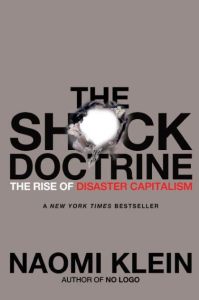 Naomi Klein’s The Shock Doctrine: The Rise of Disaster Capitalism (2007) is a searing indictment of neoliberalism, wielding a scalpel to dissect what Klein terms “disaster capitalism.” With relentless clarity, she argues that crises—natural, military, or economic—are exploited to ram through free-market policies that enrich elites while impoverishing the masses. The book’s 500-plus pages pulse with urgency, weaving history, economics, and geopolitics into a narrative as gripping as it is grim. Yet, its polemical zeal and occasional overreach—stretching causal links to near-conspiracy—risk undermining its rigor. This review outlines Klein’s thesis, summarizes the book’s contents, and critically assesses its claims with precise quotations and citations.
Thesis: Crisis as Capitalist Opportunity
Klein’s central thesis is that neoliberal policies, championed by Milton Friedman and the Chicago School, thrive on chaos. She argues that “the shock doctrine” exploits moments of collective trauma—wars, coups, natural disasters—to impose deregulation, privatization, and austerity, policies that “no one votes for” in free elections (Klein, 2007, p. 140). These shocks create a “blank slate” for corporate interests, as populations, disoriented by crisis, cannot mount effective resistance. “An economic system that requires constant growth… generates a steady stream of disasters all on its own,” she writes, citing financial crashes and wars as both byproduct and enabler of this system (p. 425). Klein challenges the myth of neoliberalism’s democratic triumph, asserting it relies on “violence and shock perpetrated on people, on countries, on economies” (p. 9). While compelling, her thesis occasionally flirts with hyperbole, implying intent where chaos and opportunism may suffice.
Summary of Contents
The Shock Doctrine spans seven parts, tracing neoliberalism’s rise through global case studies. Part 1 draws a provocative parallel between economic “shock therapy” and psychiatric experiments by Ewen Cameron, whose CIA-funded electroshock treatments aimed to “wipe” patients’ minds for reprogramming—a metaphor for neoliberalism’s erasure of existing economic orders (p. 29). Part 2 examines South America in the 1970s, focusing on Chile’s 1973 coup against Salvador Allende. Klein details how “Chicago Boys,” Friedman-trained economists, used Pinochet’s dictatorship to impose “shock treatment” policies like privatization, noting that “torture… was a tool used to build and maintain this free-market laboratory” (p. 105).
Parts 3 and 4 analyze the doctrine’s spread to Poland, Russia, South Africa, and Asia during the 1997 financial crisis, where “the destruction of entire societies” enabled rapid market reforms (p. 237). Part 5 introduces the “disaster capitalism complex,” a network of corporations profiting from privatized disaster response, as seen in post-tsunami Sri Lanka, where “developers… cleared fishing communities off the coasts” for luxury hotels (p. 381). Part 6 dissects Iraq post-2003, described as “the ultimate expression” of the doctrine, with “an orgy of privatization” amid war’s chaos (p. 381). The Conclusion highlights resistance, citing South America’s rollback of neoliberal policies and grassroots activism in Lebanon and South Africa as signs of hope (p. 455). Klein’s narrative is vivid, but her reliance on dramatic examples sometimes overshadows systemic analysis.
Critical Assessment
Klein’s strength lies in her meticulous research—four years of on-the-ground reporting—and her ability to connect disparate events into a coherent narrative. Reviewers like John Gray praise it as “one of the very few books that really help us understand the present,” noting its exposure of neoliberalism’s reliance on crisis (The Guardian, 2007). Stephen Amidon affirms its relevance to Iraq, where “Rumsfeld’s decision to allow the looting of the nation’s cultural identity” aligns with Klein’s thesis (New York Observer, 2007). Yet, critics like Joseph Stiglitz argue that her parallel between Cameron’s experiments and economic policy is “overdramatic and unconvincing,” stretching causality (The New York Times, 2007). The Economist is harsher, calling the book “a true economics disaster” for claims like the Falklands War spurring neoliberalism in Britain, which lack robust evidence (The Economist, 2007).
Klein’s portrayal of neoliberalism as a monolithic force can oversimplify. Her claim that “the Argentinian invasion of the Falklands was done in order to spur neoliberal reforms in Britain” (p. 131) is speculative, as geopolitical motives were more complex. Similarly, her assertion that Tiananmen Square “spurred China’s turn to the market” ignores China’s pre-1989 economic reforms (p. 171). As Shashi Tharoor notes, Klein is “too ready to see conspiracies where others might discern… chaos and confusion” (The Washington Post, 2007). Her focus on corporatism—where “public wealth [is turned] to private companies” (Bookbrowse, 2007)—is incisive, but risks conflating opportunistic profiteering with deliberate orchestration. Still, her evidence of profiteering, like Halliburton’s profits in Iraq’s “ghoulish dystopia” (p. 429), is damning and well-documented.
Conclusion
The Shock Doctrine is a tour de force, exposing the predatory underbelly of neoliberalism with a ferocity that demands attention. Its narrative, as Arundhati Roy declares, is “nothing less than the secret history of what we call the ‘free market’” (Amazon, 2007). Yet, its occasional lapses into exaggeration—casting every crisis as a calculated capitalist plot—dilute its precision. Klein’s call to resist, grounded in examples of grassroots pushback, offers hope, but her vision of systemic change feels underdeveloped. Read it for its revelatory scope, but temper its claims with skepticism: the truth of disaster capitalism is chilling enough without embellishment.
References
- Klein, N. (2007). The Shock Doctrine: The Rise of Disaster Capitalism. Picador.
- Gray, J. (2007). “The Shock Doctrine by Naomi Klein.” The Guardian. Retrieved from https://www.theguardian.com/books/2007/sep/15/politics.
- Amidon, S. (2007). “The Shock Doctrine.” New York Observer. Retrieved from https://observer.com/2007/09/the-shock-doctrine/.
- Stiglitz, J. E. (2007). “The Shock Doctrine by Naomi Klein.” The New York Times. Retrieved from https://www.nytimes.com/2007/09/29/books/review/Stiglitz-t.html.
- The Economist. (2007). “Naomi Klein Smackdown Roundup.” Retrieved from https://www.economist.com/blogs/freeexchange/2007/10/naomi_klein_smackdown_roundup.
- Tharoor, S. (2007). “The Shock Doctrine by Naomi Klein.” The Washington Post. Retrieved from https://www.washingtonpost.com/wp-dyn/content/article/2007/09/28/AR2007092801350.html.
- Bookbrowse. (2007). “The Shock Doctrine by Naomi Klein.” Retrieved from https://www.bookbrowse.com/reviews/index.cfm/book_number/2025/the-shock-doctrine.
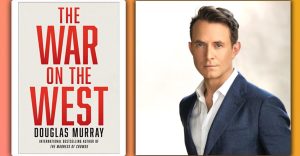 Douglas Murray’s The War on the West: How to Prevail in the Age of Unreason (2022) is a polemic that surges with conviction, decrying what Murray perceives as a concerted attack on Western civilization. With razor-sharp prose, he skewers ideologies he believes erode the West’s cultural and intellectual foundations. Yet, while his fervor galvanizes, the book’s reliance on selective evidence and occasional factual missteps muddies its truth-seeking ambition. This review outlines Murray’s thesis, summarizes the book’s contents, and critically assesses its claims with precise quotations and citations to ensure rigor.
Thesis: A Civilization Besieged
Murray argues that Western civilization faces an existential threat from within—a cultural war waged by ideologues who vilify its history and values while ignoring its triumphs. He contends that “the West is now the only major power bloc in the world that is talked about as though its very existence is a question, a problem, or a sin” (Murray, 2022, p. 7). This assault, he claims, stems from revisionist narratives—particularly around race, history, and culture—that weaponize guilt to dismantle reason and unity. Terms like “anti-racism” have been “twisted into a desire for vengeance” (p. 53), he asserts, urging a defense of Western principles as universal goods. While compelling, this thesis oversimplifies: Murray’s portrayal of the West as uniquely scapegoated sidesteps global critiques of other powers, such as China’s Uyghur policies, and risks painting dissent as a monolithic conspiracy.
Summary of Contents
The book dissects perceived attacks across multiple domains. In the chapter on race, Murray critiques policies like the English Touring Opera’s 2021 decision to prioritize “diversity” in casting, which he claims led to “the firing of white singers purely because of their race” (p. 64). He also targets America’s early COVID-19 vaccine prioritization for minority groups, arguing it reflects “anti-white racism dressed up as justice” (p. 71). His critique of the 1619 Project is scathing, calling it “an attempt to rewrite American history as a story of unremitting racial oppression” (p. 89), though he engages little with its scholarly debates.
Murray then surveys history, art, and education, lamenting the “erasure” of Western achievements. He cites the 2020 defacement of Winston Churchill’s statue in London as evidence of a “new puritanism” (p. 112) and questions why figures like Kant are condemned for historical racial views while Karl Marx’s anti-Semitic writings escape scrutiny (p. 136). Critical Race Theory (CRT) is a recurring target, branded as “a doctrine that turns anti-racism into a new form of racism” (p. 165). He also critiques intellectuals like Edward Said, accusing them of fostering “anti-Western resentment” (p. 181). While Murray’s defense of Western art and science as universal treasures resonates, his examples—like a Twitter claim that “2+2=4 is Western imperialism” (p. 203)—often amplify marginal voices to inflate the threat.
Critical Assessment
Murray’s passion is undeniable, but his argument falters under scrutiny. A key factual error undermines his credibility: he cites a California ethnic studies curriculum as advocating “counter-genocide” against Christians, a claim traced to activist Christopher Rufo. This is false; the curriculum draft, revised in 2021, contains no such language (California Department of Education, 2021, “Ethnic Studies Model Curriculum”). Similarly, Murray misrepresents a Sandia National Laboratories exercise as forcing white employees to apologize for privilege, when it was a voluntary diversity training with no such mandate (Snopes, 2020, “Did Sandia Labs Force White Employees to Apologize?”). As reviewer Samuel Catlin notes, “Murray’s reliance on such sources makes you seriously wonder about how accurately described the rest of the book is” (Jewish Currents, 2022).
His treatment of the 1619 Project also lacks nuance. Murray dismisses it as “arrogant overreach” (p. 89), yet ignores historians like Gordon Wood, who, while critical, engage its arguments as part of legitimate historiographical debate (Wood, 2020, The New York Review of Books). This selective outrage—condemning Western critics while excusing Marx’s slurs—betrays a double standard. His defense of slavery’s historical context, arguing “every society from Africa to the Middle East had slaves” (p. 98), veers into whataboutism, dodging the West’s unique role in the transatlantic trade’s scale and legacy.
Murray’s broader narrative—framing critics as a unified anti-Western cabal—overreaches. For instance, his claim that mathematics itself is under attack relies on a single, obscure blog post rather than mainstream discourse (p. 203). As The Times review observes, “Murray sometimes picks fights with paper tigers, inflating trivial incidents into existential threats” (The Times, 2022). This hyperbole risks trivializing his case, turning a call for reasoned defense into a culture-war shouting match.
Conclusion
The War on the West is a fervent plea to cherish Western civilization, but its flaws—factual inaccuracies, selective reasoning, and exaggerated threats—corrode its persuasiveness. Murray’s prose shines, and his defense of universal values like reason and liberty is laudable. Yet, as Catlin aptly puts it, “the war he describes is less a clash of civilizations than a clash of rhetorics” (Jewish Currents, 2022). The West’s strength lies in its capacity for self-critique, a trait Murray champions but undercuts with his combative tone. Read it for its vigor, but cross-check its claims: the battlelines are real, but far less tidy than Murray insists.
References
- Murray, D. (2022). The War on the West: How to Prevail in the Age of Unreason. HarperCollins.
- California Department of Education. (2021). Ethnic Studies Model Curriculum. Retrieved from https://www.cde.ca.gov/ci/cr/cf/esmc.asp.
- Snopes. (2020). “Did Sandia Labs Force White Employees to Apologize?” Retrieved from https://www.snopes.com/fact-check/sandia-labs-white-privilege/.
- Catlin, S. (2022). “The War on the West: A Review.” Jewish Currents. Retrieved from https://jewishcurrents.org/the-war-on-the-west.
- Wood, G. (2020). “The 1619 Project: A Debate.” The New York Review of Books. Retrieved from https://www.nybooks.com/articles/2020/11/19/1619-project-debate/.
- The Times. (2022). “The War on the West by Douglas Murray: Review.” Retrieved from https://www.thetimes.co.uk/article/the-war-on-the-west-by-douglas-murray-review.
The word “woke” has been buzzing around for years, popping up in political debates, social media threads, and even casual conversations. But what does it really mean? Depending on who you ask, you might get wildly different answers. As someone curious about the term, I decided to explore three perspectives: one from a critic, one from a supporter, and one for those who might not care much about the whole debate.
Perspective 1: The Critic’s Take (James Lindsay’s Definition)
James Lindsay, a vocal anti-Communist thinker, offers a definition that digs into the intellectual roots of “woke.” In a recent X post (June 13, 2025), he describes it not as a set of fixed beliefs but as a “critically conscious way of seeing the world.” For Lindsay, being woke means believing that society is fundamentally organized around a hidden dynamic of oppression and alienation, splitting people into two classes: the privileged oppressors and the marginalized oppressed. He argues this view requires you to “wake up” (almost like a born-again experience) to see this reality, which the powerful have cleverly concealed.
Lindsay ties this to historical ideas, like Paulo Freire’s Pedagogy of the Oppressed (1968), where education becomes a tool to liberate the downtrodden. It’s a provocative take, suggesting woke is less about specific policies and more about a method of thinking. But it’s also controversial—there’s no hard data proving a universal oppression structure, and some say it oversimplifies complex social dynamics. Still, it’s a useful lens if you’re trying to understand the philosophy behind the term.
Perspective 2: The Woke Perspective
Now, let’s hear from those who embrace the label. From a “woke” viewpoint—drawing from voices like those in the NAACP Legal Defense Fund and equity experts—being woke is about awareness and action. It starts with recognizing that systemic injustices, like racism, sexism, and economic inequality, are baked into society’s foundations, often dating back centuries. This perspective, rooted in the African American Vernacular English use of “woke” (meaning staying alert to injustice since the early 20th century), sees it as a call to stay educated and engaged.
For example, a woke advocate might point to the 2020 Black Lives Matter protests or efforts to diversify curricula as evidence of this consciousness in action. It’s not just about seeing problems but working to fix them—think policies on equitable hiring or inclusive education. Critics might call it idealistic, but supporters argue it’s essential for progress, especially when data like the 2023 U.S. Census showing persistent racial wealth gaps (e.g., Black households at $44,900 median wealth vs. $285,000 for white households) backs up the systemic lens.
Perspective 3: The Casual Observer’s View
Not everyone’s deep into this debate, and that’s okay! For the average person who’s not engaged—maybe you’ve heard “woke” on the news or in a meme but don’t follow the ideology wars—it’s simpler. To them, “woke” often just means being on the progressive side of social issues. It’s the stuff you see on TV: support for LGBTQ+ rights, climate action, or calls to “cancel” problematic figures. A 2022 Pew Research survey found 58% of U.S. adults link it to left-leaning politics, not a grand theory of society.
This version doesn’t care about hidden oppression dynamics or critical methods—it’s more about a vibe. You might hear someone say, “Oh, that’s so woke,” meaning it’s trendy or socially aware, like a brand launching a sustainability campaign. It’s less a worldview and more a cultural marker, which makes it accessible but also vague for those not in the thick of it.
So, Which Definition Wins?
There’s no single “right” answer—each reflects a different lens. Lindsay’s version is great for dissecting the intellectual side, the woke perspective shines if you’re passionate about justice, and the casual take works if you just want to keep up with the chatter. Personally, I think they all have a piece of the puzzle. “Woke” seems to be a shape-shifter, shaped by who’s using it and why.

The illogical nature of a centrally planned economy.
Karl Marx envisioned a socialist system where the state abolishes capitalism, seizing the means of production to allocate resources according to collective needs. In this framework, central planners would determine what goods to produce, theoretically eliminating the profit motive and class disparities. Marx’s theory assumed that a planned economy could efficiently coordinate production and distribution without the market mechanisms inherent in capitalism.
Ludwig von Mises, in his groundbreaking 1920 essay Economic Calculation in the Socialist Commonwealth, challenged this vision by exposing a fundamental flaw: the absence of market prices renders rational economic planning impossible. Mises argued that prices, generated through supply and demand in a free market, convey critical information about scarcity, consumer preferences, and production costs. Without these prices, central planners lack a mechanism to assess the relative value of resources or to make informed decisions about what to produce, in what quantities, or at what cost. For example, without price signals, planners cannot determine whether steel is better allocated to building bridges or manufacturing tools, leading to inefficiency and waste.
Mises’ critique directly refutes Marx’s socialist framework by demonstrating that the absence of market prices dismantles the logic of economic coordination. He did not argue that socialism was immoral but that it was impractical, as it lacked a functional method for economic calculation. Without prices to guide resource allocation, a socialist economy cannot rationally prioritize production or evaluate trade-offs, resulting in chaos rather than a coherent economy. Mises’ insight underscores the indispensability of market mechanisms, positioning capitalism as a logical necessity for economic order.

Central planning too limited.
Karl Marx’s vision of socialism relied on central planners to orchestrate production and distribution, assuming they could gather and process the necessary information to meet societal needs. In Marx’s framework, a centralized authority would replace the decentralized market, directing resources to eliminate inefficiencies and inequities inherent in capitalism. This approach presumed that planners could acquire comprehensive knowledge of economic conditions to allocate resources effectively.
F.A. Hayek, in his seminal works such as The Use of Knowledge in Society (1945), refuted this by arguing that no central planner could possibly possess the dispersed, tacit knowledge held by individuals across society. Hayek emphasized that prices in a market economy are not mere numbers but dynamic signals that aggregate and communicate localized information about needs, preferences, and resource scarcities. For instance, a rising price for lumber signals increased demand or limited supply, prompting producers and consumers to adjust without any single authority needing to understand the full context of every transaction.
Hayek’s insight directly challenges Marx’s centralized model by demonstrating that the spontaneous coordination enabled by market prices surpasses the capabilities of any planner, expert, or algorithm. Prices encapsulate fragmented knowledge—such as a farmer’s awareness of crop yields or a manufacturer’s grasp of production costs—that no central authority could fully replicate. By enabling individuals to act on this dispersed information, markets achieve efficient resource allocation without requiring a comprehensive plan, rendering Marx’s vision of centralized control not only impractical but fundamentally incapable of matching the adaptive complexity of a price-driven economy.

In recent years, we’ve seen protests that aren’t just peaceful marches but also aren’t as extreme as riots or wars. These actions are often called “mid-level violence.” Groups like activists and Antifa—a loosely organized movement against fascism—use them to fight what they see as unfair systems or dangerous ideas. This primer will explain what mid-level violence is, how it works, and why it can be both helpful and tricky.
What Is Mid-Level Violence and How Is It Used?
Mid-level violence is more intense than peaceful protests but less destructive than full-scale chaos. Think of actions like breaking windows, clashing with opponents in the street, or disrupting events. These groups use it to show they’re serious about their cause, whether it’s stopping oppression or challenging authority.
To make it work, they use specific tactics:
- Black umbrellas: Protesters hold these up to hide their faces from cameras, so police can’t easily identify them.
- Noisemakers: Loud horns or drums create confusion, overwhelming police or opponents.
- Filming confrontations: They record everything with their phones, especially if police or others react in a way that looks bad, to share their side of the story.
These tools help them push their message and protect themselves while doing it.
Why Does It Work Best With a Low-Information Audience?
These tactics are most effective when people don’t know the full story. Imagine you see a short video online of police pushing protesters. It might make you think the police are wrong—unless you saw what happened earlier, like protesters throwing things. This is called a “low-information audience”—people who only get a small piece of the puzzle.
Social media makes this even stronger. Videos spread fast, and people react before digging deeper. A clip that looks dramatic can get tons of attention, shaping opinions without showing the whole picture.
What Are the Risks?
While mid-level violence can grab attention and rally support, it has downsides. It can scare off people who aren’t sure where they stand—sometimes called “moderates.” If all they see is chaos, they might turn away from the cause. It can also make society more divided, as groups stop talking and start fighting instead. So, while it’s a powerful tool, it can backfire and make things harder to fix.
Why Understanding This Matters
Knowing how mid-level violence works helps us make sense of today’s protests. It reminds us to look past quick videos and find the full story. By doing that, we can figure out what’s really going on and work toward solutions that bring people together, not push them apart.











 bleatmop
 Mystro


 Dead Wild Roses
Your opinions…