
You are currently browsing the category archive for the ‘Politics’ category.
To speak publicly about politics is to shape how people understand the world. That power is a privilege—and a civic responsibility. A public voice can clarify or distort, empower or demoralize, elevate or degrade. Too many voices in today’s public square choose the latter, trading integrity for attention or tribal loyalty. The only antidote is a higher standard: one demanded by audiences and upheld by those who choose to speak.Anyone who steps into the political arena owes their audience five core duties.
- Truth
The first duty is truth—plain, direct, and unvarnished. Truth requires more than avoiding lies; it demands clarity. Deliberate vagueness, selective omission, and euphemistic fog are forms of manipulation. They create suspicion without resolution and leave audiences less informed than before.
A responsible speaker illuminates. They do not hide the ball, blur the edges, or gesture toward implications they refuse to own. Truth is the foundation on which every other duty rests. - Principle Over Personal Feeling
Public speech must be anchored in principle, not personal loyalty or emotional comfort. Friendship with a public figure who behaves badly is not a shield against accountability. Silence in the name of loyalty is complicity.
This duty is difficult—because it asks us to prioritize values over relationships, and integrity over tribe. But politics is not a social club. It is the arena where ideas shape real lives. If we sacrifice principle for personal feeling, we betray the very people we claim to serve. - Responsibility for the Platform
A platform is not a megaphone; it is an editorial choice. Anyone who invites a guest, amplifies a voice, or endorses a narrative is responsible for that decision.
This means asking real, truth-seeking questions, being transparent about agreement or disagreement, acknowledging when a promoted voice proves flawed, and refusing to hide behind “I’m just giving them a platform.”
Public speakers are not neutral conduits. They are curators. And curation carries moral weight. - Evidence
Claims require evidence. Not vibes, not insinuation, not “just asking questions.” Evidence.
In a fragmented information landscape, audiences are already overwhelmed by speculation and outrage. A responsible speaker cuts through the noise by grounding arguments in verifiable facts. Evidence-based inquiry is not the enemy of passion—it is what gives passion legitimacy.
Without evidence, rhetoric becomes manipulation. With evidence, it becomes persuasion. - Solutions and Agency
The final duty is to offer solutions—real ones, grounded in reality. Telling people that everything is rigged or hopeless may generate clicks, but it destroys agency. A population convinced that nothing is within their control will stop trying to improve anything at all.
Responsible voices do the opposite. They show paths forward. They encourage personal responsibility. They foster hope rooted in action, not fantasy. They remind people that while the world is imperfect, it is not immovable.
Solutions are not about optimism; they are about empowerment.
The Standard We Should Demand
These duties are not optional. They are the price of admission for anyone who chooses to influence public understanding. Frauds and opportunists thrive by exploiting fear, tribalism, and cynicism. They will continue to do so until audiences refuse to reward them—and until speakers commit to something better.
When we insist on truth, principle, responsibility, evidence, and agency, we build a healthier public square. Not a perfect one, but a stronger one—one capable of sustaining a free society.

For Canadians observing American politics from across the border, the U.S. conservative movement can look unusually volatile—especially after Donald Trump’s 2024 victory reinforced his influence over the Republican Party. If the Canadian Conservative Party is a “big tent,” the GOP is a sprawling, louder, and more internally divided version of the same idea. Its factions share broad goals but clash over identity, strategy, and the future of the movement.
In a recent public commentary, writer James Lindsay outlined five distinct factions competing for influence on the American right. His taxonomy is one interpretation among many, but it captures real ideological and generational tensions. For Canadians trying to understand how these divisions might shape U.S. policy, it’s a useful map.
1. Establishment Republicans: The Institutional Conservatives
These are the traditional, business-oriented conservatives—what Lindsay calls the “stodgy suit-wearing” wing. They emphasize:
• limited government
• free trade
• predictable governance
• strong national defense
For Canadians, this group resembles the Mulroney-era blue Tories: polished, institutionally minded, and cautious about populist disruption.
2. “RINO” Moderates: The Centrist Republicans
“RINO” (Republican In Name Only) is a pejorative label used by hardliners to describe moderates they see as too conciliatory or ideologically soft. Think of figures who prioritize bipartisan cooperation or resist populist rhetoric.
The Canadian parallel would be how some conservatives dismiss “Red Tories” as insufficiently committed to conservative principles. The term reflects internal policing rather than a neutral category, but it marks a real divide between ideological purists and pragmatic centrists.
3. Middle MAGA: The Populist-Pragmatic Core
Lindsay identifies Middle MAGA as the current center of gravity within the GOP. This faction emphasizes:
• patriotism
• common-sense governance
• America First policies
• civic engagement
• skepticism of foreign wars
It is largely Gen X–led and blends populist energy with practical governance. For Canadians, the closest analogue is Pierre Poilievre’s populist-but-practical conservatism: anti-elite, affordability-focused, and oriented toward achievable reforms rather than sweeping ideological overhauls.
4. The Woke Right / Post-Liberal Radicals
This faction—also described as post-liberal, paleoconservative, or national conservative—rejects classical liberalism’s emphasis on individual rights and free markets. Instead, they advocate:
• a more interventionist state
• protectionist economics
• government enforcement of cultural or religious norms
• a strong national identity
Lindsay criticizes this group for adopting tactics he associates with left-wing activism, such as purity tests and identity-based rhetoric. For Canadians, this resembles fringe nationalist or sovereigntist currents—loud, ideological, and disruptive, but not representative of mainstream conservative policy.
5. Pragmatic Neo-Establishment Republicans (e.g., DeSantis-aligned)
This faction overlaps with Middle MAGA but is distinct in its technocratic, results-oriented approach. These conservatives:
• embrace populist themes
• maintain classical liberal commitments
• prioritize policy execution and administrative competence
Lindsay uses Ron DeSantis as an example of this style: populist in tone, managerial in practice. For Canadians, this resembles the Harper-era blend of populist messaging with disciplined governance.
Where the Movement Is Heading
Lindsay predicts that the most likely future for the American right is a fusion between Middle MAGA (3) and the pragmatic neo-establishment (5). This coalition would combine populist energy with administrative competence, pulling many traditional establishment conservatives (1) along with it.
By contrast, he expects the RINO moderates (2) and the Woke Right/post-liberal radicals (4) to resist this consolidation—“kicking and screaming,” as he puts it—and potentially causing disruption from the fringes.
Why This Matters for Canada
These internal American debates have direct implications for Canadians. U.S. conservative politics influence:
• trade policy and tariffs
• energy infrastructure, including pipelines and cross-border projects
• border security and immigration coordination
• NATO and continental defense
As Trump’s second term unfolds, the balance of power among these five factions could shape everything from tariff structures to foreign aid priorities. For Canada, understanding these divisions is essential. Our closest ally and largest trading partner is navigating a period of ideological realignment—one that echoes our own debates, but on a larger, louder, and more consequential scale.

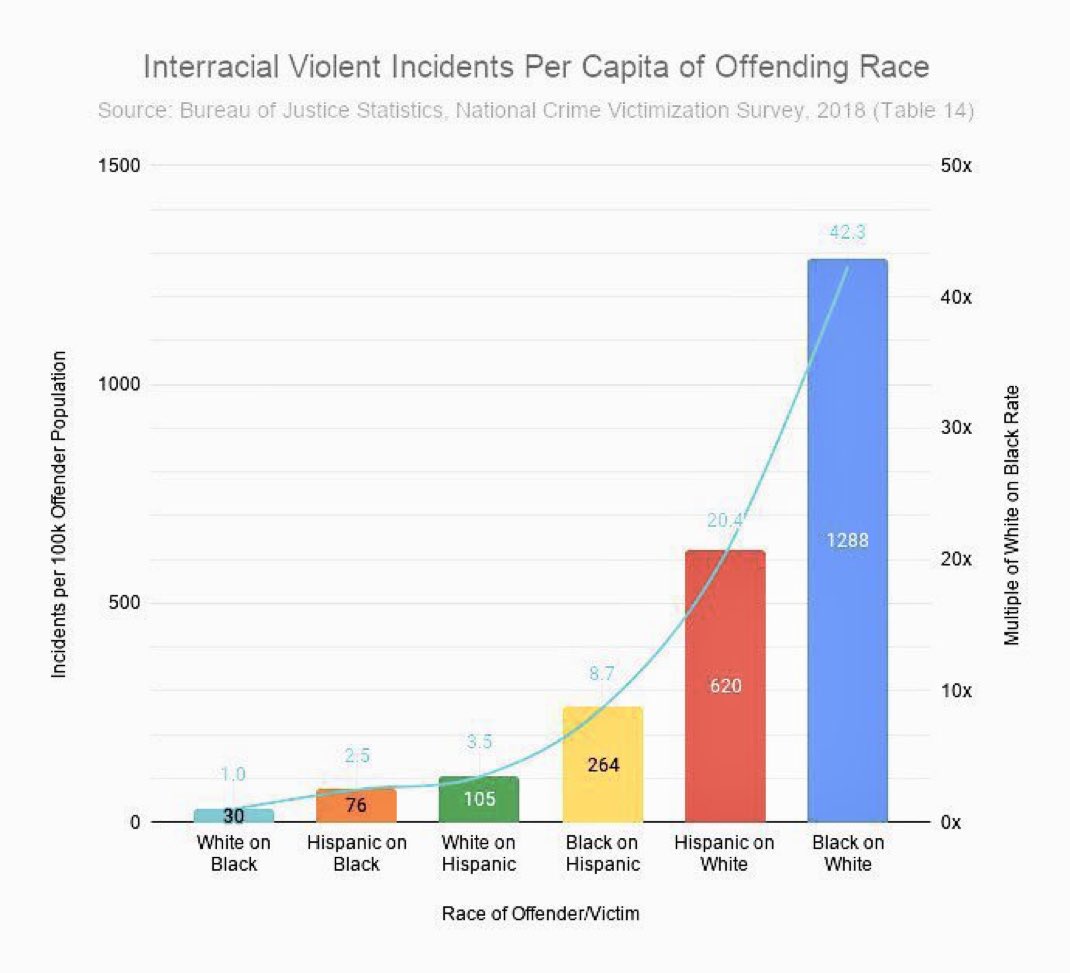
A widely circulated graph derived from the 2018 National Crime Victimization Survey (NCVS) reveals a stark asymmetry in interracial violent crime: Black offenders were perceived by victims to commit violence against Whites at a per capita rate dramatically higher than the reverse. Adjusted for population sizes—Blacks comprising roughly 13% of the U.S. population and Whites about 60%—the offending rate shows Black-on-White violence occurring at approximately 40 times the rate of White-on-Black violence per 100,000 offenders in each group.
This raw per capita disparity explodes the “woke” narrative that portrays racial dynamics in crime as symmetric or driven primarily by White aggression toward minorities. Instead, victim reports indicate that interracial violence flows overwhelmingly in one direction, undermining claims of equivalent racial bias or systemic White-on-Black targeting in everyday criminal acts.Critics often attempt to downplay this by noting that most violent crime is intraracial and that random opportunity—Whites being far more numerous—should lead to more Black-on-White incidents even without disproportionate offending. Adjusting for the larger White victim pool reduces the ratio to around 7:1, which still represents a significant elevation beyond what pure chance would predict.
This adjusted figure accounts for contact opportunities but does not erase the evidence of disproportionate involvement; it simply contextualizes it. The NCVS, based on direct victim perceptions rather than police reports, bypasses potential biases in arrests and provides a clearer picture of actual experiences, further challenging narratives that attribute disparities solely to law enforcement racism.
Ultimately, these statistics dismantle the oversimplified “woke” framing of crime as a tool of White supremacy oppressing minorities. While socioeconomic factors, segregation, and historical inequities contribute to crime patterns, the data show no equivalence in interracial harm—Whites are disproportionately victimized in cross-racial incidents relative to their offending rates. Ignoring per capita realities or dismissing them as misleading sustains a politicized myth that distorts public understanding and policy. Honest engagement with victim-survey evidence demands rejecting narratives that equate vastly unequal patterns, focusing instead on addressing root causes without excusing directional disparities.
For context, a related BJS report comparing NCVS offender data to arrests is here: https://bjs.ojp.gov/library/publications/race-and-ethnicity-violent-crime-offenders-and-arrestees-2018 (and its PDF: https://bjs.ojp.gov/content/pub/pdf/revcoa18.pdf).
On December 3, 2025, Calgary pastor Derek Reimer was arrested for breaching the conditions of his conditional sentence order after refusing to write a court-mandated letter of apology to a public library manager and members of the LGBTQ+ community. The apology stemmed from his earlier conviction for criminal harassment related to protests against Drag Queen Story Hour events at Calgary libraries in 2023, where he had confronted organizers and posted videos online.
Reimer, citing his sincerely held religious beliefs, argued that complying would constitute compelled speech in violation of Canada’s Charter of Rights and Freedoms; however, the court deemed his refusal a breach, leading to his immediate detention.At a bail hearing on December 5-6, 2025, no decision was reached on Reimer’s release, and he remains in custody awaiting a further hearing on Tuesday, December 9. The case highlights the extraordinary nature of the original sentencing requirement: court-ordered apologies are rare in Canadian criminal law and typically reserved for restorative justice or defamation contexts, not as a tool to enforce ideological conformity. By jailing a citizen for refusing to express remorse that contradicts his conscience, the justice system effectively punishes thought and belief rather than solely actions, raising serious concerns about state overreach.
This incident exemplifies growing authoritarian tendencies in Canada’s legal approach to dissent on cultural issues, where protections for freedom of expression and religion appear subordinated to enforcing compliance with progressive orthodoxies. Forcing individuals to voice insincere apologies—or face imprisonment—echoes compelled speech regimes in totalitarian systems, undermining the Charter’s guarantees and signaling that the government views certain religious convictions as incompatible with public order. As of December 6, 2025, Reimer’s continued detention without resolution further illustrates how such measures can be used to silence opposition through prolonged pre-trial incarceration.

Here are some reliable sources for readers seeking more details on Pastor Derek Reimer’s case, including the original protests, the court-ordered apology, his December 3, 2025 arrest for non-compliance, and the ongoing bail proceedings as of December 6, 2025:
- Original X post highlighting the case: https://x.com/RealMattA_/status/1997166177433321898 (Quotes journalist Chris Dacey’s update on the bail hearing delay.)
- Video update from the December 6 bail hearing (posted by
@chrisdacey
): https://x.com/chrisdacey/status/1997152423396204956 (Confirms no bail decision was reached and Reimer remains in custody until December 9.)
- Western Standard – Arrest coverage: https://www.westernstandard.news/news/watch-calgary-pastor-arrested-after-refusing-to-apologize-to-librarian/69520 (Includes details on the breach and compelled speech concerns.)
- Rebel News – Breaking arrest report: https://www.rebelnews.com/derek_reimer_arrested_after_refusing_court_ordered_apology (Features video of the arrest and background on the conditional sentence order.)
- Caldron Pool – Analysis of compelled speech: https://caldronpool.com/compelled-speech-canadian-pastor-arrested-for-refusing-to-issue-court-ordered-apology/ (Discusses Charter violations and Reimer’s religious objections.)
- LifeSiteNews – Recent developments: https://www.lifesitenews.com/news/canadian-pastor-arrested-for-refusing-to-write-apology-to-librarian-who-hosted-drag-queen-story-hour/ (Covers the arrest and broader context of protests against drag events for children.)
– Evidence from the Harper Era in CanadaIn Canadian political discourse, it’s a common trope—often repeated in partisan debates—that “Conservatives hate the poor.” This accusation implies that conservative governments prioritize the wealthy at the expense of low-income families, offering little to no support for those in need. However, a closer look at the record of Stephen Harper’s Conservative government (2006–2015) reveals a different story: a series of targeted policies designed to put more money directly into the pockets of low-income Canadians, working families, and vulnerable groups.
This was powerfully illustrated in a recent X post by user@GreatBig_Sea, which directly refuted the claim in response to another user’s assertion that “Conservatives have always hated the poor and working class.” The post compiled a detailed, evidence-based list of 15 major Harper-era initiatives, backed by official records and Statistics Canada data showing measurable reductions in poverty and low-income rates during that period.Key Harper-Era Policies Supporting Low-Income CanadiansThe Conservative approach emphasized tax relief, direct cash transfers, and incentives to encourage work and family stability—rather than large-scale institutional programs. Here are some highlights from the post:
- Universal Child Care Benefit (UCCB, 2006; expanded 2015): Provided $100/month per child under 6 (later $160), plus $60/month for ages 6–17. This universal payment went to all families, delivering $1,200–$1,920 annually per young child to help with living or childcare costs—directly benefiting low-income households without means-testing stigma.
- Working Income Tax Benefit (WITB, 2007; precursor to Canada Workers Benefit): A refundable credit topping up earnings for low-wage workers (up to $1,000 for singles, $2,000 for families), reducing the “welfare wall” and making work more rewarding.
- Registered Disability Savings Plan (RDSP, 2008): Government matching grants up to 300% plus bonds up to $1,000/year for low-income families with disabled members.
- Tax-Free Savings Account (TFSA, 2009): Allowed tax-free growth and withdrawals, helping low-income Canadians build emergency savings.
- Children’s Fitness and Arts Tax Credits (2006–2014 expansions): Up to $500–$1,000 per child, made partially refundable for low-income families.
Other measures included enhanced GST/HST credits, public transit tax credits, caregiver credits, and increased funding for First Nations child welfare. These weren’t trickle-down theories—they were direct transfers and credits that disproportionately aided lower-income groups.Measurable Impact: Poverty and Low-Income Rates DeclinedStatistics Canada data corroborates the effectiveness of these policies:
- Child poverty under the Market Basket Measure (MBM, Canada’s official poverty line since 2018) showed improvement during the Harper years, with overall poverty at 14.5% in 2015 (the benchmark year for federal targets).
- Low-income rates using the after-tax Low Income Measure (LIM-AT) fell from around 13–14% in the mid-2000s to 11.2% by 2015.
- After-tax incomes for the bottom income quintile rose approximately 17% from 2006 to 2015, driven by tax cuts and benefits.
While poverty dropped more sharply after 2015 with the introduction of the Canada Child Benefit (which built on and reformed some Harper-era programs), the Harper government laid groundwork with direct supports that helped stabilize and reduce low-income rates amid the 2008 global recession.Why the Myth Persists—and Why It’s MisleadingCritics often prefer expansive government-run programs (e.g., national daycare) over direct cash to families, viewing the latter as insufficient.
Yet the Harper policies empowered parents to choose how to use the money—whether for childcare, essentials, or work incentives—while avoiding bureaucracy. As one reply to the X post noted, Conservatives focus on growing the economy and providing targeted relief to encourage participation, rather than broad welfare expansion.The original X post (available here: https://x.com/GreatBig_Sea/status/1982121517665137029) serves as a valuable, fact-checked resource in heated debates, reminding us that policy differences aren’t about “hating the poor” but about differing philosophies on how best to help them.

References:
- Original X thread and policy list: https://x.com/GreatBig_Sea/status/1982121517665137029
- Statistics Canada Dimensions of Poverty Hub (MBM and LIM trends): https://www.statcan.gc.ca/en/topics-start/poverty
- Government of Canada background on Harper-era family measures: https://www.canada.ca/en/news/archive/2015/07/today-parents-get-child-care-payments-harper-government-1003359.html
- Wikipedia summary of Universal Child Care Benefit (with sources): https://en.wikipedia.org/wiki/Canada_Child_Benefit
In the end, actions speak louder than slogans. The Harper record shows a commitment to practical support for low-income families—not indifference.
In British Columbia, a dangerous woke ideology masquerading as “reconciliation” is being weaponized by Premier David Eby and his inner circle to dismantle the foundations of Canadian society. As Caroline Elliott reveals in her piercing National Post opinion piece, Eby’s advisors—figures like Doug White and Dr. Roshan Danesh—promote a worldview that treats Canada’s formation as an “original sin” demanding atonement through “turbulent transition,” “rupture,” “sacrifice,” and the “utter transformation of human affairs.” This is not benign progressivism; it is extremist zealotry that views Western civilization as inherently oppressive, requiring painful societal upheaval to achieve absolution.
By framing non-Indigenous Canadians as “settlers,” “colonizers,” or “uninvited guests,” these ideologues sow division and guilt, paving the way for the erosion of property rights, economic stability, and democratic norms.
At the heart of this agenda lies the Declaration on the Rights of Indigenous Peoples Act (DRIPA), which mandates aligning B.C. laws with the United Nations Declaration on the Rights of Indigenous Peoples (UNDRIP), including taking “all measures necessary” to enforce it. Elliott highlights how this has led to precedents like the Haida agreement, which recognizes Aboriginal title over private property for the first time, and the B.C. Supreme Court’s Cowichan decision, creating profound uncertainty for landowners. Advisors like Danesh explicitly link this to colonialism’s “domino effect,” where ignoring Indigenous title “knocks down much of the foundation for certainty of fee simple property title.” What woke zealots celebrate as justice is, in reality, a calculated assault on private ownership—the bedrock of a free society—turning secure homes and businesses into contested territories subject to Indigenous jurisdiction.
This radical push extends to land-use and resource development, where officials demand Indigenous consent as the “rightful owners,” effectively halting projects and ceding control over vast public lands. NDP figures like Spencer Chandra Herbert and Christine Boyle openly advocate for the “LandBack” movement, criticizing government ownership and calling for jurisdiction to be handed over to Indigenous groups. Elliott quotes the advisors’ chilling vision of reconciliation as a “coming of age” process that renders “widely accepted practices and conventions, cherished attitudes and habits… one by one being rendered obsolete.” Such language betrays the true intent: not coexistence, but the deliberate obsolescence of Canadian traditions, values, and economic prosperity in favor of a reorganized society built on perpetual atonement.
The consequences of this woke extremism are already manifesting in an “ungovernable province,” where economic devastation looms from blocked development, property values plummet amid title uncertainty, and social cohesion fractures under the weight of imposed guilt. By prioritizing ideological purity over the public interest, Eby’s government treats disagreement as complicity in oppression, dismissing concerns as veiled racism. This is the hallmark of authoritarian zealotry: silencing opposition while pursuing a transformative agenda that benefits a narrow elite of activists and bureaucrats at the expense of ordinary citizens.
Ultimately, British Columbia’s radical reconciliation agenda exemplifies how woke ideology seeks the destruction of society as we know it—replacing merit, individuality, and rule of law with collective guilt, tribalism, and state-enforced rupture. If unchecked, this precedent will spread, undermining Canada’s sovereignty and prosperity nationwide. True reconciliation requires mutual respect and practical solutions, not the painful demolition demanded by these extremists. Citizens must resist this zealotry before the foundations of our civilized order are irrevocably shattered.

Bill C-9, officially titled the Combatting Hate Act and introduced in September 2025, amends the Criminal Code to address rising hate crimes by creating new offences, codifying a definition of “hatred,” and streamlining prosecutions. Key provisions include a new hate-motivated crime offence applicable to any Criminal Code violation (potentially carrying enhanced penalties, including life imprisonment in severe cases), criminalizing the willful promotion of hatred through public display of certain hate or terrorism symbols, and removing the requirement for Attorney General consent in hate propaganda cases. The bill also introduces offences for intimidating or obstructing access to places of worship, schools, or community centres used by identifiable groups. While presented as a response to increased antisemitism, Islamophobia, and other hatreds, critics argue it expands state power over expression in ways that threaten fundamental freedoms.
A particularly alarming development is the proposed amendment—supported by the Liberals in a deal with the Bloc Québécois—to repeal section 319(3)(b) of the Criminal Code. This longstanding defence protects individuals from conviction for wilfully promoting hatred if, in good faith, they express an opinion on a religious subject or based on a religious text. Removing it would expose pastors, priests, imams, and everyday believers to prosecution for faithfully teaching or quoting sacred scriptures on contentious issues like marriage, sexuality, or morality. The Canadian Conference of Catholic Bishops has warned that this risks criminalizing core religious doctrine, disproportionately targeting Christianity’s traditional teachings while undermining freedom of religion under the Charter.
Beyond religious discrimination, Bill C-9 erodes cognitive liberty—the right to hold and express unpopular thoughts without fear of state punishment—and free speech more broadly. By codifying a definition of “hatred” as detestation or vilification (explicitly stating it does not include mere dislike, disdain, or offence), the bill arguably lowers the high bar set by Supreme Court precedents like R. v. Keegstra and Whatcott, potentially chilling debate on public issues. Removing Attorney General oversight for prosecutions invites politically motivated charges, while broad new offences around symbols and obstruction could capture peaceful protest or artistic expression, despite carve-outs for legitimate purposes like education or journalism.
This bill exemplifies a broader authoritarian drift in Canada, where the state increasingly polices thought and belief under the guise of combating hate. Existing laws already prohibit incitement to violence and genuine hate propaganda; expanding them risks turning disagreement into crime and faith into liability. Cognitive liberty demands that Canadians can think, speak, and worship freely, even when offensive to others—yet Bill C-9 subordinates these rights to subjective interpretations of “hatred.”
As Parliament debates this legislation amid reports of a Liberal-Bloc agreement to strip religious protections, citizens must demand its rejection or substantial amendment. True tolerance protects unpopular speech, including religious conviction; suppressing it paves the way for tyranny. Canada’s Charter promises freedom of conscience, religion, thought, and expression—Bill C-9 puts them all at grave risk.

References
- Official text of Bill C-9: https://www.parl.ca/DocumentViewer/en/45-1/bill/C-9/first-reading
- Department of Justice summary: https://www.justice.gc.ca/eng/csj-sjc/pl/c9/index.html
- Charter Statement on Bill C-9: https://www.justice.gc.ca/eng/csj-sjc/pl/charter-charte/c9_2.html
- Canadian Conference of Catholic Bishops on religious exemption removal (December 2025): https://www.cccb.ca/media-release/proposed-restrictions-on-religious-freedom-bill-c-9/
- CBC News on Bloc-Liberal deal to remove religious defence (December 2025): https://www.cbc.ca/news/politics/c9-hate-speech-religion-9.7001891
- National Post on implications for faith (December 2025): https://nationalpost.com/opinion/changes-to-bill-c-9-arent-combating-hate-theyre-criminalizing-faith
- LEGISinfo page for Bill C-9: https://www.parl.ca/legisinfo/en/bill/45-1/c-9
- Canadian Civil Liberties Association concerns: https://ccla.org/press-release/ccla-bill-c-9-risks-criminalizing-peaceful-protest/











 bleatmop
 Mystro
 The Arbourist


 Dead Wild Roses
Your opinions…