
Having conversations might be the toughest one on list, but it is so necessary if we wish our democracy to continue to flourish.
“Democracy now requires much more than voting. What should a 21st century Schoolhouse Rocks teach?
Finding information
Most fundamentally, we need to be skilled seekers of information. In this era of deepfakes, bots, and fragmenting media platforms, the ability to access and evaluate information is key. Algorithms push us ever more deeply into one point of view. To address multifaceted 21st century issues, we need deliberately to seek a variety of information, including backstories about controversial events, from differing sources to construct the whole picture.
Understanding our own biases
We must process information skillfully, getting around our inherent neurobiological biases. For example, we naturally lap up information that confirms what we already think but ignore information that challenges our world view. We also are wired for double standards: we attribute another person’s bad behavior to their personality (“she’s late because she’s disrespectful”) while giving ourselves a pass for the same behavior (“I’m late because traffic was bad”). Understanding these natural biases lets us challenge ourselves to explore issues more fully.
Having conversations – not arguments – across divides
Understanding biases promotes a third democratic skill: truly talking with one another. Research, including my own, shows that liberals and conservatives alike often experience cross-divide conversations as an assault on their values. Yet most people also believe these conversations are important and would like to have them to feel connected and informed.
Constructive conversations require listening and asking good questions. Political scientist Andrew Dobson describes listening as our “democratic deficit.” We rarely listen closely to the other side. This undermines our ability to create policy which is seen as a legitimate outcome of democratic debate. Nor do we ask enough genuinely curious questions to learn why others think what they do to help find common ground. As Steve Benjamin, former head of the National Conference of Mayors, noted, “We all suffer from some degree of experiential blindness and need to become experts at learning about others’ perspectives.”
Having complicated relationships
Perhaps the most important – and most difficult — 21st century citizenship skill is maintaining relationships with people who think differently. For a democracy to function, we need not only a robust marketplace of ideas, but also the ability to work together for policy that meets widespread needs. A conservative interviewee in my study remarked, “Everybody is so comfortable being polarized – they are not happy unless they’re mad.”
It’s challenging to hold conflicting feelings about people, appreciating their good qualities while disagreeing on politics. But perhaps we make it harder than it is.
Research shows we overestimate both how much the other party dislikes us as well as how much they disagree with us about policy. Asking genuinely curious questions and remembering what we appreciate just might help us find that we have more in common than we think. Our 21st century democracy needs us to develop these skills.”
“Feminist standpoint theorists make three principal claims: (1) Knowledge is socially situated. (2) Marginalized groups are socially situated in ways that make it more possible for them to be aware of things and ask questions than it is for the non-marginalized. (3) Research, particularly that focused on power relations, should begin with the lives of the marginalized. Feminist standpoint theory, then, makes a contribution to epistemology, to methodological debates in the social and natural sciences, to philosophy of science, and to political activism.”
I think part of the problem that we’ve run into with the transgender issue is that a good chunk of feminism has been using a methodology that puts Knowledge in the realm of being socially situated, rather than being a set of objective facts that exist regardless of human consciousness/interference.
“Standpoint epistemology (or standpoint theory) arose within feminist epistemology in the 1970s and 1980s, reaching something of a zenith in its application under the noted feminist theorist Sandra Harding in the late 1980s. (Harding is perhaps most famous for her developments of standpoint theory and her related notion of “strong objectivity,” unless it is for calling Isaac Newton’s Principia Mathematica a “rape manual.”) In short, standpoint theory posits that one’s social position relative to systemic power confers additional insight or access to knowledge(s) that allows the oppressed to understand both oppression and the society or systems it operates within better than the privileged are able to (see also, white ignorance, white innocence, lived experience, and ways of knowing).
Though Harding credits the idea to Marxian thought—not without reason—this concept ultimately seems to arise from Georg W. F. Hegel’s “master-slave dialectic,” which is where Marx likely got similar ideas. The rough concept here is that the “slave” (oppressed, marginalized, or subordinated) class possesses a kind of double understanding of society because the “master” class experiences life as a master in a masters’ world while the “slave” class experiences it as a slave in a masters’ world, thus deriving direct insight about both social positions (see also, double consciousness, kaleidoscopic consciousness, multiple consciousnesses, and master’s tools). Harding, ultimately, believed that one’s standpoint within oppression—i.e., by introducing a known bias to counteract allegedly hidden or invisible biases (see also, implicit bias)—confers better access to objectivity than is possible from a standpoint within dominance.
Under intersectionality, as articulated by the black feminist Patricia Hill Collins (see below), standpoint theory was challenged and ultimately adapted to a new context. Intersectionality, being fully reliant upon postmodern thought (see also, Foucauldian and Matrix of Domination), does not accept that objectivity is possible whatsoever and thus lies at natural odds with feminist standpoint epistemology. This prevents any naive extensions from critical race Theory, black liberationism, and/or black feminism of a standpoint epistemology with regard to other facets of identity (this has been written about extensively by the Theorist José Medina).
Consequently, Collins (and later Medina and many others) adapted standpoint epistemology in a way more consistent with postmodern and intersectional thought, moving away from Harding’s “strong objectivity,” which should give something like the truth about oppression and (eventually) toward Medina’s “kaleidoscopic consciousness,” which offers multiple truths about different forms of oppression. This would represent the same kind of shift that took feminist consciousness raising and made it more about gaining awareness of multiple consciousnesses.
In this new “kaleidoscopic” understanding, one can engage their positionality to identify which “truths” or “knowledges” they can access and be taken as an authority upon. Possessing a racially minoritized identity provides insight into black truths, Asian truths, or Latinx truths, for example, and other identities provide access to additional truths. Where one is privileged, the expectation is roughly that one is to “shut up and listen,” and where one is Theoretically oppressed, one’s views can be considered authoritative, so long as they’re “authentic,” which roughly means in alignment with how Theory describes the experience of oppression for that identity group.
As Harding noted (below), it is not sufficient for one to merely possess the identity group membership to gain the special insight on offer by standpoint epistemology. One must also be politically engaged, which means having adopted the right critical methods and a critical consciousness (or, wokeness). In other words, insight into societal truths is available, by virtue of standpoint theory, to members of minoritized groups who are also critical theorists, but essentially nobody else. Everyone else is trapped in the “masters’ world” and somehow subscribing to the “masters’ view” (see also, internalized dominance; internalized oppression, internalized racism, internalized sexism, internalized misogyny, internalized ableism, internalized transphobia, and false consciousness).
That said, there are also believed (usually within Social Justice perspectives) to be specialized knowledges based in the lived experience of belonging to some identity group (see also, racial knowledge, racial humility, and cultural humility). These aren’t necessarily strictly understood under the umbrella of standpoint epistemology, and unless the invoke positionality or power dynamics as the reason for the specialized insight, they represent a different form of identity-based “knowledges.” This kind of claim to knowledge (especially “cultural knowledge”) is not necessarily something to be skeptical of, as everyday experiences of certain phenomena may tend to be different for people with different physiological features, living in different environments, or belonging to different cultures.
In practice, though it is possible, it is very difficult for this other kind of identity-knowledge claim to refrain from drawing upon standpoint epistemology when utilized by any member of a minoritized group, especially in service of Critical Social Justice, because the lived experience of being such a person will almost definitely bring up what it’s like to be such a person in a society that is allegedly rife with such power dynamics. This is because of the critical orientation of Critical Social Justice, which is by definition interested in these power dynamics and essentially nothing else. Therefore, in practice, these legitimate forms of identity-based knowledge claims often act as a means to slide standpoint epistemology beneath the door, particularly when used in service to a critical perspective.
Of note on this, one will notice that identity-based knowledge based in “whiteness” is a very thoroughly Theorized concept—always problematically. Under the view of Critical Social Justice, there is very much something understood to be white knowledge (or Western, or Eurocentric). It is, in fact, described as an “epistemology of ignorance,” wherein white people, as a result of their privilege, are invested in not-knowing so actively, willfully, perniciously, and (semi)-intentionally as for it to constitute its own kind of false knowledge (see also, white ignorance). Moreover, whiteness itself would constitute, or at least possess, its own kind of knowledge system (see also, episteme) that characterizes “white knowledge” (see also, white mathematics, white science, and white empiricism), which is often held up as a reason why racial minorities and people outside of the West shouldn’t adopt science, reason, civility, or other vestiges of “Western culture,” which are deemed inherently white supremacist and colonialist (among other sins). It’s difficult to discern how this blatant confusion about practical realities is meant to help anyone.
In summary, standpoint epistemology (and related identity-based epistemologies) are a complicated and widely discredited way to create and justify a kind of gnosticism around critical conceptions of identity and the relevant power dynamics in society. In practice, this typically means it is yet another justification within Theory for only people who agree with Theory to be considered knowledgeable authorities, which is then used to silence opposition and install “professionals” in positions of authority and power based on group identity alone—or, almost alone, as such people tend to have to present a critical consciousness, i.e., be woke Critical Social Justice activists, as well (see also, diversity and inclusion).”
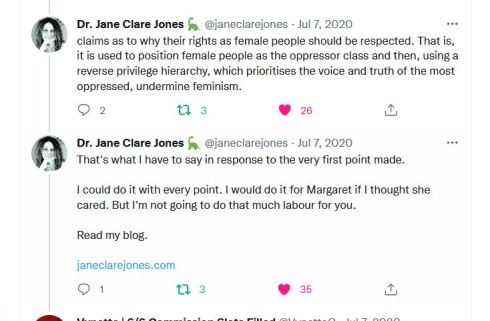
Feminists in bringing this epistemology to bear have also unleashed it upon themselves and their movement as trans identified males now claim they are the most oppressed in society and can – using this method – claim special knowledge and insight into what it means to be a woman and not have their point of view challenged without sever social consequences for the questioner. This is based on social power dynamics as criticizing their uniquely oppressed point of view – which grants them great CLARITY – means that you must be an oppressor and part of problem and thus, your critiques can be dismissed.
Not really a good operating system in a society that values truth and the free expression of ideas.
The good Doctor was in her usual fine form trying to reach out to a trans ideologically addled Margret Atwood.












 bleatmop
 Mystro
 The Arbourist


 Dead Wild Roses
Your opinions…