
You are currently browsing the tag archive for the ‘Abortion’ tag.
Re-posted from http://hplusbiopolitics.wordpress.com
Inconsistancy in the “life begins at conception” argument
Wednesday, 25 June, 2008
The view that human life begins at conception is a favoured view of most of the pro-life camp. By it, they do not mean that the sperm and ova were not alive and only became so at conception, but rather that ‘human life’ – in the special sense of a person who deserves protection under the law – begins at conception. Unfortunately for them, this view is logically inconsistent with that pesky thing called reality. There is absolutely no sense in which life, whatever is meant by the term, could be said to commence during the process of conception.
Conception is a process, not a distinct point in time
The process of conception, also known as fertilisation, involves many chemical reactions and processes. It is not an instantaneous occurrence. Look at the diagram I made:
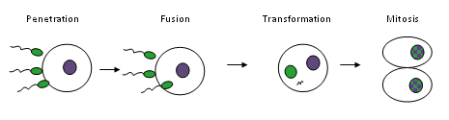
So somewhere along that set of chemical reactions, which finally result in two cells with a unique human genetic combination (the zygote immediately after the fusion of sperm has two pronuclei – one from the sperm and one from the ovum), are we to say that a single human life has started? If so, at what point does that happen?
The fact of the matter is that conception is no less of an arbitrary ‘line in the sand’ than any other point that one picks, such as the development of the brain, birth or development of self-awareness. But there is nothing wrong per se with something being arbitrary (after all, the time when people are old enough to vote is arbitrary), so we should now look at whether there is a good reason for not using conception as the start of a human being’s life.
Twins, chimeras and clones
The idea that a “human life begins at conception” also has problems with the existence of identical twins and tetrazygotic chimeras and the possibility human clones. Again, I have diagrams to explain these.

Consider the case of monozygotic twins, as explained by the above diagram. Here we have one fertilisation event, but two individuals result. Do those twins have to share the ‘human life’ they had from conception? Surely not, for we treat twins as separate persons. So, when did both lives start, if not at conception? During the twinning process? Or sometime after? And if lives start during the process of twinning, perhaps it is morally wrong not to twin an embryo, as it prevents the cells from realising their potential as multiple human beings.

Also consider the above diagram of the formation of a tetragametic (four gametes, two sperm + two eggs) chimera. Such an individual results when fraternal twins, derived from separate conceptions, merge very early in development to form a single individual with some cells with one genome and some cells with another (if the two zygotes were different, such as one female and one male or one dark-skinned and the other pale-skinned, this can be noticeable on the person). So, do chimeric people get twice as much human life, seeing as they resulted from two conceptions? Or was a life destroyed when the two embryos merged, despite not a single cell being destroyed? If the intentional formation of chimera is morally wrong, why isn’t the failure to twin an embryo?

Consider finally the case of a human clone (see diagram above), which hasn’t yet occurred but is surely possible. In this case, there is no conception event to be found (unless you go back to the one that created the somatic cell), but yet an individual results. Do clones not have any human life? Surely not, for they would be persons like you or I. So if life begins at conception, how can there be life without conception? Does life begin at conception OR nuclear transfer?
As can be seen, the idea of human life beginning at conception has some serious issues with the processes that can, and sometimes do, occur in human reproduction.
Potentiality
It is often claimed that conception should be the marker for a human life because it marks the formation of something that can grow into a thinking, feeling, reasoning human being. Apart from the fact that conception is not a distinct point, but a process, this potentiality argument has two key problems.
First, if a zygote should be protected because it can from a human being, why not also protect the sperm and eggs, for they can form a zygote which in turn can form a human being. And seeing as males can form billions of sperm but females only form thousands of ova, it follows that males are a million times more worthy of protection than females. But seeing as this conclusion is ludicrous, there must be something wrong with the potentiality argument.

The second, a major flaw, is that being potentially something isn’t the same as being something already. To see this, consider extrapolating the potential argument in the other direction: all human beings will die. And, seeing as a zygote will form a human being who will later form a corpse, it follows that we should treat both people and zygotes as if they were corpses. If we can give the right to life for an unborn baby, maybe we should give the right to a decent burial for a pre-dead corpse (i.e. a live baby). Not to mention that skin cells can replace sperm in forming a human being (see the cloning diagram above), so it follows that each skin cell destroyed is akin to destroying a human being. Unless, of course, having the potential to do something or be something isn’t equal to actually doing or being it.
Member of the human species
Perhaps it could be argued that an embryo should be protected because it is human. We don’t morally protect our own skin cells, despite the fact they are living human skin cells. So, what does the embryo have that skin cells don’t? If the answer is potential to develop into a human being, then this is just the potentiality argument again (and by cloning, perhaps a skin cell does have the potential to develop into a human being).
However, if the answer is that an embryo is a human being (and we accept that as truth, even though it is arguably false) then we need to then ask whether being a human being is enough to give the moral weight – the intrinsic value – conveyed by the term ‘human life’. Perhaps being a human being is only special because it usually correlates with having some other property, such as consciousness or self-awareness, that is special. In that case, then we should be using that other property to value the embryo instead of whether or not the embryo is a human being.
Consider whether it would be acceptable to kill a member of a non-human species that was capable of thinking human-like thoughts, was conscious and felt their lives were valuable, such as the intelligent aliens (think E.T. or Jar Jar Binks) or robots of science-fiction. If such a species (biological or not) is also worthy of protection, due to the fact they have certain psychological characteristics, then isn’t it safe to say that is those characteristics that are truly being valued here?
In addition, applying rights based on what group you belong to, rather than what you are able to do, seems a lot like bigotry or prejudice. History shows us many applications of rights based on being of a certain economic class, race, gender or religious group. Why should doing the same for being part of a species be any different?
Unique genetic combination
It is often said that because the zygote is a new human being because it has a unique human genome. This is a relatively weak argument, because a unique genome is not required to form a human being (e.g. identical twins, or clones, or human parthenotes) and unique genomes often do not form human beings (e.g. mutated genomes of cancers or the modified genome of induced pluripotent stem cells). Unless we are willing to admit that melanomas are actually human beings because they have a different genome, and that a woman who is pregnant with her clone (or identical twin) is not actually pregnant with a human being, then this argument should be abandoned.
Failure of an embryo to implant
The fact that only a fraction of zygotes go on to form a human being also hits hard the “life begins at conception” dogma. Firstly, the results of most conceptions are not viable embryos, and these abnormal embryos are usually passed out during a menstrual cycle. If such embryos are human beings, should we hold a funeral? Should we feel bad for not even realising they existed in the first place? Also, assisted reproductive technologies are much like natural reproduction in that far more embryos are conceived than result in pregnancy, and therefore shouldn’t IVF and sex be just as much of a problem as abortion? Or is the death of dozens of lives justified if it creates a life in the process (if that is the case, shouldn’t doctors and nurses be making babies instead of saving lives)?
Further, the oral contraceptive pill is known to make the uterine environment more hostile to any embryos that would implant there. The hormone progesterone released during breastfeeding acts in the same was as the oral contraceptive pill (in fact, progesterone analogues are the key ingredient of the pill), which is why breast-feeding is a ‘natural contraceptive’. Therefore, shouldn’t both the contraceptive pill and sex while breast-feeding be complained about just as much as abortion and embryonic stem cell research?
Conclusion
It is evident that the idea that life begins at conception is at odds with reality. Many human beings can result from a single conception, many conceptions can result in just one human being and theoretically human beings could develop without any conception event occurring at all. The idea that conception is a key point in the process of development is unfounded, as the potential to develop into a human being is not only possessed by sperm and eggs, but is completely logically fallacious in the first place. In addition, it doesn’t even appear that being a human being qualifies as having the intrinsic value required to convey moral status, as it is possible that non-human beings should have same intrinsic value attributed to ‘human life’. Neither can genetics rescue this argument, for a unique genetic composition is possessed by some non-human beings, and some human beings don’t have a unique genetic composition. Finally, the way most people act normally, and the way nature is, is very wasteful of zygotes, making the conclusions of this argument very difficult in practice.
It is not a scientific fact that human life begins at conception. The truth is that human life, in the sense of a person like you or I, emerges slowly from the genetic information and molecules that made up the sperm and eggs in your parents body, from the processes of controlled growth of the resulting embryo and foetus, using nutrients that nourished you in the womb. Science informs us that it is a continuous process. Those looking for a nice distinct point in time that can be used as the starting point of each person’s existence will be sorely disappointed if they look at the science. Philosophically, I’d argue that no intrinsic value of human beings exists, except for the value applied by a being to itself. Although this may be criticised for being overly restrictive (not attributing any intrinsic value to neonates), this criticism only works if we have a another significant reason to think neonates should have such value – I do not believe such a reason exists (see also the latter part of this post).
Pro-Choice argumentation seems to be a little underrepresented on the web. I found an insightful article from the Pro-Choice Action Network that provides some useful argumentation against the anti-choice arguments. I will include the main section of the Fetus Focus Fallacy in this post.
“Anti-choicers insist that the key question in the abortion debate is whether a fetus is a person or not. If so, abortion is murder, they say, and therefore obviously immoral and illegal. That is not the key question at all, of course – anti-choicers are committing the “fetus focus fallacy.” The practice of abortion is unrelated to the status of the fetus – it hinges totally on the aspirations and needs of women. Women have abortions regardless of the law, regardless of the risk to their lives or health, regardless of the morality of abortion, and regardless of what the fetus may or may not be. On average, abortion rates do not differ substantially between countries where it’s legal and countries where it’s illegal.[2] Which reveals a more pertinent question: Do we provide women with safe legal abortions, or do we let them suffer and die from dangerous illegal abortions? Read the rest of this entry »
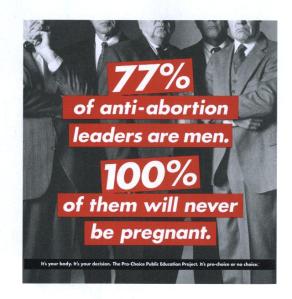 The debate on the initial thread has been… interesting. The capacity for people to talk past each other is quite distressing. I am really starting to appreciate the work George Lakoff has done on the issue Cognitive Framing in his book Moral Politics. How we think about and respond to issues is based on this cognitive framework which can affect how we view opposing points of view and how credible we judge them to be.
That being said, it is important to review the arguments in favour of ownership of one’s body.
1) A person owns themselves.
2) Self ownership implies the right to free will
3) In having free will, you cannot have a duty to perform any affirmative actions.
Conclusion– You have no duty to provide another with the means to live.
Therefore it is permissible to remove anything classified as a separate entity from your body.
The objections raised to this have been middling at best and include the assertion that the sylogism ‘begs the question’ by not addressing the issue of fetal rights or the status of the fetus. The actual explanation of the begging the question was left at that, but I will extrapolate and make the objection that the term person should also be applied to the fetus/zygote/blastocyst etc. (Note: Allowing this extrapolation does not invalidate this particular argument and it is still a strong argument for the right of a woman to control her body)
If we are to allow the idea of personhood to a fetus then it is important to allow the distinction between the biological definition of human and the moral definition of human. Biologically, the mass of cells in question can be defined as a ‘human being’ (and is often shrilly bleated repeatedly by the opponents of choice) but certainly not a fully functional independently biological entity. Is it fair to describe the zygote/embryo/blastocyst as equivalent to that of an adult human being?
This would entail this view:
1. Embryos are human beings.
2. All human beings have equal moral status.
3. Therefore, embryos have full moral status.
The implications of this argument have been discussed in part 2 of this series, which makes the claim that to be consistent those who endorse this claim must also accept the fact that spontaneous abortion is a much larger and more pressing issue that should be dealt with first, if we are to define the embryo as having full and equivalent moral status as an adult human being.
Going back to the conclusion of the first sylogism, we read that “In having free will, you cannot have a duty to perform any affirmative actions” the anti-choice side would put forward that the woman does have the duty to perform an affirmative action, that is to let the fetus grow in her womb (at direct risk to her health) as we have defined the embryo in question as having full moral rights equivalent to that of an adult human being, and therefore positive affirmative actions must be taken.
Therefore, if we are to follow the argumentation, we all have the absolute duty to save human beings and if given the opportunity to take affirmative action that will save a life we must do so. The implications of this are far reaching as consider the following case:
A house is on fire and someone is trapped behind a deadly wall of flame. That person will perish if we do not act to save his life. We are obligated then, to run into the fire and attempt to save his life, if we subscribe to the notion that it is a duty to take positive affirmative action.
So,the rights view of the anti-choice stance, to be consistent, should state that whenever there is an opportunity to take affirmative action to save a human life, it must be undertaken. This would lead to people being obligated to be the ‘hyper-good samaritain’. That is risking their life and abandoning their rights in order to save the life of another. This situation, clearly, is absurd.
This situation calls into question then the idea that a fetus/zygote/blastocyst should have the moral equivalence of an adult human being.
Once you start down a path, the goodness just keeps on coming. Did you want another argument to use against the anti-woman, anti-choice zealots? Here is one from the American Journal of Bio Ethics. Bust it out and let the squirm. :) Please note I did a rough job of paraphrasing,quoting and using text from the article. I will link to the original here… 
Here is what I have posted once in the comment section already, but I think it is worthy of a post of its own.
The argument begins as such, a common pro-life position, human fetus/zygotes/cells have the moral equivalent to a adult human being…summarized below.
Embryos are human beings.
All human beings have equal moral status.
Therefore, embryos have full moral status.
This has been the pro-life stance pretty much all through the debate in part I , rhetoric and ad hominum attacks aside. This study comes to some interesting conclusions about the above conclusion.
The majority of embryos die within a few weeks of conception. See studies by Hertig (1967) and French and Bierman (1962).
The results of these studies graphically represented below.
Intrauterine life: Graph of survival and weeks since conception. (Click link below for graphs)
https://deadwildroses.wordpress.com/2009/06/17/graphs-for-reference-sake/
During the early stage, 8-10 days only 50% of embryos survive. Those that successfully implant, the risk of death becomes much less significant. These numbers show that spontaneous abortion is an everyday phenomenon. A mother of three children could be expected to have also five spontaneous abortions. The embryo’s survival to term is the exception rather than the norm. This next graph shows the effects of spontaneous abortion on human lifespan.
Graph of mortality in the United States from conception through to death. (Please click link below for graphs)
https://deadwildroses.wordpress.com/2009/06/17/graphs-for-reference-sake/
In the first few months, more than 60% of the entire population dies due to the effects of spontaneous abortion (approximately 220 million per year).
IF you accept the first claim:
Embryos are human beings.
All human beings have equal moral status.
Therefore, embryos have full moral status
THEN: Each of these deaths must have just as much weight as an adult human (which you so frequently harp on about). Spontaneous abortion is by FAR the greatest killer of them all.
Some conclusions drawn from that data: Spontaneous abortion kills more than 200 million each year, it accounts for ¾ of all deaths per year, reduces life expectancy in the developed world to mere 29 years, kills only the very young and innocent: those who are powerless to save themselves.
IF you contend that an embryo has full moral status as a human being, then you must agree that spontaneous abortion is clearly the greatest problem facing humanity.
Cancer in all forms kills 7.6 million people per year, while spontaneous abortion kills 30 times this number. Finding a means to save even 5% of embryos from spontaneous abortion would save more lives that a cure for cancer. To remain consistent in your views you must accept the following:
The embryo has the same moral status as a adult human life.
Medical studies show that more than 60% of all people are killed by spontaneous abortion (a biological fact).
Therefore, spontaneous abortion is one of the most serious problems facing humanity, and we must do our utmost to investigate ways of preventing this death – even if this is to the detriment of other pressing issues. (See the current pro-life loonery)
The only way to avoid this conclusion is to abandon the conclusion that full moral status begins at conception.
So really, if you are so concerned about life, what the heck are you doing trying to fix the relatively minuscule amount of human choice aborted fetuses? I am guessing that really…you (pro-life zealots in general) are just about disenfranchising women in service to your silly notion of a god as you adhere to your inconsistent, incoherent beliefs.
Please note again: The article in full can be found in The Scourge: Moral Implications of Natural Embryo Loss by Toby Ord. The American Journal of Bioethics, 8(7): 12-19, 2008. I have taken excerpts, quotes and text from the article and used them in my post.
 Woo, a real argument with premises and conclusion. A tight argument I stumbled over on the Killing the Afterlife blog. (http://killtheafterlife.blogspot.com) A neat thread to look at if ya have the time.
1) A person owns themselves
2) Self ownership implies the right to free will
3) In having free will, you cannot have a duty to perform any affirmative actions.
Conclusion– You have no duty to provide another with the means to live.
Therefore it is permissible to remove anything classified as a separate entity from your body.
As my partner edified for me in talking about abortion on a feckless youtube thread. Do not even go down the ‘personhood’ road. It starts and ends with a persons right to their own body. I think this particular argument does a nice job of augmenting that sentiment.
 I do not know how I missed it but in 2004, the Bush regency passed the unborn victims of violence act (UVVA). The UVVA codifies the assertion that life essential begins at conception it defines as follows:
“ d) As used in this section, the term “unborn child” means a child in utero, and the term “child in utero” or “child, who is in utero” means a member of the species homo sapiens, at any stage of development, who is carried in the womb.”
-Wikipedia (http://en.wikipedia.org/wiki/Unborn_Victims_of_Violence_Act)
This is some scary legislation at first glance. However, the frothing at the mouth anti-choice advocates seem to miss sub section c :
“(c) Nothing in this section shall be construed to permit the prosecution—
(1) of any person for conduct relating to an abortion for which the consent of the pregnant woman, or a person authorized by law to act on her behalf, has been obtained or for which such consent is implied by law;
(2) of any person for any medical treatment of the pregnant woman or her unborn child; or
(3) of any woman with respect to her unborn child.”
At the same time, the right to get an abortion is still firmly in the hands of a woman. So go ahead, define a mass of cells as an unborn child (in the US), define it as the damn Pope, if the woman wants it gone, it remains her right to have it removed.
Hopefully Obama can make some of this go away and soon.











 bleatmop
 Mystro
 The Arbourist


 Dead Wild Roses
Your opinions…