
You are currently browsing the tag archive for the ‘Canada’ tag.
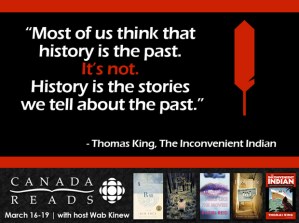 We here in Canada often like to think of ourselves as the ‘good guys’. Our history somehow a few degrees shinier, more pristine than the the bloodstained record our American neighbours seem to bandy about with pride.
Like any colonial narrative though certain distortions are present and sometimes the distortions are encouraged. Let’s take a look at one incident in our history through the lens of Thomas King in his work The Inconvenient Indian – specifically about a land grant in 1717 by the French Crown of a parcel of land by the Ottawa River to the Sulpician Missionary Society:
“The gift did not sit well with the Mohawk, since the land in the French Grant was their land, and for the next 151 years, this piece of real estate wold be a thorn in the side of Mohawk and Sulpician relations.
In 1868, a year after Confederation had overtaken Canada, Joseph Onasakenrat, a chief of the Mohawk, wrote a letter to the Sulpicians demanding the return of the land within eight days. The Sulpicians ignored the warning, and Onasakenrat led a march on the Sulpician seminary, weapons in hand. After a short and rather unpleasant confrontation, local authorities arrived and forced the Mohawks to retreat. Then, in 1936, the Sulpicians sold the property and left the area. The Mohawk protested the sale, and again, the protest fell on deaf ears.
Twenty three years later, in 1959, a nine-hole golf course, Club de Golf d’Oka, was built on the land, right next to the band’s cemetery. This time the Mohawk launched a legal protest, hoping that the courts would provide them with some relief from White encroachment. The authorities and the courts dillied back and dallied forth, and in the meantime, the developers went ahead with the construction of the course, and happy golfers began roaming up and down the fairways in their little carts.
Finally in 1977, the Mohawk filed an official land claim with the federal Office of Native Claims in an attempt to recapture the land. Nine yearts later, the claim was rejected because it failed to meet certain legal criteria. Which was a fancy way of saying that the Mohawk couldn’t prove that they owned the land, at least not in the way that Whites recognized ownership.
For the next eleven years, relations between the town of Oka and the Mohawk were spotty. Then, in 1989, the mayor of Oka Jean Ouellette, announced exciting news that the old golf course was going to be expanded into an eighteen-hole course, and that sixty luxury condominiums would also be built. In order to manage this expansion, the town prepared to move on the Mohawk, taking more of their land, levelling a forest known among the Mohawk as “the Pines”, and building new fairways and condominiums on top of the band cemetery.
That did it. After 270 – odd years of dealing with European arrogance and indifference, after trying every legal avenue available, the Mohawk had had enough. On March 10, 1990, Natives began occupying the Pines, protecting their trees and their graveyard. Their land.
Five months later, in the heat of July, the confrontation became a shooting war. Neither the provincial government not the federal government wanted to deal with the situation. Jean Ouellette had no intention of talking with the Mohawk and said so on television. Instead, he insisted that the province send in the Sûreté du Québec, and in they came, storming the barricades that the Mohawk had erected with tear gas and flash-bang grenades. Shots were fired. No one knows who fired first. Not that it would have made much difference. And when the smoke cleared, Corporal Marcel Lemay had been mortally wounded and a Mohawk elder, Joe Armstrong, had suffered what would be a fatal heart attack trying to escape an angry mob.
So began the Oka Crisis.”
-Thomas King. The Inconvenient Indian. p. 233 – 234
A mere 270 years-ish of lag time to get a land claim resloved, of course with loss of life and bloodshed. And Canada still claims to be one of the “good” colonial powers…
The CBC does such a remarkable job for a mere pittance per Canadian. We need to up the ante and properly fund the CBC at least to the average amount, $82 dollars. Imagine no commercials on CBC Radio 2 and a sharp curtailing of the ‘adult contemporary’ drivel and a return to the classical haven Radio 2 once was. Oooo…warm and snuggly feelings all over in DWR land. :)

Time to properly fund the CBC.
 Hey Jimmy Boy, you certainly have shown where you priorities are and what you think of Albertans.
I don’t blame you though; we let you take power basically through acclimation – no fucks were given, as long as got rid of that WOMAN who was single-handedly ruining the province. The flyby-night parachute (Hi Steven Mandel and other assorted Tory hacks! Your exercise in nepotism and narcissistic self-aggrandizement is noted) elections that merely waved at the trappings of democracy, that shit was cool here in Alberta where the electorate gave an enthusiastic “hell ya“. It’s all okay thought because the electorate would enthusiastically vote in a bag of empty shirts as long as was the right shade of Tory blue.
Not that any of this fucking matters here in Blue Zombie Tory PC land. The latest example of the Alberta Tories pouring shit on the people of Alberta came from the priemier himself. Corporate shill-master Jimmy Prentice was dropping truth left and right on CBC radio.
‘Speaking on CBC’s Alberta@Noon Wednesday, Premier Jim Prentice told host Donna McElligott that “in terms of who is responsible, we need only look in the mirror. Basically, all of us have had the best of everything and have not had to pay for what it costs.”
Damn son, you just said a mouthful. I mean your predecessors have all at least tried to cover their contempt for the public and the public good. You may as well just get a T-Shirt that says “privatize the profit and publicize the risk” it would simplify your PR and keep the rest of your team on message. You could do it here in Blue-Zombie Alberta, they’d still vote you in, I guarantee it.
“I’ve never said Albertans are the problem,” Prentice told the Calgary Herald Thursday. “I’ve never, ever said that or anything like that. What I’ve said is that Albertans have to be part of the solution.
Prentice admits he “touched a nerve,” but is not backing away from his tough line.”
Oh, I get it now. We all have to buckle down and tighten our belts!
“Premier Jim Prentice says Alberta has no plans of raising corporate taxes to deal with the current economic woes in the province.”
 Well, that was completely obvious wasn’t it? We certainly can’t raise the lowest corporate tax rates in the country that, fellow peons, would be virtual seppuku for EVERYBODY. Instead, lets gut the public service, education and healthcare – the real culprits. Let’s watch Jimmy helpfully explain why we must not tax the rich:
“[…] if we increase our corporate taxes, we will simply make ourselves uncompetitive and it will result in losing jobs,”
Oh, right. Because of all the other competing Tar Sands projects located in politically safe areas will completely take all the business… I’m not sure how much more clarity is required for Blue-Zombie Voters to see fealty expected of our elected public officials toward their oil-overlords.
Oh hey, it’s also spring election time in Alberta. And I bet that we’re going to vote these craven corporate sycophants in *again* because penury is awesome!
I was looking for an image to describe the Alberta electorate and their behaviour. I think I’m getting closer with this one. The last person in the human centipede is the typical ‘Alberta Voter’ getting all the shit, and just loving it (and clamouring for more!).

The Blue Zombie PC Vote Train! – Maybe it’s time to stop the madness and not vote Alberta PC?
 I’m always impressed with La Belle Province and her ability to serve up controversy. Recently a judge in Quebec decided that a hijab was considered not to be suitable attire for her courtroom and dismissed a case when the litigant refused to comply with her request. The judge’s words courtesy of the CBC:
“Hats and sunglasses for example, are not allowed. And I don’t see why scarves on the head would be either,” Marengo says in the recording.
“The same rules need to be applied to everyone. I will therefore not hear you if you are wearing a scarf on your head, just as I would not allow a person to appear before me wearing a hat or sunglasses on his or her head, or any other garment not suitable for a court proceeding.”
The stage is set and the result:
“When El-Alloul first appeared before Marengo, the judge asked her why she had a scarf on her head. El-Alloul replied that it was because she is a Muslim. The judge then said she would take a 30-minute recess.
When Marengo returned, she told El-Alloul she had a choice: remove her headscarf immediately or apply for a postponement in order to consult a lawyer. El-Alloul replied that she couldn’t afford a lawyer and that she didn’t want to postpone the case. Marengo then adjourned the case indefinitely.”
Boom. Tinder meet match. Religious freedom versus the institutional values of a secular court.
There are a multitude of ways to look at what transpired in the courtroom but here are two that I think represent both sides of the argument.
A. In a secular court of law, the secular values and rules of a society must be followed. If a judge rules that what you’re wearing to be inappropriate for the proceedings it behooves you to follow the same standards that everyone else must follow.
B. Canada is a multicultural society and we respect and treasure the cultural practices that every Canadian brings to the table and, if secular protocol can be reinterpreted to allow for the diversity of cultural expression within secular institutions we should do so.
Before we go into further discussion we should note the reaction from El-Alloul, it was one of shock and dismay:
“[…] But what happened in court made me feel afraid. I felt that I’m not Canadian anymore.”
“El-Alloul said she’s speaking out because she doesn’t want what happened to her to happen to any other Muslim woman. When she insisted I should remove my hijab, really I felt like she was talking with me as … not a human being. I don’t want this thing to happen to any other lady. This is not the work of a judge. She doesn’t deserve to be a judge.”
El-Alloul is rightly quite upset at the outcome of her hearing (or lack thereof). There should be a more amenable solution available to the parties involved – a transfer to a different judge that has a more liberal interpretation of ‘suitably dressed’ might have saved a lot of ink and electrons as this story blossomed across Canadian news networks.
This seemingly simple case of what “suitably dressed” means and how it is enforced speaks to how intersectional an issue multiculturalism is. Institutional power in Canada remains largely white and male and thus reflects the normative values of what is considered ‘normal’ culture here in Canada. From this orthodoxy we get the notions such as:
1. Why should our Canadian institutions cater to every whim of the minorities?
2. If it is good enough for everyone else, what is the problem here?
3. Why aren’t secular Canadian values being learned by new Canadians?
Under the assumption that we are a multicultural society, clearly, point 1 is out to lunch. The very point of having a tolerant open society is that we appreciate and try to accommodate the everyone and their preferences within the state structure of Canada.
Point 2 is problematic because the words “everyone else” usually uses the dominant culture as a touchstone thus, by play of words, avoids the obvious racism associated with similar statements.
Point 3 has the most merit as new Canadians do adopt Canadian values and standards, but the process of acculturation takes a great deal of time, often generations before the values of the dominant culture are ingrained. It is unrealistic however to expect that somehow Canadians of all types have a switch that can be flipped instantaneously that would guarantee cultural assimilation.
The Hijab should be allowed in Canadian courtrooms as it does not interfere with workings of the court or the dispensing of justice.
However, as an open and tolerant secular society we should also have the ability to rightly name and not adopt cultural practices that would be corrosive to our society. For instance, honour killings and female genital mutilation, have no place in Canadian or any other civilized society and I can assert this claim with a good deal of confidence because we need only to discuss the negative impacts these practices have on those societies who still practice these modalities (cultural relativism be damned).
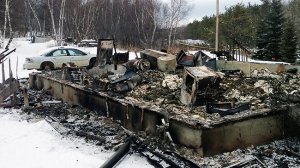 Why should children have to burn to death because of bureaucratic mismanagement? The CBC sets the scene.
“An early-morning fire on a First Nation west of Meadow Lake, Sask., has claimed the lives of two toddlers — prompting criticism about the lack of firefighting services on reserves. RCMP said officers were dispatched around 1:30 a.m. CST Tuesday to the Makwa Sahgaiehcan First Nation, where they found a home engulfed in flames. They said a man, who had gone to the home and found it was on fire, came out carrying two small children. According to RCMP, the man was the father of the two-year-old boy and one-year-old girl. Both children died at the scene.”
Unpaid bills apparently are the reason why children must die.
“Chief Richard Ben of Makwa Sahgaiehacan said the community, which is 60 kilometres west of Meadow Lake, usually depends on volunteer firefighters from Loon Lake, but they didn’t respond.
Volunteer fire chief Larry Heon in Loon Lake, near the Makwa Sahgaiehcan First Nation, says he got an automated call about the fire Tuesday morning, his crew didn’t go to the scene. The reserve sent a letter cancelling its contract last year with the village for fire services, Heon said.”
Let this be a lesson to those who clamour for more privatization of public services – it comes down to the simple reality witnessed here. The present situation is more complex as we are discussing a different jurisdiction – a First Nations Reserve – the question of funding, and the allocation of resources comes into play.
“Makwa Sahgaiehcan, like other First Nations across [Saskatchewan], does not receive sufficient funding to cover even two fire calls per year from the municipal volunteer fire department,” the Federation of Saskatchewan Indian Nations said in a statement released Thursday. Unless there is a significant increase in funding, there is no way First Nations can meet any kind of fire safety codes and regulations,” said FSIN vice-chief Dutch Lerat”
It would seem that the murky mess that is the First Nations/Canadian government relationship is also at fault in this situation.
“Funding levels are determined by a regionally based formula, according to Aboriginal Affairs, which factors in the number of buildings on reserve, remoteness, population and local environment. Local band councils manage fire protection services on reserve and prioritize spending according to their needs. Communities can divert funding meant for fire services to other areas that are more urgent.”
Mmm… Is it just me or does being able to reallocate funds meant for fire protection seem like a bad idea? Surface evaluation though let’s look a little deeper at the situation and how one First Nations representative sees it:
“He said, for example, that often there is not enough fuel on reserves to heat the fire halls, so fire trucks are in the cold in the wintertime and unable to respond to calls fast enough. There also might not be adequate water infrastructure with the proper pressure to combat fires. Another challenge is the regulatory gap where no inspections or building codes are mandated, said Blaine Wiggins of the Aboriginal Firefighters Association of Canada, which receives about $200,000 from Aboriginal Affairs to co-ordinate prevention initiatives.
Without enforceable requirements or national standards, he said, safety issues don’t get fixed.
Fire services are not just about suppressing fires, he said in an interview with CBC News, but also about building codes, as well as home safety, prevention programs and general awareness.
“What’s needed is the entire gamut of fire services,” Wiggins said, in order to get First Nation reserves to be comparable to off-reserve communities.”
The problem, unsurprisingly, seem to be systemic in nature requiring that basic improvements to infrastructure and building codes be in place before meaningful changes can happen.
These are ‘chicken and egg’ type problems. It is sadly symbolic of the so many of the problems and difficulties First Nations communities face. It illustrates the government of Canada’s lack of planning and foresight when it comes to First Nations communities.
The problems of this particular incident are many fold, but we should start with those responsible for the safety of their community – Chief Richard Ben claimed that he “didn’t remember signing that [fire] contract” and that he “didn’t know”. That dear friends is horseshit weaseling at its finest. If the buck doesn’t stop with the leader of one’s community where does it stop?
The second issue is funding from the Canadian government. The process of distributing funds for fire protection on Reserves seems designed to fail, right from square one.
So, individual and bureaucratic failure unnecessarily costs people their lives. Oh Canada :( Let’s get in there and make sure that all of our citizens have access to basic public services.
 When one turns to the word “propaganda” images of totalitarian states come to mind – Pravda, The North Korea Times. We envision an army of Winston Smith’s carefully scrubbing the news of improper thoughts and meanings, carefully crafting the government approved message of the day. Of course we don’t have that here in North America, we have freedom of speech, we have a free press, we have liberty! We also have institutionalized self-censorship,demarcated areas of approved debate, and a media establishment that tends to take the government’s word at face value. These factors contribute to a media system that appears to be free and without censure, but in reality, craft obsequious stories that pose no threat to power or the norms of society. Essentially, the (self)censorship we have in the West is on autopilot, it is subtle, unremarkable, but yet *very* effective (for more detail on our system, see my post on Manufacturing Consent).
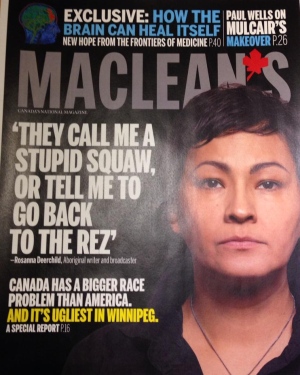
All this being said, sometimes our subtle system of media control goes a little haywire, it loses its subtle sheen, and becomes a little more transparent in how it operates. Stories slip through the net and give the status-quo a good shake. The recent furor caused by Maclean’s naming “Winnipeg: Where Canada’s Racism Problem is at its Worst.” is a prime example of such a happening. The article pokes many holes in white Canada’s notion of a vibrant multicultural society. Some highlights:
“One in three Prairie residents believe that “many racial stereotypes are accurate,” for example, higher than anywhere else in Canada. In Alberta, just 23 per cent do, according to polling by the Canadian Institute for Identities and Migration (CIIM). And 52 per cent of Prairie residents agree that Aboriginals’ economic problems are “mainly their fault.” Nationally, the figure drops to 36 per cent.”
***
“Earlier this fall, Robert Falcon-Ouellette, director of the University of Manitoba’s Aboriginal focus programs, hit the Grant Park Shopping Centre in Winnipeg’s south end to hustle for signatures for his mayoral nomination form. The 37-year-old was a late entrant to the election. He’d cobbled together a campaign staff—idealistic political neophytes he knew from academia and activists he’d met at last year’s Idle No More rallies.
It was an ugly entry into politics. “I know you,” a shopper told Falcon-Ouellette, approaching him shortly after he arrived at the mall. “You’re that guy running for mayor. You’re an Indian,” he said, pointing a finger at Falcon-Ouellette. “I don’t want to shake your hand. You Indians are the problem with the city. You’re all lazy. You’re drunks. The social problems we have in the city are all related to you.”
***
“Tyler Henderson, a 28-year-old Ojibway nursing student at the University of Manitoba, says he feels racism every time he walks out his front door. Henderson says Winnipeg police stopped him 15 times last year. “You fit the description,” police tell him when he asks what he did wrong. Once, police claimed he’d pulled to a stop a few inches beyond the stop line. “It makes me mad,” he says. “But there’s nothing I can do.” Some young indigenous men are stopped twice per month in the inner city, according to University of Manitoba criminologist Elizabeth Comack. “
***
“Don Marks, a Winnipeg writer, recently visited an ER with an indigenous friend. They’d dropped a painting, and the broken glass had cut his friend. “Aw!” a nurse exclaimed in greeting them. “Have we been drinking and fighting again?” The nurse’s assumptions were harmless, says Marks, who edits Grassroots News, an Aboriginal newspaper. “But this was someone responsible for treating Native people in our hospitals. We all know racism exists in our health care system.”
I would go read the entire article at Maclean’s as it touches many important points and different facets of the racist experience going on in Winnipeg. But the lowlights sampled here are enough to show that punches were not pulled in writing this article.
Response from the Mayor of Winnipeg was predictable.
“We have come together to face this head-on as a community,” Bowman added, noting that Winnipeg exists on what is traditional Treaty One territory. We have to shine a light on it. Without the light, we can’t see what we’re fighting. We’re not going to end racism tomorrow, but we’re sure as hell going to try.”
Way to go Mr.Mayor. Ending workplace inefficiency with enhanced system synergies is also on his “to do” list. I find the reactions of Robert-Falcon Ouellette and Rosanna Deerchild to be much more interesting.
Ouellette ran for Mayor in the last Winnipeg Civil election and of course faced racist comments on him an his campaign. He is no stranger to the ugly tide of racism in Winnipeg, but when asked of the Maclean’s article he said this:
“The cover treatment Maclean’s gave the story is sensationalist, he said. The cover features a quote from a Winnipeg resident who says,”They call me a stupid squaw or tell me to go back to the rez.”
“They used the word ‘squaw,’ which is very, you know, derogatory type of comment,” Ouellette said. “But at the same time, I understand they need to be selling magazines and getting people interested to buy the magazine.” Ouellette has experienced racism, including during his campaign, but it’s not something he sees on a daily basis. He said he believes the majority of people in the city aren’t racist, but that there’s always the loudmouth that stands out.”
His restraint and decorum in the face of such ugliness is impeccable. At the same time, troublesome because he’s just being so darn nice about the entire situation. We see the same pattern with Rosanna Deerchild, here is what she says:
“They call me a stupid squaw, or tell me to go back to the rez,” the quote reads. But on Friday, Deerchild recorded a segment for Saturday’s Unreserved, saying she does not want to be racism’s cover girl.
“I am far from the angry Indian complaining about being hard done by,” she says.
“Let me be clear. I love my city, my community, my home: Winnipeg, North End, Canada. But neither will I quantify, qualify or pacify racism in this place, or any place it rears its ugly head.”
I’m scratching my head a little over what she said. I applaud her for being so diplomatic in the face of injustice, but I think that she has every right to be royally pissed off over the state of affairs regarding Winnipeg and racism.
Her choice of words speaks volumes to how the concerns of aboriginal woman have been treated in white Canada in the past. She makes it very clear that she is not an “angry Indian complaining about being hard done by”. Deerchild, even in her respected position in society (broadcaster for the CBC), is keenly aware of the stereotypes and negative tropes arrayed against her. She is aware of what I was alluding to earlier in this post – the system of self censorship/censorship that marginalizes dissident views such as hers, in favour of the comforting white feel-good multicultural narrative that is an acceptable “truth” in Canadian society.
I applaud all those quoted in the articles, they are speaking directly to the problem of racism in our society. The fact that this article is creating so much noise and buzz in Canada is a testament to how adept our media is at maintaining the status-quo most of the time and for generally not allowing articles of this calibre to be published within the mainstream news establishment.
[Source: Macleans.ca]

Just like using Vitamin C to treat cancer…
“It’s a case that has Canadians and the legal community buzzing.
Earlier this month Ontario Judge Gethin Edward ruled in favour of a First Nations girl and her family, who stopped chemotherapy to treat her acute lymphoblastic leukemia, choosing traditional medicine instead.
The judge rejected an application from McMaster Children’s Hospital that would have required the Children’s Aid Society to intervene in the case.”
Buzzing indeed. Let us be clear up front – evidenced based medicine works. Anything else is just a fine grade mixture of bullshit and the placebo effect that happened to work in that specific case on that specific day. We can safely assume that “Traditional Medicine” falls into the later category and most definitely not the former.
“Edward ruled that it was the mother’s aboriginal right — which he called “integral” to the family’s way of life — to allow her to choose traditional medicine for her daughter.
While many hailed the decision as a victory for aboriginal rights, others call it a failure in the protection of child welfare”
While others like myself would be calling this a death sentence for the child in question. Treating cancer with magical mumbo-jumbo almost always ends in tragedy.
“I’ve never seen a judge recognize a broad right for a First Nation like the Mohawk Nation to have their medical practices — their traditional ways of life regarding health and healing — protected by the Constitution under Section 35,” said Larry Chartrand, professor at the faculty of law.
“Chartrand specializes in aboriginal governance and health, and while he states that this decision is positive in terms of aboriginal rights, “the unfortunate circumstance is that it revolved around a fact situation where a little girl’s life is potentially at stake. So that makes the decision very difficult to appreciate.”
The ‘decision very difficult to appreciate my ass’ – Leave it to lawyers to miss the point. We have this thing called medical science, it is the justified, tested and reviewed methods of saving lives. Denying a child access to life saving treatment is neglect.
“McMaster doctors said she has a 90 to 95 per cent chance of survival on chemotherapy, but that they didn’t know of anyone who had survived acute lymphoblastic leukemia without the treatment.”
Traditional methods of healing in this case means death for the child.
“I understand the mother’s decision. I have a 12-year-old son, and I’m not sure I would make that decision myself under the circumstances. But I understand why, because of the impact of colonization, the distrust of the mainstream system, and the need to protect Mohawk culture — sometimes at all costs.”
If protecting Mohawk culture means sacrificing your child to woo, it may be time to rethink that aspect of Mohawk culture. If the child dies because of this fanciful foray into neglect the parents should be charged with child endangerment and neglect causing death. Welcome to the other end of the legal system – the one where murdering children, even for cultural reasons is against the law.
“A Florida health resort licensed as a “massage establishment” is treating a young Ontario First Nations girl with leukemia using cold laser therapy, Vitamin C injections and a strict raw food diet, among other therapies.
The mother of the 11-year-old girl, who can not be identified because of a publication ban, says the resort’s director, Brian Clement, who goes by the title “Dr.,” told her leukemia is “not difficult to treat.”
Vitamin C? Raw Food?… To treat lymphoblastic leukemia? *shakes head* Using woo to treat cancer, this is going to end badly for everyone.
Orac over at Respectful Insolence says it best:
“My view is that what matters the most is the life of the child and making sure that child is given her best shot at life by being treated with the best science-based medicine has to offer. Everything else is secondary and, to me, important only inasmuch as it helps or hinders achieving the goal of saving the life of the child. I don’t care much about whether I offend by criticizing a religion that would allow a child to die. I don’t care much if it bothers anyone that I criticized a racial, ethnic, or cultural group that facilitates the medical neglect of children. And I don’t really care that much, in the context of this case, about the historical grievances native peoples have based on past transgressions of the Canadian government. That’s not to say I don’t recognize them as important; rather, it’s that I do not accept them as valid reasons to let a child die.”
[Source 1: cbc.ca – Aboriginal right to refuse chemotherapy for child spurs debate.]
[Source 2: cbc.ca –‘Doctor’ treating First Nations girls says cancer patients can heal themselves.]











 bleatmop
 Mystro


 Dead Wild Roses

Your opinions…